
Lent and Repentance


            The Christian season of Lent encompasses the forty days before Easter.  This year it’s from February 10 (Ash Wednesday) to March 27 (Easter), 2016.  Lent is a season of the Christian Year where believers focus on simple living, prayer, and fasting in order to grow closer to God.  At the baptism of our Lord the sky opened and the Spirit of God, which looked like a dove, descended and landed on Jesus.  A voice from heaven said, “This is my Son, My Beloved, with whom I am pleased.” Jesus was then sent into the wilderness by the Spirit where he fasted and prayed for forty days (Matthew 4:1-11). During his time in the desert Jesus was tempted by Satan and found clarity and strength to resist temptation. Afterward, he was ready to begin his ministry.
 
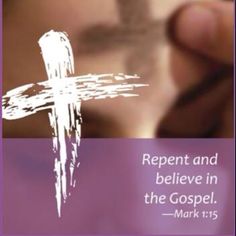
            Lent is the ideal time of year to repent — to return to God and re-focus our lives to be more in line with Jesus. It’s like a forty-day trial run in changing your lifestyle and letting God change your heart.  Repentance is the key that unlocks the soul’s ability to connect with God.  To repent means to turn around, to stop going in one direction and start going in another one.  It is repentance that makes all the difference in the orientation of our souls in this life.
 
            Certainly, no one can really judge the heart of another.  Only God can rightly do that.  Yet, the New Testament lets us in on how to truly measure the sincerity of one’s repentance (2 Corinthians 7:2-12).  Worldly sorrow or grief does not lead to repentance, but only separation and death.  The person with worldly sorrow beats himself up but never really changes direction.  Like Judas Iscariot of old, he just metaphorically hangs himself instead of admitting his guilt to Jesus. 
 
            But godly sorrow leads to repentance, a real change of direction.  And here is the evidence from the Scriptures of the genuineness of the change:  owning up to the problem/sin; an eagerness to make things right; indignation over what has been done or said; seeing that there is more pain in avoiding the problem than there is in confronting it; a desire and energy to do what is best for the person whom we have wronged; and, a willingness to accept whatever consequences that might result from the offense.
 
            Crying and tears might occur and can even be necessary, but they can also be a cheap form of avoiding true repentance and might only be worldly sorrow.  Instead, there must be solid action that changes direction and seeks to rectify offenses, as much as it is within our control to do so.  Deliverance from the power of sin can only come through repentance.  There are no shortcuts or easy routes to the soul’s orientation to practical godliness.  There is nothing romantic about repentance; it is typically messy, usually ugly, and often painful.  Yet, there must be suffering before glory.  Trying to take repentance out of the equation is to eviscerate the Christian life and leave our souls vacuous and empty.
 
            Sometimes we do not even know we need to repent because we get caught up in the drama of school, relationships, family, and work. Our lives are filled with distractions that take us away from living a life with Christ. We might try to fill the emptiness inside us with mindless web-surfing, meaningless chatter, too many activities or other stuff that just keeps us busy without thinking too much. We run away from real life and from God.  But when we intentionally create a plan to connect with God, his Spirit begins to reveal the need for repentance.  That plan during Lent ought to include some form of fasting, prayer, and service.  For example, you could take the Christmas cards you received and pray for one of the people/families each day in the forty days, instead of eating the candy bar or drinking the soda; and, then send them a note of encouragement.  Or, get up ten minutes earlier than usual and spend those minutes in silence and prayer.


            To choose nothing is to give into worldly sorrow and feel guilty.  To choose something, whatever that something is, is to anticipate that God will work in your soul to thaw it out, warm it up, and form it to better discover Jesus Christ.

Deuteronomy 9:15-24


            God is full of grace, steadfast love, and covenant commitment.  But this does not mean that God is okay with sin.  He does not shrug his divine shoulders in a “meh” kind of attitude.  In fact, grace does not exist apart from sin.  Where there is boundless grace and compassion there will be found bucket loads of sin.  And, oh my, was there a load of sin among the ancient Israelites!  They were characterized as stiff-necked, stubborn, rebellious, and idolatrous.  This is the kind of stuff that evokes the ire of God.
             The truly godly person is the one who shares God’s heart and interests; what upsets God, upsets him/her; what makes God pleased, makes him/her pleased.  Notice Moses’ response to the people’s idolatry and sin:  he was visibly angered; he confronted the people with their sin; and, he engaged in an extended time of fasting and prayer on their behalf. 
             Lackadaisical attitudes and approaches toward God are rife throughout the Western church.  There is little to no sustained, prolonged, and focused times of prayer and fasting among both individuals and groups of people because we are too busy indulging in revelry with our idols of money, sex, power, and perfectionist control.  Until we are cut to the heart with this present darkness of empty souls and vacuous spirits which run to everything and everyone but God, there will be no entering the Promised Land of peace, love, and joy in the Holy Spirit.  The glory of the Lord is almost upon us, and the season of Lent is nearly here.  So, let us make a solid spiritual plan for the forty days leading up to Easter for prayer and fasting on behalf of our own sin, and the sin of the world.
             Holy God, idolatrous sin brings about your wrath because you cannot stand for the lack of love to take root in your world.  I bow before you and bend the knee to your sovereign reign in my life.  Please lead me in your way of righteousness, and have mercy on those trapped in darkness so that we might see you, through Jesus Christ, our Lord and Savior.  Amen.

2 Corinthians 7:2-12

            I’m in the soul business.  Not in the Detroit Mo-town Aretha Franklin kind of soul business (although that would be very cool) but in the sense of engaging in the craft of leading human souls to God and building them up in Christ.  Key to the Christian life’s soul is the term “repentance.”  To repent means to turn around, to stop going in one direction and start going in another one.  It is repentance that makes all the difference in the orientation of our souls in life.
 
            Certainly, no one can really judge the heart of another.  Yet, today’s New Testament lesson lets us in on how to truly measure the sincerity of a person’s repentance.  Worldly sorrow or grief does not lead to repentance, but only death.  The person with worldly sorrow beats himself up but never really changes direction.  Like Judas Iscariot of old, he just hangs himself instead of admitting his guilt to Jesus.  But godly sorrow leads to repentance, a change of direction.  And here is the evidence of the real change:  owning up to the problem; an eagerness to make things right; indignation over what has been done or said; seeing that there is more pain in avoiding the problem than there is confronting it; a desire and energy to do what is best for the person whom we have wronged; and, a willingness to accept whatever consequences that might result from the offense.
 
            Crying and tears can be necessary, but they can also be a cheap form of avoiding true repentance.  Instead, there must be solid action that changes direction and seeks to rectify offenses, as much as it is within our control to do so.  Deliverance from the power of sin can only come through repentance.  There are no shortcuts or easy routes to the soul’s orientation to practical godliness.  There is nothing romantic about repentance; it is typically messy, usually ugly, and often painful.  Yet, there must be suffering before there is glory.  Trying to take true repentance out of the equation is to eviscerate the Christian life and leave our souls vacuous and empty.


            Holy God, I confess to you the things which I have done and the things I have left undone.  And, yet, your mercy is from everlasting to everlasting.  Open my eyes to the ways I have offended others, and help me to step boldly into repentance and faith in Jesus Christ, through the power of the Holy Spirit.  Amen.

2 Kings 23:15-25

            To say that King Josiah cleaned house would be a gross understatement.  Having found the Book of the Law, lost for generations deep within the temple, Josiah took its words to heart and set about a campaign of reformation like no king before him.  Indeed, Josiah was determined to restore and implement the Law in the life of the nation of Judah.  His zeal knew no bounds.  Josiah was relentless, radical, and redolent with the smell of transitioning the Jews back to the true worship of Yahweh.
 
            King Josiah did not just re-institute the Passover and other festivals of the Lord; he first upended the pagan worship which had moved in like a death-dealing cancer.  Josiah cut it out with ruthless precision.  He made ashes out of Asherah poles and put pagan priests out of business permanently.  He did away with everything that was contrary to the worship of the One true God, including spiritual mediums, household gods, and sacrificial high places.  In order to turn his heart fully to God, he did away with all competing gods.
 
            If there is to be true repentance, there must be a two-fold process:  turning away from what is false; and, turning toward what is true.  Turning from sin without turning to God is merely a half-repentance.  And turning to God without turning one’s back on sin is both denial and dangerous.  We are to put off the old clothes of injustice, and put on the new clothes of righteousness.  We are to forsake the old in order to embrace the new.  There needs to be a radical gouging out of sin so as to replace it with what is just and right.  It must be born in mind that none of this is pretty or romantic; it is a messy ugly process of dispelling darkness and letting light shine.  It is not for the faint of heart.
 
            Where to begin?  Make a fierce, brutally honest inventory of your life.  You cannot turn from something that you are not really aware of, so create in your schedule some time in the week to connect with God.  After identifying some areas for change, list the things that stand in your way of turning from them, i.e. fear, despair, financial repercussions, etc.  Face the obstacles honestly and forthrightly.  Then, begin to form a rudimentary plan to forsake the old ways and embrace new paths of righteousness.  This is but a beginning.  Let God take that process and direct it in ways he wants to take it….


            Holy God, you are jealous for your own glory.  I decide today to identify and put away all that is contrary to your righteousness and will for my life.  And I choose to turn to you with all my heart.  In body, soul, and spirit I belong to you.  Amen.