Jeremiah 31:7-14 – A Restored People

Now this is what the Lord says:
“Sing with joy for Israel.
    Shout for the greatest of nations!
Shout out with praise and joy:
‘Save your people, O Lord,
    the remnant of Israel!’
For I will bring them from the north
    and from the distant corners of the earth.
I will not forget the blind and lame,
    the expectant mothers and women in labor.
    A great company will return!
Tears of joy will stream down their faces,
    and I will lead them home with great care.
They will walk beside quiet streams
    and on smooth paths where they will not stumble.
For I am Israel’s father,
    and Ephraim is my oldest child.

“Listen to this message from the Lord,
    you nations of the world;
    proclaim it in distant coastlands:
The Lord, who scattered his people,
    will gather them and watch over them
    as a shepherd does his flock.
For the Lord has redeemed Israel
    from those too strong for them.
They will come home and sing songs of joy on the heights of Jerusalem.
    They will be radiant because of the Lord’s good gifts—
the abundant crops of grain, new wine, and olive oil,
    and the healthy flocks and herds.
Their life will be like a watered garden,
    and all their sorrows will be gone.
The young women will dance for joy,
    and the men—old and young—will join in the celebration.
I will turn their mourning into joy.
    I will comfort them and exchange their sorrow for rejoicing.
The priests will enjoy abundance,
    and my people will feast on my good gifts.
    I, the Lord, have spoken!” (New Living Translation)

Experiencing restoration is a beautiful thing. Sick and suffering bodies restored to health brings rejoicing. Estranged relationships brought together again elicits singing. Spirits broken by sin made whole again through restoring grace causes shouts of joy.

God is an expert in restoration. Dilapidated communities, broken individuals, and peoples in diaspora can find fresh hope amid challenging circumstances.

Take a look at the actions of God through the verbs in today’s Old Testament lesson:

  • “I will bring.” The Lord gathers scattered people together, as well as making the disparate parts of people into a unified whole again.
  • “I will not forget.” In the gathering action of God, no one is left behind. Attention is given to the stragglers, to those unable on their own strength or ability to journey on the road back to the Lord.
  • “I will turn.” The unfortunate are turned into the fortunate. The underprivileged become privileged. Grief, lament, and mourning give way to joy and a new lease on life.
  • “I will comfort.” A great reversal occurs with God’s intervention. Sorrow is transformed into praise. Goodness is found in abundance because the Lord is a good God.

God calls the people to action, to a response of experiencing the restorative powers of grace. The Lord encourages such behavior because it helps us never forget that no one and no circumstance is ever beyond the renewing grace of God. Notice the verbs which characterize that response:

  • “Sing.” No mumbling here, my friends. No timidity about being off tune. A lonely person, fragmented group, depressed community, polarized neighborhood, or scattered nation restored by God’s merciful grace becomes an exuberant people. Singing organically arises from them.
  • “Shout.” Even the rocks will cry out if the people don’t. A last second win in the sports stadium amongst thousands of fans doesn’t even hold a candle to celebrative shouts of believers gathered and restored.
  • “Listen.” Whenever hearing God’s voice results in restoration, then the desire and motivation to listen increases exponentially.
  • “Proclaim.” Proclaiming good news is a joy and privilege. And in anticipation of Epiphany, the gospel declared to Gentiles is a gracious message of inclusion and hope.

We are helped to picture the incredible restoration of people coming together and gathered by God with two metaphors:

  1. The Good Shepherd. Like a faithful shepherd over the flock of sheep, the Lord actively seeks the lost, brings them home, and continues to stand watch over them as a compassionate guardian.
  2. The Exodus. Just as God redeemed the people out of Egyptian slavery and took them to a good land of abundance, so the Lord shall return those persons exiled from that abundant place and restore them to the peace of settled rest.

The restoring action of God gathers the scattered. The lost are found. That which is fragmented is made whole. Those previously disabled become able. The weak become strong, the sick healed, the hungry fed, and the prisoner freed.

In times of famine, pandemic, poverty, hardship, and scant resources, there is hope. The Lord knows how to restore fortunes and bring untold abundance amid the most difficult of situations.

True joy comes through hard suffering. The pains of childbirth give way to unspeakable joy.

Today is the final day in the twelve days of the Christmas season. God, entering humanity through a woman, in the flesh, began the gracious work of ransoming, redeeming, and restoring a sinful world that had exiled itself from peace and abundance. In Christ, our lives are full of blessing.

Praise the God and Father of our Lord Jesus Christ for the spiritual blessings that Christ has brought us from heaven! (Ephesians 1:3, CEV)

“I am the gate. Those who come in by me will be saved; they will come in and go out and find pasture. The thief comes only in order to steal, kill, and destroy. I have come in order that you might have life—life in all its fullness. I am the good shepherd, who is willing to die for the sheep.” (John 10:9-11, GNT)

May you know and experience the restorative grace of God in Christ today and every day. Amen.

Isaiah 11:1-9 – A Vision of Hope and Peace

The Peaceable Kingdom by Edward Hicks, 1826

A shoot will come up from the stump of Jesse;
    from his roots a Branch will bear fruit.
The Spirit of the Lord will rest on him—
    the Spirit of wisdom and of understanding,
    the Spirit of counsel and of might,
    the Spirit of the knowledge and fear of the Lord—
and he will delight in the fear of the Lord.

He will not judge by what he sees with his eyes,
    or decide by what he hears with his ears;
but with righteousness he will judge the needy,
    with justice he will give decisions for the poor of the earth.
He will strike the earth with the rod of his mouth;
    with the breath of his lips he will slay the wicked.
Righteousness will be his belt
    and faithfulness the sash around his waist.

The wolf will live with the lamb,
    the leopard will lie down with the goat,
the calf and the lion and the yearling together;
    and a little child will lead them.
The cow will feed with the bear,
    their young will lie down together,
    and the lion will eat straw like the ox.
The infant will play near the cobra’s den,
    and the young child will put its hand into the viper’s nest.
They will neither harm nor destroy
    on all my holy mountain,
for the earth will be filled with the knowledge of the Lord
    as the waters cover the sea. (New International Version)

In some quarters of Christianity, the church exists as a mere stump of its former existence. In many Christians’ daily experience the Spirit has been supplanted by individual ingenuity, hard work, and getting ahead through accumulation of more and more. Basic Christian spirituality is a mere shadow of its former influence. If Christians desire the Spirit of the Lord to rest upon them, they will seek Christ as of foremost importance.  

Indeed, it is when we are worn down to a stump and have no ability to grow or sustain life anymore that God enters, specializing in giving hope to the hopeless, justice for the poor, wisdom to the confused, and peace to all who desire a harmonious world.

In the awful feelings of helplessness and hopelessness, a faint sign of life can be seen. A fresh shoot becomes discernible. Could there be possibility amidst impossible circumstances? Can there be life again? Do I dare hope again? Will things really change, and do so for the better?

The answer is “yes.” For where the Spirit of the Lord blows there is the force of resurrection power, spiritual energy, and fresh courage. Where others see only the impossible, the believer has a capacity of faith to see the possible. The Spirit’s force generates possibility where none existed before. When the breath of God whispers to the sprout in the stump, pessimistic despair turns to optimistic hope, even joy.

Christ is the Christian’s hope. In Christ, there is security, well-being, and life. With Jesus, there is a vision of justice in which all persons receive what they need to live, thrive, and flourish in God’s world. Christ works for our benefit without the personal greed and indifference of so many earthly rulers. The weak and vulnerable have a champion in Jesus Christ. Renewal and restoration are possibilities.

I have taken a liking to a show called “The Repair Shop,” a British television series in which family heirlooms with sentimental value are restored by experts for their owners. What captivates me about the show is how a few people can take old broken-down items (and by all appearances now a piece of junk) and restore them to their once glorious newness.

Yet, there is more to my captivation. I am struck by the sheer pleasure the restorers take in handling the old object, enjoying the process. Just by the looks on their faces, I can tell they consider it a privilege to be restoring a precious object of the past.

I am sure this is precisely how God feels with us. Rather than envisioning the Lord as some reluctant deity who feels put out with having to rescue a bunch of dumb and wayward people, God is One who takes delight in taking this old stump of fallen damaged humanity and restoring people to their original luster and beauty.

Transformation is God’s specialty, and the Lord goes about the process of restoration with great care and delight.

The Peaceable Kingdom by Malcah Zeldis

The impossible possibility of God’s new creation is poetically described in Isaiah as the peaceful co-existence of animals who are inconceivably together without fear or violence. There is a time coming when death will be no more, and so, the necessity in this life of hunter and prey will be forever negated. No more snakes terrorizing women and children. No more big fishes eating little ones. No more human fat cats preying upon and striking poison on the small and vulnerable.

The presence of the godly Ruler means the world will be governed rightly, detoxified of its sinful impurities – a place where the poor, the weak, and the little lambs will indeed be safe and secure forever. There will be peace because of the Prince of Peace. All creation will be full of God, and so, free of all malice.

Isaiah envisions a deep, radical, limitless transformation in which there will be no more desire to injure another; no need to dominate another; and no motive for selfish power over others.

The Lord will bring about a metamorphosis of human hearts and institutions, a renovation of the animal kingdom, and a radical change down to every blade of grass in creation. The Apostle Paul had this grand prophetic vision of God in mind when he wrote to the Church at Rome:

I believe that the present suffering is nothing compared to the coming glory that is going to be revealed to us. The whole creation waits breathless with anticipation for the revelation of God’s sons and daughters. Creation was subjected to frustration, not by its own choice—it was the choice of the one who subjected it—but in the hope that the creation itself will be set free from slavery to decay and brought into the glorious freedom of God’s children. We know that the whole creation is groaning together and suffering labor pains up until now. And it’s not only the creation. We ourselves who have the Spirit as the first crop of the harvest also groan inside as we wait to be adopted and for our bodies to be set free. We were saved in hope. If we see what we hope for, that isn’t hope. Who hopes for what they already see? But if we hope for what we don’t see, we wait for it with patience. (Romans 8:18-25, CEB)

The implication for us as humanity was voiced by Paul to the Colossian Church:

Each of you is now a new person. You are becoming more and more like your Creator, and you will understand him better. It doesn’t matter if you are a Greek or a Jew, or if you are circumcised or not. You may even be a barbarian or a Scythian, and you may be a slave or a free person. Yet Christ is all that matters, and he lives in all of us.

God loves you and has chosen you as his own special people. So be gentle, kind, humble, meek, and patient. Put up with each other, and forgive anyone who does you wrong, just as Christ has forgiven you. Love is more important than anything else. It is what ties everything completely together.

Each one of you is part of the body of Christ, and you were chosen to live together in peace. So let the peace that comes from Christ control your thoughts. And be grateful. (Colossians 3:10-15, CEV)

The transformation is all-pervasive, thoroughly public, and intimately personal. It is a gift from God; it is the impossible made possible. And it is this precise thing which we acknowledge, celebrate, and long for in the season of Advent. When the angel came to Mary and communicated that Isaiah’s vision was coming to reality through her womb, Mary astonishingly retorted:

 “How will this be, since I am a virgin?”

The angel, with supreme confidence, answered Mary as a matter of fact:

“The Holy Spirit will come on you, and the power of the Most High will overshadow you. So, the holy one to be born will be called the Son of God…. For no word from God will ever fail.”

Mary’s response gives voice to our own desires and longings for the new order of things:

“I am the Lord’s servant. May your word to me be fulfilled.” (Luke 1:34-38, NIV)

This is our confession, too. We are the Lord’s servants.

May God’s word to us about the coming of Christ be fulfilled, just as Isaiah said. The hopes and fears of all the years are met in Jesus on a starry night so many years ago.

Soli Deo Gloria

2 Kings 23:15-25 – Repent, Renew, and Reform

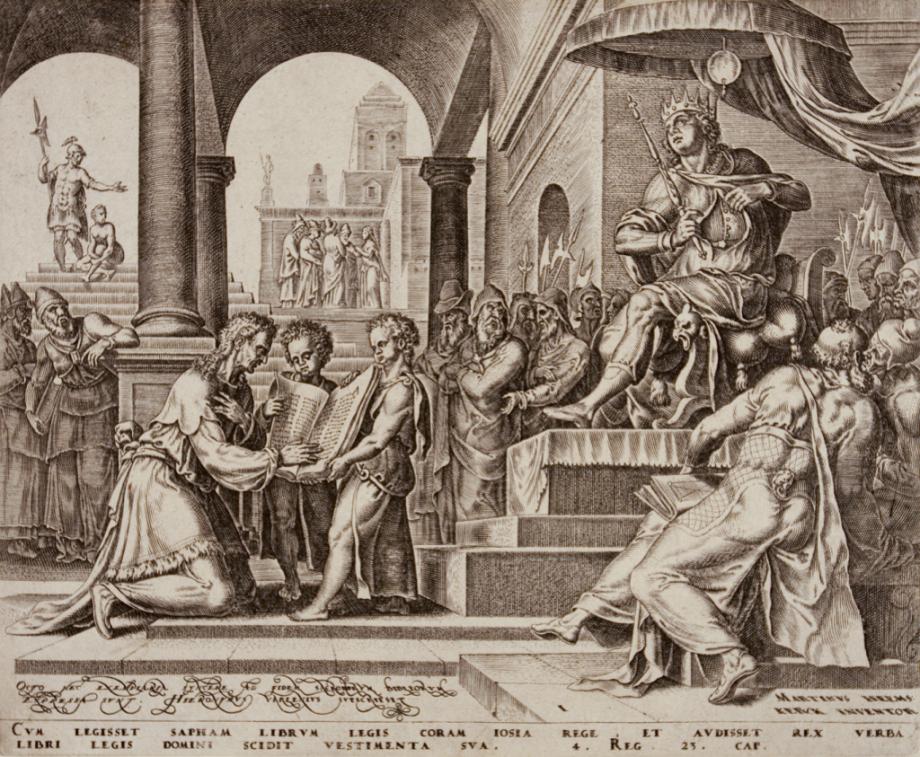
The Book of the Law, Read to King Josiah by Dutch artist Maerten van Heemskerck, c.1569

The king smashed all the altars to smithereens—the altar on the roof shrine of Ahaz, the various altars the kings of Judah had made, the altars of Manasseh that littered the courtyard of The Temple—he smashed them all, pulverized the fragments, and scattered their dust in the Valley of Kidron. The king proceeded to make a clean sweep of all the sex-and-religion shrines that had proliferated east of Jerusalem on the south slope of Abomination Hill, the ones Solomon king of Israel had built to the obscene Sidonian sex goddess Ashtoreth, to Chemosh the dirty-old-god of the Moabites, and to Milcom the depraved god of the Ammonites. He tore apart the altars, chopped down the phallic Asherah-poles, and scattered old bones over the sites. Next, he took care of the altar at the shrine in Bethel that Jeroboam son of Nebat had built—the same Jeroboam who had led Israel into a life of sin. He tore apart the altar, burned down the shrine leaving it in ashes, and then lit fire to the phallic Asherah-pole.

As Josiah looked over the scene, he noticed the tombs on the hillside. He ordered the bones removed from the tombs and had them cremated on the ruined altars, desacralizing the evil altars. This was a fulfillment of the word of God spoken by the Holy Man years before when Jeroboam had stood by the altar at the sacred convocation.

Then the king said, “And that memorial stone—whose is that?”

The men from the city said, “That’s the grave of the Holy Man who spoke the message against the altar at Bethel that you have just fulfilled.”

Josiah said, “Don’t trouble his bones.” So, they left his bones undisturbed, along with the bones of the prophet from Samaria.

But Josiah hadn’t finished. He now moved through all the towns of Samaria where the kings of Israel had built neighborhood sex-and-religion shrines, shrines that had so angered God. He tore the shrines down and left them in ruins—just as at Bethel. He killed all the priests who had conducted the sacrifices and cremated them on their own altars, thus desacralizing the altars. Only then did Josiah return to Jerusalem.

The king now commanded the people, “Celebrate the Passover to God, your God, exactly as directed in this Book of the Covenant.”

This commanded Passover had not been celebrated since the days that the judges judged Israel—none of the kings of Israel and Judah had celebrated it. But in the eighteenth year of the rule of King Josiah this very Passover was celebrated to God in Jerusalem.

Josiah scrubbed the place clean and trashed spirit-mediums, sorcerers, domestic gods, and carved figures—all the vast accumulation of foul and obscene relics and images on display everywhere you looked in Judah and Jerusalem. Josiah did this in obedience to the words of God’s Revelation written in the book that Hilkiah the priest found in The Temple of God.

There was no king to compare with Josiah—neither before nor after—a king who turned in total and repentant obedience to God, heart and mind and strength, following the instructions revealed to and written by Moses. The world would never again see a king like Josiah. (The Message)

The Book of the Law Found, Unknown artist, 1913

To say that King Josiah cleaned house is a significant understatement. Having found the Book of the Law, which was lost for generations deep within the temple, Josiah took its words to heart and set about a campaign of reformation like no king before him. 

Indeed, Josiah was determined to restore and implement the Law in the life of the nation of Judah. His zeal knew no bounds. Josiah was doggedly relentless and actively radical in returning the Jews to the true worship of Yahweh.

Josiah did more than reinstitute the Passover and other festivals of the Lord. The king first upended the alternative pagan worship which had become embedded in Judah like a death-dealing cancer. Josiah surgically removed it with ruthless precision. 

King Josiah made ashes out of Asherah poles; put pagan priests out of business permanently; and did away with everything contrary to the worship of the One true God, including spiritual mediums, household gods, and sacrificial high places. In order to turn his heart fully to God, he did away with all competing gods.

Repentance, renewal, and reformation requires a two-fold process: 1) Turning away from what is false; and 2) Turning toward what is true.

Turning from spiritually unhealthy ways of living – without turning to God – is merely a half repentance. Furthermore, turning to God – without turning one’s back on damaging lifestyles – is a form of denial and is dangerous. 

We are to put off the old clothes of spiritual insensitivity and social injustice. We are to put on the new clothes of righteousness and peace. We are to forsake the old inner person of shame in order to embrace the new life of freedom and joy. 

There needs to be a radical removal of sin, so as to replace it with what is just and right. And, keep in mind, that none of this is pretty or romantic. Repentance and renewal is a messy ugly process of dispelling darkness and letting light shine. It is not for the faint of heart.

Where to begin? Make a fierce, brutally honest spiritual inventory of your life. No one can turn from something they are not really aware of. So, create in your schedule some time in the week to connect with God and do the following: 

  • Identify some areas for change, then list the obstacles to turning away from them (e.g., fear, despair, financial repercussions, etc.). Face those obstacles honestly and forthrightly. 
  • Form a rudimentary plan to forsake the old ways and embrace new paths of righteousness. This is only a beginning. Let God take that process and direct it in redemptive and purifying ways.

Holy God, you are jealous for your own glory. Today, I decide to identify and put away all that is contrary to your righteousness and will for my life. And I choose to turn to you with all my heart. In body, soul, and spirit I belong to you. Amen.

2 Corinthians 4:13-5:1 – Do Not Lose Heart

It is written: “I believed; therefore, I have spoken.” Since we have that same spirit of faith, we also believe and therefore speak, because we know that the one who raised the Lord Jesus from the dead will also raise us with Jesus and present us with you to himself. All this is for your benefit, so that the grace that is reaching more and more people may cause thanksgiving to overflow to the glory of God.

Therefore, we do not lose heart. Though outwardly we are wasting away, yet inwardly we are being renewed day by day. For our light and momentary troubles are achieving for us an eternal glory that far outweighs them all. So, we fix our eyes not on what is seen, but on what is unseen, since what is seen is temporary, but what is unseen is eternal.

For we know that if the earthly tent we live in is destroyed, we have a building from God, an eternal house in heaven, not built by human hands. (New International Version)

We all face seasons and circumstances that stretch our faith and press the limits of what we can handle.

We have no promise from Scripture we will avoid trouble. 

Instead, Jesus promises his followers there will be adversity and stressful predicaments. 

The pressures of life can sometimes be so overwhelming, we might lapse into losing heart, either by chiding ourselves for the adversity and wishing things were different, or blaming others for our troubles, and believing that if they would just get their act together, all would be well with my soul. 

The ancient Corinthian Church had a bevy of relational issues and problems. Some they created themselves. Some came from other people. Other issues arose simply by living in a fallen world, surrounded by the effects of ever-present sinful crud. 

Yet, no matter the source or nature of the problem, the Corinthians needed a point of focus to direct their troubled hearts. They needed to be reminded of the grace they possessed in Jesus Christ.

Faith is a gift given by God. It is planted in the heart of the believer so that, over time, it will nurture, grow, and bear spiritual fruit. Out of that belief arises speaking words of hope and love that embrace the work of God in the life of the believer. The Apostle Paul said elsewhere to the Roman Church: 

If you openly declare that Jesus is Lord and believe in your heart that God raised him from the dead, you will be saved. For it is by believing in your heart that you are made right with God, and it is by openly declaring your faith that you are saved. (Romans 10:9-10, NLT)

Christ’s resurrection from death is both a spiritual and a physical reality. If we believe this truth in our hearts, we will be raised both spiritually and physically. Faith in Christ gives shape to the hope that, although we might be experiencing the effects of mortality and the fall of humanity, we are, at the same time, being spiritually renewed day by day. 

The very same afflictions causing our bodies to degenerate and challenging our spirits, are the same means to achieving a glorious, resurrected existence. There cannot be the glory of spiritual and bodily resurrection without a shameful death. Jesus absorbed the shame of the world’s violent ways onto himself so that we might be raised with him. 

However, this does not mean we will never experience difficulty in this present life. In fact, daily spiritual renewal can and does happen through adverse circumstances. There must be suffering before glory, both for Jesus and for us. Deliverance from sin, death, and hell is not an inoculation from trouble. Because it is the troubles of this life which teach us to trust in God, as well as weaning us from everything we previously trusted to deal with those troubles.

“Don’t let your hearts be troubled. Trust in God, and trust in me.”

Jesus (John 14:1, NIV)

So, we need to fix our gaze firmly on the unseen reality of faith and hope. All we see with our physical eyes is temporary. All that is unseen is eternal, especially and namely, God. Therefore, it is imperative we traffic in building heavenly treasure, learning to deal with the intangible and unseen dimensions of life.

We are to allow the physical to serve as a sign and seal of the spiritual realities they represent.

For example, Christians come to the Lord’s Table so that the tangible elements of bread and cup will bolster and fortify our faith with the grace that points to the intangible. The Table is to accomplish for us a spiritual renewal of lifting us up by God’s Spirit and joining us with Jesus. This union with Christ can never be taken away from us, even in death, because we have an eternal building from God which makes this present life look like a camping trip.

When I think of a person who is outwardly wasting away, yet inwardly being renewed, I think of Joni Eareckson Tada. She has been a paraplegic for fifty years, after an accident as a teenager in which she dove into shallow water and broke her neck. Afterwards, lying in a hospital for months unable to move, she had completely lost heart to the point of being suicidal. 

Joni could not even kill herself since she could not physically move. Finally, in her darkest moment, she cried to God with what she says was the most significant prayer she ever prayed: “Lord, if I can’t die, show me how to live.” And God did. Joni’s faith is as strong and robust as anyone’s, despite her infirmity and handicaps. She has learned to embrace her troubles as the means of growing her faith.

The path to accept, cope, and transcend our troubles and afflictions begins with acknowledging them. They only have power over us for ill if we ignore them or put up a false front to hide them. The Apostle Paul was open with the Corinthians about his life: 

We do not want you to be unaware, brothers and sisters, of the affliction we experienced in Asia; for we were so utterly, unbearably crushed that we despaired of life itself. Indeed, we felt that we had received the sentence of death so that we would rely not on ourselves but on God who raises the dead. (2 Corinthians 1:8-9, NRSV) 

Paul faced whippings, beatings, stoning, shipwreck, hunger, poverty, danger, and trouble, not to mention the stress of caring for fledgling churches. Through it all, Paul was transparent, and named his troubles so he could apply the poultice of God’s grace to his afflictions. 

It is our brokenness – not having it all together – which shows the grace of God to others.

Paul consistently described his life and ministry in apparent paradoxes: strength in weakness; glory through shame; life through death; riches through poverty. 

Although we experience the fallen nature of the world, God bends each situation toward divine purposes so that what seems to be our downfall becomes the means to our spiritual renewal.

Therefore, we do not lose heart. 

Holy Scripture encourages us not to give up because of hardship, since those very same troubles are the divine implements used to form us into solid followers of Jesus.

We need some stress. Just like a violin needing its strings adjusted to the right pressure, God will tune us with the right amount of stress we need to produce beautiful melodious music. God is the musician, and we are the instrument, not the other way around. 

We are to interpret our stress as God tuning us for good purposes. The pressure we experience becomes the means of glorious music in daily spiritual renewal for the life of the world.

Believers are being renewed daily into a valuable work of God. The stress and trouble we experience is very real and sometimes quite hard. Yet, we have the hope God will bend each circumstance for good purposes so that, even though we seem to be wasting away on the outside, on the inside those experiences are renewing us. 

When this present life is over, it is not the end; it is just the beginning.

God Almighty, you reign supreme, including over our stress and pressure in this present life. You have brought us in safety to this day. So, preserve us according to your mighty power, so that we might not fall into sin, nor be overcome by adversity. In all the situations of life, whether good or bad, direct us to the fulfilling of your purposes through Jesus Christ our Lord. Amen.