Joshua 4:14-24 – The Importance of Visual Reminders

That day the Lord brought honor to Joshua before all Israel. They respected him all his life, just as they had respected Moses.

The Lord told Joshua, “Instruct the priests carrying the ark of the covenantal laws to come up from the Jordan.” So, Joshua instructed the priests, “Come up from the Jordan!” The priests carrying the ark of the covenant of the Lord came up from the middle of the Jordan, and as soon as they set foot on dry land, the water of the Jordan flowed again and returned to flood stage.

The people went up from the Jordan on the tenth day of the first month and camped in Gilgal on the eastern border of Jericho. Now Joshua set up in Gilgal the twelve stones they had taken from the Jordan. He told the Israelites, “When your children someday ask their fathers, ‘What do these stones represent?’explain to your children, ‘Israel crossed the Jordan River on dry ground.’ For the Lord your God dried up the water of the Jordan before you while you crossed over. It was just like when the Lord your God dried up the Red Sea before us while we crossed it.He has done this so all the nations of the earth might recognize the Lord’s power and so you might always obey the Lord your God.” (New English Translation)

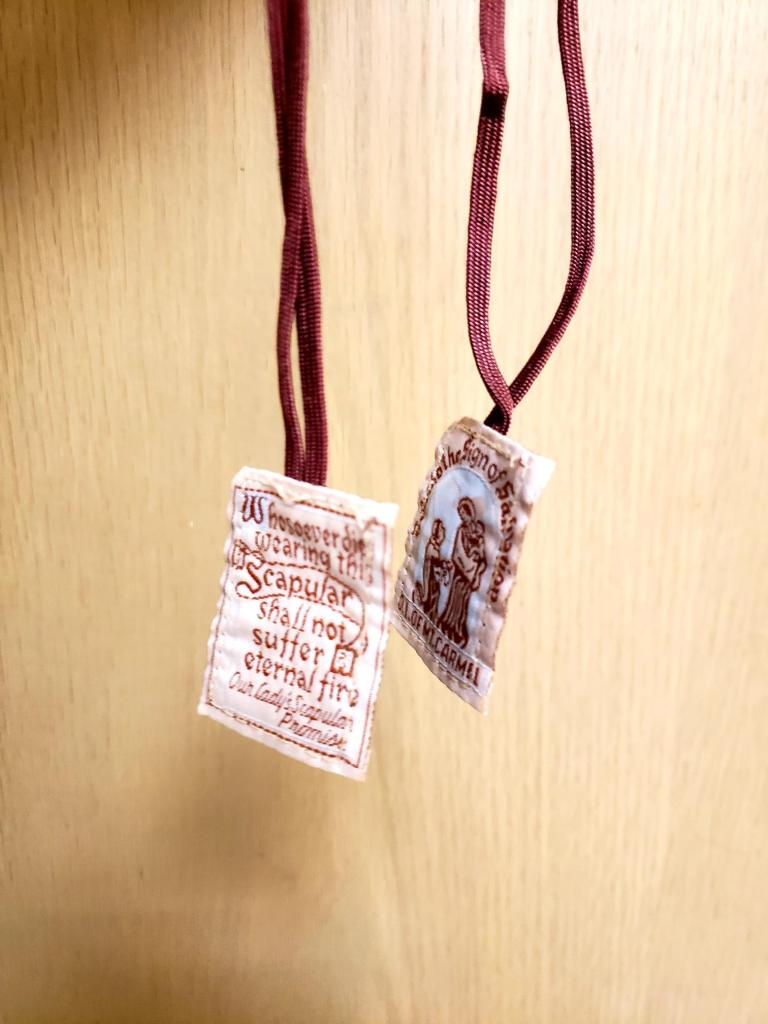
On my hospital office desk, where I can see it every day, is a scapular. “Scapular” is the Latin word for “shoulders.” A scapular typically consists of two small pieces of cloth, a few inches in size, which has a religious image on one, and a message on the other. There are two bands of cloth connecting the message or image.

The wearer places one square on the chest, rests the bands on each shoulder and lets the second square drop down the back. Worn by some Catholic faithful, the scapular serves to remind the believer of their commitment to live a Christian life.

The particular scapular I have in my possession was given to me by a patient when I was first starting out as a hospital chaplain. I was called to the room of a dying patient. He was afraid of death. So, we conversed together for an hour about his life, his fears, and his devotion to faith. At the end of the conversation, the patient took off the scapular he was wearing, which states, “Whosoever dies wearing this Scapular shall not suffer eternal fire.”

Regardless of what you think about scapulars and the particular message on this one, most important to me is what the patient said next with tears in his eyes: “I’ve worn this scapular every day for the past forty years. Here, I want you to have it. I don’t need it anymore. I am no longer afraid of death.”

The patient died. But he died at peace with God and without fear. I keep his scapular on my desk as a constant reminder of why I am a hospital chaplain, and how important the work I do is. Anytime I get discouraged or have a hard day, when I return to my office, the scapular reminds and reorients me that the spiritual care of patients is a privileged and sacred responsibility.

The ancient Israelites were finally ready to enter the Promised Land. The twelve tribes miraculously crossed the Jordan River on dry ground. God had stopped the water from flowing. After everyone crossed over, the river went back to flowing again.

Joshua, their leader, instructed people from each tribe to take a large stone from the river and place them in a heap for two didactic reasons:

1) To educate future generations inside Israel that God kept the promise to bring them into a land of abundance; and

2) To educate those outside Israel that God is mighty.

It’s important that we all have a continual awareness of why we are here on this earth and what our purpose is. Our history is significant and needs to be remembered.

Yet, there are many families and faith communities in which the children know little about how God worked in their parents’ lives, not to mention the many previous generations. Having tangible reminders of God’s past actions helps everyone remember. 

Just as people ask me about why I have a scapular on my desk, so having reminders of God’s grace in prominent visible places serves to aid all ages of folks to ask why those mementos are there.

It is good to have visual reminders of faith and the faithful people who influenced us around our homes, places of work, and communities so that others may discover and know the redemptive acts of God, that the Lord keeps promises.

Almighty God, we praise and magnify your holy Name for all your servants who have finished their course in faith and patience. May we remember them and their service well. We humbly pray that, at the day of resurrection, we and all who are members of the mystical body of your Son may be set on his right hand, and hear his most joyful voice: “Come, you who are blessed by my Father, inherit the kingdom prepared for you from the foundation of the world.” Grant this, O merciful Father, for the sake of Jesus Christ, our only Mediator and Advocate. Amen

All Saints Day

In all times and every place throughout history God has specialized in taking imperfect or broken people and transforming their lives. On the Christian Calendar, November 1 is the day each year to remember the saints who have gone before us. This day is meant to be a way of not forgetting the people, friends, and family, as well as long-dead historical saints, who have made a significant impact in our spiritual lives.

All Saints Day is much more than a focus on extraordinary persons; it highlights the work of ordinary Christians who faithfully lived their lives and persevered to the end. We give thanks for the gift of how they daily lived their faith. We also remember that all believers in Jesus are united and connected.

Remembering is a prominent theme in Holy Scripture. Over a hundred times we are told to remember God’s covenant with people and redemptive actions on their behalf; to remember the needy and those less fortunate; and, to remember the significant persons who influenced us in our journey of faith.

“Remember your leaders, who spoke the word of God to you.  Consider the outcome of their way of life and imitate their faith.” (Hebrews 13:7, NIV)

The saints of the past are an inspiration to us in the present. They serve us as a model of faithfulness in persevering in our Christian lives. Through biblical stories of very human persons being used of God, as well as reading biographies of godly people who were dedicated to God in service, we gain motivation and patience until Jesus returns.

“God creates out of nothing. Wonderful you say. Yes, to be sure, but he does what is still more wonderful: he makes saints out of sinners.”

Søren Kierkegaard

Who were the people in your life that went out of their way to communicate God’s love to you with both words and actions?  Who were those persons who labored behind the scenes in prayer so that you and others would know Jesus? 

If any of those persons are still around, and you know where they are, remember them. Drop them a note. Express to them a simple thank you for their influence in your life. You will not only encourage that person – it will help you remember and re-engage with something in your life you may have forgotten or have just taken for granted for too long.

Gordon McDonald, a Christian pastor and writer, at the passing of a lifelong mentor, recalled the loyalty and crucial counsel given in a time of crisis:

“He was there when, many years later, my life fell apart because of a failure for which I was totally responsible. In our worst moments of shame and humiliation, he came and lived in my home for a week and helped me do a searing examination of my wife. I will always remember his words: ‘You are momentarily in a great darkness. You have a choice to make. You can—as do so many—deny this terrible pain, or blame it on others, or run away from it. Or you can embrace this pain and let it do its purifying work as you hear the things God means to whisper into your heart during the process. If you choose the latter, I expect you will have an adventurous future modeling what true repentance and grace is all about.’”

We truly stand on the shoulders of those who have gone before us in faith and patience. We will continue to persevere and thrive in faith when we remember them and allow those here in the present to journey with us along this road of faith.

Today is an intentional day of remembrance. We remember answered prayer and salvation. We recollect the people who gave us the life-giving gospel message in both word and deed. We remember the death of Christ and recall that he said he is coming back.

It is sage to recall events of rescue and pull them forward into the present so that all God’s worshipers can taste and see that the Lord is good. This is exactly what the Apostle Peter did for a church which needed to recall and remember the mighty acts of God:

Like newborn babies, crave pure spiritual milk, so that by it you may grow up in your salvation, now that you have tasted that the Lord is good. As you come to him, the living Stone—rejected by humans but chosen by God and precious to him—you also, like living stones, are being built into a spiritual house to be a holy priesthood, offering spiritual sacrifices acceptable to God through Jesus Christ. (1 Peter 2:2-5, NIV)

Our memories are accessed through symbols and with taste and sight. God uses symbols as a means of revelation. For example, when the Lord wanted to demonstrate the ugliness of sin and the cost of forgiveness, he told the Israelites to kill an animal and sprinkle its blood on their clothing and on the altar. It sounds awful. Yet, the worshiper never walked away from the experience scratching his head and wondering what it was all about because he encountered and tasted the drama of sin and redemption. His senses saw it, felt it, smelled it, and tasted the meat from it. 

Symbols have the power to access other parts of our being in knowing God. We are more than thinking beings; we are also emotional and sensory creatures. We need ordinary events, like shared meals, that include symbols and rituals. Every year faithful Jews gather to remember and re-enact the Passover – the story of how they were enslaved in Egypt, oppressed by Pharaoh, and set free by God. To this day pious Jews still remember the Passover by eating and drinking together and telling stories.

We need both words and sacraments. Therefore, holidays like Thanksgiving and Christmas involve both verbal expressions of gratitude and love, and particular actions of kindness and gratitude in giving gifts and sharing food. Together, it all connects us to God, to one another, and to a history of God’s people. Jesus met his disciples in the Upper Room to celebrate Passover together. Jesus energized their time together by filling it with words and symbols of care and redemption. Jesus told the disciples about his upcoming death and provided symbols which reinforced the words. 

“Take and eat – this is my body…. Take this cup – drink from it, all of you.” (Luke 22:7-20)

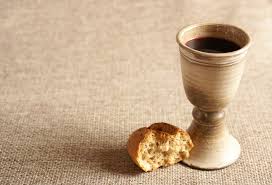
Rather than analyzing the bread and discussing the wine’s vintage, the disciples simply ate and drank. They tasted real food and drink. They also tasted real spiritual food. It is one thing to speak of God’s presence, and it is another to experience that presence through an ordinary shared ritual of bread and cup.

God is good, all the time; and, all the time, God is good. Jesus is our Emmanuel, God with us. Christ is present with us through our ritual of fellowship and food. When the sixteenth-century Reformer John Calvin was asked how Jesus is present to us at the Lord’s Supper he explained:

“Now if anyone asks me how this takes place, I shall not be ashamed to confess that it is a secret too lofty for either the mind to comprehend or my words to declare….  I rather experience it than understand it.”

John Calvin

The taste of real bread reminds us of the physical incarnation of Christ, and Christ’s humiliation and death. Drinking from the tangible cup reminds us of the bodily sacrifice of Christ, the drops of blood which Jesus sweat in Gethsemane, and the beatings, floggings, nails, and crown of thorns that caused the bleeding. Tasting the bread and cup when celebrating communion reminds us that our sins are forgiven, we are united to Christ, and we are united together. 

There are historical events which happened and are forgotten. Then, there are past actions which linger with continual results into the present. The incarnation, life, death, resurrection, ascension, and glorification of the Lord Jesus are past redemptive events which continue to exert powerful force into the here and now.

Saints throughout church history moved the message of Christ along and demonstrated for us that the past is alive in the person of Jesus Christ. Along with them we proclaim that Christ has died, Christ has risen, Christ is coming again. And God has something planned for those who have gone before us, along with us, so that together we will experience the perfect righteousness of Christ forever. (Hebrews 11:39-40)

Believers are encouraged through word and sacrament to proclaim the good news of Jesus Christ until he comes again. So, let us respond to God’s wooing invitation to eat and drink, to taste and see that the Lord is good through faith, hope, and love. For God is our refuge and strength, our ever-present help.

Hebrews 1:1-4, 2:5-12 – World Communion Sunday

In the past God spoke to our ancestors through the prophets at many times and in various ways, but in these last days he has spoken to us by his Son, whom he appointed heir of all things, and through whom also he made the universe. The Son is the radiance of God’s glory and the exact representation of his being, sustaining all things by his powerful word. After he had provided purification for sins, he sat down at the right hand of the Majesty in heaven. So, he became as much superior to the angels as the name he has inherited is superior to theirs….

It is not to angels that he has subjected the world to come, about which we are speaking. But there is a place where someone has testified:

“What is mankind that you are mindful of them,
    a son of man that you care for him?
You made them a little lower than the angels;
    you crowned them with glory and honor
    and put everything under their feet.” [Psalm 8:4-6]

In putting everything under them, God left nothing that is not subject to them. Yet at present we do not see everything subject to them. But we do see Jesus, who was made lower than the angels for a little while, now crowned with glory and honor because he suffered death, so that by the grace of God he might taste death for everyone.

 In bringing many sons and daughters to glory, it was fitting that God, for whom and through whom everything exists, should make the pioneer of their salvation perfect through what he suffered. Both the one who makes people holy and those who are made holy are of the same family. So, Jesus is not ashamed to call them brothers and sisters.He says,

“I will declare your name to my brothers and sisters;
    in the assembly I will sing your praises.” [Psalm 22:22] (New International Version)

Today is World Communion Sunday. We come to the Lord’s Table with awareness of Christian sisters and brothers throughout the world, in all nations, and in all the various traditions of Christianity. We may not all agree about a lot of things in the church and the Christian life. Yet, every Christian tradition – past and present – has and does observe communion around the Lord’s Table. It is a practice which binds us and reminds us of our unity with another.

And that unity is focused and centered in Jesus Christ our Savior and Lord. Jesus is the person who holds us together. Jesus is the one in whom all the good promises of God are fulfilled. Today we remember Jesus, commune with Jesus, and express our hope in Jesus.

We remember that Jesus was made perfect through suffering – and that we, too, experience spiritual formation through suffering.

We commune with Jesus and one another because the cross of Christ achieved deliverance from spiritual estrangement and relational loneliness and gathered us into the one people of God.

We hope with confident expectation, as we celebrate Jesus at the Table along with all the saints everywhere, that Christ will return and take us to be with him forever in glory. There will be no more suffering, no more pain, no more poverty, no more oppression, no more injustice. There will be complete faith, realized hope, and absolute love for all time and forever. Amen!

Our past, present, and future all belong to Jesus. And we are not alone, for all Christians in everyplace from every race, ethnicity, class, and gender – whether they are Pentecostals in Puerto Rico, Anglicans in Africa, Catholics in Poland, Coptic Egyptians, or Orthodox Russians – the beautiful diversity of Christ’s Body comes together in harmonious unity at the Lord’s Table. It is this sacrament which raises our awareness of both solidarity with Christ and with all believers everywhere.

The purpose of the Lord’s Table is to participate in the blessings of Christ by visually re-creating the story of Jesus. There are three different terms for the Table in the New Testament, and each term is meant to convey a different aspect of the Table’s significance. 

The Lord’s Supper is a focus on remembrance, a memorial of Christ’s death that is deeply reflective and contemplative. 

What you must solemnly realize is that every time you eat this bread and every time you drink this cup, you reenact in your words and actions the death of the Master. You will be drawn back to this meal again and again until the Master returns. You must never let familiarity breed contempt.

Anyone who eats the bread or drinks the cup of the Master irreverently is like part of the crowd that jeered and spit on him at his death. Is that the kind of “remembrance” you want to be part of? Examine your motives, test your heart, come to this meal in holy awe. (1 Corinthians 11:26-28, MSG) 

The Eucharist literally means “thanksgiving.” The Lord’s Table as Eucharist means we celebrate Christ’s victory over sin, death, and hell on our behalf. 

While they were eating, Jesus took a piece of bread, gave a prayer of thanks (Eucharist), broke it, and gave it to his disciples. “Take it,” he said, “this is my body.” Then he took a cup, gave thanks to God (Eucharist), and handed it to them; and they all drank from it. (Mark 14:22-23, GNT) 

Communion means to participate in Christ and with other Christians. This emphasizes that when we partake of the Lord’s Table, we ought to do so with unity and fellowship. We are more than individual Christians. We share in the Lord together as the community of the redeemed.

When we drink from the cup that we ask God to bless, isn’t that sharing in the blood of Christ? When we eat the bread that we break, isn’t that sharing in the body of Christ? By sharing in the same loaf of bread, we become one body, even though there are many of us. (1 Corinthians 10:16-17, CEV) 

As we allow the Table to be a remembrance, celebration, and participation with each other, we engage in a ritual that helps us to know Christ better. And we are better able to realize God’s grace to us.

Participating and sharing in communion is important because we can easily be fragmented and not fellowship with one another in a local church, as well as the world-wide church. The cross of Jesus Christ has ended division. The cross has brought us peace and reconciliation between God and others. 

The suffering of Jesus on the cross has restored a broken relationship between us and God, and also between one another. Therefore, there is to be no more ignoring one another, or brothers and sisters elsewhere, because we are one unified people around the good news of Jesus – enjoying solidarity with each other in both our joys and our sufferings.

One awareness needed as we share in communion together is to be mindful of others. Not everyone is the same. We must avoid coming to the Table expecting people to be the way we want them to be. Instead, we are to come because we have staked our souls on the fact that Christ is the Way, the Truth, and the Life, and the Church is the best place to be while we all struggle to figure out what that means. We come because we’d be hard pressed to say which is the bigger of the two scandals of God: that he loves me—or that he loves everyone else. 

The Lord’s Table is the great leveler, where we all have equal footing and accept one another according to a common confession of Christ. Communion emphasizes participation in the body and blood of Christ, as well as participation with all Christians everywhere. 

Therefore, we are not alone. Communion means God is with us, and that Christ has so closely identified with us that he took our place on the cross. As a result, every believer in Jesus is linked to all the others so that, when one suffers or rejoices, all suffer or rejoice, whether it is a Pastor down the street rejoicing over a newly saved soul, or a suffering Syrian Christian trying to survive in a refugee camp.

Let us live up to what, and whom, we profess. Since we are God’s forgiven people, we are to work at living the Christian life together. This unity is symbolized by partaking together of the same loaf of bread and drinking from a common cup.

One Sunday, a group of missionaries and believers in Papua New Guinea were gathered to observe communion together.  After one young man sat down, one of the missionaries recognized that he seemed to be quite upset. Then, after a while, the young man seemed to be fine. 

The missionary leaned over and whispered to him, “What was it that troubled you?”  The young man replied, “The man who just came in happens to be the man who killed and ate the body of my father.  And now he has come in to observe communion with us. At first I didn’t think I could do that. But it is all right now.  He is washed in the same precious blood as I am.”  And so together they participated in Christian communion.

We have peace because of Jesus. Christ’s suffering and death has brought reconciliation not only between us and God, but between each other. As we approach the Lord’s Table, let us be aware not only of our personal relationship with God, but our relationships with one another in the local church, and our unity with the world-wide church. 

May our lives be shaped and formed around the cross of Jesus Christ, as we remember, celebrate, and participate together.

Almighty and everlasting God, may this time we partake of the body and blood of Jesus unite us in the community of saints who know your love and proclaim your Son with fervor and grace to a broken and hurting world. May your healing hands be the salve for ending hurt and violence in this world, even as we prepare for the next. In the holy Name of Jesus. Amen.

Joshua 4:1-24 – Remembrance

When the entire nation had finished crossing over the Jordan, the Lord said to Joshua, “Pick twelve men from the people, one man per tribe. Command them, ‘Pick up twelve stones from right here in the middle of the Jordan, where the feet of the priests had been firmly planted. Bring them across with you and put them down in the camp where you are staying tonight.’”

Joshua called for the twelve men he had appointed from the Israelites, one man per tribe. Joshua said to them, “Cross over into the middle of the Jordan, up to the Lord your God’s chest. Each of you, lift a stone on his shoulder to match the number of the tribes of the Israelites. This will be a symbol among you. In the future your children may ask, ‘What do these stones mean to you?’ Then you will tell them that the water of the Jordan was cut off before the Lord’s covenant chest. When it crossed over the Jordan, the water of the Jordan was cut off. These stones will be an enduring memorial for the Israelites.”

The Israelites did exactly what Joshua ordered. They lifted twelve stones from the middle of the Jordan, matching the number of the tribes of the Israelites, exactly as the Lord had said to Joshua. They brought them over to the camp and put them down there. Joshua also set up twelve stones in the middle of the Jordan where the feet of the priests had stood while carrying the covenant chest. They are still there today.

Meanwhile, the priests carrying the chest were standing in the middle of the Jordan. They stood there until every command that the Lord had ordered Joshua to tell the people had been carried out. This was exactly what Moses had commanded Joshua. The people crossed over quickly. As soon as all the people had finished crossing, the Lord’s chest crossed over. The priests then moved to the front of the people. The people of Reuben, the people of Gad, and half the tribe of Manasseh crossed over, organized for war ahead of the Israelites, exactly as Moses had told them. Approximately forty thousand armed for war crossed over in the Lord’s presence to the plains of Jericho, ready for battle. The Lord made Joshua great in the opinion of all Israel on that day. So, they revered him in the same way that they had revered Moses during all his life.

The Lord said to Joshua, “Command the priests carrying the chest containing the testimony to come up out of the Jordan.”

So, Joshua commanded the priests, “Come up from the Jordan.” The priests carrying the Lord’s covenant chest came up from the middle of the Jordan, and the soles of their feet touched dry ground. At that moment, the water of the Jordan started flowing again. It ran as before, completely over its banks. The people came up out of the Jordan on the tenth day of the first month. They camped at Gilgal on the east border of Jericho.

Joshua set up at Gilgal those twelve stones they had taken from the Jordan. He said to the Israelites, “In the future your children will ask their parents, ‘What about these stones?’ Then you will let your children know: ‘Israel crossed over the Jordan here on dry ground.’ This was because the Lord your God dried up the water of the Jordan before you until you crossed over. This was exactly what the Lord your God did to the Reed Sea. He dried it up before us until we crossed over. This happened so that all the earth’s peoples might know that the Lord’s power is great and that you may always revere the Lord your God.” (CEB)

I like coffee. I like coffee mugs. I like buying a coffee mug from places I visit. Although it drives my wife nuts, the mugs serve as a continual reminder of a certain place or event I have experienced. As we journey with the Israelites in the Old Testament book of Joshua, we experience with them the significant places and events of their taking the Promised Land. God did a miraculous work by causing the Jordan River to congeal so that the Israelites could cross over on dry ground in entering the land.  Once they were across on the other side, God instructed them to take twelve stones, one for each tribe, and pile them up together.

Crossing Over the Jordan River by Yoram Raanan

The purpose of the heap of twelve stones is made clear in the story and had a twofold purpose: to educate future generations inside Israel that God kept the promise to bring them into a land of abundance; and, to educate those outside Israel that God is mighty.

It is important to be tethered to the past and aware of why and how we are here. Yet, there are many families and faith communities in which the children know little about how God worked in previous generations. So, having tangible reminders of God’s past actions serves everyone to remember, and especially enables children to know the past actions of God. Just as people ask me about why I have certain coffee mugs, so having reminders of God’s grace in prominent visible places serves to aid kids and others to ask why those mementos are there.

It is good to have reminders of faith and the faithful people who influenced us around our homes, places of work, and communities so that others may know the redemptive acts of God, that the Lord keeps promises. And it is a whole lot more important than a coffee mug.

Almighty God, we praise and magnify your holy Name for all your servants who have finished their course in faith and patience. May we remember them and their service well. We humbly pray that, at the day of resurrection, we and all who are members of the mystical body of your Son may be set on his right hand, and hear his most joyful voice: “Come, you who are blessed by my Father, inherit the kingdom prepared for you from the foundation of the world.” Grant this, O merciful Father, for the sake of Jesus Christ, our only Mediator and Advocate. Amen