Remember God, for God Has Remembered Us (Psalm 105:1-11, 45b)

Give thanks to the Lord;
    call upon his name;
    make his deeds known to all people!
Sing to God;
    sing praises to the Lord;
    dwell on all his wondrous works!
Give praise to God’s holy name!
    Let the hearts rejoice of all those seeking the Lord!
Pursue the Lord and his strength;
    seek his face always!
Remember the wondrous works he has done,
    all his marvelous works, and the justice he declared—
    you who are the offspring of Abraham, his servant,
        and the children of Jacob, his chosen ones.

The Lord—he is our God.
    His justice is everywhere throughout the whole world.
God remembers his covenant forever,
    the word he commanded to a thousand generations,
        which he made with Abraham,
        the solemn pledge he swore to Isaac.
God set it up as binding law for Jacob,
    as an eternal covenant for Israel,
    promising, “I hereby give you the land of Canaan
    as your allotted inheritance….”

Praise the Lord! (New Revised Standard Version)

Human thoughts and actions respond to divine thoughts and actions. We remember because God remembers. We act because God acts in history. We give because the Lord first gave to us.

The psalmist calls us to act and to think – and it’s all a response to God’s merciful attention to God’s people. Notice the imperative verbs which call us to use our words, emotions, and actions, so that we press spiritual truth into our minds and hearts, and do not forget our experiences. They all, from a Christian perspective, have their fulfillment in the person and work of Jesus.

Give thanks to the Lord

Give thanks in all circumstances; for this is God’s will for you in Christ Jesus. (1 Thessalonians 5:18, NIV)

Make known God’s deeds

“Righteous Father, though the world does not know you, I know you, and they know that you have sent me. I have made you known to them, and will continue to make you known in order that the love you have for me may be in them and that I myself may be in them.” (John 17:25-26, NIV)

Sing praises to the Lord

For I tell you that Christ has become a servant of the Jews on behalf of God’s truth, so that the promises made to the patriarchs might be confirmedand, moreover, that the Gentiles might glorify God for his mercy. As it is written:

“Therefore I will praise you among the Gentiles;
    I will sing the praises of your name.”

Again, it says,

“Rejoice, you Gentiles, with his people.” (Romans 15:8-10, NIV)

Dwell on God’s works

Let the message of Christ dwell among you richly as you teach and admonish one another with all wisdom through psalms, hymns, and songs from the Spirit, singing to God with gratitude in your hearts. (Colossians 3:16, NIV)

Give praise to God’s holy name

Now on his way to Jerusalem, Jesus traveled along the border between Samaria and Galilee. As he was going into a village, ten men who had leprosy met him. They stood at a distance and called out in a loud voice, “Jesus, Master, have pity on us!”

When he saw them, he said, “Go, show yourselves to the priests.” And as they went, they were cleansed.

One of them, when he saw he was healed, came back, praising God in a loud voice. He threw himself at Jesus’ feet and thanked him—and he was a Samaritan.

Jesus asked, “Were not all ten cleansed? Where are the other nine? Has no one returned to give praise to God except this foreigner?” Then he said to him, “Rise and go; your faith has made you well.” (Luke 17:11-19, NIV)

Pursue the Lord

Flee the evil desires of youth and pursue righteousness, faith, love and peace, along with those who call on the Lord out of a pure heart. (2 Timothy 2:22, NIV)

Seek God’s face

And without faith it is impossible to please God because anyone who comes to him must believe that he exists and that he rewards those who earnestly seek him. (Hebrews 11:6, NIV)

Remember God’s works and God’s justice

“Why do you look for the living among the dead? He is not here; he has risen! Remember how he told you, while he was still with you in Galilee: ‘The Son of Man must be delivered over to the hands of sinners, be crucified and on the third day be raised again.’” (Luke 24:5-7, NIV)

We are to remember because God remembers. The Lord has an ongoing reminder in the divine day timer: Fulfill the promises I made. Keep the covenant I initiated with the people, even when they are stinkers and forget who I am.

God does not forget. The Lord keeps divine promises.

For the Christian, all God’s promises are remembered and fulfilled in the person and work of Jesus Christ.  Deliverance from sin, death, and hell; the gift of the Holy Spirit; and, ongoing divine presence and provision are given to us graciously and freely by the God who loves and cares for people. 

For Christians everywhere, remembering means coming to the Lord’s Table, entering into the once for all loving sacrifice of Christ on our behalf. It is here that we remember to give thanks and praise, seek and sing. In doing so, we make invisible realities visible, and the divine character of God known to amongst the nations.

God and Father of all, and of Jesus Christ our Lord, as you remember your dear Son, remember us. Grant us peace in our time and a longing for the day when people of every language, race, and nation will be brought into the unity of Christ’s kingdom, where there shall be endless praise, singing, thanksgiving, and joy in the Holy Spirit. This we ask in your holy Name, because of your great glory, and for the sake of Christ’s rule and reign over the earth, now and forever. Amen.

Remember and Listen to History (Deuteronomy 32:1-10)

Listen, heaven, and I will speak.

Earth, hear the words from my mouth.

Let my teachings come down like raindrops.
Let my words drip like dew,
like gentle rain on grass,
like showers on green plants.
I will proclaim the name of the Lord.
Give our God the greatness he deserves!
He is a rock.
What he does is perfect.
All his ways are fair.
He is a faithful God, who does no wrong.
He is honorable and reliable.

He recognizes that his people are corrupt.
To their shame they are no longer his children.
They are devious and scheming.
Is this how you repay the Lord,
you foolish and silly people?
Isn’t he your Father and Owner,
who made you and formed you?

Remember a time long ago.
Think about all the past generations.
Ask your fathers to remind you,
and your leaders to tell you.
When the Most High gave nations their land,
when he divided the descendants of Adam,
he set up borders for the tribes
corresponding to the number of the sons of Israel.

But the Lord’s people were his property.
Jacob was his own possession.
He found his people in a desert land,
in a barren place where animals howl.
He guarded them, took care of them,
and protected them because they were helpless. (God’s Word Translation)

In addition to being a church pastor and a hospital chaplain, I hold two academic history degrees. I firmly believe the past is important. Having an historical perspective on just about everything is helpful in order to negotiate present circumstances.

Another way of saying this is that it’s imperative that we remember times from long ago, and think about all the past generations – what they faced, why they faced it, and how they dealt with it – because it all influences us right now, whether we are aware of it, or not.

Listening to others is important. Hearing and responding to the voice of God is necessary. And listening to voices of the past is just as crucial. After all, Holy Scripture is ancient, containing the voices of hundreds of people, as well as the voice of the Lord. The faithful throughout the ages have encountered all sorts of situations related to their religious tradition; and they remain as a great cloud of witnesses testifying to us and encouraging us in the way we ought to go.

In today’s Old Testament lesson, the Lord exhorted the people to remember, simply because they had forgotten. And whenever a people forget where they have come from, they forget who they are; and if they forget who they are, their very identity is in jeopardy of being hijacked by corruption, guilt, and shame.

Israel needed to recall their own history, because they were in danger of failing to tell their stories to the next generation, who in turn, would not then have anything to remember.

The great redemptive events of God in calling their father, Abraham, out of Chaldea, promising divine presence and property to the descendants of Abraham, Isaac, and Jacob; the miraculous deliverance from Egyptian slavery; and the wandering in the wilderness had to be lifted up and recognized, not forgotten.

In fact, every generation of believers needs to not only affirm their faith, but also restate that faith for the next generation.

And that is precisely what Moses did for the people. He restated Israel’s history and the giving of God’s Law for a new generation about to enter the Promised Land. Only with this collective memory of divine help and revelation would the people be able to make it in in the place they were going.

There is, I believe, a great collective ignorance of history. Many Westerners know very little of their own genealogy beyond a generation or two. Folks have little to no recollection of seminal events which have shaped the places where they live and work. It’s as if there is no foundation under their feet from which to stand firm.

For example, this is one reason why so many people of color get treated as if they do not belong – because the white folk in the room don’t even know their own history, let alone the background and challenges of those who look different than them.

“Every true history must force us to remember that the past was once as real as the present and as uncertain as the future.”

George Macaulay Trevelyan, Professor of History, Cambridge University, 1898-1943

History is about people, and not so much about dates and facts. And so, to be indifferent about history is to be disinterested, even calloused, toward other people. Conversely, to engage history and learn from it is to be transformed by it.

Historians are people tasked with describing and interpreting the past. They take the many historical facts and responsibly interpret those facts and events in a coherent narrative for the benefit of those in the present. That’s exactly what Moses did. He told Israel’s story.

Moses recalled the past, then retold it and revised it for his contemporary generation. All history is revisionist – and that’s a good thing. It just means that we faithfully tell the story of our past by clearly understanding that history within the historical actors own time and terms, as well as possessing an equally discerning grasp of the people who hear it.

An attention to history can guide us, and help heal us of our narcissistic ways. It can help dethrone us from the misguided belief that we are the center of the universe. History provides us with the tools necessary to hear and understand the other, enabling us to reconcile with one another. 

As we learn from reading and listening to historical narratives, we find resources that can bring transformation of our own lives and the communities in which we live. So, what are you waiting for? Read the Bible. Read history. Read the contemporary culture. Perhaps you will have a compelling, challenging, and coherent voice that will rise above all the other competing contemporary voices of contempt and corruption.

Great God of all history, thank you for the many faithful people who, through the centuries, have made a positive impact in this world.

Thank you for the godly men and women who, by your grace, have rewritten history books by their actions; who have heard your call to go into the world. We praise you for the good example they have shown and the difference they have made.

May you enable each of us to leave an imprint and legacy of your love and mercy in our spheres of influence, so that those who come after us will look back one day and say, “They made a difference.” Amen.

Bread from Heaven (Exodus 16:27-35)

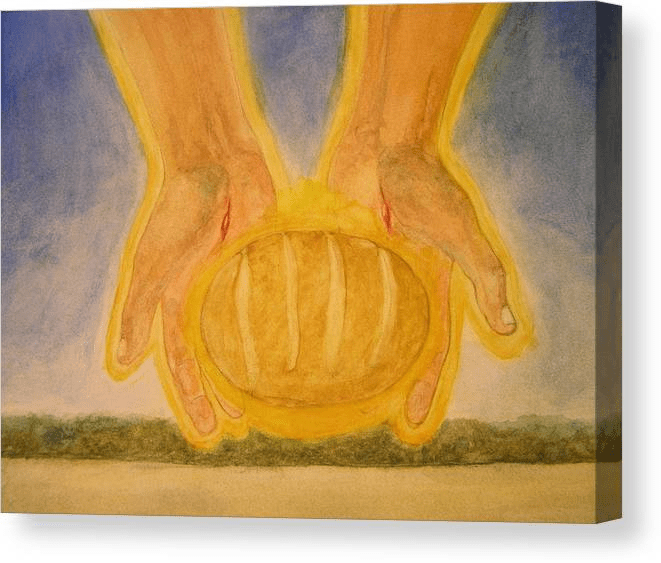
Bread From Heaven, by Nigel Wynter

On the seventh day some people went out to gather food, but they didn’t find any. The Lord said to Moses, “How long will you refuse to do what I have commanded and instructed you to do? Remember: The Lord has given you this day of rest as a holy day. That’s why he gives you enough food on the sixth day for two days. On the seventh day stay in your place—no one is to go out. Everyone, stay where you are.” So the people never worked on the seventh day of the week.

The Israelites called the food manna. It was like coriander seeds. It was white and tasted like wafers made with honey.

Moses said, “This is what the Lord has commanded: Take two quarts of manna to be kept for your descendants. This way they will see the food that I gave you to eat in the desert when I brought you out of Egypt.”

Moses said to Aaron, “Take a jar, put two quarts of manna in it, and put it in the Lord’s presence to be kept for your descendants.” Aaron put the jar of manna in front of the words of God’s promise to be kept there, as the Lord commanded Moses.

The Israelites ate manna for 40 years until they came to a place to settle. They ate manna until they came to the border of Canaan. (God’s Word Translation)

“What is it?” is the quite literal meaning of the word manna. And the answer is: It is bread from heaven.

The manna was food for the Israelite people in their 40 years of sojourning through the desert. There is also an implicit question surrounding this bread: What to do with it? Well, of course, you eat it. But, before eating it, there are issues and instructions about the manna’s arrival and collection.

The special food, only graciously given to this particular group of cantankerous people, appeared in the mornings for six days a week, not seven, and only had a shelf life of one day, with the exception of the singular Sabbath day each week.

There is a time to go out and gather, and there is a time to stay put and eat; a time to work, and a time to rest. The lack of wisdom in timing could cost you not only a meal, but also your overall sense of paying attention to God’s commands.

It is the fool who spurns the relationship between events, that is, the space between when the Lord speaks and when humanity responds. Our human responsibility is dependent upon Divine sovereignty. Ignoring the voice of God, or simply failing to listen out of present anxieties or fears, will nearly always result in a skewed response-ability.

Yes, indeed, we all have very legitimate needs for cuisine, clothing, companionship, care, and compassion. If these vital needs go unmet, we are undone and shall die. Yet, there is also the question of how we will go about getting those very important and basic needs met – and many people, having not listened well to the instructions about life, will go about attempting to meet those needs in illegitimate ways.

Trying to satisfy legitimate needs through illegitimate means ends up eroding the soul, compromising character, and searing the conscience. It’s inevitable that such a person will grumble and complain, projecting on God the evil that is, in reality, residing within the human heart.

Whenever folks go out and try to gather what isn’t there, they have lost their way and their very real needs will not really be met, at all.

This is why humans need remembrances – to have reminders of what time it is and what’s important to do and not do, to seek the appropriate paths of living well, and to avoid the pitfalls of dead end trails.

One purpose of Sabbath is to remember – to recall the great story of deliverance and never forget where we came from, so that we will continually have before us where we are going.

I Am the Bread of Life, by Joseph Matar

The Christian remembers the saving and redemptive events of Jesus by coming to the Table. We gather together to ingest bread from heaven, to partake of the Bread of Life. For those who choose to carefully listen and pay attention, the words of Christ will not only speak life into our weary selves, but shall also shape how we go about getting our needs met and satisfied:

The people began to murmur in disagreement because he had said, “I am the bread that came down from heaven….”

But Jesus replied, “Stop complaining about what I said. For no one can come to me unless the Father who sent me draws them to me, and at the last day I will raise them up. As it is written in the Scriptures, ‘They will all be taught by God.’ Everyone who listens to the Father and learns from him comes to me….

“I tell you the truth, anyone who believes has eternal life. Yes, I am the bread of life! Your ancestors ate manna in the wilderness, but they all died. Anyone who eats the bread from heaven, however, will never die. I am the living bread that came down from heaven. Anyone who eats this bread will live forever; and this bread, which I will offer so the world may live, is my flesh.”

Then the people began arguing with each other about what he meant. “How can this man give us his flesh to eat?” they asked.

So Jesus said again, “I tell you the truth, unless you eat the flesh of the Son of Man and drink his blood, you cannot have eternal life within you. But anyone who eats my flesh and drinks my blood has eternal life, and I will raise that person at the last day. For my flesh is true food, and my blood is true drink. Anyone who eats my flesh and drinks my blood remains in me, and I in him. I live because of the living Father who sent me; in the same way, anyone who feeds on me will live because of me. I am the true bread that came down from heaven. Anyone who eats this bread will not die as your ancestors did (even though they ate the manna) but will live forever.” (John 6:41-58, NLT)

Consider well, then, where and how you will find the sustenance of the soul, love, and in what ways you will listen to the words of Jesus and gather them for your next meal. Will you hoard your heaven-sent food, or will you share?

O God, our Provider and Sustainer, we who are many are one body in Christ, for we all share in the one bread. Refresh, strengthen, and preserve us as we journey in this life, in the name of Jesus Christ. Amen.

Spiritual Dementia (Deuteronomy 30:1-9)

Now, once all these things happen to you, the blessing and the curse that I’m setting before you, you must call them to mind as you sit among the various nations where the Lord your God has driven you; and you must return to the Lord your God, obeying his voice, in line with all that I’m commanding you right now—you and your children—with all your mind and with all your being. 

Then the Lord your God will restore you as you were before and will have compassion on you, gathering you up from all the peoples where the Lord your God scattered you. Even if he has driven you to the far end of heaven, the Lord your God will gather you up from there; he will take you back from there. 

The Lord your God will bring you home to the land that your ancestors possessed; you will possess it again. And he will do good things for you and multiply you—making you more numerous even than your ancestors!

Then the Lord your God will circumcise your hearts and the hearts of your descendants so that you love the Lord your God with all your mind and with all your being in order that you may live. 

The Lord your God will put all these curses on your enemies and on those who hate you and chase you. But you will change and obey the Lord’s voice and do all his commandments that I’m commanding you right now. 

The Lord your God will help you succeed in everything you do—in your own fertility, your livestock’s offspring, and your land’s produce—everything will be great! Because the Lord will once again enjoy doing good things for you just as he enjoyed doing them for your ancestors. (Common English Bible)

The mind is a vast, glorious, and (un)explored territory. Although there is much we know about it, there’s even more we don’t know about the human mind.

The mind can be both a blessing and a curse. Anyone with depression, anxiety, or other mental disorders and diseases can tell you that, especially family members who have loved ones with dementia.

Dementia is a general term for a decline in mental ability severe enough to interfere with daily life. Professionally, I visit patients with dementia nearly every day. Personally, I watched my own mother’s faculties slowly erode and decline in the last few years of her life. In her final months, my Mom rarely remembered my name, only knew me once in a while, and never recalled the conversation we had thirty seconds ago. It was difficult to watch, this woman who once cared for me, needing to be cared for.

The biblical book of Deuteronomy is the retelling of Israel’s story as they were about to enter the Promised Land. It’s a book completely dedicated to memory care. If the people were to forget who they are, they would not know what they’re supposed to be doing. The Israelites strayed from the blessings into the curses of God’s covenant life because their collective mind slowly slipped into spiritual dementia.

The mind’s need to remember is not a new issue; it’s endemic to the human condition. The constant refrain of the author of Deuteronomy is to recall and to remember where the people came from, where they are going, and why. 

Moses reiterated the covenant and the law for the people before they entered the land. It was a fresh re-hashing, nothing really new, of what God had already communicated to them. God’s people were to remember that they were once slaves in Egypt and that God had delivered to be a people for his name. They were not to forget that they had provoked the Lord in the desert – with the result of an entire generation of people being lost because they had neglected and forgotten what God told them.

Memory issues continue into the Gospels. Jesus miraculously fed a great crowd of people not once, but twice. The second time, he called his disciples to remember what had happened the first time in order to understand the second. 

In the New Testament Epistles, Paul kept reminding the Jews in the churches that they should remember the ancient covenant, and called the Gentiles to remember that they were once estranged from that very same covenant. Both Jew and Gentile together needed to collectively remember the death of Christ that united them into a new covenant community. Like them, we are to “Remember Jesus Christ, raised from the dead, descended from David.” (2 Timothy 2:8)

Like the ancient Israelites, Christians are to remember who they are and what they are about: blood-bought people of God, belonging to Christ, and given a mission to make disciples and participate with God in the redemption of all creation through remembering the poor, seeking justice, and being peacemakers in the church and the world. 

Think about where you have fallen from, and then turn back and do as you did at first. (Revelation 2:5, CEV)

There’s a difference between the disease of dementia and the church’s spiritual dementia. Folks inflicted with dementia will not recover but only worsen, whereas the church can recover its collective memory by listening again to the ancient Word of God and being constantly refreshed with the promises and covenant of God.

  • Why do you and the church exist? 
  • How do God’s words inform and influence your identity? 
  • Does the mission and practice of your church intentionally remember the risen and ascended Christ? 
  • Are disciples being formed around collective remembering of God’s covenant and promises? 
  • Are ministries, spiritual practices, and policies being established based on Christ and his commission, or on something else? 

Let’s continually work through answers to those questions so that we are not cursed but blessed, and continually built up in the faith.

May the Lord bless you and keep you.
May the Lord show you his kindness
    and have mercy on you.
May the Lord watch over you
    and give you peace. Amen.