Final Exhortations on the Christian Life (Hebrews 13:1-16)

Forever Hebrews, by Anthony Falbo

Keep on loving one another as brothers and sisters. Do not forget to show hospitality to strangers, for by so doing some people have shown hospitality to angels without knowing it. Continue to remember those in prison as if you were together with them in prison, and those who are mistreated as if you yourselves were suffering.

Marriage should be honored by all, and the marriage bed kept pure, for God will judge the adulterer and all the sexually immoral. Keep your lives free from the love of money and be content with what you have, because God has said,

“Never will I leave you;
    never will I forsake you.”

So we say with confidence,

“The Lord is my helper; I will not be afraid.
    What can mere mortals do to me?”

Remember your leaders, who spoke the word of God to you. Consider the outcome of their way of life and imitate their faith. Jesus Christ is the same yesterday and today and forever.

Do not be carried away by all kinds of strange teachings. It is good for our hearts to be strengthened by grace, not by eating ceremonial foods, which is of no benefit to those who do so. We have an altar from which those who minister at the tabernacle have no right to eat.

The high priest carries the blood of animals into the Most Holy Place as a sin offering, but the bodies are burned outside the camp. And so Jesus also suffered outside the city gate to make the people holy through his own blood. Let us, then, go to him outside the camp, bearing the disgrace he bore. For here we do not have an enduring city, but we are looking for the city that is to come.

Through Jesus, therefore, let us continually offer to God a sacrifice of praise—the fruit of lips that openly profess his name. And do not forget to do good and to share with others, for with such sacrifices God is pleased. (New International Version)

Whenever I read this final chapter in the New Testament book of Hebrews, it gives me the feel of a parent blurting out a bunch of loving exhortations before the kids leave.

Throughout this incredible letter to a group of struggling Jewish Christians, the author of Hebrews offered a mix of pastoral encouragement along with pointed spiritual warnings. Now, after doing his best to demonstrate that Jesus is worth holding on to, the author exhorts the people with several practical instructions to help focus them for a life of guidance and direction in the ways of Christianity.

Keep on Loving Each Other

Love is the distinguishing characteristic of a Christian. A group of people can only persevere if they encourage one another daily with a combination of cheerleading and rebuke. The big idea is that everyone must hold each other accountable for living the Christian life.

Show Hospitality to Strangers

The word for hospitality literally means “love of stranger.” It’s the opposite of xenophobia (fear of the other). Hospitality is an expression of love for Christ in meeting the needs of people we don’t even know. Why do it? One good reason is that they just might be angels.

Remember Prisoners and Mistreated Persons

In the ancient world, there was no state-supported prison system. Incarcerated persons were completely dependent upon the mercy of their family and friends for food and relational connection. In the case of those who were truly alone, the church extended needed benevolence to them. Otherwise, prisoners would languish and eventually die.

Furthermore, we are to be observant of those who endure suffering from mistreatment. Why? Because the believers were in that position, too. Instead of “looking out for number one,” the church was to engage the community and not be isolated from its needs.

Honor the Institution of Marriage

God cares about how we honor our commitments. Ideally, couples are to keep their relationship pure without adulterating themselves with others. They submit to one another out of reverence for Christ. And they keep their promises to each other, no matter what circumstances they find themselves in.

In God’s economy, there’s no such thing as “free love” in the sense that we can have multiple partners without any sort of consequence or fallout. Friends with benefits is a misnomer. Random sex is oxymoronic. And casual lovers are in huge denial. There is a high cost to it all.

Don’t Love Money

This, of course, is a tricky one. We need money. Everyone must use money. But the love of money sets us on a dark path from which few are able to return. The best way (and really the only way) of avoiding the money pit is to be content with what you have.

Gratitude and thanksgiving has the power to grant us a happy life, even though it may be a very simple one. The only permanent things in the universe are relationships – everything else will burn.

Remember Your Leaders

Recall those persons who were good examples in both their speech and action. And imitate their faith. I wonder how many of us could say that to another person – to mimic our own life. If you’re like me, one of the things which stick out to you about respected leaders in your life, is their passion and desire in living for Christ. And, like Jesus, they were never fickle, but were always consistent and unwavering in their commitments.

Don’t Be Carried Away by Different Teachings

The basic message of the gospel has not changed: There is still good news of great joy for all who believe, because Jesus has taken care of the sin issue once for all through his singular sacrifice. And Jesus will sustain us by means of the Holy Spirit graciously given us. There’s no need to look elsewhere for our needs to be met.

Bear Christ’s Disgrace

Go to Jesus outside the camp – or in other words – live a holy life. Live into the words and ways of Christ. In doing so, we will actually end up being ridiculed, even abused. In concluding the Beatitudes in the Sermon on the Mount, Jesus promised that living a holy life of humility, righteousness, mercy, purity and peacemaking will result in persecution. (Matthew 5:10-12)

So, why live this way? Because it is the path to our eternal inheritance. The broad road leads to destruction, but the narrow way of holiness brings us to eternal life.

Continually Offer to God a Sacrifice of Praise

Praise comes from a heart full of gratitude for deliverance from sin, death, and hell – for salvation from all the guilt and shame of things done and things left undone. Praise is our sacrifice, not animals. In a world where many people want followers of Jesus to keep their mouths shut, those devoted to Christ find themselves incessantly chattering about Jesus because of their union with him.

Be Benevolent

Part of offering a sacrifice of praise is using our time and resources for the benefit of blessing the church and the world. We aren’t simply consumers who receive salvation and blessing from God; we are also producers who thoughtfully and compassionately give of our gifts, talents, time, and money for those in need of grace and love.

Conclusion

Why are we to obey these various exhortations from the author of Hebrews? Because we were purchased at a price – the precious blood of Jesus Christ. And as a result of receiving such a grace from God, the believer willingly gives themselves to becoming holy, serving faithfully, and offering compassionate spiritual care in the name of Christ.

For love is always the true litmus test of every genuine follower of Jesus, and the thing which gives motivation and shape to each exhortation.

Amen. May it be so, to the glory of God.

Forsaken (Jeremiah 2:4-13)

Hear the word of the Lord, you descendants of Jacob,
    all you clans of Israel.

This is what the Lord says:

“What fault did your ancestors find in me,
    that they strayed so far from me?
They followed worthless idols
    and became worthless themselves.
They did not ask, ‘Where is the Lord,
    who brought us up out of Egypt
and led us through the barren wilderness,
    through a land of deserts and ravines,
a land of drought and utter darkness,
    a land where no one travels and no one lives?’
I brought you into a fertile land
    to eat its fruit and rich produce.
But you came and defiled my land
    and made my inheritance detestable.
The priests did not ask,
    ‘Where is the Lord?’
Those who deal with the law did not know me;
    the leaders rebelled against me.
The prophets prophesied by Baal,
    following worthless idols.

“Therefore I bring charges against you again,”
declares the Lord.
    “And I will bring charges against your children’s children.
Cross over to the coasts of Cyprus and look,
    send to Kedar and observe closely;
    see if there has ever been anything like this:
Has a nation ever changed its gods?
    (Yet they are not gods at all.)
But my people have exchanged their glorious God
    for worthless idols.
Be appalled at this, you heavens,
    and shudder with great horror,”
declares the Lord.
“My people have committed two sins:
They have forsaken me,
    the spring of living water,
and have dug their own cisterns,
    broken cisterns that cannot hold water. (New International Version)

We are all wounded lovers. Keeping a steadfast commitment to someone who’s fickle, and sometimes spurns our love, is a universal feeling of deep hurt. And that is precisely how God felt about the ancient Israelites.

The feel of today’s Old Testament lesson is like being in a divorce court – God lamenting the distance which evolved between divinity and humanity. It happened because Israel went after other lovers, and practiced infidelity in their relationship with the Lord.

Since a person tends to take on the character of the god they follow, Israel had become a mess of a people. Because the gods they turned to were nothing but worthless idols. The Israelites became empty and vacuous, drained of all the robust spiritual character within their nation.

The object of love determines the quality of love.

To lose God is to lose our way of being in the world.

And the reason we lose God is that we stop telling our stories of grace, love, and forgiveness. New life, over time, becomes old hat. We end up forgetting where we came from, and so, discover that we don’t really know where we’re going.

We suffer from a severe case of spiritual amnesia.

God is who God is; I Am who I Am – and not as we may think God might be. The Lord is tied to justice and righteousness; and so, is concerned for both the individual and the community. Private life and public life each need to be characterized by integrity, service, and meeting one another’s needs.

Public institutions, corporate businesses, and even faith communities all collapse without the guiding compass of civic duty, social justice, and community service. Leaders everywhere have forgotten that power and authority is divinely given, not personally earned.

Whenever a people loses sight of their foundational stories and ethical points of reference, systemic evil arises to keep certain folks in power. And the rest of the people are coerced into serving those in authority. It’s a situation ripe for the judgment of God.

The Lord will take people to task for failing to remember who they are, where they came from, and thus, what they’re supposed to be doing.

Tragically, the Israelites swapped their God for other gods who are utterly unreliable and, frankly, not real. They lost touch with reality itself, not being able to distinguish between truth and error, and unable to discern what the good life actually is.

We must take God on God’s own terms. We are people created in the image of God, not people who create a god in the image they want. We can no more do that than a cake can claim self-existence apart from the baker.

Heaven and earth are witnesses to the folly of human forgetfulness – a lack of memory which forsakes commitment to the Divine. It’s the sort of madness that can result from a lack of sleep or water.

In such a condition, we need living water. We cannot conjure it up. There’s no way to be our own source of life, any more than a child can birth itself without any parents. Life must be given. Life is a gift.

The gift has been given. The real issue is whether we will receive it, open it, and use it.

There are many questions which cry out for us to answer:

  • Will the ego get in the way of living well?
  • Will a false sense of self delude us into believing we are the architects of our own reality?
  • Will we colonize others for what they can do for us, rather than seeking to uphold the common good of all persons?
  • What is our relationship to power and authority?
  • What are we doing with the influence we have?
  • What fault have you found with God?
  • When are we going to renew our vows to God?
  • Who are you?
  • What are you doing?
  • Where are you going?
  • Why are you here?
  • How, then, shall we live?

Sovereign God of all, I will try this day to live a simple, sincere and serene life, repelling every thought of discontent, anxiety, discouragement, impurity, and self-seeking; cultivating cheerfulness, magnanimity, charity, and the habit of holy silence; exercising economy in expenditure, generosity in giving, carefulness in conversation, diligence in appointed service, fidelity to every trust, and a childlike faith.

I will try to be faithful in those habits of prayer, work, study, physical exercise, eating, and sleep which I believe the Holy Spirit has shown me to be right. And as I cannot in my own strength do this, nor even with a hope of success attempt it, I look to you, O Lord God my Father, in Jesus my Savior, and ask for the gift of the Holy Spirit. Amen.

Bread from Heaven (Exodus 16:27-35)

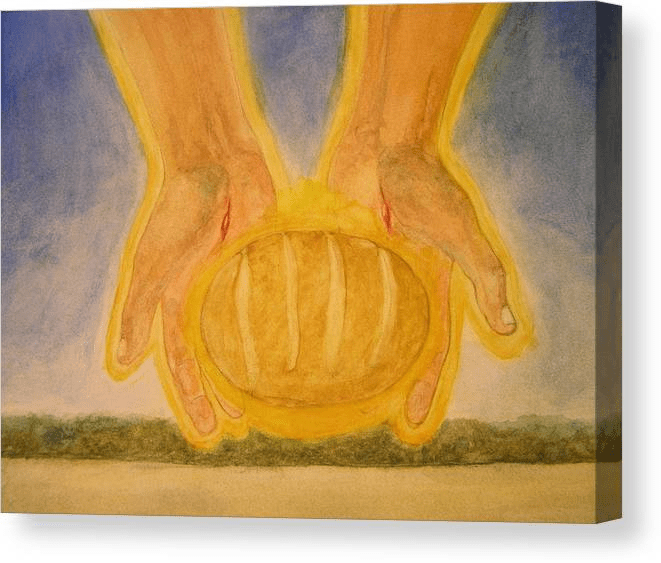
Bread From Heaven, by Nigel Wynter

On the seventh day some people went out to gather food, but they didn’t find any. The Lord said to Moses, “How long will you refuse to do what I have commanded and instructed you to do? Remember: The Lord has given you this day of rest as a holy day. That’s why he gives you enough food on the sixth day for two days. On the seventh day stay in your place—no one is to go out. Everyone, stay where you are.” So the people never worked on the seventh day of the week.

The Israelites called the food manna. It was like coriander seeds. It was white and tasted like wafers made with honey.

Moses said, “This is what the Lord has commanded: Take two quarts of manna to be kept for your descendants. This way they will see the food that I gave you to eat in the desert when I brought you out of Egypt.”

Moses said to Aaron, “Take a jar, put two quarts of manna in it, and put it in the Lord’s presence to be kept for your descendants.” Aaron put the jar of manna in front of the words of God’s promise to be kept there, as the Lord commanded Moses.

The Israelites ate manna for 40 years until they came to a place to settle. They ate manna until they came to the border of Canaan. (God’s Word Translation)

“What is it?” is the quite literal meaning of the word manna. And the answer is: It is bread from heaven.

The manna was food for the Israelite people in their 40 years of sojourning through the desert. There is also an implicit question surrounding this bread: What to do with it? Well, of course, you eat it. But, before eating it, there are issues and instructions about the manna’s arrival and collection.

The special food, only graciously given to this particular group of cantankerous people, appeared in the mornings for six days a week, not seven, and only had a shelf life of one day, with the exception of the singular Sabbath day each week.

There is a time to go out and gather, and there is a time to stay put and eat; a time to work, and a time to rest. The lack of wisdom in timing could cost you not only a meal, but also your overall sense of paying attention to God’s commands.

It is the fool who spurns the relationship between events, that is, the space between when the Lord speaks and when humanity responds. Our human responsibility is dependent upon Divine sovereignty. Ignoring the voice of God, or simply failing to listen out of present anxieties or fears, will nearly always result in a skewed response-ability.

Yes, indeed, we all have very legitimate needs for cuisine, clothing, companionship, care, and compassion. If these vital needs go unmet, we are undone and shall die. Yet, there is also the question of how we will go about getting those very important and basic needs met – and many people, having not listened well to the instructions about life, will go about attempting to meet those needs in illegitimate ways.

Trying to satisfy legitimate needs through illegitimate means ends up eroding the soul, compromising character, and searing the conscience. It’s inevitable that such a person will grumble and complain, projecting on God the evil that is, in reality, residing within the human heart.

Whenever folks go out and try to gather what isn’t there, they have lost their way and their very real needs will not really be met, at all.

This is why humans need remembrances – to have reminders of what time it is and what’s important to do and not do, to seek the appropriate paths of living well, and to avoid the pitfalls of dead end trails.

One purpose of Sabbath is to remember – to recall the great story of deliverance and never forget where we came from, so that we will continually have before us where we are going.

I Am the Bread of Life, by Joseph Matar

The Christian remembers the saving and redemptive events of Jesus by coming to the Table. We gather together to ingest bread from heaven, to partake of the Bread of Life. For those who choose to carefully listen and pay attention, the words of Christ will not only speak life into our weary selves, but shall also shape how we go about getting our needs met and satisfied:

The people began to murmur in disagreement because he had said, “I am the bread that came down from heaven….”

But Jesus replied, “Stop complaining about what I said. For no one can come to me unless the Father who sent me draws them to me, and at the last day I will raise them up. As it is written in the Scriptures, ‘They will all be taught by God.’ Everyone who listens to the Father and learns from him comes to me….

“I tell you the truth, anyone who believes has eternal life. Yes, I am the bread of life! Your ancestors ate manna in the wilderness, but they all died. Anyone who eats the bread from heaven, however, will never die. I am the living bread that came down from heaven. Anyone who eats this bread will live forever; and this bread, which I will offer so the world may live, is my flesh.”

Then the people began arguing with each other about what he meant. “How can this man give us his flesh to eat?” they asked.

So Jesus said again, “I tell you the truth, unless you eat the flesh of the Son of Man and drink his blood, you cannot have eternal life within you. But anyone who eats my flesh and drinks my blood has eternal life, and I will raise that person at the last day. For my flesh is true food, and my blood is true drink. Anyone who eats my flesh and drinks my blood remains in me, and I in him. I live because of the living Father who sent me; in the same way, anyone who feeds on me will live because of me. I am the true bread that came down from heaven. Anyone who eats this bread will not die as your ancestors did (even though they ate the manna) but will live forever.” (John 6:41-58, NLT)

Consider well, then, where and how you will find the sustenance of the soul, love, and in what ways you will listen to the words of Jesus and gather them for your next meal. Will you hoard your heaven-sent food, or will you share?

O God, our Provider and Sustainer, we who are many are one body in Christ, for we all share in the one bread. Refresh, strengthen, and preserve us as we journey in this life, in the name of Jesus Christ. Amen.

Spiritual Dementia (Deuteronomy 30:1-9)

Now, once all these things happen to you, the blessing and the curse that I’m setting before you, you must call them to mind as you sit among the various nations where the Lord your God has driven you; and you must return to the Lord your God, obeying his voice, in line with all that I’m commanding you right now—you and your children—with all your mind and with all your being. 

Then the Lord your God will restore you as you were before and will have compassion on you, gathering you up from all the peoples where the Lord your God scattered you. Even if he has driven you to the far end of heaven, the Lord your God will gather you up from there; he will take you back from there. 

The Lord your God will bring you home to the land that your ancestors possessed; you will possess it again. And he will do good things for you and multiply you—making you more numerous even than your ancestors!

Then the Lord your God will circumcise your hearts and the hearts of your descendants so that you love the Lord your God with all your mind and with all your being in order that you may live. 

The Lord your God will put all these curses on your enemies and on those who hate you and chase you. But you will change and obey the Lord’s voice and do all his commandments that I’m commanding you right now. 

The Lord your God will help you succeed in everything you do—in your own fertility, your livestock’s offspring, and your land’s produce—everything will be great! Because the Lord will once again enjoy doing good things for you just as he enjoyed doing them for your ancestors. (Common English Bible)

The mind is a vast, glorious, and (un)explored territory. Although there is much we know about it, there’s even more we don’t know about the human mind.

The mind can be both a blessing and a curse. Anyone with depression, anxiety, or other mental disorders and diseases can tell you that, especially family members who have loved ones with dementia.

Dementia is a general term for a decline in mental ability severe enough to interfere with daily life. Professionally, I visit patients with dementia nearly every day. Personally, I watched my own mother’s faculties slowly erode and decline in the last few years of her life. In her final months, my Mom rarely remembered my name, only knew me once in a while, and never recalled the conversation we had thirty seconds ago. It was difficult to watch, this woman who once cared for me, needing to be cared for.

The biblical book of Deuteronomy is the retelling of Israel’s story as they were about to enter the Promised Land. It’s a book completely dedicated to memory care. If the people were to forget who they are, they would not know what they’re supposed to be doing. The Israelites strayed from the blessings into the curses of God’s covenant life because their collective mind slowly slipped into spiritual dementia.

The mind’s need to remember is not a new issue; it’s endemic to the human condition. The constant refrain of the author of Deuteronomy is to recall and to remember where the people came from, where they are going, and why. 

Moses reiterated the covenant and the law for the people before they entered the land. It was a fresh re-hashing, nothing really new, of what God had already communicated to them. God’s people were to remember that they were once slaves in Egypt and that God had delivered to be a people for his name. They were not to forget that they had provoked the Lord in the desert – with the result of an entire generation of people being lost because they had neglected and forgotten what God told them.

Memory issues continue into the Gospels. Jesus miraculously fed a great crowd of people not once, but twice. The second time, he called his disciples to remember what had happened the first time in order to understand the second. 

In the New Testament Epistles, Paul kept reminding the Jews in the churches that they should remember the ancient covenant, and called the Gentiles to remember that they were once estranged from that very same covenant. Both Jew and Gentile together needed to collectively remember the death of Christ that united them into a new covenant community. Like them, we are to “Remember Jesus Christ, raised from the dead, descended from David.” (2 Timothy 2:8)

Like the ancient Israelites, Christians are to remember who they are and what they are about: blood-bought people of God, belonging to Christ, and given a mission to make disciples and participate with God in the redemption of all creation through remembering the poor, seeking justice, and being peacemakers in the church and the world. 

Think about where you have fallen from, and then turn back and do as you did at first. (Revelation 2:5, CEV)

There’s a difference between the disease of dementia and the church’s spiritual dementia. Folks inflicted with dementia will not recover but only worsen, whereas the church can recover its collective memory by listening again to the ancient Word of God and being constantly refreshed with the promises and covenant of God.

  • Why do you and the church exist? 
  • How do God’s words inform and influence your identity? 
  • Does the mission and practice of your church intentionally remember the risen and ascended Christ? 
  • Are disciples being formed around collective remembering of God’s covenant and promises? 
  • Are ministries, spiritual practices, and policies being established based on Christ and his commission, or on something else? 

Let’s continually work through answers to those questions so that we are not cursed but blessed, and continually built up in the faith.

May the Lord bless you and keep you.
May the Lord show you his kindness
    and have mercy on you.
May the Lord watch over you
    and give you peace. Amen.