Trust vs. Trickery (Genesis 30:25-36)

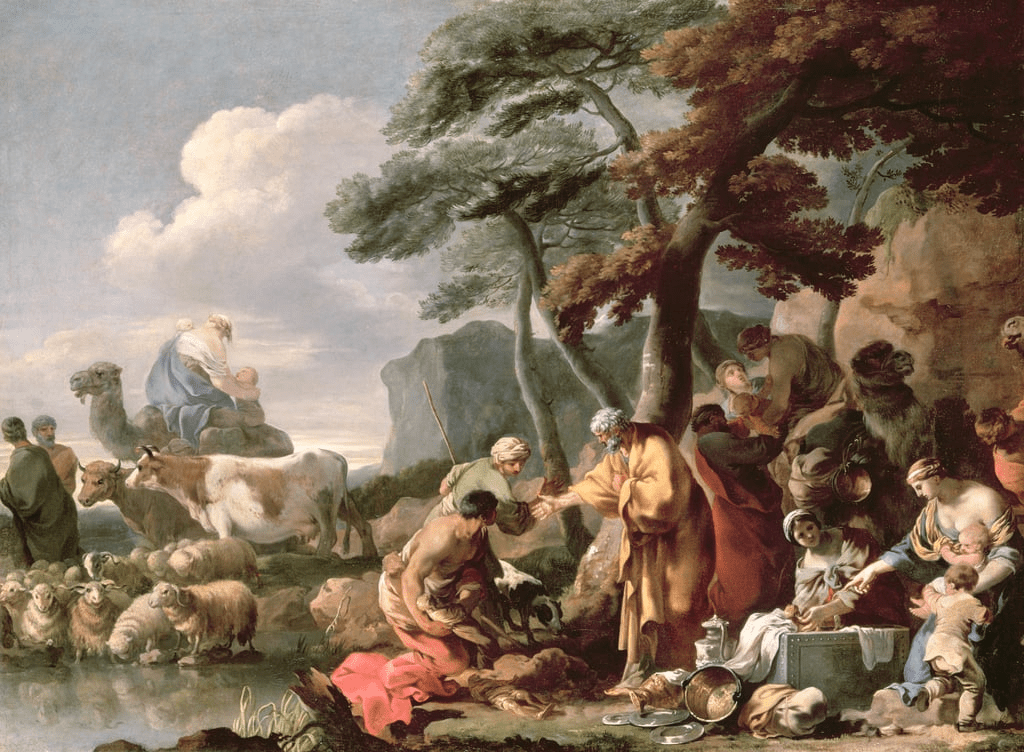
Jacob and Laban, by Pietro da Cortona (1596-1669)

After Joseph was born, Jacob said to Laban, “Release me from our agreement and let me return to my own country. You know how hard I’ve worked for you, so let me take my wives and children and leave.”

But Laban told him, “If you really are my friend, stay on, and I’ll pay whatever you ask. I’m sure the Lord has blessed me because of you.”

Jacob answered:

You’ve seen how hard I’ve worked for you, and you know how your flocks and herds have grown under my care. You didn’t have much before I came, but the Lord has blessed everything I have ever done for you. Now it’s time for me to start looking out for my own family.

“How much do you want me to pay you?” Laban asked.

Then Jacob told him:

I don’t want you to pay me anything. Just do one thing, and I’ll take care of your sheep and goats. Let me go through your flocks and herds and take the sheep and goats that are either spotted or speckled and the black lambs. That’s all you need to give me. In the future you can easily find out if I’ve been honest. Just look and see if my animals are either spotted or speckled, or if the lambs are black. If they aren’t, they’ve been stolen from you.

“I agree to that,” was Laban’s response. Before the end of the day, Laban had separated his spotted and speckled animals and the black lambs from the others and had put his sons in charge of them. Then Laban made Jacob keep the rest of the sheep and goats at a distance of three days’ journey. (Contemporary English Version)

Jacob left home by himself and went to his mother’s family. After twenty years away, he had two wives and twelve sons by four different women. He had worked for his father-in-law Laban for all that time – all to Laban’s advantage. During those twenty years, there was plenty of complicated and awkward family drama.

Now Jacob was ready to be done with all that. He wanted to move on and go back to the place of his family origin. But, of course, Laban had a good thing going and did not want Jacob to leave. So, he did his best to convince him to stay. Jacob was able to set his own terms. And there was some space put between his burgeoning family and his in-law’s.

But returning is a lot more difficult than leaving. When I left home as a young man I had all my worldly possessions in a ’74 Chevy Vega. And when I returned to the land of my origins, it was in a large rental truck with a wife a three kids. There was a lot of logistics involved, not to mention all the relationships we left.

For twenty years, Jacob and Laban did a weird relational dance. They were both tricky dudes, and were continually attempting to maneuver and outmaneuver the other. Yet, Jacob mostly got the brunt of unfairness.

In reality, Jacob owed Laban nothing. He had agreed to work for him fourteen years in total. But he could take nothing with him except his family – which would leave him with no means of support. And Laban was not about to give his son-in-law any support outside of his fatherly-in-law control.

Jacob came up with a strange set of terms concerning the flocks of sheep. Laban logically calculates that Jacob is unlikely to gain much profit from the plan, and can still keep the status quo going. So it becomes a done deal.

In a typical relational dynamic which they have become accustomed to, Laban himself sorts the flock, removes all the spotted and speckled sheep to a safe distance, and leaves Jacob with the rest.

So, if Jacob is to acquire any flock of his own, he needs to discover a way of breeding multicolored sheep from monochrome ones – a task which seems to be improbable if not impossible. But that’s exactly what Jacob does in the end, and that is yet the subject of another Old Testament lesson….

So, exactly what is today’s lesson? Life is anything but a nice, neat trajectory upwards toward achieving goals. Rather, life is a series of twists and turns, leading us to often take three steps forward and two steps backward in a herky-jerky sort of journey. Yet, behind it all, the Lord’s promises are still there, still in effect, still being worked out, in order to be fully realized. Nothing and no one is going to derail the plans and purposes of God.

Sometimes we need to be reminded that God is the giver of prosperity, and not anyone or anything else.

When you become successful, don’t say, “I’m rich, and I’ve earned it all myself.” Instead, remember that the Lord your God gives you the strength to make a living. That’s how he keeps the promise he made to your ancestors. (Deuteronomy 8:17-18, CEV)

To the person who pleases him, God gives wisdom, knowledge and happiness, but to the sinner he gives the task of gathering and storing up wealth to hand it over to the one who pleases God. (Ecclesiastes 2:26, NIV)

If any of you lacks wisdom, you should ask God, who gives generously to all without finding fault, and it will be given to you. (James 1:5, NIV)

We may, at times, feel the need to acquire what we want through trickery or manipulation. However, there is a God in heaven who sees and who cares. The Lord delights is being generous and giving to us, that is, if we are aware and attentive enough to ask. We might not get what we want immediately, and it likely won’t be easy, but we shall nonetheless receive it. We only need to trust.

Heavenly Father, source of all life, we thank you for the many ways in which you have blessed and enriched our lives: Keep us from possessiveness and greed, and lead us into the greater joy of sharing your gifts with others, through Jesus Christ, in whom is perfect peace. Amen.


Family Drama (Genesis 29:15-28)

Jacob works to gain Rachel’s hand, 5th century mosaic, Basilica of Santa Maria Maggiore, Rome

Laban said to him [Jacob] “Just because you are a relative of mine, should you work for me for nothing? Tell me what your wages should be.”

Now Laban had two daughters; the name of the older was Leah, and the name of the younger was Rachel. Leah had weak eyes, but Rachel had a lovely figure and was beautiful. Jacob was in love with Rachel and said, “I’ll work for you seven years in return for your younger daughter Rachel.”

Laban said, “It’s better that I give her to you than to some other man. Stay here with me.” So Jacob served seven years to get Rachel, but they seemed like only a few days to him because of his love for her.

Then Jacob said to Laban, “Give me my wife. My time is completed, and I want to make love to her.”

So Laban brought together all the people of the place and gave a feast. But when evening came, he took his daughter Leah and brought her to Jacob, and Jacob made love to her. And Laban gave his servant Zilpah to his daughter as her attendant.

When morning came, there was Leah! So Jacob said to Laban, “What is this you have done to me? I served you for Rachel, didn’t I? Why have you deceived me?”

Laban replied, “It is not our custom here to give the younger daughter in marriage before the older one. Finish this daughter’s bridal week; then we will give you the younger one also, in return for another seven years of work.”

And Jacob did so. He finished the week with Leah, and then Laban gave him his daughter Rachel to be his wife. (New International Version)

There’s no drama quite like family drama. Love and hate, unity and inequality, privileged and powerless, gender and patriarchy, altruism and selfishness, all combine for a strange brew we call “family.” It seems you can’t live with them, or without them.

In a love story for the ages, the lonely Jacob meets the lovely Rachel. It was a divine appointment, and quite literally, a match made in heaven. (Genesis 29:1-14)

Although the romance appears to lead to a happy and better days, it is anything but. The family dynamics are at play, and it leads to plenty of dysfunctional stuff. Just as Jacob the deceiver successfully wrangled a blessing away from his brother for himself, Rachel’s father Laban did his own bit of deception.

Having promised Rachel to Jacob, the elder daughter Leah replaces her sister and is found in the marriage bed in the morning after the wedding. Oy! It was Laban’s doing. He had Jacob over a barrel.

The whole situation ended up creating an unhealthy competition between the two sisters for the affection of their husband. So much for living happily ever after.

A lot of this story exposes the gap between the ancient biblical world and our own contemporary cultural context. The patriarchal and tribal society within the book of Genesis assumes that marriage is first and foremost an alliance between men involving the exchange of women. This is anything but a commitment between individuals intending to share their lives together. Laban and Jacob work out the marriage price of seven years of labor without any consultation of the bride(s)-to-be.

What’s more, polygamy seems a given. We get no objections to multiple women being married to one man. And this is typically how Old Testament narratives work – they give us the story, without moral comment, and let that story speak for itself about the ethics involved. The consequences to the decisions and actions are meant to demonstrate the morality or immorality of it all.

There remains, however, a tender love story inside all the drama. Despite all the deceit and masculine posturing for position, Jacob was madly in love with Rachel and would do anything for her – including working fourteen years in unjust conditions.

As in most family affairs, all of this is terribly complicated. Jacob’s singular love for Rachel, and Laban’s finagling, strands the older sister Leah in a loveless marriage. Even with God’s enablement of giving Leah many children, the tragedy of the family drama continued. Rachel envied her elder sister’s fertility, as she herself desperately tried to conceive. It’s all a quite convoluted way to realizing the blessing of God to Abraham’s descendants.

The casual introduction of servant women in this narrative raises all sorts of issues concerning social class, slave and domestic labor, and reproductive rights – not to mention such realities as sexual trafficking and abuse with which we still wrestle in the twenty-first century.

Despite the distance between the ancient world and our own, we have a lot in common with people of the past. We are far from perfect. Families are messy and often broken. We hurt each other intentionally and unintentionally. We act in our own best interest and against the greater good of others. We forget to ask those with less power about decisions that impact their lives.

To look in on this family reality show in Genesis is to look straight into human brokenness. And yet, through all of Jacob’s family drama, God’s purposes were advanced. Jacob had been promised he would have a multitude of descendants, and it was through the unloved Leah and her servant Zilpah that eight of the twelve tribes of Israel trace their descent.

Even the deceitfulness of Laban and Jacob cannot stand in the way of God’s purposes. Human sin may delay the realization of God’s promises, but our human foibles shall never overrule the sovereignty and providence of God’s good plans for humanity.

God of compassion, whose Son Jesus Christ, the child of Mary, shared the life of a home in Nazareth, and on the cross drew the whole human family to himself: Have mercy on us all, especially on our families of origin and all the various family situations we find ourselves within.

Strengthen us in our daily living, so that in joy and in sorrow we may know the power of your presence to bind together and to heal, through Jesus Christ our Lord, the power of the Holy Spirit. Amen.

Communicate with Clarity and Care (Genesis 35:1-4)

Jacob burying the false gods under the oak by Shechem, by Sébastien Bourdon (1616-1671)

Then God said to Jacob, “Go to Bethel and live there. Make an altar there. I am the God who appeared to you when you were fleeing from your brother Esau.”

So Jacob said to his family and those who were with him, “Get rid of the foreign gods which you have, wash yourselves until you are ritually clean, and change your clothes. Then let’s go to Bethel. I will make an altar there to God, who answered me when I was troubled and who has been with me wherever I’ve gone.” So they gave Jacob all the foreign gods that they had in their possession as well as the earrings that they had on. Jacob buried these things under the oak tree near Shechem. (God’s Word Translation)

Christianity has existed for 2,000 years; Judaism for 4,000 years or more. That’s a long time. On the one hand, this is a tremendous legacy of faith, grounded in several millennia of solid religious tradition. And on the other hand, something existing for so long is bound to accumulate some barnacles that get encrusted on the faith.

And if those barnacles are there for too long, it becomes assumed that they’re just part of the ship of faith. But they’re not; they need to be removed so we can see the real thing and move through life unencumbered and not dragged by extraneous stuff.

The familiar, over time, is taken for granted. And when that happens, we lose sight of what is most important, of what is most needed.

God helped Jacob – the son of Isaac, the son of Abraham – to reconnect with a seminal experience from earlier in his life. That experience was a vison of God, and an assurance that God was with Jacob. He was not alone.

But, years later, after accumulating two wives, twelve sons, and many flocks of sheep and other animals, it was time to move and make a home and an altar elsewhere. Instead of taking the Lord for granted, and forgetting the difficulties of the past, God intervened and called the whole crew to go and live in another place.

The communication from God brought Jacob to a spiritual place of realizing what had happened over the years; slowly and perhaps imperceptibly, the barnacles of idolatry had become encrusted amongst his family. And they were obstacles which needed to be jettisoned before they could move on.

Jacob needed to hear from God. Jacob’s family needed to hear from him. And that communication had to be a helpful way of scraping the barnacles off from decades of misplaced living.

Our world today is marked by unfeeling meanness to strangers, a profound lack of empathy, respect, and basic human kindness toward one another. Individuals, groups, communities, and entire nations don’t know how to talk to each other in a way that is helpful and life-giving.

We need a process which helps us have a way of being with others that is compassionate. It is imperative that we have communication that guides us in both expressing ourselves and listening to others. And that process must focus on what we are observing, feeling, and needing.

It is essential that humanity creates deeper personal relationships and maintains them. If not, we will be overcome by the barnacles of suspicion, hate, distrust of others, as well as distance from God.

Unless we are with each other in helpful ways, we will devolve into judgmental and critical speech directed toward others or even ourselves. Violent words are the main obstacle to having compassion on others.

Comparisons and classifications of people, denial of responsibility for words and behaviors, and making demands, leads to estranged relationships. Instead, we can do better. We can be with one another and talk to each other by communicating observations, feelings, needs, and requests.

Observation

  • Observe, rather than evaluate. Whenever we observe something, and then quickly evaluate it, the other person will tend to hear criticism and resist what we are saying.
  • Be specific, not general. It’s helpful to make a specific observation instead of a general one. For example, God was specific about what Jacob was to do. And Jacob was quite specific about the situation of idolatry and what to do about it before the family could move to Bethel.

Feeling

  • Acknowledge and express your emotion. Clearly and specifically identify and name your emotions because this is the way we connect more easily with others. Jacob told his family of feeling troubled in the past and that God helped him deal with it.
  • Be vulnerable. Expressing our feelings can help resolve conflicts. The old adage is true: People don’t care how much you know until they know how much you care.

Need

  • What do you need? Take responsibility for your feelings. Connect your feeling with your need. Jacob was devoted to God because his emotions were tethered with how God had met his needs throughout his life.
  • Others do not cause our feelings, and they are not responsible for our emotions. Jacob’s family did exactly what Jacob told them to do – and did not buck him or resist him – mainly because he let them know how he was feeling, and why he was telling them to rid themselves of idols and move on with him to Bethel.
  • Listen to yourself. Judgments of others are projections of our own unmet needs; and conversely, being kind to ourselves, listening to our thoughts, and paying attention to how we carry stress in our bodies, allows us to be helpful to others and present to them in whatever they are going through.
  • We are not responsible for other people’s feelings. We can never meet our own needs by trying to make others feel guilt or shame.

Request

  • Ask for what you need and want. We honor ourselves by making requests in clear, positive, and concrete language of what we really need. The clearer we are about what we want, the more likely it is that we’ll get it.
  • The message we send is not always the message which is received by another. Be clear about the response you want so that there is no confusion about what we truly need.

The objective of communication is not to change people and their behavior in order to get our way. Rather, it is to establish relationships based on honesty and empathy that will eventually fulfill everyone’s needs.

There is a need to express honestly and clearly our observations, feelings, needs, and requests, as well as receive another’s communication with focused attention and empathy.

So then, how we talk to and about God, and how we talk to ourselves, becomes a template for how we talk to others. A lack of clear communication is a surefire way of allowing the barnacles of displeasure and disappointment to attach to our souls.

However, clear communication is life-giving and even lifesaving. It’s worth putting significant effort into it.

Blessed Lord, in your infinite wisdom, you created us with the gift of communication. May we use this gift to foster love, understanding, and unity amongst ourselves and with you.

Guide our hearts to speak words of kindness and encouragement. May our tongues be instruments of love, grace and compassion to those around us.

Open our ears, so that we may truly listen and understand the needs and desires of our fellow humanity. Grant us the patience to hear their stories and the wisdom to respond with love and empathy.

Enlighten our minds to be clear and thoughtful in our affect and speech. As we share our thoughts and ideas, may we be ever mindful of your presence, seeking your holy and good will in all we say and do.

Fill our conversations with honesty and vulnerability. May we find the strength and courage to speak our truth while always remaining respectful and considerate of the feelings of others.

Bind us together in unity and love through our shared communication. May our words build bridges and forge bonds that reflect your divine love and mercy. Amen.

The Truth About You (John 8:21-30)

Once more Jesus said to them, “I am going away, and you will look for me, and you will die in your sin. Where I go, you cannot come.”

This made the Jews ask, “Will he kill himself? Is that why he says, ‘Where I go, you cannot come’?”

But he continued, “You are from below; I am from above. You are of this world; I am not of this world. I told you that you would die in your sins; if you do not believe that I am he, you will indeed die in your sins.”

“Who are you?” they asked.

“Just what I have been telling you from the beginning,” Jesus replied. “I have much to say in judgment of you. But he who sent me is trustworthy, and what I have heard from him I tell the world.”

They did not understand that he was telling them about his Father. So Jesus said, “When you have lifted up the Son of Man, then you will know that I am he and that I do nothing on my own but speak just what the Father has taught me. The one who sent me is with me; he has not left me alone, for I always do what pleases him.” Even as he spoke, many believed in him. (New International Version)

Jesus was an interesting guy – both cagey and confrontational at the same time. He had a way (the way, in fact) that left those who longed for mercy and encouragement to receive it, while also giving rebuke to those satisfied with being stuck in their misguided lives.

This made Christ one of those persons whom you either loved or hated. The people that loved him, adored him; and those that hated him, sought to kill him.

It’s really a matter of self-perception. The ones who tend to self-loathe and wonder if they’re accepted, or not, are the ones who feel on the outside. These are the folks who discover themselves on the inside, accepted by God. And Jesus made it happen for them.

On the other hand, the ones who are enamored with themselves and their superior religion, looking down at others and feeling secure as insiders, are the people who will find they’re actually on the outside looking in; indeed, they will die in their self-delusion.

Our self-identification matters. If identity is tied to what we’re able to do for God, and/or how pious we look for others to see, then our inflated egos will eventually be popped with the pinprick of divine judgment. But if identity is tethered to belonging to God by divine grace and mercy, then we shall know true acceptance.

We need to know the truth about ourselves. Both truth and error are powerful. If we have misguided notions of self, we are like empty wells with no water to draw from. Many of our problems, failures, and shame are largely due to a misunderstanding of the kind of person we are. 

A profound result of this misunderstanding is a lack of self-worth. When we are in error about who we really are, we are severely limited in what we can do in our lives. We can neither solve the problem by comparing ourselves with others nor by trying to generate good feelings about ourselves. Only through accepting what the Holy Scriptures say about us, and responding in faith, can we be truly helped.

So, here are some bedrock truths about us:

  1. We are created in the image and likeness of God. (Genesis 1:16-17)  We begin to understand ourselves by beginning with the creation of the world. Since God is a Person of infinite perfection and goodness, to be created in God’s image means we are persons of great potential and value.
  2. We are special to God. The Lord treats us as persons; therefore, we may not treat ourselves any less than that. To be a person means that we are self-conscious and can make decisions. We also have inherent rights to know, to be heard, to feel, to have an opinion, to be honored, to develop potential, to assume responsibility, and to enjoy life and all creation.
  3. We are loved by God (John 15:9; 17:23) God recognizes us as persons, gives us our rightful place in the divine life, and will do what is right by us. In other words, God has our back. The Lord will not gaslight us.
  4. We are called to a relationship with the loving God (1 Corinthians 1:9) No greater honor could be bestowed on us than to be invited to interact with the Living God. As we do, the door is open so God can minister to us and lead us into the knowledge and practice of a good life.
  5. We are the recipients of divine revelation (Hebrews 1:1-3) Having the Holy Scriptures available to us is the greatest possession we could ever receive. There is nothing more powerful than the truth about God and God’s design for our daily life. Therefore, we commit a profound sin when we neglect and disobey what God has so graciously given us.
  6. We are the objects of divine redemption (Romans 5:8-9) The great evidence of our human worth is the reality that Jesus Christ has secured our redemption from sin, death, and hell. Jesus, the Son of God, has loved us and gave himself for us. (Galatians 2:20)
  7. We are the temple of the Holy Spirit (1 Corinthians 6:19-20) The actual physical temple of the Old Testament was filled with the glory of God. Today, through Christ’s redeeming love on the cross, every believer in Jesus is God’s temple. Therefore, God wants to work in us and through us for to bless and serve the world.

The conclusion to the matter is that the only way we will know true self-worth is to accept what God says about us and respond by faith and love to this loving and redeeming message. You are a person of infinite worth to God, so live into this wonderful truth.

Gracious Creator, blessed all-knowing God, be merciful to upgrade my opinion of myself and my vision for the future so I never feel the need to protect and preserve the past. Show me how to be a faithful steward of the greatness you have placed within me.

Loving Lord, you know everything about me and love me anyway! As I accept and experience your grace and mercy, help me to grasp the depth and perfection of your love as demonstrated by the sacrifice of your only Son, Jesus Christ my Lord, who with you and the Holy Spirit are one God, now and forever. Amen.