Receive the Blessing (Genesis 48:8-19)

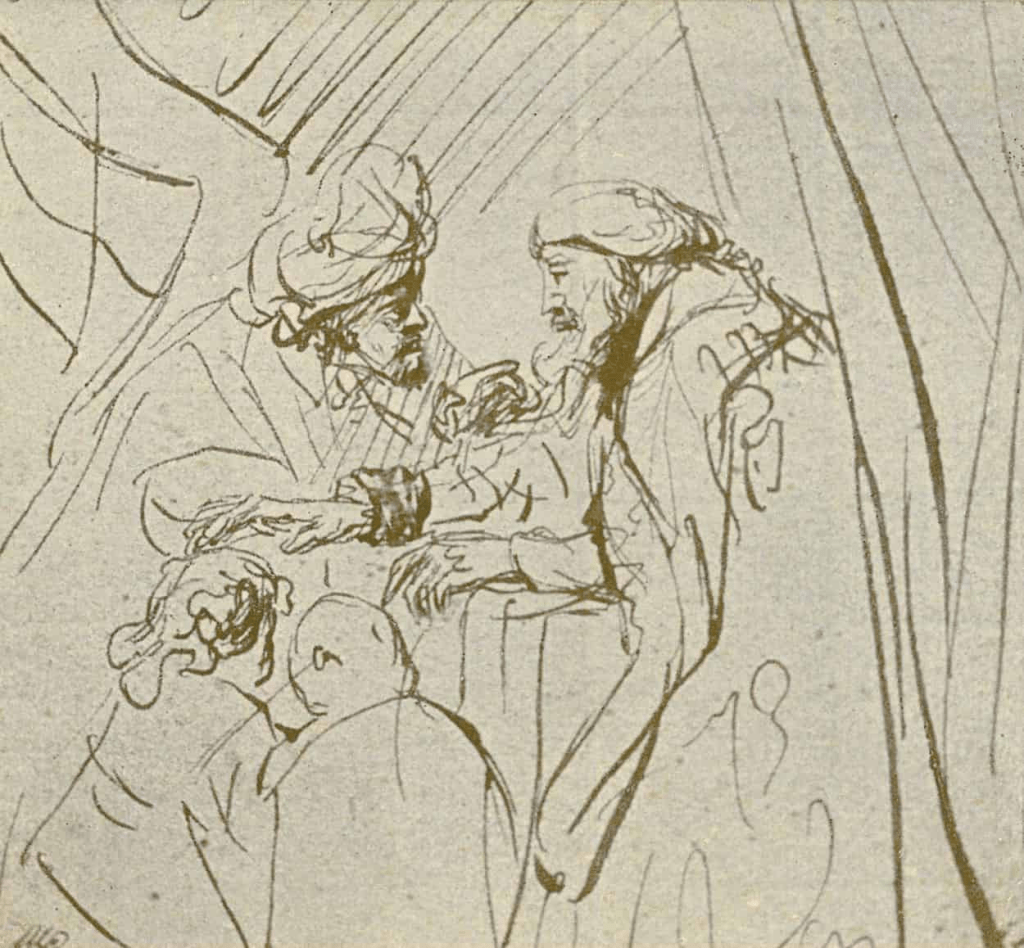
Jacob Blessing Ephraim and Manasseh, by Rembrandt van Rijn (1606-1669)

When Israel saw the sons of Joseph, he asked, “Who are these?”

“They are the sons God has given me here,” Joseph said to his father.

Then Israel said, “Bring them to me so I may bless them.”

Now Israel’s eyes were failing because of old age, and he could hardly see. So Joseph brought his sons close to him, and his father kissed them and embraced them.

Israel said to Joseph, “I never expected to see your face again, and now God has allowed me to see your children too.”

Then Joseph removed them from Israel’s knees and bowed down with his face to the ground. And Joseph took both of them, Ephraim on his right toward Israel’s left hand and Manasseh on his left toward Israel’s right hand, and brought them close to him. But Israel reached out his right hand and put it on Ephraim’s head, though he was the younger, and crossing his arms, he put his left hand on Manasseh’s head, even though Manasseh was the firstborn.

Then he blessed Joseph and said,

“May the God before whom my fathers,
    Abraham and Isaac, walked faithfully,
the God who has been my shepherd
    all my life to this day,
the Angel who has delivered me from all harm
    —may he bless these boys.
May they be called by my name
    and the names of my fathers, Abraham and Isaac,
and may they increase greatly
    on the earth.”

When Joseph saw his father placing his right hand on Ephraim’s head he was displeased; so he took hold of his father’s hand to move it from Ephraim’s head to Manasseh’s head. Joseph said to him, “No, my father, this one is the firstborn; put your right hand on his head.”

But his father refused and said, “I know, my son, I know. He too will become a people, and he too will become great. Nevertheless, his younger brother will be greater than he, and his descendants will become a group of nations.” (New International Version)

Jacob Blessing Ephraim and Manasseh, by Frederick Pickersgill (1820-1900)

Jacob (Israel) was on his deathbed. His son, Joseph, was in charge of all Egypt. Jacob had Joseph bring his two sons to him so that he could bless them. Joseph fully expected that his father would follow the convention of primogeniture, that is, the elder son receives a double inheritance. But that is not what happened. Jacob purposely went against normal convention.

It was not, however, against biblical convention. In the stories of Ishmael and Isaac, Esau and Jacob, the rights of the first-born are superseded by the promises of the next-born.

Family rules, ethnic customs, and cultural procedures are fine. Yet, when those practices become inflexible laws which are never to be different, then we get into trouble. Joseph had an expectation of how the blessing of his sons was to go. Jacob had another idea about it.

“We’ve never done it that way before,” are the seven last words of any institution. Any group organized around that belief is doomed. If we cannot make a distinction between the letter and the spirit of a law, rule, or custom, then our inflexibility will eventually break us.

In the ancient world, and even in many cultures today, birth order determines how things go with families, societal rights, and personal obligations. The firstborn occupies an esteemed position. In Judaism, when the temple still stood, the first fruits and firstborn of animals were considered the best sacrifices.

By blessing the younger son, and going against expected convention, Jacob taught future generations a valuable lesson: A person’s actions and character matter more than birth order. What’s more, being blessed first or last or whenever is not what guarantees future success.

Jacob had firsthand knowledge and experience that life is unpredictable and requires faith in God. One’s life cannot be projected and determined along an upward linear trajectory. We cannot predict what will happen in our lives by laying things out with Cartesian coordinates. Ultimate control belongs to God, not us. And that’s a good thing, because the Lord is good, all the time.

Our Lord, everything you do
    is kind and thoughtful,
and you are near to everyone
    whose prayers are sincere.
You satisfy the desires
    of all your worshipers,
and you come to save them
    when they ask for help.
You take care of everyone
who loves you,
    but you destroy the wicked. (Psalm 145:17-20, CEV)

It’s best to trust in pure goodness than to rely upon human ingenuity. Abraham – who was not a firstborn son, but the youngest of three – received the call from God to receive blessing. Isaac inherited the birthright over his older half-brother Ishmael. Jacob himself received the birthright over his older twin brother Esau. And Joseph, next to the youngest in a long line of sons from Jacob, was the clear head of the clan.

In matters of human faith and divine promises, birth order and typical cultural mores don’t apply. More important is fidelity to God, concern for one’s fellow humanity, and upholding love for the family. And it is these very things that are important going forward. Inevitably, suffering comes. And when it does, birth order, primogeniture, and societal expectations aren’t going to get you through it.

It is likely that the main reason why some folks embrace the adage “we’ve never done it that way before” is because of fear. Doing the same thing over and over again, even if it isn’t helpful anymore or is useless in a particular situation, still feels normal and secure. Moving out in faith is scary; we don’t really know how things are going to shake out.

This is why our concept and understanding of God is so crucial. A good God acts on our best interests and does not act with malevolence toward us.

I prayed to the Lord, and he answered me;
    he freed me from all my fears.
The oppressed look to him and are glad;
    they will never be disappointed. (Psalm 34:4-5, GNT)

Only obeying the letter of the law leads to fear. Only acknowledging the spirit of the law results in bondage. Only by observing both the letter and the spirit of the law will we experience freedom from fear and deliverance from anxious striving for blessing.

Blessing is given freely by the God who delights in doing so. Let the Lord bless you in the ways God wants to do so.

May God have mercy on you, bless you, and show you kindness, today and every day. And may the grace of the Lord Jesus, the love of God the Father, and the encouragement of the Holy Spirit be with you, now and forever. Amen. 

Jesus the Mentor (Mark 3:13-19)

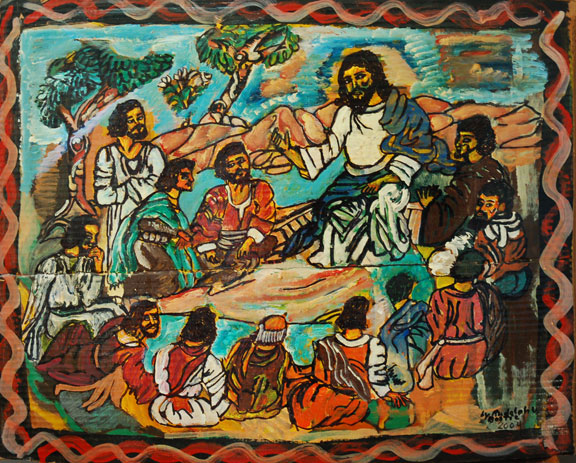
Jesus and the Disciples, by Rudolph Bostic

Jesus went up on a mountainside and called to him those he wanted, and they came to him. He appointed twelve that they might be with him and that he might send them out to preachand to have authority to drive out demons. These are the twelve he appointed: Simon (to whom he gave the name Peter), James son of Zebedee and his brother John (to them he gave the name Boanerges, which means “sons of thunder”), Andrew, Philip, Bartholomew, Matthew, Thomas, James son of Alphaeus, Thaddaeus, Simon the Zealotand Judas Iscariot, who betrayed him. (New International Version)

For me, every place in Holy Scripture is significant, even the seemingly mundane portions of it. Today’s verses might appear rather insignificant. However, there is some important meaning to recording who Christ called as his disciples and why he did it.

Jesus appointed twelve Jewish men to be his close disciples, his apostles. In choosing them, let’s not read into it something that isn’t there. This choosing, in no way, is meant to convey that church leadership boards are always supposed to have twelve men. It seems to me, that if such churches believe this, they ought to go all the way by insisting that they ought also to be Jewish Christians – no Gentiles on the election ballot at the annual meeting!

Excluding women, maintaining a particular number of people to a group, or considering only one ethnicity to leadership is nowhere to be interpreted in this text of Scripture. I can imagine Jesus sitting at the right hand of the Father raising a Spock-like eyebrow to such hermeneutical gymnastics and stating the lone word, “fascinating!”

A disciple is a follower. An apostle is one who is sent out with a specific purpose. Jesus called these particular people in order to send them out with a mission. In other words, Christ’s disciples are really missionaries. And these apostles, these missionaries, are appointed in order that they might be with Jesus, follow him everywhere, learn from him, and then have the received authority to go out and accomplish the mission given them to do.

An apostle can only properly carry out the instructions of the Teacher by first being a disciple who spends copious amounts of time in that Teacher’s presence. Indeed, if we are looking for some contemporary application in these more mundane texts of Scripture, let us find here an insight into our own Christian formation.

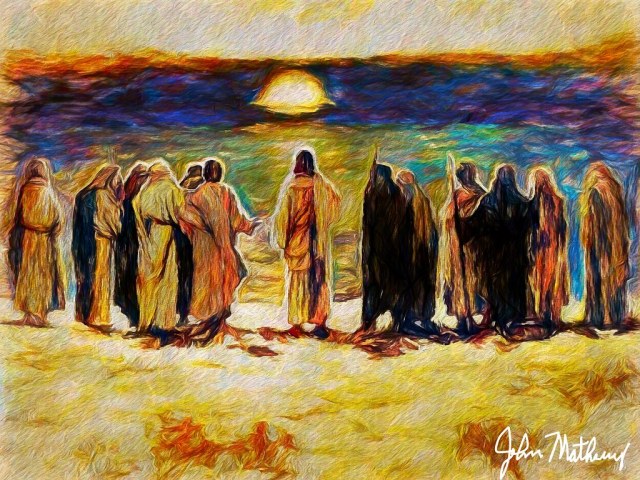
Jesus and the Disciples, by John Mathews

Christian ministry is rightly patterned after the Teacher we follow, Jesus our Lord. Christ himself demonstrated for us the way of mentoring or discipling, through his own words and actions. He called particular individuals, taught them, and equipped them for spiritual warfare in this world by granting them authority to do the work.

If we need a pattern, there it is. It’s a model of mentoring others in the ways of Christian mission and ministry. The idea is that we call, teach, equip, and authorize others in the words and ways of Jesus. I really don’t much care what you call it: Christian discipling, relational mentoring, small group teaching, spiritually forming, or any other word or phrase.

The important thing is to actually understand and do this very Christ-like work of developing mature followers of Jesus who can do the important work of spiritual warfare and ministry, then in turn, develop others. We are to pass on a body of faith and doctrine, of mission and ministry, to a group of people who will do the work. And they then do the same for others.

I rather like the word “mentoring” because for most people it evokes the idea of putting time and effort into some relationships for a specific purpose. And when we look at Christianity as a great mentoring project, perhaps we will see why church is becoming a byword in many parts of the Western world. This also ought to perhaps clue us into how we might move forward as Christians.

I am suggesting that, generally speaking, we have neglected this pattern of Jesus in calling, teaching, equipping, and authorizing. It is one large reason why there is such a decline in church attendance (and participation) in the West. And until we collectively take up this mantle of mentoring ministry, we shall continue to lessen, because we are irrelevant to people’s daily lives – both inside and outside the church.

As a first course of action, I invite you – no matter your age or stage in life – to make it a priority to simply “hang out” with individuals and groups of people. Maybe that sounds like an extrovertish sort of thing to do. However, this invitation is coming from me, an introvert. I didn’t say you have to be the life of the party, or engage in a lot of talking. But I am saying that mature followers of Jesus ought to strongly consider some intentional relationships with people other than family and a few friends.

Hang out around any given church, on any given Sunday, after any given worship service, and you are likely to see small groups of people talking with each other. Those groups typically center around friends according to age. What is often lacking are intentional interactions between the generations.  

Ethiopian Orthodox Church depiction of Christ and his disciples

The younger generations (particularly persons aged 18-29) often need and want to have relationships with more experienced (older!) believers in the faith. Younger adults, however, tend to lack the confidence to go after older adults in order to be mentored or influenced by them. I believe the onus is on the older generations to go after the younger.  

Maybe I’m just old, but it seems like younger generations have an incredible array of relationships, differing levels of friendship, and a complexity to their interactions that I didn’t have “back in my day.” What’s different, it seems, is that their relationships are more gray, and less black and white. And they appear to do a solid amount of hanging out.

Hanging out is typically sitting around with a group of people, eating and drinking, watching movies, studying (or doing bible study) or any other activity. Its doing just about anything, but doing it together with others. And this is the perfect environment for initially establishing how to begin living into the words and ways of Jesus to mentor others.

One of the things we older folks can do is to really understand the reality of younger generations’ relational interactions. For example, when I lived in a university town I used to often just “hang out” with college students, with no agenda other than just being with them. The local Perkins restaurant was at its busiest at midnight, filled with college students hanging out.

There are places in every town and city where young adults go, especially the bar scene. Bars aren’t just places to drink, but are locations of conviviality where persons have the chance to be around one another in a kind of secular church where fellowship happens, looking for a chance to relate meaningfully with others.

All people desire intimacy and want to know that someone else cares about them. This is a very real and felt need. How that need is going to be met can be either legitimate or illegitimate. And we can help with that.

One of the best things we can do for others is to communicate to them that we “have their back,” that we care, love, and genuinely like them.

No one can sniff out a disingenuous attitude quite like a young adult. So, our interactions have to be an authentic desire to be around them. Also, this does not mean we have to pretend to be younger than we are. Instead, one of the greatest needs a young person has is to be in a mentoring relationship with someone older and wiser who can help them navigate life and bring some sort of definition to relationships that they may lack.

The older generations could learn to “hang out” with younger generations and find individuals for whom they can build a solid one on one or group relationship with. If they can have such relationships now, it will serve them for a lifetime.

It seems to me that, as I look at the biblical text, being a mentor, and walking alongside another with love, grace, and wisdom, is built into Christianity by Jesus himself. So, let’s consider how we might best go about this important work.

May your love overflow more and more with knowledge and full insight to help you to determine what really matters, so that in the day of Christ you may be pure and blameless, having produced the harvest of righteousness that comes through Jesus Christ for the glory and praise of God. (Philippians 3:9-11, NRSV)

The Righteous and the Wicked (Isaiah 26:7-15)

The path of the righteous is level;
    you, the Upright One, make the way of the righteous smooth.
Yes, Lord, walking in the way of your laws,
    we wait for you;
your name and renown
    are the desire of our hearts.
My soul yearns for you in the night;
    in the morning my spirit longs for you.
When your judgments come upon the earth,
    the people of the world learn righteousness.
But when grace is shown to the wicked,
    they do not learn righteousness;
even in a land of uprightness they go on doing evil
    and do not regard the majesty of the Lord.
Lord, your hand is lifted high,
    but they do not see it.
Let them see your zeal for your people and be put to shame;
    let the fire reserved for your enemies consume them.

Lord, you establish peace for us;
    all that we have accomplished you have done for us.
Lord our God, other lords besides you have ruled over us,
    but your name alone do we honor.
They are now dead, they live no more;
    their spirits do not rise.
You punished them and brought them to ruin;
    you wiped out all memory of them.
You have enlarged the nation, Lord;
    you have enlarged the nation.
You have gained glory for yourself;
    you have extended all the borders of the land. (New International Version)

Within the Bible, there are really only two sorts of people: the righteous and the wicked. Repeatedly throughout Scripture, we are told that God attends to the needs, hopes, and prayers of the righteous; and conversely, God is opposed to the unjust practices and oppressive acts of the wicked.

The righteous are people who are attentive to God’s law and trust God with all their heart, soul, mind, and strength. For the righteous, God will make a way where there seems to be no way. If there’s a mountain obstructing the way of the righteous, they believe the Lord will flatten it. And if it isn’t flattened immediately, the righteous patiently wait, seeking to be obedient and full of faith, until it happens.

The world learns about life and faith and the divine through these postures of living by righteous persons. The exception to this is the wicked; they learn nothing. The wicked could see a mountain leveled before their very eyes, and refuse to see or acknowledge the power of God behind it.

All this is to say that the truly righteous persons among us stand out like a sore thumb to the prevailing wickedness of the world. Thus, the wicked would like to see them leveled, instead of a mountain. So, the wicked persons among us are committed to lies, half-truths, injustice, and even violence. They’ll use any practice that would knock down the righteous and advance the wicked person’s agenda.

Yet, in making this distinction between the two groups of people, we need to be very careful. Because whenever we group people, there is always the danger of assuming that the righteous are always righteous and the wicked always wicked – as if the righteous could never do any wrong, nor the wicked ever do anything right and just.

However, the reality is that we don’t live in a completely black and white world; there is a lot of gray. The world is far more complex than our simplistic categories of good and bad. This is why it can be so maddening to try and navigate this world each and every day.

So, when we speak of the righteous and the wicked, let’s have some clarity and understanding of the basic patterns of a person’s or a group’s life.

Biblically, the righteous are righteous – not because they are intensely moral and always actively obedient – but because the basic orientation of their lives is committed to communing and relating to the God of the universe.

And the wicked are wicked – not because they are belligerent and bullying – but because the general direction of their lives is continually bent inward to serve their own interests and ignore the Divine.

Therefore, the righteous have the foundational characteristics of yearning for God, and pursuing the Lord with all their energy. They desire a meaningful relationship with God that gives shape to their plans and purposes for living.

The righteous, as a general pattern of living, find their ultimate longings in life through belonging to God. They seek divine interventions for everything, and deeply desire the divine presence to envelop them and surround the world with love, mercy, and justice. Along with the psalmist, the righteous say:

I ask only one thing, Lord:
Let me live in your house
    every day of my life
to see how wonderful you are
    and to pray in your temple. (Psalm 27:4, CEV)

Like a deer drinking from a stream,
    I reach out to you, my God.
My soul thirsts for the living God.
    When can I go to meet with him? (Psalm 42:1-2, ERV)

As long as I have God, I don’t need anyone else in heaven or on earth. (Psalm 73:25, GW)

In contrast to these heartfelt longings, the wicked are dense and obtuse. They fail to see the beauty in any of this. Their end will be precisely what they have wanted throughout life: To be left alone and have space away from God altogether – which is the classic definition of hell.

But the righteous will also have their desires fulfilled, and shall experience peace and right relations forever with God.

How then shall we live?

Blessed is the person who does not
follow the advice of wicked people,
take the path of sinners,
or join the company of mockers.

Rather, he delights in the teachings of the Lord
and reflects on his teachings day and night.

He is like a tree planted beside streams—
a tree that produces fruit in season
and whose leaves do not wither.
He succeeds in everything he does.

Wicked people are not like that.
Instead, they are like husks that the wind blows away.

That is why wicked people will not be able to stand in the judgment
and sinners will not be able to stand where righteous people gather.

The Lord knows the way of righteous people,
but the way of wicked people will end. Amen. (Psalm 1, GW)

Thankful for Your Faith (1 Thessalonians 1:1-10)

Paul, Silas and Timothy,

To the church of the Thessalonians in God the Father and the Lord Jesus Christ:

Grace and peace to you.

We always thank God for all of you and continually mention you in our prayers. We remember before our God and Father your work produced by faith, your labor prompted by love, and your endurance inspired by hope in our Lord Jesus Christ.

For we know, brothers and sisters loved by God, that he has chosen you, because our gospel came to you not simply with words but also with power, with the Holy Spirit and deep conviction. You know how we lived among you for your sake. You became imitators of us and of the Lord, for you welcomed the message in the midst of severe suffering with the joy given by the Holy Spirit. And so you became a model to all the believers in Macedonia and Achaia. The Lord’s message rang out from you not only in Macedonia and Achaia—your faith in God has become known everywhere. 

Therefore we do not need to say anything about it, for they themselves report what kind of reception you gave us. They tell how you turned to God from idols to serve the living and true God, and to wait for his Son from heaven, whom he raised from the dead—Jesus, who rescues us from the coming wrath. (New International Version)

The Apostle Paul wrote to the Church in Thessalonica, essentially saying, “I really can’t say enough good about you!” I also echo the same about your faith. Paul had plenty of reasons to express thanks for them in his prayers. He was thoroughly convinced of God’s work in them, and acknowledged the good work of God in their spiritual transformation.

The background of Paul and the Thessalonians

Paul visited Thessalonica on his second missionary journey (Acts 17). Thessalonica was the capital of Macedonia, located on an inlet, and so, was a port city along an important trade route. Thessalonica was a very religious city, with a host of various deities that were worshiped. It was also a politically prominent city that prided themselves on embodying the ideals of the Roman Empire, including bravery, loyalty, piety, seriousness, respect and authority.

When the Thessalonians heard Paul’s message and accepted its call to worship the God of Israel exclusively, they faced rejection and possibly persecution from their polytheistic families and neighbors. To accept and worship Jesus took some solid faith, hope, and love, because to be a Christian was costly within the culture.

God loved and chose the Thessalonians

Paul could praise their faith because it lifted and upheld the gracious work of God on this earth. Before the Thessalonians chose God, God chose them. God didn’t have to do that. But the Lord was gracious, merciful, and kind, extending salvation and deliverance from an empty way of life to a group of people who didn’t deserve it. In fact, none of us do. God’s grace chooses to grant us faith and salvation. To be included amongst God’s people is an incredible privilege.

The good news of Jesus Christ came to the Thessalonians with power, assurance, and the Holy Spirit. They turned from their idols to God. Jesus redeemed and rescued them from darkness and judgment. The Thessalonian believers turned from their previous religious expressions in order to serve the living and true God. As a result, they began imitating Jesus and his apostles. And because of their Christian way of life, the Thessalonian Christians then became worthy of imitation themselves.

Because of God’s merciful intervention in their lives, Paul was grateful for the work of God for three specific elements and expressions about the Thessalonians’ Christian lives:

  1. Their work produced by faith
  2. Their labor prompted by love
  3. Their endurance inspired by hope

Indeed, for every Christian, the Christian life is lived with the essential tools of faith, hope, and love.

Endurance inspired by hope

It’s a standup quality to be characterized as people of hope. The Thessalonian believers were anticipating and waiting for the Lord’s return; they had no doubt Jesus will come again. The Christians just needed some reassurance about those who have already died without yet seeing Christ – which is why Paul wrote his letter to them. And the believers were good at encouraging each other with the hope of Christ’s return.

Labor prompted by love

Paul didn’t really even need to teach the Thessalonian Christians about loving each other because they were good students of God as their teacher. They had a reputation of hearing the Word of God, then doing it. Specifically, they learned to love, not only one another within their local church, but the whole of the family of God throughout Macedonia. So then, the Thessalonians excelled at expressing their faith through love. (Galatians 5:6)

Work produced by faith

The Thessalonian believers became well-versed and practiced in the Christian elements of hope and love. And their faith became known everywhere. Paul was thankful for their work produced by faith. Yet, as the rest of the letter bears out, along with the second letter to the Thessalonians, Paul will have much to say to them about the nature of faith.

Paul reminded the Christians of his example to them and the gospel which he proclaimed. Several times, Paul talked of the work he put into them on their behalf (1 Thessalonians 2:9; 3:5; 2 Thessalonians 3:8). On the topic of following godly examples, Paul also admonished them to respect those who have authority over them, who labor and work among them (1 Thessalonians 5:12-13).

The Apostle encouraged the Thessalonians to continue in their work, so that every need would be met within the church; and so that there would be a good witness to those outside the church (1 Thessalonians 4:11-12). Paul let them know that a very practical way they can express their love is by working with their hands so that none among them have any need.

Faith and work are not mutually exclusive. Even though the Thessalonian believers were transformed by their belief in Christ, they still needed to remember that they must carry on in their regular daily lives until Christ returns.

Imitating the faith and patience of solid believers

And we are all still responsible to be faithful, every day, no matter what the situation or circumstances are. We must carry on in our faith, hope, and love through obeying and living into the words and ways of Jesus. We do this through imitating the faith and patience of trusted Christians, like the Apostle Paul.

Remember your leaders, who spoke the word of God to you. Consider the outcome of their way of life and imitate their faith.

Hebrews 13:7, NIV

People can only experience the fullness of their humanity when they are in deep, trusting relationships with one another. Even more, relationships have more depth when experienced and centered in a relationship with Jesus Christ. Imitation then becomes an outgrowth of this strong relationship.

Far too often we seek excuses, or to find loopholes, in order to avoid the vulnerability that a close mentoring relationship demands. We may look for ways to justify not getting close, or simply distance ourselves from other believers.

Maybe we do not want to do the work — desiring to avoid being hurt. It could be that we are tired of doing the relational work necessary for closeness and walking with Christ and one another. Relationships get messy and they take lots of energy. But our spiritual growth is completely tied to relational growth. The Apostle Paul himself was vulnerable:  

Just as a nursing mother cares for her children, so we cared for you. Because we loved you so much, we were delighted to share with you not only the gospel of God but our lives as well. Surely you remember, brothers and sisters, our toil and hardship; we worked night and day in order not to be a burden to anyone while we preached the gospel of God to you. (1 Thessalonians 2:7-9, NIV)

This imitative relationship is important for the advancement of the gospel. The faith is passed on from generation to generation, from disciple to disciple, in one long progression stretching all the way back to Jesus and the original twelve disciples. For our own faith, hope, and love to be effective, it requires following the example of Paul, and of committed faithful believers in your own life, through close relationships with them.

God of all faith, hope, and love, we praise and give you thanks for the resurrection of your Son, Jesus Christ. We celebrate the joy of life in you, and are grateful for the privilege and opportunity to live into the reality and power of the resurrection.

Inspire us, by your grace, to live the life of intentionally following Jesus. We surrender ourselves to the life of Jesus, who called us to be faithful servants of God. We commit to living for Christ, our Savior and Lord, in whose name we are bold to pray. Amen.