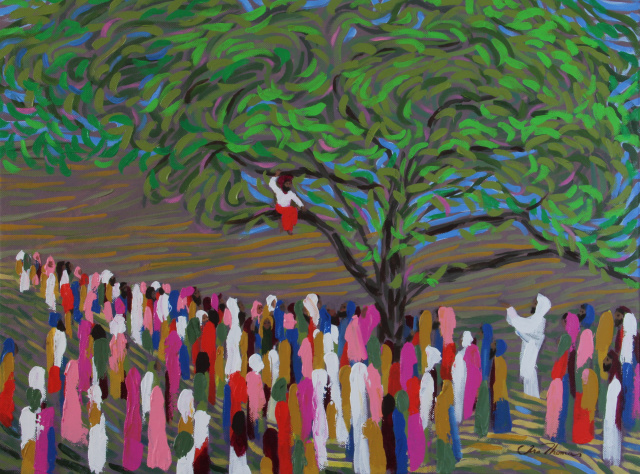
“I Want to See Jesus!” (Luke 19:1-10)

Zacchaeus, by Ira Thomas

Jesus entered Jericho and was passing through. A man was there by the name of Zacchaeus; he was a chief tax collector and was wealthy. He wanted to see who Jesus was, but because he was short he could not see over the crowd. So he ran ahead and climbed a sycamore-fig tree to see him, since Jesus was coming that way.

When Jesus reached the spot, he looked up and said to him, “Zacchaeus, come down immediately. I must stay at your house today.” So he came down at once and welcomed him gladly.

All the people saw this and began to mutter, “He has gone to be the guest of a sinner.”

But Zacchaeus stood up and said to the Lord, “Look, Lord! Here and now I give half of my possessions to the poor, and if I have cheated anybody out of anything, I will pay back four times the amount.”

Jesus said to him, “Today salvation has come to this house, because this man, too, is a son of Abraham. For the Son of Man came to seek and to save the lost.” (New International Version)

Every time I read this story about Zacchaeus climbing up the sycamore tree to see Jesus because he was a short man, I think of the old ‘70s song Short People by Randy Newman. The song was (and still is) criticized by some as being prejudiced against short people. 

Indeed, the criticism seems justified with lyrics such as “short people got no reason to live.” Yet, the song’s intended purpose was really the opposite – to be an attack on the pervasive prejudice of the day, and an attempt to “heighten” (pun intended) awareness of other people’s importance. 

“Short people are the same as you and I. All men are brothers until the day they die” are the lyrics containing the real message within the song.

At first glance, the story of the short Zacchaeus seems to be about his inability to see. Yet the real heart of the story is that:

Zacchaeus is unable to see because the other people are obstacles to his sight. 

In turns out that Jesus is the only person who truly sees Zacchaeus. No one else sees him. No one else seems to care. While everyone else is busy with their own line of sight, Jesus is concerned to see the one person who is unseen: Zacchaeus. 

And here’s the reason why Jesus had his radar attuned to picking up Zacchaeus: Because Jesus came to see people like Zacchaeus; Christ came to seek and to save the lost.

One of the most pertinent applications of this story for us, is that we must not be an obstacle for others coming to Jesus – and instead be a conduit for others to meet Jesus. For that to happen, we need a reformation of both attitude and our action.

Our chief obstacle to realizing a reformation is the sort of hindrance that Zacchaeus overcame in order to see Jesus and experience him:

Zacchaeus did not take himself so seriously.

A very serious Zacchaeus would not have been playful enough and much too respectable to climb a tree. Maybe he was used to living with short jokes all his life; I don’t know. I just see a rich businessman who was lighthearted enough to climb a tree; and who lightened up enough to give a big pile of money away.

As a tax collector, metrics and measurements and figures were his world. All of that accounting can create a serious and sterile environment – concerned with doing more, being more, and getting more.

Reformation – reforming oneself, one’s culture, and one’s institutions – comes through the disposition and willingness of not being so doggone serious all the time.

“Jesus and Zacchaeus” by Soichi Watanabe

Hanging one’s happiness and well-being on other people adopting my opinions, my plans, and my way is a surefire prescription for getting knocked down several pegs by both others and God.

A reformation comes through collegiality, cooperation, and collaboration with others. To acknowledge that God is God, and I am not, and that all people (even the ones I don’t like) are just as important as me, is to see with new eyes. This is the way of seeing Jesus because it’s the willingness to climb trees and to not care how it makes me look to do it.

People short on faith, short on hope, and short on love desperately need the love of God in the gracious person of Jesus Christ. 

Let us then, help, and not hinder, people’s ability to see Jesus.

Jesus said, “You are the light of the world. A town built on a hill cannot be hidden. Neither do people light a lamp and put it under a bowl. Instead they put it on its stand, and it gives light to everyone in the house. In the same way, let your light shine before others, that they may see your good deeds and glorify your Father in heaven.” (Matthew 5:14-16, NIV)

Let us not become discouraged when our expectations obscure our sight.

When John, who was in prison, heard about the deeds of the Messiah, he sent his disciples to ask him, “Are you the one who is to come, or should we expect someone else?”

Jesus replied, “Go back and report to John what you hear and see: The blind receive sight, the lame walk, those who have leprosy are cleansed, the deaf hear, the dead are raised, and the good news is proclaimed to the poor. (Matthew 11:2-5, NIV)

Let us have eyes to see and not be blinded by our own seriousness.

Jesus said, “For judgment I have come into this world, so that the blind will see and those who see will become blind.” (John 9:39, NIV)

Anyone who has seen me has seen the Father. (John 14:9, NIV)

Let us humble ourselves and stoop to see the incredible reality in front of us.

As they entered the tomb, they saw a young man dressed in a white robe sitting on the right side, and they were alarmed.

“Don’t be alarmed,” he said. “You are looking for Jesus the Nazarene, who was crucified. He has risen! He is not here. See the place where they laid him. But go, tell his disciples and Peter, ‘He is going ahead of you into Galilee. There you will see him, just as he told you.’” (Mark 16:5-7, NIV)

Let us see and believe.

“What is mankind that you are mindful of them,
    a son of man that you care for him?
You made them a little lower than the angels;
    you crowned them with glory and honor
    and put everything under their feet.”

In putting everything under them, God left nothing that is not subject to them. Yet at present we do not see everything subject to them. But we do see Jesus, who was made lower than the angels for a little while, now crowned with glory and honor because he suffered death, so that by the grace of God he might taste death for everyone. (Hebrews 2:6-9, NIV)

In God’s kingdom, the tall are short, and the short are tall. And there are plenty of trees to climb so that everyone can see Jesus.

Loving Lord Jesus, give me the grace to see you in all things throughout my days on this earth. Help me to see your benevolent kingdom come and see your ethical will be done, here on earth, as it is always done in heaven. Amen.

Reformation Sunday


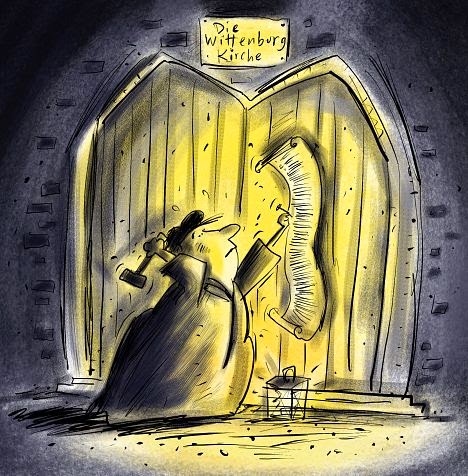
We all may be familiar with the fact that Martin Luther posted his 95 Theses on the door of the Wittenberg castle church which sparked the Protestant Reformation, but we are probably less familiar with the theological meat of Luther’s reforming spirit, his Heidelberg Disputation of 1518, written the year following the 95 Theses.
 
            In his Disputation, Luther contrasted two opposing ways of approaching Christianity.  He called these two ways the theology of the cross and the theology of glory.  The cross, as expressed by Luther, is God’s attack on human sin.  It is the death of Christ that is central to Christianity, and one must embrace the cross and rely completely and totally upon Christ’s finished work on the cross to handle human sin.  It is through being crucified with Christ that we find the way to human flourishing and life.  In other words, righteousness is gained only by grace through faith in Christ.
 
            The theology of glory is the opposing way of the cross.  For Luther, the wicked person, and the vilest offender of God is not the person who has done all kinds of outward sinning that we readily see.  You perhaps have an idea in your head of what the worst of sinners is like.  My guess is that it probably has something to do with an actual sinful lifestyle or particular evil acts. 
 
            Luther, however, insisted that the worst of sinners are those people who do good works, who pursue a theology of glory.  More specifically, the wicked person is the one who has clean living and does all kinds of nice things, but does them disconnected from God by wanting others to see their good actions.  Another way of putting it is that the wicked person is one who seeks to gain glory for him/herself, rather than giving glory to God.
 
            Our good works, Luther insisted, are the greatest hindrance to being a truly righteous person and living in the way of the cross.  It is far too easy to place faith in our good works done apart from God, rather than having a naked trust in Christ alone.  It is far too easy to do good things for the primary purpose of having others observe our goodness, rather than do them out of the good soil of being planted in God’s Word.  The only remedy for sin is the cross, and the sinner is one who lives life apart from that cross, trusting in him/herself so that people can recognize them and give them their due respect and praise.
 
            Here is what Luther had to say in a nutshell concerning his thoughts:  “It is impossible for a person not to be puffed by his good works unless he has first been deflated and destroyed by suffering and evil until he knows that he is worthless and that his works are not his but God’s.”
 
            So, then, the answer to this problem of doing good works out of our intention of gaining glory for ourselves is not to avoid good works, but to do them from the good soil of being planted in the law of God and being connected to the vine of Christ. 


            Reformation Sunday is a time to remember, and a time to repent.  We remember that we are saved by grace alone through faith alone in Jesus Christ.  We also take the time to repent of our works done apart from Christ and acted for the accolades of others.  Perhaps what we need today is another Reformation, that is, a reformation of spiritual habits that truly connect us to the vine of Christ – practices that shape our lives around the person and work of Jesus, and not around the idols of our hearts that make us look good and impress others.  What will you choose on this day?

Discovering the Reformation

Sometimes I need to go into my daughter’s room to get something.  More often than not, it ends up becoming an archaeological dig as I wade through the layers of stuff.  I don’t always find what I’m looking for, and I sometimes discover things I didn’t know I had lost.  Nearly five-hundred years ago, when Martin Luther went digging into the Bible, he found that he was wading through layers of church tradition and came upon something that was lost; he rediscovered that God justifies sinners by grace through faith apart from any good works done by us.  In other words, Luther found in the Scriptures that we are completely and totally at the mercy of God in Christ.


            The cross of Jesus Christ is our only means of salvation from what ails us because the cross is an attack on human sin.  Luther discovered that we all have layers and layers of stuff that have grown around our hearts to the degree that we no longer see the sheer grace of God in Christ alone to meet the most pressing needs of our lives.  In the centuries before Martin Luther and John Calvin came into history, God’s grace had gradually become something of a supplement to whatever is left of our human willpower.
 
            Apart from Jesus we are addicted to ourselves; and, the cross is the intervention we need to help us in order to confront our constant me-ism.  We might sometimes justify ourselves with the fact that we do good works.  However, one of the legacies of the Reformation is that good works do not earn us deliverance from sin.  What is more, Luther said that our good deeds are the greatest hindrance to our salvation because we have the tendency to trust in those good deeds instead of the death of Christ.  So, Luther actually called our good works a mortal sin that sets off God’s wrath and leads straight to hell.  In other words, doing good deeds are deadly if they are done as a means of approaching God.  It is only through the suffering of Jesus on the cross, his death for us while we were still sinners, not when we were lovely and looking fine with all our pious actions, that we are saved.  Luther had this to say in his Heidelberg Disputation:  “He who does not know Christ does not know God hidden in suffering.  Therefore he prefers works to suffering, glory to the cross, strength to weakness, wisdom to folly, and, in general, good to evil.  These are the people whom are under God’s wrath!  God can only be found in suffering and the cross.  It is impossible for a person not to be puffed by his good works unless he has first been deflated and destroyed by suffering and evil until he knows that he is worthless and that his works are not his but God’s.”
 
            God does not come to us in our beauty and goodness; instead, he comes to us in our ugliness and sin.  While we were still sinners, ungodly, enemies of God, powerless to save ourselves, Christ died on the cross for us (Romans 5:6-11).  We might spend too much of our time and effort concerned about looking good and doing good things in order to present ourselves acceptable to each other and even to God.  But that is the very sin, Luther said, that sends people to hell.  Places of damnation are actually reserved for those outwardly righteous persons who trusted all their lives in themselves and how they looked to others without a thought at all about justification, reconciliation, and being restored to God through Christ.


            Like a gold ring in a pig’s snout, is a person who has good deeds but knows nothing of God’s grace.  It is a completely human tendency to decide which sinful actions are trivial and which are the biggie sins.  Yet, the only way of approaching God is by seeing our true ugliness, our rebellious hearts, and that the only hope of salvation is through the cross of Christ.  We are justified by God and restored to relationship with him because of Jesus, and not for any other reason.  A new relationship is established based solely in God’s grace.
 
            When we grasp this truth, even a little bit, it should cause us to repent of our good works done apart from faith.  When there is humility that leads to a total turning to Jesus, there is a revival to new life in God, and a personal reformation around the doctrine of grace instead of the doctrine of my glorious works that I perform.
 
            We, then, as the people of God, saved and justified through the blood of Jesus, ought to be the most joyful and grateful people on the planet.  We have salvation from the deception of our hearts to life in Christ!  Apathy and lethargy in the church to the things of God are the twin evils that reign in the place of awe and appreciation for what God has done for us in Christ.
 
            There is nothing more God can do to show us that he loves us than by actually dying for us, and by doing so, satisfying his own wrath against the sin which seeks to destroy us.  The late Brennan Manning once told the story about how he got the name “Brennan.” While growing up, his best friend was Ray. The two of them did everything together: bought a car together as teenagers, double-dated together, and went to school together. They even enlisted in the Army together, went to boot camp together and fought on the frontlines together. One night while sitting in a foxhole, Brennan was reminiscing about the old days in Brooklyn while Ray listened and ate a chocolate bar. Suddenly a live grenade came into the foxhole. Ray looked at Brennan, smiled, dropped his chocolate bar and threw himself on the live grenade. It exploded, killing Ray, but Brennan’s life was spared.
 
When Brennan became a priest he was instructed to take on the name of a saint. He thought of his friend, Ray Brennan. So he took on the name “Brennan.” Years later he went to visit Ray’s mother in Brooklyn. They sat up late one night having tea when Brennan asked her, “Do you think Ray loved me?” Mrs. Brennan got up off the couch, shook her finger in front of Brennan’s face and shouted, “What more could he have done for you?” Brennan said that at that moment he experienced an epiphany. He imagined himself standing before the cross of Jesus wondering, does God really love me? And Jesus’ mother Mary pointing to her son, saying, “What more could he have done for you?”
 
The cross of Jesus is God’s way of doing all he could do for us. And yet we often wonder:  Does God really love me? Am I important to God? Does God care about me?  We tend to ask those questions when we are trusting in ourselves, because we never really know where we stand.  Let the doubts roll away.  No matter how bad or how good we are, the path of suffering of our Lord Jesus has taken care of the sin issue once for all.


This is what we call the gospel, the good news that Jesus suffered and died for all the bad things we have done, and all the good things we have done to try and justify ourselves before God and each other.  Week after week for the past 2,000 years, God’s people have been gathered together to worship this same Lord Jesus who died on the cross.  The only thing left for us to do, since Jesus has done it all for us, is to offer our lives to him.  In doing so, the spirit of the Reformation lives on.