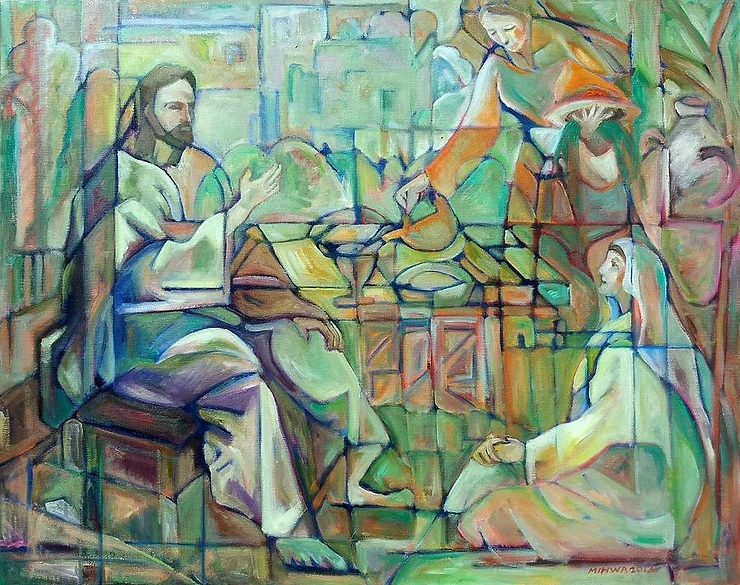
Renewal (Mark 6:30-34, 53-56)

Great Crowds Followed Jesus as He Preached the Good News, by Elizabeth Wang (1942-2016)

The apostles gathered around Jesus and told him all that they had done and taught. He said to them, “Come away to a deserted place all by yourselves and rest a while.” For many were coming and going, and they had no leisure even to eat. And they went away in the boat to a deserted place by themselves. 

Now many saw them going and recognized them, and they hurried there on foot from all the towns and arrived ahead of them. As he went ashore, he saw a great crowd, and he had compassion for them, because they were like sheep without a shepherd, and he began to teach them many things….

When they had crossed over, they came to land at Gennesaret and moored the boat. When they got out of the boat, people at once recognized him and rushed about that whole region and began to bring the sick on mats to wherever they heard he was. 

And wherever he went, into villages or cities or farms, they laid the sick in the marketplaces and begged him that they might touch even the fringe of his cloak, and all who touched it were healed. (New Revised Standard Version)

Recuperation

Christ’s disciples had just returned from their first ministry trip without Jesus. He had sent them in pairs to take authority over unclean spirits, with specific instructions on how to handle themselves. (Mark 6:6-13)

Now they had come together after a successful experience. Jesus immediately recognized that the disciples needed rest in a private retreat so that they could recover and debrief on their mission.

Jesus knew a thing or two about what we now call “self-care.” Christ understood the necessity for awareness of one’s physical, mental, emotional, and spiritual state – and to take appropriate steps in caring for oneself in order to maintain a vigorous life and ministry. He often punctuated his life with solitary times away with his heavenly Father. (e.g. Mark 1:35)

So, the disciples followed Jesus to a deserted place where they could be alone. Besides, it had become ever more risky to be out in the open. The religious authorities were looking for ways to snuff out this popular upstart of a movement with Jesus as rabbi.

Redirection

Things don’t always go as planned, even for the Son of God. Interruptions are part of working with people. Yet, Jesus never saw those disruptions as a bad thing. It seems that perhaps he even understood them as part of the plan from his heavenly Father. However Christ thought of them, he was unfazed by them.

With an expanding ministry came a larger and more expansive crowd following Jesus. Like a group of ancient paparazzi, there were people dedicated to tracking down Jesus and watching for him; they were absolutely intent on seeing him.

Whereas a lot of people might be annoyed with this behavior (especially us introverts!) Jesus truly saw them, viewing the crowds as “sheep without a shepherd.” In other words, Christ understood the people’s vulnerability, and he had compassion on them.

Refocus

Christ felt genuine care and concern for the people from the pit of his gut. Jesus knew their very real spiritual predicament, an age-old one that God was familiar with:

I, the Lord God, say you shepherds of Israel are doomed! You take care of yourselves while ignoring my sheep. You drink their milk and use their wool to make your clothes. Then you butcher the best ones for food. But you don’t take care of the flock! You have never protected the weak ones or healed the sick ones or bandaged those that get hurt. You let them wander off and never look for those that get lost. You are cruel and mean to my sheep. They strayed in every direction, and because there was no shepherd to watch them, they were attacked and eaten by wild animals. (Ezekiel 34:2-5, CEV)

Jesus, in the spirit Moses, took up the concern for people:

Moses spoke to the Lord: “Let the Lord, the God of all living things, appoint someone over the community who will go out before them and return before them, someone who will lead them out and bring them back, so that the Lord’s community won’t be like sheep without their shepherd.” (Numbers 27:15-17, CEB)

Because the Lord Jesus is the Good Shepherd and takes up the responsibility of caring for the flock, there were sheep (the crowds of people) continually either present around him or pursuing him (hence, the need for continual times of rest and recuperation).

All of this resulted in the impossibility of Jesus strolling into a town, village, or city under the radar.

Restoration

Not only did everyone want to see Jesus, but the people also desired to touch him, or at least the tassels of his garment – anything toget close and experience healing.

What’s so amazing about this account is that every single person who Jesus saw or touched experienced healing – without exception. It wasn’t that a few people, or even some of them, walked away changed. All of them did.

Indeed, Jesus is the divine shepherd, who will gather his sheep from the places where they have been scattered.

Christ went into towns and villages to the public places where the people were. That meant Jesus spent a good deal of time in the marketplaces. Since these were gathering areas where people bought and sold and interacted with each other, there you would also find the weakest, sickest, and most vulnerable people.

The needy were looking for help. And Jesus did for them, well beyond what any of them expected.

The Lord Jesus was also doing more than we might expect, as well. By conducting ministry in the economic center of a town, he was introducing a different (and subversive) economy from the kingdom of God.

Those with goods, resources, and money do not occupy the commercial spaces in God’s kingdom realm. Instead, the ones with the least, inhabit the spaces and places of honor. Indeed, many who are first will be last, and the last will be first. (Mark 10:31)

Christ’s earthly ministry restored people’s bodies, minds, emotions, and spirits – thus bringing a thriving economy into God’s kingdom. All of his work resulted in renewal of people’s lives, and a renewed way of living in this world.

“Healer of Our Every Ill” by Marty Haugen, 1987

Refrain:
Healer of our every ill,
light of each tomorrow,
give us peace beyond our fear,
and hope beyond our sorrow.

You who know our fears and sadness,
grace us with your peace and gladness;
Spirit of all comfort, fill our hearts. [Refrain]

In the pain and joy beholding
how your grace is still unfolding,
give us all your vision, God of love. [Refrain]

Give us strength to love each other,
every sister, every brother;
Spirit of all kindness, be our guide. [Refrain]

You who know each thought and feeling,
teach us all your way of healing;
Spirit of compassion, fill each heart. [Refrain]

Amen.

One Thing (Psalm 27)

And We Shall Dwell in the House of the Lord, by Dale Terbush

The Lord is my light and my salvation—
    whom shall I fear?
The Lord is the stronghold of my life—
    of whom shall I be afraid?

When the wicked advance against me
    to devour me,
it is my enemies and my foes
    who will stumble and fall.
Though an army besiege me,
    my heart will not fear;
though war break out against me,
    even then I will be confident.

One thing I ask from the Lord,
    this only do I seek:
that I may dwell in the house of the Lord
    all the days of my life,
to gaze on the beauty of the Lord
    and to seek him in his temple.
For in the day of trouble
    he will keep me safe in his dwelling;
he will hide me in the shelter of his sacred tent
    and set me high upon a rock.

Then my head will be exalted
    above the enemies who surround me;
at his sacred tent I will sacrifice with shouts of joy;
    I will sing and make music to the Lord.

Hear my voice when I call, Lord;
    be merciful to me and answer me.
My heart says of you, “Seek his face!”
    Your face, Lord, I will seek.
Do not hide your face from me,
    do not turn your servant away in anger;
    you have been my helper.
Do not reject me or forsake me,
    God my Savior.
Though my father and mother forsake me,
    the Lord will receive me.
Teach me your way, Lord;
    lead me in a straight path
    because of my oppressors.
Do not turn me over to the desire of my foes,
    for false witnesses rise up against me,
    spouting malicious accusations.

I remain confident of this:
    I will see the goodness of the Lord
    in the land of the living.
Wait for the Lord;
    be strong and take heart
    and wait for the Lord. (New International Version)

Just recently, I was reflecting on my vocational life with a friend. I realized that, for the majority of my adult life, I have worked at least two jobs at once. On top of that, for several years, I was also going to school. Even now that I have gotten older and (finally) pared my work life down to just one job, I still work in two different places, complete with different offices and staff.

For us Americans, this is like a badge of honor – that we can demonstrate what hard workers we are. Yet, there is also something quite unhealthy about all this work that leaves room for little else in life. Typically, our relationships suffer. And the relationship which suffers the most is with God.

The psalmist had a singular desire – one thing – that he wanted above all else.

It’s the same thing that the Apostle Paul wanted more than anything else in the world (Philippians 31-14); and the one thing Jesus said to the rich young ruler that he lacked (Mark 10:17-31). It’s the thing that Mary pursued, and the thing Martha neglected (Luke 10:38-42). The blind man discovered the one thing in his healing encounter with Jesus (John 9:1-34).

Perhaps we, especially in the United States, need a miraculous healing, not only from our compulsions toward work, but also from our collective spiritual attention-deficit-disorder. We need to be able to focus on the one thing that is needed above all other things – without any sort of multitasking.

Rather than adding another thing to our calendar, and just trying to work harder, let’s step back and reconnect with what is most important to us. What is your highest priority in life? That question isn’t only for me as an American; it’s for all of us everywhere.

It’s instructive that the one thing the psalmist doesn’t ask for is revenge, or judgment, or, at the least, some comeuppance and protection. Instead, he simply asks this: To dwell in the house of the Lord. That is, the psalmist, David, wants more than anything else to live fully in God’s presence – because when that happens, everything else falls into place.

The inherent nature of God is goodness and beauty. So, to be with God is to be surrounding by what is lovely and good. To be in God’s presence is to relax and know real security.

In this state, we are then able to get our bearings and remember the good deeds of deliverance the Lord has done in the past; the mighty acts of power God will show in the future; and are blanketed in the present with the reality that the world doesn’t cease spinning on it’s axis because I have only one job, or take a break, or turn off my cellphone for a day. I can do it without fear or anxiety because God is with me.

With renewed focus, I can center my schedule, my calendar, my plans, and all my decisions around the surety that God is with me; and that I can enjoy the Lord forever. After all, this is what the Christian season of Advent teaches us – that Jesus, our Immanuel, is God with us, come in the flesh for us and for our salvation. That is the one thing we need to know today.

Ever-present and ever-loving God, we plant the seeds that one day will grow. We water seeds already planted, knowing that they hold future promise. We cannot do everything; and so help us have a sense of liberation in realizing this, so that we are enabled to do one thing very well; to take joy in being part of the process; to see that taking some steps, and then rest, is enough. We see in part, yet you, O Lord, see all things in their entirety. We are open to being, not just doing, no matter that circumstances, through Jesus Christ our Lord. Amen.

On a Time Out (Exodus 2:11-15)

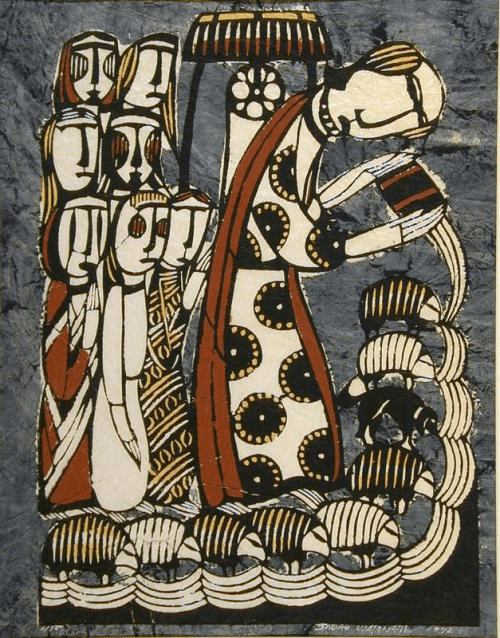
Moses in Midian, by Japanese artist Sadao Watanabe, 1972

One day, after Moses had grown up, he went out to where his own people were and watched them at their hard labor. He saw an Egyptian beating a Hebrew, one of his own people. Looking this way and that and seeing no one, he killed the Egyptian and hid him in the sand. The next day he went out and saw two Hebrews fighting. He asked the one in the wrong, “Why are you hitting your fellow Hebrew?”

The man said, “Who made you ruler and judge over us? Are you thinking of killing me as you killed the Egyptian?” Then Moses was afraid and thought, “What I did must have become known.”

When Pharaoh heard of this, he tried to kill Moses, but Moses fled from Pharaoh and went to live in Midian, where he sat down by a well. (New International Version)

Faith is dynamic, not static. It flows and moves, waxes and wanes, strengthens and weakens. Faith isn’t like a kitschy trinket you buy in a quaint downtown shop, and then place it as a nice object in a prominent place of your house or office. Rather, faith is much more subjective, like taking an adventure down some whitewater rapids, not quite knowing what’s going to happen.

Moses needed to learn how to make healthy decisions of faith, just like the rest of us. Just because we stand at this point in history and can look back at what a religious titan he was, doesn’t mean that Moses was always a paragon of faith and patience. In fact, quite the opposite.

An eighty year old Moses became the human agent of God’s deliverance of the Israelites from the Egyptians, after a forty year stint in the backside of the desert. This tells us that it took him awhile to mature into being the sort of leader God wanted to bring God’s people out of slavery. 

Even though the forty year old Moses may have had a sense that the Israelites needed freedom from slavery and acted on that sense by killing a ruthless Egyptian, his method, maturity, and misplaced timing were off.

There is a time for everything, said the Teacher of wisdom (Ecclesiastes 3:1). Wisdom – the ability to apply faith to concrete situations with appropriate forms – is often in the timing of things. To know when to speak and when to listen, when to act and when to wait, is an important facet of faith. 

The ancient Israelites were slaves in Egypt for a long time, 400 years. Moses knew they were suffering, and he acted in “good faith.” Yet, it was not yet time, and it was a rash action, in killing the Egyptian. Eventually, the Jewish cry of suffering arose to God, and God heard them, remembering the divine covenant. 

Questions of why God did not act sooner, or use Moses earlier, is information that is only privy within God, and likely will not be answered satisfactorily for us, this side of heaven.

In order to develop a strong and wise faith – with an opportune sense of timing – we need to rely on God. Trusting in ourselves, our own efforts, and our own gauge of how things ought to proceed, will usually not end well. We may, like Moses, find ourselves taking a “time out” from God in obscurity until we learn to wait on him.

Some might think of a “time out” as being negative, even punitive, such as giving a time out to a toddler because of naughtiness, or calling a time out in sports because the team is playing poorly. However, a time out can also be a positive experience. The following are some advantages of the “time out:”

Reflect

Little did Moses know at the time, but he would have the next 40 years to reflect on his life and actions in Egypt. Reflection is important. It gives us a chance to step back, learn from what happened, and adjust for the next time we experience a similar situation. Taking this time acts like a mirror, enabling us to gain some clarity on what we’ve said and done.

So I reflected on all this and concluded that the righteous and the wise and what they do are in God’s hands, but no one knows whether love or hate awaits them. All share a common destiny—the righteous and the wicked, the good and the bad, the clean and the unclean, those who offer sacrifices and those who do not. (Ecclesiastes 9:1-2, NIV)

Refocus

Upon taking the time to reflect, it then provides us with the opportunity to refocus our efforts with wisdom. To refocus means to come back around in giving close attention and concentration on what’s most important to us. The desire of Moses was admirable in being concerned about his fellow Israelites. He just went too far and needed to fix his eyes on the Lord and how to best go about freeing them.

We must focus on Jesus, the source and goal of our faith. He saw the joy ahead of him, so he endured death on the cross and ignored the disgrace it brought him. (Hebrews 12:2, GW)

Renew

Reflecting on the past and refocusing in the present are not quite enough to get us back in the game of life. We also need renewal. To be renewed involves fresh commitment to the things we have learned. I believe it’s best to renew our commitments with some sort of ritual, because rituals help us psychologically and spiritually to launch into the focused endeavors ahead of us. That’s why athletes always have a short ritual of breaking their huddle before returning to the contest.

Don’t be conformed to this world, but be transformed by the renewing of your mind, so that you may prove what is the good, well-pleasing, and perfect will of God. (Romans 12:2, WEB)

Return

A “time out” is designed to be temporary. Eventually, a “time in” happens. We get back in the game. We return to what we were doing, hopefully with a better understanding and grasp of what needs to happen and how to go about it.

In the fullness of time, the Apostle Paul said to the Galatians, Jesus came, born of a woman, born under law, to redeem those under the law (Galatians 4:4-5). God knows what he’s doing, even though it might seem like the Lord is sometimes slow to act. Yet, God sees, and God delivers – and does it according to divine timing.

If we live, we live for the Lord; and if we die, we die for the Lord. So, whether we live or die, we belong to the Lord. For this very reason, Christ died and returned to life so that he might be the Lord of both the dead and the living. (Romans 14:8-9, NIV)

Redeeming God, you control all things, including the clock. Give me wisdom so that my sense of timing might reflect your will and your way, through Jesus Christ, your Son, who with you and the Holy Spirit reign supremely as one God, now and forever. Amen.