Hebrews 8:1-13 – Deliverance through a Manger

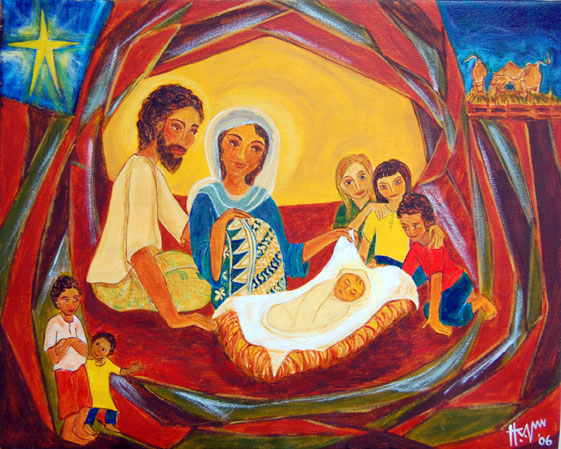
God Is With Us, by Malaysian artist Hanna Varghese, 2006

Now the main point of what we are saying is this: We do have such a high priest, who sat down at the right hand of the throne of the Majesty in heaven, and who serves in the sanctuary, the true tabernacle set up by the Lord, not by a mere human being.

Every high priest is appointed to offer both gifts and sacrifices, and so it was necessary for this one also to have something to offer. If he were on earth, he would not be a priest, for there are already priests who offer the gifts prescribed by the law. They serve at a sanctuary that is a copy and shadow of what is in heaven. Therefore, Moses was warned when he was about to build the tabernacle: “See to it that you make everything according to the pattern shown you on the mountain.” But in fact, the ministry Jesus has received is as superior to theirs as the covenant of which he is mediator is superior to the old one, since the new covenant is established on better promises.

For if there had been nothing wrong with that first covenant, no place would have been sought for another. But God found fault with the people and said:

“The days are coming, declares the Lord,
    when I will make a new covenant
with the people of Israel
    and with the people of Judah.
It will not be like the covenant
    I made with their ancestors
when I took them by the hand
    to lead them out of Egypt,
because they did not remain faithful to my covenant,
    and I turned away from them,
declares the Lord.
This is the covenant I will establish with the people of Israel
    after that time, declares the Lord.
I will put my laws in their minds
    and write them on their hearts.
I will be their God,
    and they will be my people.
No longer will they teach their neighbor,
    or say to one another, ‘Know the Lord,’
because they will all know me,
    from the least of them to the greatest.
For I will forgive their wickedness
    and will remember their sins no more.”

By calling this covenant “new,” he has made the first one obsolete; and what is obsolete and outdated will soon disappear. (NIV)

Our wait is nearly over. Christmas Day is almost here. The Messiah is coming. I genuinely believe that Jesus is the mid-point of history; everything for all time hinges upon Christ’s incarnation. The most cataclysmic event in the history of the world is a birth. The hopes of humanity are focused, of all things, in a stinky old feeding trough for animals – a manger.

Yes, Christians put a lot of focus on the cross and resurrection. Yet, the incarnation was the signature event of God’s breaking into this world. The inconceivable was conceived. God became human. Nothing would ever be the same again….

Nativity by African artist Joseph Mulamba-Mandangi, 2001

Jesus is our great high priest, the nexus between heaven and earth. All else are only mere shadows of the real Savior. Christ is the hinge upon which our own personal lives turn. The old system of law fades and gives way to the person for whom it all pointed. For the law, as important as it was, has never been able to save. In Christ there is a new covenant established by grace, taking care of the sin issue once for all.

Through the Christ child, all other means of deliverance have become obsolete. No matter how much he washed his hands, Pilate could not wash away his guilt. Despite all our efforts to hide or undo our shame, it will not go away. It is through Jesus that all guilt and shame have been banished. Human iniquity is taken away. All that we have done and left undone is forgiven – our sin is purged forever.

A new age has dawned. A new era has been inaugurated. The miracle of the Nativity explodes with continuing effect throughout history. Its continuing effects can still be felt, two-thousand years later. Nothing will ever undo the power of love and grace which was unleashed in the little town of Bethlehem.

Here is a clear and confident declaration to any and all in despondency or despair, no matter the reasons why: We may feel crushed, dejected, confused, or broken because of this past year’s events; but our salvation depends not on our mood or the constant changing of circumstances. Christ has offered himself once for all. The work is finished. Our faithful high priest is even now interceding for you and me in heaven.

Our faith is grounded not in our pedigree, our position, or our ability to produce but forever in what Christ has done in becoming human on our behalf. See the manger where he lies. Know that salvation is before us. Believe the promise of God.

May this eternal truth be always on our hearts:
That the God who breathed this world into being
Placed stars into the heavens
And designed a butterfly’s wing
Is the God who entrusted his life
to the care of ordinary people
became vulnerable that we might know
how strong is the power of Love
A mystery so deep it is impossible to grasp
A mystery so beautiful it is impossible to ignore.


Hebrews 2:1-9 – Paying Attention

Calvin and Hobbes - paying attention

We must pay the most careful attention, therefore, to what we have heard, so that we do not drift away. For since the message spoken through angels was binding, and every violation and disobedience received its just punishment, how shall we escape if we ignore so great a salvation? This salvation, which was first announced by the Lord, was confirmed to us by those who heard him. God also testified to it by signs, wonders, and various miracles, and by gifts of the Holy Spirit distributed according to his will.

It is not to angels that he has subjected the world to come, about which we are speaking. But there is a place where someone has testified:

“What is mankind that you are mindful of them,
a son of man that you care for him?
You made them a little lower than the angels;
you crowned them with glory and honor
     and put everything under their feet.”

In putting everything under them, God left nothing that is not subject to them. Yet at present we do not see everything subject to them. But we do see Jesus, who was made lower than the angels for a little while, now crowned with glory and honor because he suffered death, so that by the grace of God he might taste death for everyone. (NIV)

My wife and three daughters all have attention deficit disorder (A.D.D.). Although many people believe this to be a disadvantage, I have noticed that since their brain chemistry doesn’t have a good filter for filtering all the stimuli they hear each day, each of them are much more intentional about picking out the voice they want to hear and engaging with it.  Whereas you and I might take this for granted, the women in my life know the value of creating the skills to pay attention.

The ability to pay attention and listen is necessary for a sustainable Christian life. The consequence of not developing such competency is that we will drift away – our minds will wander and allow other competing voices to overwhelm the singular voice of Jesus.  Taking salvation for granted may be setting us up for spiritual failure. That is, we think we already know about Christ’s person and work, so we neglect to really pay attention. Bad idea.

Assuming we are paying attention is not the same thing as actually doing it. Assumptions lead to drifting away from truth.  We are meant to have continual reminders of Christ’s redemptive events. We are to avoid the precarious position of being lost in a sea of competing voices. We need an intentional plan for paying attention without assuming we will be focused. Along with paying attention to our physical health and being vigilant about keeping the coronavirus at bay, here are a few ways of daily being mindful of our spiritual health:

  • Read the Scripture each day with a combination of standing and sitting, reading silently and out loud.
  • Hold a cross or other Christian reminder in your hand and feel free to fidget with it.
  • Journal your thoughts in a notebook.
  • Set a consistent time and place for bible reading and prayer.
  • Use different translations and versions of the Bible to read.
  • Go outside occasionally and pray while walking.
  • Focus on your breathing, and consider using breath prayers, i.e. Breathe out: “Speak Lord.” Breathe in: “I am listening.”
  • Drink some coffee, tea, or something soothing, and picture the comfort of Christ coming into your life.
  • Be aware of distractions and acknowledge them without judging yourself.
  • Observe the Christian Year and the Daily Lectionary.

While some might argue that observing Lectionaries, the Church Calendar, Christian seasons, and worship liturgies are vain repetition, I insist otherwise: We are in grave danger of not paying attention to what we have heard, lest we drift away from it.  Like a beach goer on the lake drifting on her flotation device far out from shore, we can be unaware of how far we have strayed from our spiritual moorings.  If the passion and death of Jesus can only get a shoulder shrug and a “meh” out of us, there is a real problem.

Forming habits of worship, fellowship, service, and piety are essential to deliberately maintaining attention to Jesus. Perhaps if we all had spiritual A.D.D. we would be more intentional about grafting reminders and practices into our lives.

Ignorance does not come from a lack of education; it comes from a failure to pay attention to the most important things in life.

God pays attention to us in a special way, different from all other creation. As the only creatures for whom the image and likeness of God resides, we have an innate sense of connection with the divine. Paying attention to things, especially to what Christ has secured for us through the cross, reflects the God who is continually observing humanity.

May your contemplation of Christ and his redemptive events of incarnation, holy life, teaching, death, resurrection, and ascension be always fresh and continually meaningful.

Soli Deo Gloria.

Luke 10:21-24 – Freedom and Blessing

Ethiopian Jesus 2
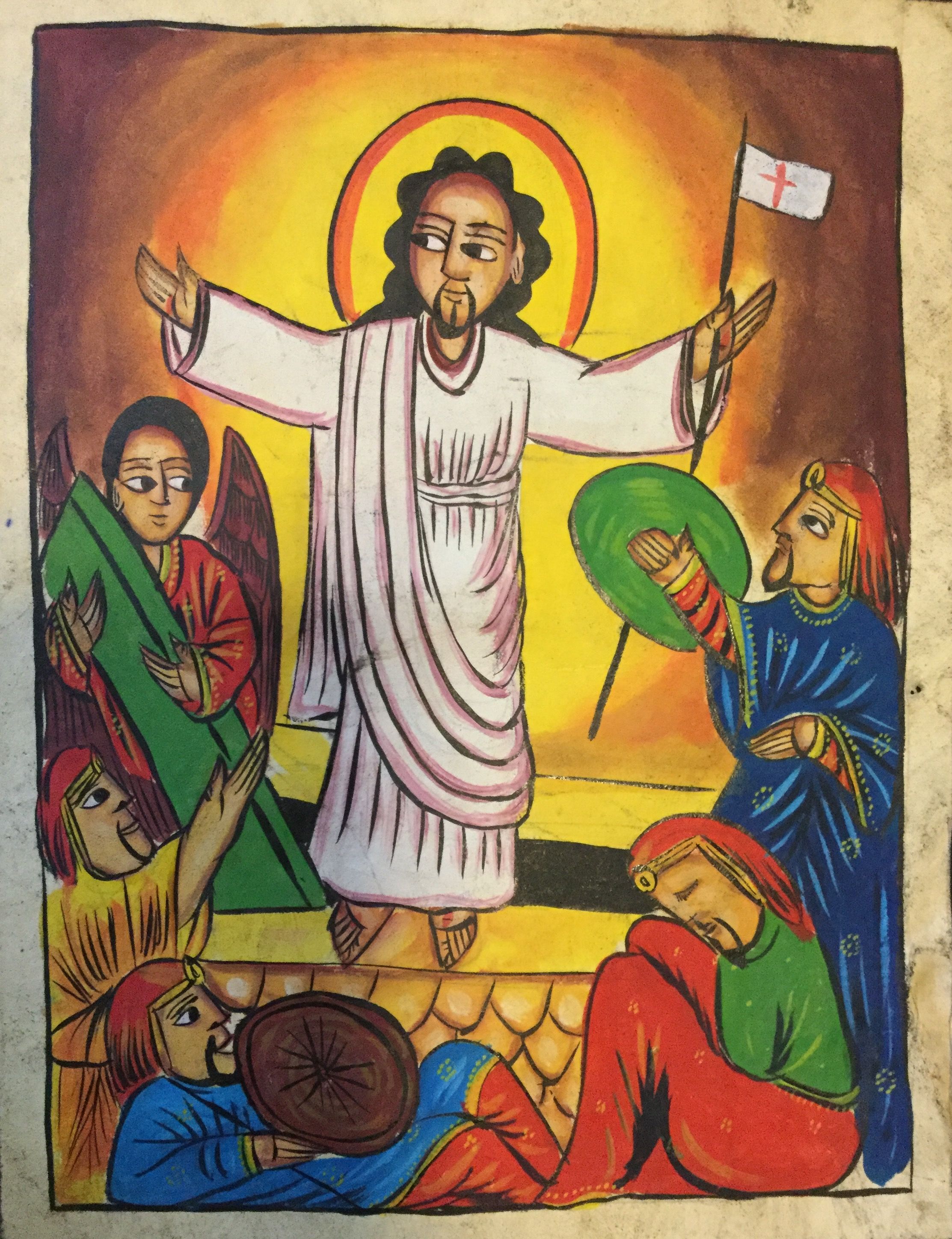
Ethiopian Orthodox depiction of Jesus teaching

Then Jesus rejoiced in the Holy Spirit and said, “I praise you, Father, Lord of heaven and earth, because you have hidden these things from the people who are wise and smart. But you have shown them to those who are like little children. Yes, Father, this is what you really wanted.

“My Father has given me all things. No one knows who the Son is, except the Father. And no one knows who the Father is, except the Son and those whom the Son chooses to tell.”

Then Jesus turned to his followers and said privately, “You are blessed to see what you now see. I tell you, many prophets and kings wanted to see what you now see, but they did not, and they wanted to hear what you now hear, but they did not.” (NCV)

A healthy view of Holy Scripture is to look at it as an unfolding drama of redemption. Ever since the fall of humanity, God has been on a rescue mission to reclaim, redeem, and restore people. This human project has obviously taken several millennia; and, it still has not reached its fulfillment.

The Christian tradition understands that the climax of victory and final restoration to our true state as humans will occur when Christ returns. By warning us that divine mysteries are hidden to some and revealed to others is Jesus’ way of cautioning us toward triumphalism and self-congratulation. Yes, redemption is a reality; and, it is also not a reality. It is both here and is coming. We are delivered from sin, death, and hell – and, we still labor against the evil machinations of systemic world problems, our own sinful nature, and a demonic realm which is looking for every opportunity to exploit sin’s residue upon the earth.

What this all means on a practical basis is that the good old days for some were the bad old days for others. History is always written by the winners and those in power. The hidden voices are typically squelched. The vision of Jesus is that all kinds of people, not just a certain segment of winners, should enjoy God’s favor.

There were ancient people who longed for spiritual and physical freedom. They looked forward into history and had the hope of Messiah and God’s promises being fulfilled. History is still unfolding. People yet remain locked in personal bondage and large swaths of humanity still experience oppression and a longing to enjoy blessings which others possess and take for granted.

On this Independence Day in the United States it is important that we recognize and hold together both the blessings of realized freedom along with the limits of others’ freedom. And, with this realization, we continue to actively work for all people and keep praying that God’s kingdom come and God’s will be done, here on earth, as it is always done in heaven.

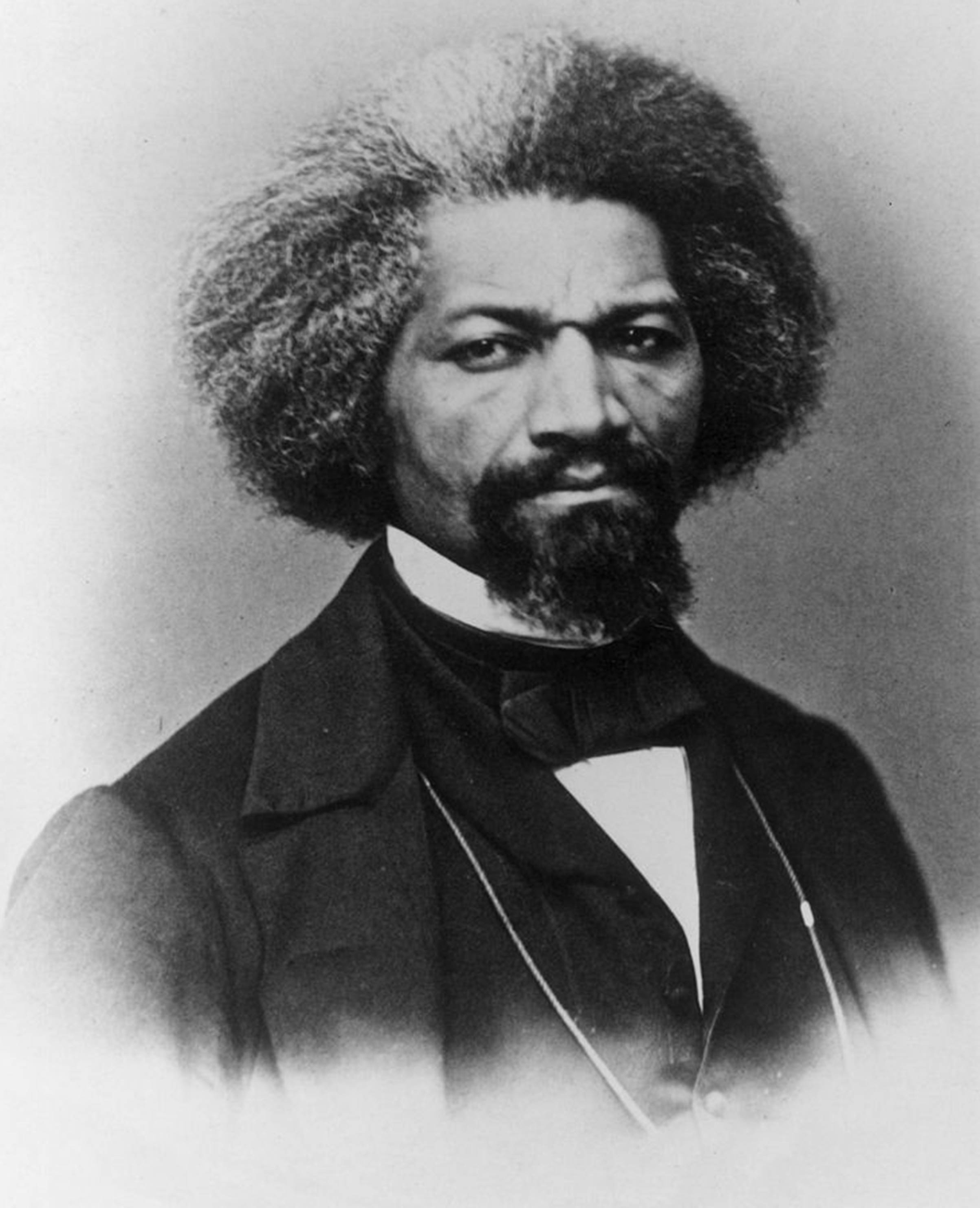
Frederick Douglass
Frederick Douglass, circa 1852

So, today, I am lifting a voice from history which exemplifies the struggle of the black experience in America. The following is a small portion from a speech by the ex-slave Frederick Douglass orated on July 4, 1852, nine years before civil war, with President Millard Fillmore and many congressional politicians in attendance:

“The feeling of the nation must be quickened; the conscience of the nation must be roused; the propriety of the nation must be startled; the hypocrisy of the nation must be exposed; and its crimes against God and man must be proclaimed and denounced. What, to the American slave, is your 4th of July? I answer: a day that reveals to him, more than all other days in the year, the gross injustice and cruelty to which he is the constant victim. To him, your celebration is a sham; your boasted liberty, an unholy license; your national greatness, swelling vanity; your sounds of rejoicing are empty and heartless; your denunciations of tyrants, brass fronted impudence; your shouts of liberty and equality, hollow mockery; your prayers and hymns, your sermons and thanksgivings, with all your religious parade, and solemnity, are, to him, mere bombast, fraud, deception, impiety, and hypocrisy — a thin veil to cover up crimes which would disgrace a nation of savages. There is not a nation on the earth guilty of practices more shocking and bloodier than are the people of these United States, at this very hour.”

Because history is forever unfolding, freedom and blessing develop over time and come more powerfully to some than others. True spiritual discernment, with the awareness to labor on behalf of the common good, does not ultimately come through astute observation and superior intellect; it comes by divine revelation. God will both conceal and reveal according to divine purposes and not human agendas.

Christian spirituality cannot be reduced to praying a sinner’s prayer and then maintaining a holding pattern on earth until heaven. Rather, Jesus remains present in this world through the person of the Holy Spirit and is continually interceding on behalf of those who need freedom and blessing. As Christ’s Body, Christians are to be the hands and feet of Jesus, animated by the Spirit to bring God’s ethical and benevolent regime to those who need it most.

If we are blessed, we are to pass blessing on without prejudice. For the kingdom of God belongs to the poor in spirit.

Dear God, Creator of the universe and all that inhabit it, we come as your Church, and as individuals, in humble submission to your word and your way. God, you are the Alpha and Omega, The Almighty Judge and The Forgiver of All Sins, so we come with humility and contrition on behalf of generations past, present and those yet unborn. We ask that you forgive us and create in us a new spirit. Bind our hearts and send forth the healing power that you and you alone can give to us and this sin-sick world. Bring us into reconciliation with one another and restore us to your righteous and holy path. Amen.

Galatians 5:2-6 – Faith Expressing Itself Through Love

The Sneetches

Mark my words! I, Paul, tell you that if you let yourselves be circumcised, Christ will be of no value to you at all. Again, I declare to every man who lets himself be circumcised that he is obligated to obey the whole law. You who are trying to be justified by the law have been alienated from Christ; you have fallen away from grace. For through the Spirit we eagerly await by faith the righteousness for which we hope. For in Christ Jesus neither circumcision nor uncircumcision has any value. The only thing that counts is faith expressing itself through love. (NIV)

Everyone needs the grace of faith expressing itself through love. I didn’t grow up committed to learning the Bible or following Christ. I pretty much went my own way throughout childhood, and especially the teenage years. I still remember what it felt like to not follow in the way of Christ. My view of the world was jaded, believing that most of humanity were basically uncaring self-absorbed creatures. I also knew the darkness of my own heart. When people, as I did long ago, view the world and self this way, there is a tragic loneliness where no one reaches out to the other, since everyone is guarded. A person and a world devoid of grace and reliant on law is, at best, a harsh place; and, at worst, a sort of dystopian nightmare.

It seems people who have a graceless past and only looked out for themselves often have a temptation to embrace strict rules when they become Christians. They know what it feels like to not have Jesus in their lives, so they sometimes, out of fear of returning to the old life, go beyond Scripture and impose standards on themselves, and then others, to keep on the straight and narrow to avoid sin.

If, or when, that happens, the Apostle Paul has something to say about it.  Embracing certain practices to obtain or maintain righteousness mean diddly-squat in God’s kingdom.  Here is how the Common English Bible version translates Paul’s words to the church who went down the path of strict outward rule-keeping:

“You people who are trying to be made righteous by the Law have been estranged from Christ. You have fallen away from grace! We eagerly wait for the hope of righteousness through the Spirit by faith. Being circumcised or not being circumcised doesn’t matter in Christ Jesus, but faith working through love does matter.” (Galatians 5:4-6, CEB)

A form of Christianity which ignores God’s grace in favor of controlling one’s own faith through certain rules is not Christianity at all, and Paul would have nothing to do with it. His position was clear and pointed:

“You were called to freedom, brothers and sisters; only don’t let this freedom be an opportunity to indulge your selfish impulses but serve each other through love.” (Galatians 5:13, CEB)

Grace is the currency of God’s kingdom, flowing freely through love. God has your back. With him we need not be guarded. God’s grace forgives, and never runs out. God’s love endures and never withdraws. When we get a hold of this essential and beautiful truth about God, the only rule we want to keep is Paul’s admonition to the Roman church:

“Let no debt remain outstanding, except the continuing debt to love one another, for whoever loves others has fulfilled the law.” (Romans 13:8, NIV)

So, are there any practices, rules, beliefs, or doctrines you impose on yourself which are burdensome to you?  Why do you do them? Do you expect others to do them, too? What would change if you threw grace and love in the mix?

It must continually be borne in mind that love does not foster an antinomian spirit of being against the law because love itself is the fulfillment of law. Paul, again, explained his reasoning:

The commandments, “You shall not commit adultery,” “You shall not murder,” “You shall not steal,” “You shall not covet,” and whatever other command there may be, are summed up in this one command: “Love your neighbor as yourself.” Love does no harm to a neighbor. Therefore, love is the fulfillment of the law. (Romans 13:9-10, NIV)

The Apostle Paul’s issue was not so much with circumcision itself as it was why the church wanted to practice it to begin with. Circumcision has always been an outward sign of an invisible reality – for the Jewish people – a truth which seemed lost on the Gentile churches. Paul’s agitation and frustration had to do with the church’s reason for considering circumcision. Much like the star-bellied Sneetches of Dr. Seuss’s classic story, the impetus behind wanting circumcision was to leverage power and superiority over others.

A vision of a new egalitarian society of redeemed persons based in the finished work of Jesus Christ (grace) was at risk, and Paul was going to address any imposed practices of exclusion (law) which would compromise and erode true community. Methinks the Apostle Paul and Dr. Seuss would have gotten along well together:

The day they decided that Sneetches are Sneetches

And no kind of Sneetch is the best on the beaches

That day, all the Sneetches forgot about stars

And whether they had one, or not, upon thars.

The Sneetches, by Dr. Seuss, 1961

Gracious God, your love has extended so far as to give your one and only Son on our behalf.  Through Jesus, I embrace the faith and love gifted to me through his redeeming work.  Help me to daily die to myself and my propensity for outward rule-keeping, and to live the gracious life you died to procure for me in the power of your Holy Spirit.  Amen.