Luke 13:31-35 – Blessed is He Who Comes in the Name of the Lord

Blessed is He Who Comes in the Name of the Lord, by José Luis Castrillo

At that time some Pharisees came to Jesus and said to him, “Leave this place and go somewhere else. Herod wants to kill you.”

He replied, “Go tell that fox, ‘I will keep on driving out demons and healing people today and tomorrow, and on the third day I will reach my goal.’ In any case, I must press on today and tomorrow and the next day—for surely no prophet can die outside Jerusalem!

“Jerusalem, Jerusalem, you who kill the prophets and stone those sent to you, how often I have longed to gather your children together, as a hen gathers her chicks under her wings, and you were not willing. Look, your house is left to you desolate. I tell you – you will not see me again until you say, ‘Blessed is he who comes in the name of the Lord.’” (New International Version)

King Herod of Judea, who was in the pocket of the Roman Empire, was issuing threats against Jesus. And those threats had some teeth behind them. Herod had recently beheaded Christ’s friend and cousin, John the Baptist (Luke 9:7-9). Yet, Jesus seemed unconcerned by the warnings. He made it clear that he was going to keep doing what he was doing, unfazed by Herod’s bluster.

Jesus had no intention of halting his travels, even because of a credible threat by the governing powers. Christ emphasizes his words by assuring his listeners that the work he is doing will be done today, and the next, and the day after that—building ultimately to his greatest work of securing redemption through his crucifixion and resurrection. 

I hope to be always journeying towards Jerusalem with a heart full of compassion that will not waver in the midst of violent killing and injustice. That isn’t easy, yet I know that my humble pilgrimage with Jesus will be worth it all, in the end.

Yet, for now, I need to make a stop in Bethlehem. I must follow the star to the place where Christ the newborn king is lying in a simple stinky feeding trough. The juxtaposition of that reality could not be more pronounced. The rightful Lord of all, far more powerful than old King Herod or the Roman Emperor, comes to earth not to be served, but to serve, and give his life as a ransom for many. (Mark 10:42-45)

What’s more, Jesus deliberately donned the clothing and postured himself as a lowly servant throughout his earthly ministry. Whereas Herod acted the predictable part of a power hungry worldly ruler, squelching all rivals to the throne, Jesus shared his authority with others, along with a promise of continual presence. (Matthew 2:16-18, 28:16-20)

“Almighty God, give us grace to cast away the works of darkness and put on the armor of light, now in the time of this life, in which your Son Jesus Christ came to visit us in great humility; So that, at the last day, when he shall come again in his glorious majesty to judge the living and the dead, we may rise to the life immortal.” 

Book of Common Prayer

Jesus is down for the struggle. He knows that injustice and systemic evil must be carefully rooted out. He understands that hearts and minds aren’t changed overnight. It will take time. Yet, Christ is in it for the long haul. The Lord is patiently, and sometimes imperceptibly, using divine power and authority to preserve the good and weed out the bad.

It will take a long time, and will be an extended process, because there are so many hard hearts. Jesus was ready, willing, and able to gather people together, as a mother hen gathers her chicks – yet there was an unwillingness to it. And Christ isn’t in the business of twisting arms and manipulating others, like Herod.

Jesus invites. He doesn’t squeeze people like an orange to get their juice. Christ carefully prepares a meal. He sets the table himself. He gives of himself. Like some wildly potent superfood, a bit of wine and morsel of bread is more than enough to fill the hungry soul and thirsty spirit.

There is always room at the Table.

There is room for you and for me. There is room for every kind of person – from every nation, race, gender, ethnicity, class – no matter the distinctions and no matter the past. It is the love of God in Christ, not the judgment, which brings people peace and salvation. It comes through a baby, not some wily old fox of a ruler.

Eventually, the phrase will be uttered, “Blessed is he who comes in the name of the Lord.” Jesus pulled this phrase from the Old Testament psalms. He did this, knowing quite well the context surrounding the verse:

The stone the builders rejected
    has become the cornerstone;
the Lord has done this,
    and it is marvelous in our eyes.
The Lord has done it this very day;
    let us rejoice today and be glad.

Lord, save us!
    Lord, grant us success!

Blessed is he who comes in the name of the Lord. (Psalm 118:22-26, NIV)

The chicks might scatter and refuse to be gathered. The builders may reject the crucial cornerstone and still try to build. Yet, it will not always be this way. As we celebrate the first advent of Christ in his incarnation, the second advent is continually in view. Christ is coming… again. The time is near….

Look! He comes with the clouds of heaven.
    And everyone will see him—
    even those who pierced him.
And all the nations of the world
    will mourn for him.
Yes! Amen! (Revelation 1:7, NLT)

The triumphal entry of Jesus on Palm Sunday is followed by a triumphal entry into my heart, and the hearts of many. And there is coming yet another triumphal entry, back to this earth. All things will made new….

“There will be no more death, no more grief or crying or pain. The old things have disappeared.” Then the one who sits on the throne said, “And now I make all things new!” (Revelation 21:4-5, GNT)

May it be so, to the glory of God.

Hebrews 10:10-18 – Out with the Old, In with the New

Because Jesus Christ did what God wanted him to do, we are all purified from sin by the offering that he made of his own body once and for all.

Every Jewish priest performs his services every day and offers the same sacrifices many times; but these sacrifices can never take away sins. Christ, however, offered one sacrifice for sins, an offering that is effective forever, and then he sat down at the right side of God. There he now waits until God puts his enemies as a footstool under his feet. With one sacrifice, then, he has made perfect forever those who are purified from sin.

And the Holy Spirit also gives us his witness. First he says,

“This is the covenant that I will make with them
    in the days to come, says the Lord:
I will put my laws in their hearts
    and write them on their minds.”

And then he says, “I will not remember their sins and evil deeds any longer.”So, when these have been forgiven, an offering to take away sins is no longer needed. (Good News Translation)

As I sit at my computer, easily keyboarding my thoughts, it is almost inconceivable to me that I made it through my undergraduate college days in the early 1980s with a manual typewriter and notetaking with the old-fashioned pen and spiral notebook.  No cell phone, no tablet, no electronic devices aiding me through my education. Typewriters are now obsolete, along with corded dial telephones and wringer washers.

Yet even more incredible is the complete replacement of an old mundane system of ritual sacrifice to a religion of the heart in which God remembers the people’s sins no more. This is such a radical change that it would be like having self-cleaning dishes or total speech-to-text “writing” of “papers.” 

The new order of things described in Hebrews is so much more than a labor-saving device; it is a completely different system that leaves the old system obsolete forever. That is what Jesus Christ’s once-for-all sacrifice did on our behalf.

We live in a New Covenant era in which God has put divine laws on our hearts and written them on our minds. No typewriter, no computer, no keyboard necessary, because the blood of Christ has introduced a seminal change in how we relate to God. 

There is now a thorough forgiveness that no longer requires any labor, ritual, or work. Indeed, it is finished. Now, we have the privilege and opportunity of living into the new reality graciously provided for us. It is an era of great peace, joy, and goodwill.  It is so good that it would be absolutely ridiculous to go back to the old way.

So, slow down enough in this season to connect or re-connect with a most wonderful truth: Jesus Christ came to save sinners. Gratitude for our salvation from sin, death, and hell, recognized and acknowledged each day, helps to stave off living in the past.

Continually looking at a bygone era as the good old days probably wasn’t, in reality, near as great as it’s remembered. That’s because when things are hard in the present, we often reflexively retreat into the past, cherry-picking some good memories, then constructing a mental narrative without all the bad stuff which actually went along with it.

Instead, in this Advent season, Christians purposely focus upon and remember God’s merciful descent to live among humanity. Christ lived, died, rose from death, and is alive – interceding for us continually. Past and present come together in the person of Jesus.

The Word became flesh and blood,
    and moved into the neighborhood.
We saw the glory with our own eyes,
    the one-of-a-kind glory,
    like Father, like Son,
Generous inside and out,
    true from start to finish. (John 1:14, MSG)

The good news of Christianity is that we are gloriously forgiven and redeemed because of Christ, given for us, the once for all sacrifice for sin.

May this season be full of grace and wonder for you, as you pilgrim to the manger and adore Christ the newborn king.

Saving God, you have completely taken care of the sin issue once and for all through the blood of your Son.  Forgive me for my predilection to retreat into old obsolete ways of trying to earn peace and joy, instead of adopting the new, which sometimes seems almost too good to be true.  Thank you for deliverance and new life in Jesus Christ.  Amen.

The Christian Year

There are, in reality, two reasons to celebrate today. Not only is it right to say, “Happy Thanksgiving,” it’s also appropriate to say, “Happy New (Christian) Year!” That’s because, for the past two-thousand years, Christians have marked time differently than their secular culture.

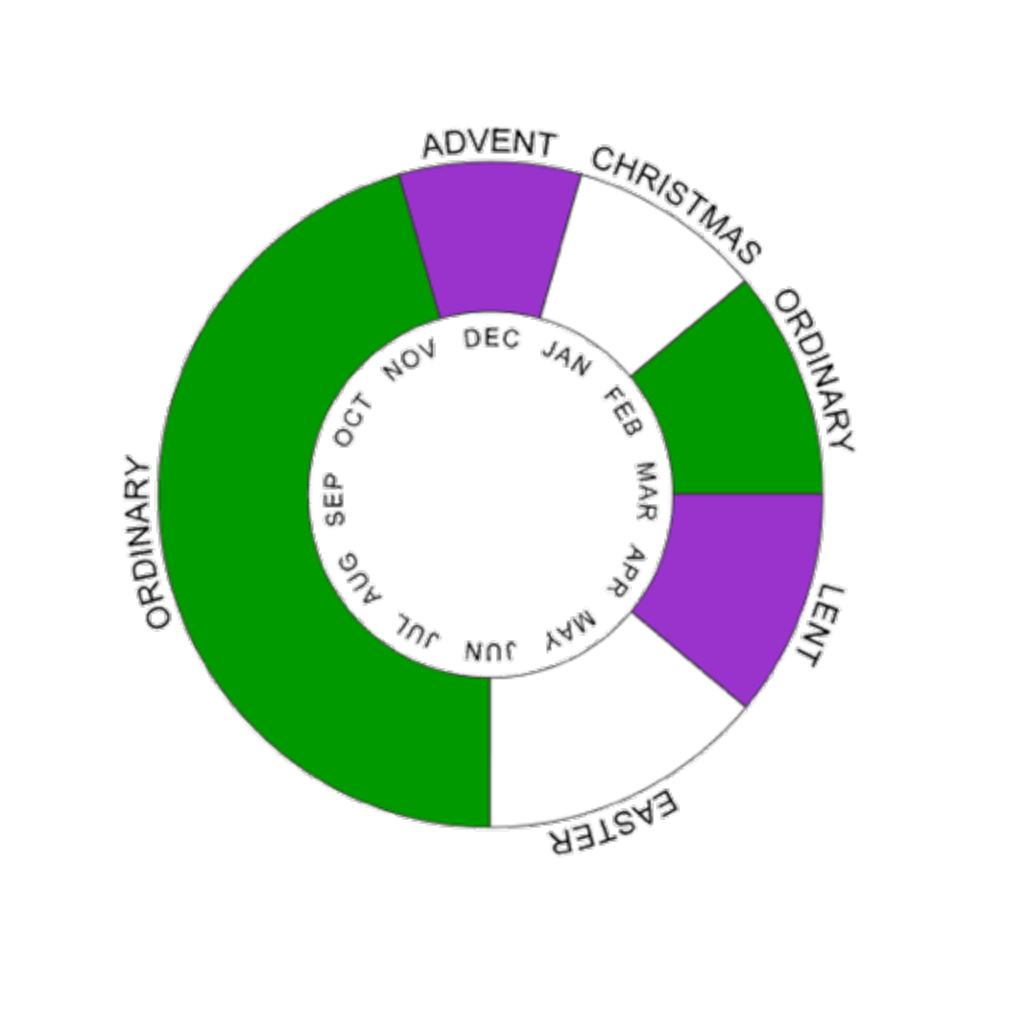
The “Christian Year” (or “Church Calendar”) refers to a yearlong calendar that marks time according to God’s activities rather than ours. It is to live life in a rhythm with Christ at the center of worship.

Time is referenced in the Bible as both chronological (Chronos) and seasonal (Kairos). The Christian Year is a co-mingling of both these kinds of time. Liturgical Christians celebrate events in which God acted in history for the benefit of his people. In order to remember those moments, dates have been assigned on the Christian Calendar so that we will not forget these significant events and praise God for what he has done.

So, then, to observe The Christian Year helps Christians as God’s people to recall and retell the story of God, especially the redemptive events of Jesus. In doing so, it provides a guide for spiritual growth. The Christian Calendar is arranged in such a way as to proclaim the gospel of Jesus Christ over the course of a year. 

One of the ways this helps followers of Christ to remember distinct seasons is through the liturgical colors: 

  • Purple signifies a time for preparation and penitence.
  • White represents celebration, joy, and victory.
  • Green lets us know it is time to focus on spiritual growth and mission.
  • Red helps us recall the Passion of Christ and the fire of the Holy Spirit.

The Christian Year is organized and arranged with these seasons:

Advent The Christian Year begins not on January 1, but four Sundays before Christmas Day and up to Christmas Eve.  The purpose of Advent is to anticipate Christ’s incarnation and prepare Christians to celebrate the coming of Jesus.  We are also reminded that Jesus will return again at the end of the age.

Christmas Yes, Christmas is more than just a day on the Church Calendar and encompasses the twelve days from December 25 to January 5 (you may recognize the “12 Days of Christmas”).  Christmas is a celebration of the birth of Christ.

EpiphanyEpiphany follows Christmas from January 6 to the day before Ash Wednesday.  The term Epiphany means “manifestation.”  This is a celebration of God’s revelation, his manifestation to the entire world, not just to the Jews, but to the Gentiles, as well.  Epiphany emphasizes Jesus Christ’s earthly ministry of teaching, healing, and preaching.

Lent There are forty days in the season of Lent, from Ash Wednesday to Holy Saturday.  Lent is a time to recall Christ’s temptation, conflict, suffering, and death.  It is a season to contemplate Christian discipleship through the light of Christ’s Passion, engage in repentance, and put deliberate focus on spiritual disciplines that connect the penitent with Jesus.

EasterAs with Christmas, Easter is not just one Sunday; it is a season of fifty days up to the day of Pentecost.  Easter celebrates the resurrection of Jesus; helps believers recognize new life in Christ; and includes celebrating the Ascension of the Lord.

Pentecost This season runs from Eastertide to the Sunday before Advent.  Pentecost celebrates the gift of the Holy Spirit, the birth of the church, acknowledges personal and communal spiritual power, and calls Christians to rejoice in receiving God’s power.

Ordinary TimeThis is the same season as Pentecost.  Ordinary time (also known as Proper Time) refers to the ongoing work of the church to spread the gospel of Jesus Christ, which is the typical, expected, proper and ordinary work of ministry that Christ’s followers are to do.

God of all time, you make all things new, bring hope alive in our hearts, and cause us to be born again. Thank you for this new Christian Year of following Jesus and all the potential it holds. Come and kindle in us a mighty flame so that in our time, many will see the wonders of God and live forever to praise your glorious name. Amen.

Hebrews 9:11-14 – A Clear Conscience

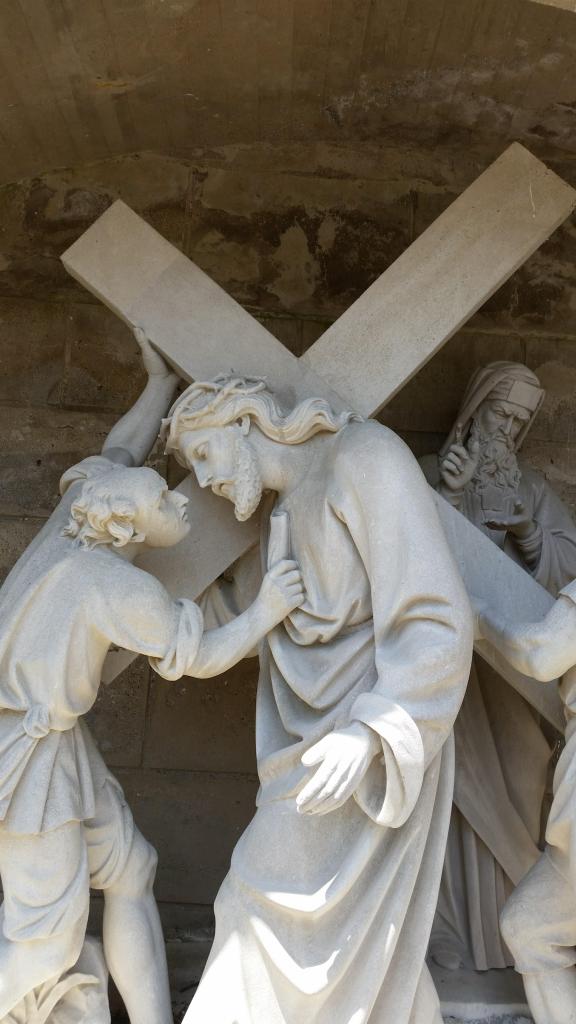
Stations of the Cross at Holy Hill, Hubertus, Wisconsin

When the Messiah arrived, high priest of the superior things of this new covenant, he bypassed the old tent and its trappings in this created world and went straight into heaven’s “tent”—the true Holy Place—once and for all. He also bypassed the sacrifices consisting of goat and calf blood, instead using his own blood as the price to set us free once and for all. If that animal blood and the other rituals of purification were effective in cleaning up certain matters of our religion and behavior, think how much more the blood of Christ cleans up our whole lives, inside and out. Through the Spirit, Christ offered himself as an unblemished sacrifice, freeing us from all those dead-end efforts to make ourselves respectable, so that we can live all out for God. (The Message)

We all have times when we feel guilty. Guilt, in and of itself, is a good thing. Guilt is the response of our conscience telling us we have done something wrong or have not done the good we know we ought to have done. It’s what we do with the guilt that determines the trajectory of our Christian lives. There are several ways we can respond to guilt.

  1. Denial. We can deny and rationalize our guilt by not accepting the truth about what we have done. Using phrases such as, “It’s not my fault,” “It’s only wrong if I get caught,” “I didn’t hurt anybody,” “They deserved it,” and “It’s not that bad,” has the effect of searing our conscience like a hot iron so that we eventually do not feel guilty. The inevitable result of this is hardness of heart.
  2. Shame. Another inappropriate way of dealing with guilt is the opposite of denying guilt; it is to hyper-focus on the guilt by feeling ashamed. Guilt feels bad for actions done or not done. Shame, however, feels bad for who I am, as if I am incapable of being good. Shame believes I do bad things because I am bad and deserve the consequences. In other words, shame is really false guilt.
  3. Inaction. Shame and false guilt may result in despair. We become inactive because of feeling discouraged or defeated. We might reason to ourselves, “What’s the point? I screw up everything I do.” So, we do nothing.
  4. Hyperactive. Some folks become a flurry of activity, working like crazy to feel better in the hope that guilt and shame disappear. It is to impose a penance upon yourself to try and cope with the icky feeling of guilt.

            The good news is that we can experience freedom from guilt and a clear conscience because of Jesus Christ.

  • If we have been victimized in the past, we no longer have to feel ashamed as though we caused or deserved the violence done to us.
  • If we have said or done some truly egregious things that displease God and damage others, we no longer have to live with the regret and the guilt on our consciences. 
  • If we have failed others and God by not living up to who we ought to be, we no longer have to live day after day with our consciences bound with guilt and shame.

            There are three reasons from Hebrews which tell us why we can have freedom from guilt and live with a clear conscience. They all focus on the person and work of Jesus Christ.

Christ has obtained eternal redemption for us by his blood.

Under the old sacrificial system, year after year, the priest offered the same sacrifices which never took away sin. The animal sacrifice was an act of worship in which the worshiper acknowledged guilt before God. The continuous ritual was designed to point forward to a better sacrifice.

The worshiper was purposely led to think, “Wouldn’t it be great if we didn’t have to do this all the time?” The blood of bulls and goats were an annual reminder of sins – such sacrifices never cleansed the conscience of the worshiper. Jesus Christ, however, is the sacrifice to end all sacrifices. Jesus has secured, once and for all, our eternal redemption through his own blood.

The death of Christ, Holy Hill, Hubertus, Wisconsin

Dr. Samuel Weinstein is the chief pediatric cardiac surgeon for a children’s hospital in the New York City. He once traveled to El Salvador to provide life-saving operations for less-fortunate children. Dr. Weinstein and his team operated on an eight year old boy. Twelve hours into the surgery, the procedure took a deadly turn.  

Dr. Weinstein said, “The surgery had been going well, but he was bleeding a lot and there were not many medicines we would use to stop the bleeding. After a while, they said they couldn’t give him blood because they were running out and he had a rare type.” The boy’s blood type was B-negative, which is present in only two percent of the population.

The only other person in the room with a blood type of B-negative was Dr. Weinstein. Immediately knowing what he had to do, he stepped down from the operating table. As his colleagues continued their work, Dr. Weinstein set aside his scalpel, took off his gloves, and began washing his hands and forearm. Then, in the corner of an unfamiliar operating room, the prestigious doctor from one of the most advanced hospitals in the world sat down to give away his own blood. 

When he had given his pint, Dr. Weinstein drank some bottled water and ate a Pop-Tart. Then—twenty minutes after stepping away from the table—he rejoined his colleagues. After watching his own blood circulating into the boy’s small veins, Dr. Weinstein completed the operation that saved the boy’s heart—and his life.

It is the blood of Jesus Christ which saves us from sin, death, and hell. Our condition is so dire that we can do nothing other than let Jesus deliver us. By faith, we trust Jesus to secure a new life for us free from guilt and shame.

Christ cleanses our consciences.

For some, the greatest prison is not tangible or physical – it is the prison of conscience bound and wracked by guilt and shame. Yet, Jesus has taken care of the problem of a guilty conscience once for all through his blood. Forgiveness comes through Jesus. Christ cleanses us from the inside-out and frees us from being slaves to our guilt.

In 1811, the U.S. government began collecting and storing letters like the following note dated from February 6, 1974: “I am sending ten dollars for blankets I stole while in World War II. My mind could not rest. Sorry I’m late.” It was signed by an ex-GI. And there was this postscript: “I want to be ready to meet with God.”  The U.S. government not only collects and stores these letters, but the Treasury Department established a fund and labeled it the “Conscience Fund.” Since its inception, the fund has grown to almost seven million dollars.

A clear conscience is worth a lot. If we try and impose penance upon ourselves, how do we know when it’s enough? In Christ, we are not just outwardly clean, but inwardly clean because of his finished work on the cross. 

Accepting this reality, through God’s eternal Spirit, helps us experience forgiveness and cleansing. The Holy Spirit takes the redemptive events of Jesus and applies them to our consciences so that we are assured of forgiveness.

Christ sanctifies our service.

In the Old Testament sacrificial system, the high priest entered the temple/tabernacle to offer animal sacrifices. Once a year, on the Day of Atonement (Yom Kippur) the priest entered the Most Holy Place. He slaughtered a heifer, took some blood, and sprinkled it on the altar. 

The priest had bells on his ankles when performing this ritual, along with a rope tied to one ankle. In case the judgment of God broke out on the priest and he was killed, then the other priests could reel him out of the Most Holy Place without entering themselves and being killed, as well.

There were several rituals to perform to access God. And, even then, the sprinkling of blood only outwardly took care of cleansing the people. But when Jesus offered himself once for all, the curtain separating the Most Holy Place from the people was torn from top to bottom. The way has been opened for complete purification, inside and out, a cleansing of the guilty conscience so that we might now serve the living God with freedom and confidence.

Since Christ has obtained redemption for us by his blood, cleansed our consciences, and sanctified our service, here’s how we can live into his finished work:

  • Confess and forsake known sin.

Those who hide their sins won’t succeed [shame] but those who confess and give them up will receive mercy. (Proverbs 28:13, CEB)

If we confess our sins, God will forgive us. We can trust God to do this. He always does what is right. He will make us clean from all the wrong things we have done. (1 John 1:9, ERV)

  • Ask forgiveness and be reconciled to anyone you have wronged. 

Jesus said, “So if you are offering your gift at the altar and remember there that another believer has something against you, leave your gift at the altar. First go away and make peace with that person. Then come back and offer your gift. (Matthew 5:23-24, GW)

  • Make restitution to those you have wronged. 

If any of you commit a crime against someone, you have sinned against me [God]. You must confess your guilt and pay the victim in full for whatever damage has been done, plus a fine of twenty percent. (Numbers 5:6-7, CEV)

  • Don’t procrastinate in clearing your wounded conscience.

Paul said he did his best to keep his conscience clear before God and others (Acts 24:16). Some people put off dealing with their guilt, believing their conscience will clear itself in time – but it will not. Procrastination only allows the guilt feelings to fester. Unchecked guilt eventually turns to shame. Today is the day to deal with guilt.

God forgives, not because of the quality of our prayers, but on the basis of Christ’s blood. We can now take advantage of our wonderful situation of freedom to serve the church and the world because God is bigger than a guilty conscience.