Hebrews 12:1-3 – Wednesday of Holy Week

As for us, we have this large crowd of witnesses around us. So then, let us rid ourselves of everything that gets in the way, and of the sin which holds on to us so tightly, and let us run with determination the race that lies before us. Let us keep our eyes fixed on Jesus, on whom our faith depends, from beginning to end. He did not give up because of the cross! On the contrary, because of the joy that was waiting for him, he thought nothing of the disgrace of dying on the cross, and he is now seated at the right side of God’s throne.

Think of what he went through; how he put up with so much hatred from sinners! So do not let yourselves become discouraged and give up. (Good News Translation)

“If there is a meaning in life at all, then there must be a meaning in suffering. Suffering is an ineradicable part of life, even as fate and death. Without suffering and death, human life cannot be complete.”

Viktor E. Frankl

We are moving, step by step, inexorably to the cross of Christ. Along the way we will face opposition, ridicule, misunderstanding, and betrayal. We will be befuddled and feel confused. The path of discipleship is not easy.

And yet, on this Holy Wednesday, today’s New Testament lesson informs us that all the suffering of Christ was motivated and animated because of joy. 

The road to the cross, along with the cross itself, is painful, in every sense of the word. None of this tortuous suffering seems joyful, at all! There’s no definition, in any dictionary, of joy including severe spiritual anguish, bodily harm, and emotional shame. Joy isn’t remotely mentioned when talking about betrayal from someone close to you.

Jesus did not relish the pain. He was no masochist. Pain with no purpose is nothing but tragic despair. Rather, Jesus clearly understood what the end of his suffering would accomplish: the saving of many lives.

It is most necessary that we do not try to sanitize Christ’s death.

Although many beautiful crosses can be found in stores, the cross of Jesus was anything but lovely to look at. It was bloody. The cross was a harsh implement of torture and execution, meant to expose the condemned to public shame.

Trying to make sense of this great sacrifice on our behalf can be difficult. No earthly illustration or word-picture can begin to adequately capture the idea of vicarious suffering. Perhaps, then, we may understand the necessity of discipline, effort, endurance, and yes, pain, in order to accomplish a goal. We know from agonizing experience that the realization of our most important goals requires a great deal of blood, sweat, and tears. 

In a former life I was a cross country runner (back far enough for Sherman to set the way-back machine). Whenever I was running on a road or a golf course, I would sometimes get that very nasty and sharp pain in my side while running. It is called a side cramp, or side stitch. 

If you have never experienced such a cramp, the pain feels like an intense stabbing, as if someone were taking a knife and twisting it inside you. Runners know there’s only one thing to do when this occurs: Keep running through the pain, and then it will subside in a few minutes. To stop running only exacerbates and prolongs getting over the hurt, not to mention losing a race.

Jesus endured the cross knowing he was going to experience terrible excruciating pain. He also knew that avoiding the shame and agony would only make things worse; it wouldn’t take care of the problem of sin. 

Jesus persevered through the foulness and degradation of the cross for you and me. All of the wretched pain was worth it to him. Christ did not circumvent the cross; he embraced it so that the result would be people’s deliverance from guilt and shame, death and hell. 

The end game of Christ’s redemptive work on the cross was joy over deposing the ruler of this dark world and obliterating the obstacles to people’s faith.

Suffering often does not fit into our equation of the Christian life. However, it needs to. No suffering, no salvation. Since Jesus bled and died for us, it is our privilege to follow him and walk with him along the Via Dolorosa, the way of suffering. 

Holy Week is a time to reflect and remember on such a great sacrifice, and to consider our Christian lives in the face of such great love. On this Wednesday, allow yourself to feel the bittersweet experience of simultaneous pain and joy – the very real bitterness of seeing the Lord crucified, along with the exultation of joy over being washed clean by the blood of the Lamb.

Gracious Lord Jesus, I give you eternal thanks for your mercy toward me through the cross. It is a small thing for me to follow you even it means great suffering on my part. My life is yours. Use it as you will, through the power of the Holy Spirit. Amen.


Revelation 19:1-8 – The Time Is Coming

Photo by Andrea Piacquadio on Pexels.com

After this I heard what sounded like the roar of a large crowd of people in heaven, saying, “Praise God! Salvation, glory, and power belong to our God! True and just are his judgments! He has condemned the prostitute who was corrupting the earth with her immorality. God has punished her because she killed his servants.” Again, they shouted, “Praise God! The smoke from the flames that consume the great city goes up forever and ever!” The twenty-four elders and the four living creatures fell down and worshiped God, who was seated on the throne. They said, “Amen! Praise God!”

Then there came from the throne the sound of a voice, saying, “Praise our God, all his servants and all people, both great and small, who have reverence for him!” Then I heard what sounded like a crowd, like the sound of a roaring waterfall, like loud peals of thunder. I heard them say, “Praise God! For the Lord, our Almighty God, is King! Let us rejoice and be glad; let us praise his greatness! For the time has come for the wedding of the Lamb, and his bride has prepared herself for it. She has been given clean shining linen to wear.” (The linen is the good deeds of God’s people.) (Good News Translation)

The past few years, it seems as if the world is upside-down. For many people, living on this earth has become something of a surreal experience of folks dying apart from loved ones, racism rearing its ugly head through microaggressions, as well as overt words and actions, and neighbors killed due to gun violence. The suffering is palpable.

However, things will not always be this way. There is coming a time when disease, death, and poverty will end. In the age to come there will be no more numbing grief, seemingly endless tears, constant oppression, grinding hardship, and silent suffering.

The day will arrive when, together with all saints past and present, and along with the angelic host, we will collectively shout, “Hallelujah!” The end of this present age will eventually come.

Time is nothing more than the relationship between events. When all events are ended, there will be no more time – only unending eternity in the presence of God. For the Christian, this is our hope and ultimate salvation. Our deliverance from sin, death, and hell will be complete.

So, we wait and watch, preparing ourselves for the consummation of God’s kingdom. Meanwhile, we are truly in an awkward time between the two advents of Christ. It is the already/not yet time. We are already saved, yet not fully; we are holy, yet not completely; we have our adoption papers as children of God, yet still wait for our celebration feast with Christ.

There are few times more impatient, agonizing, joyful, and hopeful than a marriage engagement. It’s as if two people are inextricably connected but not yet completely together.

I still remember the weird feeling of the six months between my engagement to my heart’s love and standing at the altar marrying my bride. Those months included every emotion imaginable, from exuberant happiness to agonizing waiting, along with hopeful anticipation and sheer nervousness.

It was a time, for me, of unique joy and unwanted suffering. Since I was separated by two-thousand miles from my beloved for most of our engagement, it was an unparalleled longing for the marriage to occur.

That is likely how believers have felt throughout the ages as they look forward to the second coming of Christ. In a period of hardship and even persecution, Christians long for their Savior – to be with Jesus forever and be shed of the world’s crud, the sinful nature, and the machinations of the devil.

In this present age, we have received the Holy Spirit as a sort of engagement ring, a constant sign and presence to help us until the marriage happens with Christ as groom and the Church as bride. Since we have not yet experienced this, it is difficult for us to anticipate just how incredible and inconceivable the coming age will be.

Yet, the Christian intuitively knows, by means of the Spirit, that the upcoming marriage supper will be a heavenly paradise – and so we long for it, especially in these days of uncertainty and difficulty.

Presently, the great harlot attempts to seduce the believers, if that were possible, away from Christ. However, along with all God’s holy angels, we will join in the heavenly chorus which continually sings, “Praise God!” to Father, Son, and Spirit.

The book of Revelation describes the end of history for the purpose of encouraging the saints of God in the present moment of hardship. God will, once and for all, destroy evil, and faithful believers will be united with Christ forever in glory.

So, as we plod through the Christian season of Lent, we do so with the anticipation and hope of Easter and new life. Because Jesus is risen from death, we gaze into the future longing for our own resurrection. Presently, we hold both suffering and glory together, the past and the future.

For it is the past redemptive deeds of Christ which guide us in the present and gives shape to our future. Christ shall return – and it will be soon.

Even so, come, Lord Jesus. Amen.

Blessed Is He Who Comes In the Name of the Lord

Welcome, friends, on this second Sunday in Lent. During his earthly ministry, Jesus had no intention of halting his travels because of all the unrest in the world. Christ assured his listeners that the work he is doing will be done today, and the next, and the day after that—building ultimately to his greatest work of securing redemption through his crucifixion and resurrection. Click the videos below and let us say together, “Blessed is he who comes in the name of the Lord!”…

Pastor Tim Ehrhardt, Luke 13:31-35

Lord, grant us simplicity of faith
and a generosity of service
that gives without counting cost.
A life overflowing with Grace
poured out from the One
who gave everything,
that we might show
the power of love
to a broken world,
and share the truth
from a living Word.
Lord, grant us simplicity of faith,
and a yearning to share it. Amen.

Luke 13:31-35 – Blessed Is He Who Comes In the Name of the Lord

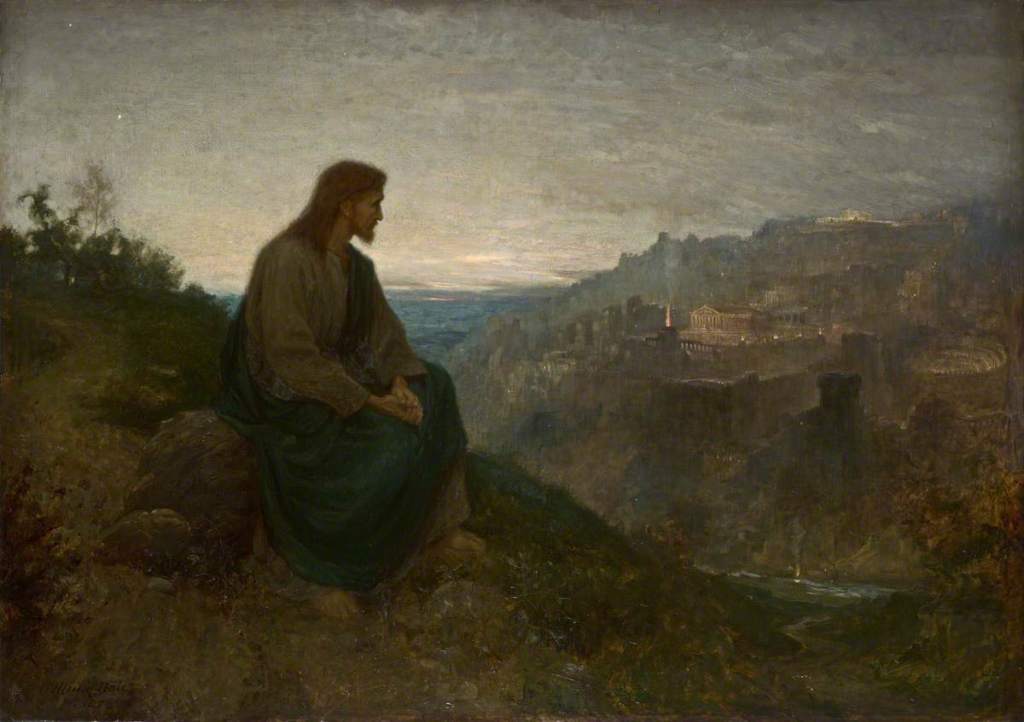
“If Thou Had’st Known” by William Brassey (1846-1917) Royal Scottish Academy of Art & Architecture; http://www.artuk.org/artworks/if-thou-hadst-known-186809

At that time some Pharisees came to Jesus and said to him, “Leave this place and go somewhere else. Herod wants to kill you.”

He replied, “Go tell that fox, ‘I will keep on driving out demons and healing people today and tomorrow, and on the third day I will reach my goal.’ In any case, I must press on today and tomorrow and the next day—for surely no prophet can die outside Jerusalem!

“Jerusalem, Jerusalem, you who kill the prophets and stone those sent to you, how often I have longed to gather your children together, as a hen gathers her chicks under her wings, and you were not willing. Look, your house is left to you desolate. I tell you – you will not see me again until you say, ‘Blessed is he who comes in the name of the Lord.’” (New International Version)

King Herod of Judea, who was in the pocket of the Roman Empire, was issuing threats against Jesus. And those threats had some teeth behind them. Herod had recently beheaded Christ’s friend and cousin, John the Baptist (Luke 9:7-9). Yet, Jesus seemed unconcerned by the warnings. He made it clear that he was going to keep doing what he was doing, unfazed by Herod’s bluster.

Jesus had no intention of halting his travels, even because of a credible threat by the governing powers. Christ emphasized his words by assuring his listeners that the work he is doing will be done today, and the next, and the day after that—building ultimately to his greatest work of securing redemption through his crucifixion and resurrection. 

I hope to be always journeying towards Jerusalem with a heart full of compassion that will not waver in the midst of violent killing and injustice. That isn’t easy, yet I know that my humble pilgrimage with Jesus will be worth it all, in the end.

A pilgrimage is an apt description for the Christian season of Lent. Believers journey with Jesus, making the slow trek with him through his earthly ministry and to Jerusalem, up the Mount of Olives. There Christ is crucified – and we with him:

I have been crucified with Christ and I no longer live, but Christ lives in me. The life I now live in the body, I live by faith in the Son of God, who loved me and gave himself for me. (Galatians 2:20, NIV)

So far, we have made a stop in Bethlehem, following the star to the place where the newborn king was laid in a simple stinky feeding trough. The juxtaposition of that reality could not be more pronounced. The rightful Lord of all, far more powerful than old King Herod or the Roman Emperor, comes to earth not to be served, but to serve, and give his life as a ransom for many. (Mark 10:42-45)

In our walk with Jesus, we observe him deliberately posturing himself as a lowly servant throughout his earthly ministry. Whereas Herod acted the predictable part of a power hungry worldly ruler, squelching all rivals to the throne, Jesus shared his authority with others, along with a promise of continual presence. (Matthew 2:16-18, 28:16-20)

There is nothing romantic about this journey, this walk with Christ. It is often a hard road, and many count the cost of discipleship and choose to walk away.

Yet, Jesus is down for the struggle. He knows that injustice and systemic evil must be carefully rooted out. He understands that hearts and minds aren’t changed overnight. It will take time. So, we walk slowly with our Lord because Christ is in it for the long haul. We see Jesus is patiently, and sometimes imperceptibly, using divine power and authority to preserve the good and weed out the bad.

Dealing with human sin and the awful fallenness of this world will take a while. It will be an extended process because there are so many hard hearts. Jesus was ready, willing, and able to gather people together, as a mother hen gathers her chicks – yet there was an unwillingness to it.

And Christ, the heavenly ruler, isn’t in the business of twisting arms and manipulating others, like Herod, the earthly ruler.

Instead, Jesus invites. He doesn’t squeeze people like an orange to get their juice. Christ carefully prepares a meal. He sets the table himself. He gives of himself. Like some wildly potent superfood, a bit of wine and morsel of bread is more than enough to fill the hungry soul and the thirsty spirit.

With Jesus, there is always room at the Table.

There is room for you and for me. There is room for every kind of person – from every nation, race, gender, ethnicity, class – no matter the distinctions and no matter the past. It is the love of God in Christ, not the judgment, which brings people peace and salvation. It comes through a baby who grew and learn and suffered, just like us, and not through some wily old fox of a ruler.

Eventually, the phrase will be uttered, “Blessed is he who comes in the name of the Lord.” Jesus pulled this phrase from the Old Testament psalms. He did this, knowing quite well the context surrounding the verse:

The stone the builders rejected
    has become the cornerstone;
the Lord has done this,
    and it is marvelous in our eyes.
The Lord has done it this very day;
    let us rejoice today and be glad.

Lord, save us!
    Lord, grant us success!

Blessed is he who comes in the name of the Lord. (Psalm 118:22-26, NIV)

The chicks may scatter and refuse to be gathered. The builders might reject the crucial cornerstone and still try to build. Yet, it will not always be this way. As we journey with Jesus, eventually along the Via Dolorosa, the way of suffering, the road to Calvary, with an eye to where this will all culminate at an empty tomb and a great celebration of new life.

We will not be looking down at our feet forever in sorrow but will lift our faces toward the clouds. Just as we see Jesus ascending, we shall see Christ coming again. The time is near….

Look! He comes with the clouds of heaven.
    And everyone will see him—
    even those who pierced him.
And all the nations of the world
    will mourn for him.
Yes! Amen! (Revelation 1:7, NLT)

The triumphal entry of Jesus on Palm Sunday is followed by a triumphal entry into my heart, and the hearts of many. And there is coming yet another triumphal entry, back to this earth. All things will made new….

“There will be no more death, no more grief or crying or pain. The old things have disappeared.” Then the one who sits on the throne said, “And now I make all things new!” (Revelation 21:4-5, GNT)

May it be so, to the glory of God.

Almighty God, you know that we have no power in ourselves to help ourselves: Keep us both outwardly in our bodies and inwardly in our souls so that we may be defended from all adversities that may happen to the body, and from all evil thoughts that may assault and hurt the soul, through Jesus Christ our Lord, who lives and reigns with you and the Holy Spirit, one God, for ever and ever. Amen.