
Ephesians 2:11-22 – Included

Therefore, remember that formerly you who are Gentiles by birth and called “uncircumcised” by those who call themselves “the circumcision” (which is done in the body by human hands)—remember that at that time you were separate from Christ, excluded from citizenship in Israel and foreigners to the covenants of the promise, without hope and without God in the world. But now in Christ Jesus you who once were far away have been brought near by the blood of Christ.

For he himself is our peace, who has made the two groups one and has destroyed the barrier, the dividing wall of hostility, by setting aside in his flesh the law with its commands and regulations. His purpose was to create in himself one new humanity out of the two, thus making peace, and in one body to reconcile both of them to God through the cross, by which he put to death their hostility. He came and preached peace to you who were far away and peace to those who were near.For through him we both have access to the Father by one Spirit.

Consequently, you are no longer foreigners and strangers, but fellow citizens with God’s people and also members of his household, built on the foundation of the apostles and prophets, with Christ Jesus himself as the chief cornerstone. In him the whole building is joined together and rises to become a holy temple in the Lord. And in him you too are being built together to become a dwelling in which God lives by his Spirit. (New International Version)

There is perhaps no better explanation in the entire New Testament about what the Church truly is than here in today’s lesson.

The redemptive events of Jesus – especially the crucifixion of Christ – has completely changed everything. The cross is the mid-point of history, the fulcrum in which all things in heaven and on earth hinge.

The cross has totally transformed our status from being:

  • in Adam (fallen and separated from God) to being in Christ (now lifted and in union with God)
  • in the flesh (driven by our immoral and unethical impulses) to being in the Spirit (now driven by moral and ethical desires)
  • a Jew or a Gentile (defined by race, ethnicity, etc.) to being one people of God, a new egalitarian society, the community of the redeemed, the Church.

We were once far from God. Now we are brought near through the blood of Christ.

We are included, not excluded; graced and loved, not shamed and shunned.

And our status isn’t based on physical circumcision but on circumcision of the heart, that is, by faith.

There was a time when we were estranged from God, as if we were migrants from another country, or aliens from another world. We were strangers with no visible hope in anything or anyone.

But now, because of Christ’s cross, we have become near to God, gained an inheritance in Christ, and are seated in the heavens as royalty. Everything has mercifully changed. All is incredibly different – a good different.

Jesus Christ himself is our peace. He is the superglue who has bonded us to God and to one another as the one people of God. Because of this gracious union, there is no more anger and malice toward each other. There is, instead, peace.

The Lord Jesus has torn down the walls of separation between people, stripped the armor off of those who used it to keep a distance, and obliterated all obstacles to genuine relational connection – including the obstacle of the Law.

By his crucifixion, death, and resurrection, Christ Jesus fulfilled all the demands of the Law. Therefore, the Law of Moses is no longer needed. Those who love one another and carry one another’s burdens are the ones who fulfill the Law of Christ.

The reason for abolishing all the laws and layers of separation is so that Christ could create one new people from the disparate groups – thus making peace through the cross.

Just as two people come together in marriage and create an entirely new relationship – one new person from the two – so Christ has joined Jew and Gentile together and formed an entirely new society of unity and one-ness.

We are, then, on equal footing with one another. One group is no longer privileged over another. There is no such thing as an underprivileged people-group in God’s new society.

The Church is to be the one place on earth where all are privileged, all are included, and none are left behind.

There is reconciliation. The situation isn’t of people simply not fighting with each other, not at one another’s throats and sitting with a grumpy affect and arms folded. Quite the opposite. It is a restored relationship, harmonious interactions, and working together in loving fellowship.

Christianity is distinct from all other religions and all other ethical systems because everything is based, tethered, and moored in Christ’s crucifixion and resurrection. In Christianity, enmity, hate, and rage aren’t managed; they’re put to death – nailed to the cross and done away with.

Unfettered access to God, through Christ and the Spirit, means that we have an open channel to receiving the faith, hope, and love needed to address the darkness of this world and those still stuck in chaos, disconnection, and shame.

Christ himself is the cornerstone to the superstructure of peace and love which has been erected – the very things we have longed for throughout our personal lives and throughout history.

Jesus is the King who brought radical amnesty and hospitality to the entire country by making us all fellow citizens, enjoying all the rights and privileges thereof.

The Lord Jesus Christ is the Son who welcomed us into God’s family, embracing our adoption and making us full-blooded brothers and sisters, and giving us a prominent place at the Table.

All of these things about Christians and the Church aren’t ideals; they’re reality.

Anytime we are spiteful, ignorant, prejudiced, or unkind, we are not living in reality – we’re living in an old evil world that isn’t ours.

Therefore, we are called to fully live into God’s new society – a community of equals – loving and leading like Jesus, living into his words and ways, embracing our new status as children of God, offering radical mercy and grace because that’s exactly what our Lord did for us.

Creator God, who made us different from one another in myriad ways, yet all made in your image: Fill our hearts with your love and our minds with your wisdom so that we may truly become brothers and sisters of your only Son, our Savior Jesus Christ our Lord; who lives and reigns with you in the unity of the Holy Spirit, one God, now and forever. Amen.

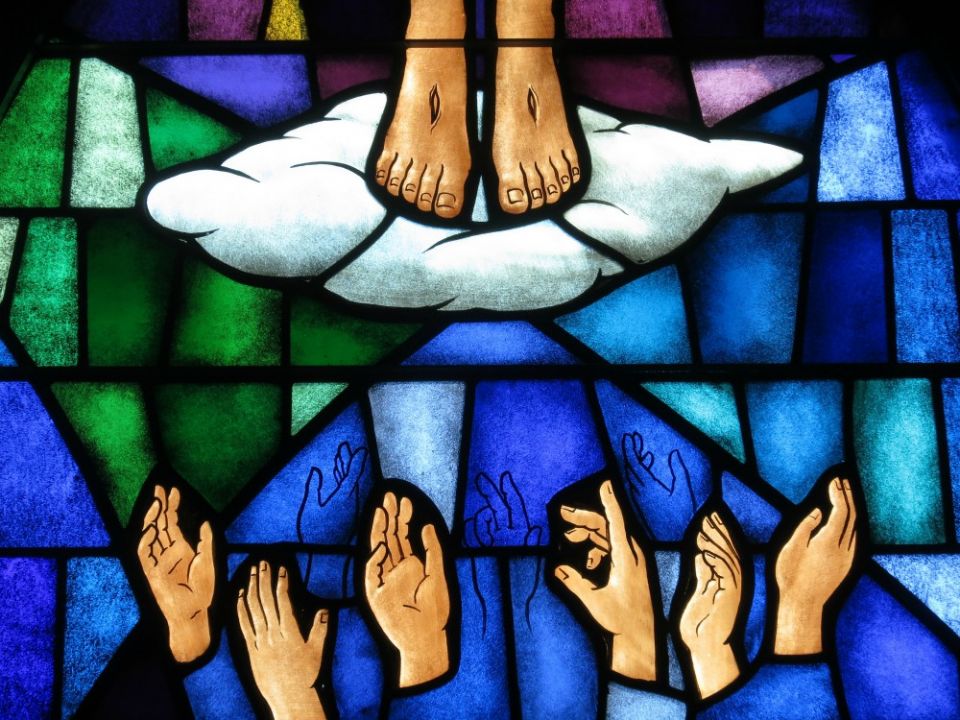
Acts 1:1-11 – Ascension of the Lord

In my first book I told you, Theophilus, about everything Jesus began to do and teach until the day he was taken up to heaven after giving his chosen apostles further instructions through the Holy Spirit. During the forty days after he suffered and died, he appeared to the apostles from time to time, and he proved to them in many ways that he was actually alive. And he talked to them about the Kingdom of God.

Once when he was eating with them, he commanded them, “Do not leave Jerusalem until the Father sends you the gift he promised, as I told you before. John baptized with water, but in just a few days you will be baptized with the Holy Spirit.”

So, when the apostles were with Jesus, they kept asking him, “Lord, has the time come for you to free Israel and restore our kingdom?”

He replied, “The Father alone has the authority to set those dates and times, and they are not for you to know. But you will receive power when the Holy Spirit comes upon you. And you will be my witnesses, telling people about me everywhere—in Jerusalem, throughout Judea, in Samaria, and to the ends of the earth.”

After saying this, he was taken up into a cloud while they were watching, and they could no longer see him. As they strained to see him rising into heaven, two white-robed men suddenly stood among them. “Men of Galilee,” they said, “why are you standing here staring into heaven? Jesus has been taken from you into heaven, but someday he will return from heaven in the same way you saw him go!” (New Living Translation)

“At his Ascension, our Lord entered Heaven, and he keeps the door open for humanity to enter.”

Oswald Chambers

Jesus was taken up to heaven in what Christians celebrate as the “Ascension of the Lord.” This is a hugely important event for followers of Jesus.

The Ascension means that Christ is now presently sitting at God’s right hand, offering continual prayers on our behalf to the Father. We have an advocate, a champion, who has gone before us and secured deliverance from sin, death, and hell.

On top of it all, Christ’s ascension means that Jesus is the universal ruler; he commands a kingdom that will never end. Yes, the Ascension of the Lord is a big deal.

So, why does a day set aside on the Christian Calendar celebrating the Lord’s mighty and redemptive ascension over all creation garner such scant attention from many churches?

Maybe the church has A.D.D. (Ascension Deficit Disorder).

Our clue to the inability to focus on such a grand redemptive event is the disciples’ response when Jesus ascended.

The picture St. Luke paints for us in the account of our Lord’s ascension, is a group of guys looking up into the sky slack-jawed and shoulders hunched.

It took a couple of angels to come along and ask them what in the world they were doing just standing there. Now is not the time to stand and gawk at the clouds, the angels insisted. Jesus will come back when he comes back. You aren’t going to know when. So, now is the time to get busy with what Jesus just told you to do two minutes ago: Tell everyone about me.

Christ’s ascension to heaven is a deeply theological event. It’s freighted with major implications for our prayer lives. And it means Christ is the King to whom we must obey.

Jesus is coming again. In the meantime, there’s to be no cloud-gawking. Instead, there is to be a well-developed and well-cultivated connection with Jesus which proclaims the good news that Christ died, rose from death, and ascended to heaven for mine and your forgiveness of sins and a new clean slate on life.

Trying to peer into the future about how the end of history will shake-out is, frankly, not the job we are called to do. Believers in Jesus aren’t supposed to stand and gawk at the clouds waiting for the Lord’s return, as if we are in some earthly holding tank until heaven. 

Rather, we are to bear witness about the person and work of Jesus. The Ascension of the Lord means we are God’s people blessed with deliverance from the realm of sin, and the hope of Christ’s coming again. The Church everywhere recognizes together the rule and reign of the Lord Jesus.

The world, as we know it, shall eventually come to an end. Until that time, Christians since the time of the ascension have been proclaiming Christ crucified, died, risen, ascended, and coming again.

This is a day of joy and celebration for us. Jesus is our ascended and glorified king! The fate of the earth is with the benevolent and mighty Ruler of all. Jesus is Lord, and no other human leader is. Thank you, Jesus.

The great Reformed Confession, the Heidelberg Catechism, question and answer 49, states:

Q: How does Christ’s ascension to heaven benefit us?

A: First, he is our advocate

            in heaven

            in the presence of his Father.

Second, we have our own flesh in heaven

            as a sure pledge that Christ our head

            will also take us, his members,

            up to himself.

Third, he sends his Spirit to us on earth

            as a corresponding pledge.

            By the Spirit’s power

                        we seek not earthly things

                        but the things above, where Christ is,

                                    sitting at God’s right hand.

Amen.

The Wonder of Christ’s Resurrection

Welcome, friends! In the New Testament Gospel of Luke 24:1-12, we find an account of women approaching the grave of Jesus, only to find an empty tomb. Today, people search for reality in all kinds of empty places. There is, however, hope, because Christ is risen! He is risen, indeed! Click the videos below and let us enjoy and be in awe that Jesus is alive!

Pastor Tim Ehrhardt, Luke 24:1-12

May the glory and the promise of this joyous time of year bring peace and happiness to you and those you hold most dear.

And may Christ, Our Risen Savior, always be there by your side to bless you most abundantly and be your loving guide. Amen.

Isaiah 52:13-53:12 – Good Friday

This stained-glass window was donated to the Sixteenth Street Baptist Church of Birmingham, Alabama by the people of Wales after the church was bombed in 1963.

The Lord says,

“My servant will succeed in his task;
    he will be highly honored.
Many people were shocked when they saw him;
    he was so disfigured that he hardly looked human.
But now many nations will marvel at him,
    and kings will be speechless with amazement.
They will see and understand
    something they had never known.”

The people reply,

“Who would have believed what we now report?
    Who could have seen the Lord’s hand in this?
It was the will of the Lord that his servant
    grow like a plant taking root in dry ground.
He had no dignity or beauty
    to make us take notice of him.
There was nothing attractive about him,
    nothing that would draw us to him.
We despised him and rejected him;
    he endured suffering and pain.
No one would even look at him—
    we ignored him as if he were nothing.

“But he endured the suffering that should have been ours,
    the pain that we should have borne.
All the while we thought that his suffering
    was punishment sent by God.
But because of our sins he was wounded,
    beaten because of the evil we did.
We are healed by the punishment he suffered,
    made whole by the blows he received.
All of us were like sheep that were lost,
    each of us going his own way.
But the Lord made the punishment fall on him,
    the punishment all of us deserved.

“He was treated harshly, but endured it humbly;
    he never said a word.
Like a lamb about to be slaughtered,
like a sheep about to be sheared,
    he never said a word.
He was arrested and sentenced and led off to die,
    and no one cared about his fate.
He was put to death for the sins of our people.
He was placed in a grave with those who are evil,
    he was buried with the rich,
even though he had never committed a crime
    or ever told a lie.”

The Lord says,

“It was my will that he should suffer;
    his death was a sacrifice to bring forgiveness.
And so he will see his descendants;
    he will live a long life,
    and through him my purpose will succeed.
After a life of suffering, he will again have joy;
    he will know that he did not suffer in vain.
My devoted servant, with whom I am pleased,
    will bear the punishment of many
    and for his sake I will forgive them.
And so I will give him a place of honor,
    a place among the great and powerful.
He willingly gave his life
    and shared the fate of evil men.
He took the place of many sinners
    and prayed that they might be forgiven.” (Good News Translation)

We all suffer. 

Whether a chronic physical condition, emotional or moral distress, mental illness, or spiritual oppression, everyone falls prey to this world’s pain and heartache. 

The refugee, the poor, the oppressed, the lonely, the forgotten, the disadvantaged, the diseased, the distressed, and the displaced are just a few of the persons experiencing their own private pain, public humiliation, and an awful suffering.

Suffering that defies reason, the kind of pain which seems senseless, the type of hurt where nothing good appears to be going on at all, is all horribly troubling to the soul.

Perhaps it seems ironic, maybe even cruel, that Christians observe a day called “Good” Friday. Considering the adverse circumstances of so many people, to call today “good” appears awkward, as if Christ’s followers have their collective heads in the sand. 

Even for Christians, “Good Friday” may seem a bit oxymoronic for a day observing the torture and death of an innocent man. Some argue that Christ is no longer on the cross, and so, we need to give all our focus on the resurrected Jesus and the victory he achieved. No need for all this suffering stuff. 

Yet, the Resurrection only has meaning because of this very day, Good Friday. Without the Suffering Servant of Isaiah, there is no King Jesus. 

Holy Hill Stations of the Cross, Hubertus, Wisconsin

For Christians everywhere, this day is very good in the sense that the crucifixion of Jesus Christ means the redemption of the world. On this day we remember and commemorate the events that led up to the cross; unpack those events and interpret them with profound meaning and significance; and worship Jesus with heartfelt gratitude because of his redeeming work of the cross.

The bulk of the New Testament Gospels of Matthew, Mark, Luke, and John are given to the final week of Christ’s life, especially leading to the cross. Good Friday observances often take a somber form due to the brevity of Christ’s experience on the cross. 

Christians remember the last words of Christ and recognize the significant impact his death had on the immediate persons around him. Believers also contemplate the lasting results of that singular death as an atoning sacrifice; perfect love; reconciliation between God and humanity; victory over evil; and redeeming all creation.

Sadness, then, is far from the only emotion on this day. It is appropriate to feel wonder, gratitude, and deep satisfaction for deliverance from the power of sin. There is the recognition that something profound and meaningful has truly happened in the egregious suffering of Jesus. 

Thus, we not only remember the anguish of Christ, but what that horrible torment accomplished. In fact, the cross of Jesus is so significant that an eternity of considering its import and impact could never plumb the depths of its far-reaching effects.

With all that has been said, one would think that Good Friday is a hugely observed day on the Christian Calendar. Yet, for a chunk of churches and Christians, it’s not. The bottom line is that the cross is not popular.  Maybe it’s because neither Christian nor non-Christian wants to ponder something so incredibly violent, hateful, and bloody.

Episcopal priest Fleming Rutledge has adroitly put her finger on the issue:

“Religious people want visionary experiences and spiritual uplift; secular people want proofs, arguments, demonstrations, philosophy, and science.  The striking fact is that neither one of these groups wants to hear about the cross.” 

Fleming Rutledge

Indeed, as the Apostle Paul has said, the cross of Christ is “a stumbling block to Jews and folly to Gentiles” (1 Corinthians 1:23).

A personalized religion which leaves the cross out of the picture (too much blood and violence) might seem appealing. Yet it will only leave us bereft of the communion of saints both past and present. Consider the ancient witness of the Church:

“I believe in Jesus Christ, his only Son, our Lord… he suffered under Pontius Pilate, was crucified, died, and was buried; he descended to hell.”

Apostles’ Creed

“For our sake he [Christ] was crucified under Pontius Pilate; he suffered death and was buried.” –Nicene Creed

Christ suffered “in both body and soul – in such a way that when he sensed the horrible punishment required by our sins ‘his sweat became like great drops of blood falling down on the ground.’ He cried, ‘My God, my God, why have you forsaken me?’ And he endured all this for the forgiveness of our sins. 

Therefore, we rightly say with the Apostle Paul that we know nothing ‘except Jesus Christ, and him crucified;’ we ‘regard everything as loss because of the surpassing value of knowing Christ Jesus our Lord.’ We find all comforts in his wounds and have no need to seek or invent any other means than this one and only sacrifice, once made, which renders believers perfect forever.” –Belgic Confession, Article 21

And let us consider further the New Testament witness:

“Jesus suffered outside the gate in order to sanctify the people through his own blood.  Therefore, let us go forth to him outside the camp, and bear the abuse he endured.” (Hebrews 13:12-13, NIV)

“May I never boast of anything except the cross of our Lord Jesus Christ, by whichthe world has been crucified to me, and I to the world.” (Galatians 6:14, NRSV)

The extent of Good Friday goes far beyond just a day on the calendar; it is the fulcrum upon which all of Christianity hinges. 

Because Christ suffered, our suffering has meaning.

Each situation of trauma; every case of disease; adversity and wholesale hard circumstances, all make sense, in the Christian tradition, when they are viewed in solidarity with Jesus Christ crucified.

So, today, let Christians everywhere contemplate the cross, observe the salvation accomplished through Christ’s death, and offer prayers and petitions for those who need deliverance from the power of evil. In short, let us worship God in Jesus Christ because of the suffering on the cross.

Along with all believers everywhere we pray:

Jesus, Lamb of God, have mercy on us.

Jesus, Bearer of our sins, have mercy on us.

Jesus, Redeemer of the world, grant us your peace. Amen.