Luke 15:1-10 – The Parable of the Lost Sheep and the Lost Coin

Parable of the Lost Sheep by Sieger Köder (1925-2015)

Now all the tax collectors and sinners were coming to hear him. But the Pharisees and the experts in the law were complaining, “This man welcomes sinners and eats with them.”

So, Jesus told them this parable: “Which one of you, if he has a hundred sheep and loses one of them, would not leave the ninety-nine in the open pasture and go look for the one that is lost until he finds it? Then when he has found it, he places it on his shoulders, rejoicing. Returning home, he calls together his friends and neighbors, telling them, ‘Rejoice with me, because I have found my sheep that was lost.’ I tell you, in the same way there will be more joy in heaven over one sinner who repents than over ninety-nine righteous people who have no need to repent.

“Or what woman, if she has ten silver coins and loses one of them, does not light a lamp, sweep the house, and search thoroughly until she finds it? Then when she has found it, she calls together her friends and neighbors, saying, ‘Rejoice with me, for I have found the coin that I had lost.’ In the same way, I tell you, there is joy in the presence of God’s angels over one sinner who repents.” (New English Translation)

Lost people matter to God… a lot. They matter so much to the Lord that one lost soul who is found is the grounds for a big celestial party. 

Please note this simple observation of today’s Gospel lesson: If there is rejoicing in the presence of angels over one sinner who repents, then it is God who is doing the rejoicing. The Lord is absolutely giddy with joy over a lost person being found.

Jesus told two short stories, each teaching the same thing, so that we will be absolutely sure to get it: A loving God has unbounded joy over lost people being found. These parables of Jesus give us a glimpse of God’s own heart. The Lord would do anything to find a lost person, to restore and reconcile that person to right relationships. 

God would go dumpster diving and wade through stinky nasty garbage to find just one lost valuable person.

Restoring lost people is such a high priority to God that the Father sent the Son to this earth. Jesus paid the ultimate price of a cruel death on a cross to reconcile a broken lost relationship between people and God.

I have not always been a devoted follower of Christ. I still remember what it felt like to be separated from God and estranged from the church – it was lonely and awful, like being in a deep black hole with no way of getting out and no one around to help. 

But God mercifully sent people into my life to share good news with me and help me out of my prodigal way of life. I once was lost. But now I am found. When I turned from my path of destruction and embraced Jesus Christ, there was a big party in heaven.
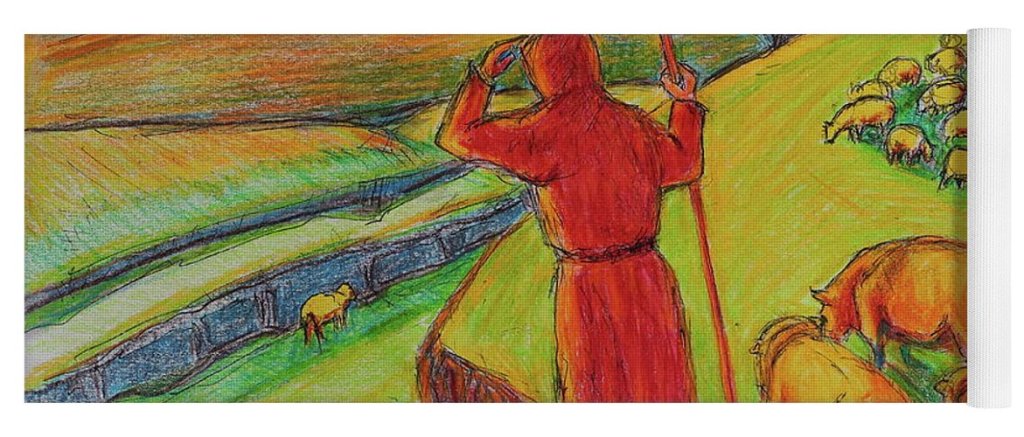
Lost Sheep Parable by Thomas Bertram Poole

God gathering wayward and lost persons is a gracious activity, seemingly free from criticism. But there was. And because there were complaints leveled at Jesus for purposely going after the lost, it therefore needs to be asked: 

Where do we locate ourselves in these parables? 

The two stories were downright offensive to many of Christ’s original hearers. Those upset with Jesus were so inwardly focused that they believed ministry ought to revolve around them and their needs.

And, what’s more, the religious leaders were offended because they thought all the fuss about sinners would only highlight their sin. In other words, there ought to be no party and no rejoicing for people who have lived an ethically and morally dubious life.

Preaching grace is always offensive to people who work for their salvation. It is scandalous to such persons to hear that Jesus did not come to call the righteous, but sinners to repentance. 

If we hear Christ’s parables and the concern for lost sinners who don’t know Jesus and say, “Well, all this talk about outreach is well and good, but what about us?  What about me? After all, I never went down a path of immorality or hurt anyone. I’m a good person. Where’s my party?” Then, we must locate ourselves as the lost persons in need of being found by God’s grace.

Consider for a moment the worst sinner you can think of – a person for whom you would label as being akin to the devil…. Now picture that person being found by God and becoming a follower of Christ….

Would you attend the party to celebrate that person’s repentance, reconciliation, and recovery? 

If any of us feels justified in our hate, then we are the lost one in need of turning from our sin.

In leaving the ninety-nine sheep in the flock and going after the one sheep, God gave preferential attention to the lost…. Can you live with that? 

These parables of Jesus have significant meaning for church programs, budgets, and committees. By most estimations, only one-in-five lost people in America even knows one Christian. Statistics like that are what keep me up at night; it deeply saddens me. It drives me to prayer.

God’s unconditional mercy and amazing grace is what makes all the difference. 

If we lose the sense of awe and appreciation for what God has done for us in Christ, then there will be no outreach. Finding lost people is not dependent on completing a class on evangelism or getting training in how to answer every question.

Outreach is fueled by passion and desire. Healthy Christians reproduce themselves. I assume you didn’t take a class on how to procreate – you just had the desire and the willingness; and then, you celebrated nine-months later, the birth of new life.

New life always needs to be celebrated because that’s what God does. Yet, the party cannot commence until the lost are found….

O God – blessed Father, Son, and Spirit – sanctify all believers everywhere with your abiding presence. Enlighten the minds of your people more and more with the light of the Gospel. Bring lost people to the knowledge of our Savior Jesus Christ; and those who are walking in the way of life, keep steadfast to the end. Guard those who are strong and prosperous from forgetting you and straying from the flock. Increase in us your grace and love so that we may participate with you in finding the lost. Amen.


1 Samuel 24:1-22 – How to Handle An Enemy

David and Saul in the Cave by James J. Tissot (1836-1902)

After Saul returned from pursuing the Philistines, he was told, “David is in the Desert of En Gedi.” So, Saul took three thousand able young men from all Israel and set out to look for David and his men near the Crags of the Wild Goats.

He came to the sheep pens along the way; a cave was there, and Saul went in to relieve himself. David and his men were far back in the cave. The men said, “This is the day the Lord spoke of when he said to you, ‘I will give your enemy into your hands for you to deal with as you wish.’” Then David crept up unnoticed and cut off a corner of Saul’s robe.

Afterward, David was conscience-stricken for having cut off a corner of his robe. He said to his men, “The Lord forbid that I should do such a thing to my master, the Lord’s anointed, or lay my hand on him; for he is the anointed of the Lord.” With these words David sharply rebuked his men and did not allow them to attack Saul. And Saul left the cave and went his way.

Then David went out of the cave and called out to Saul, “My lord the king!” When Saul looked behind him, David bowed down and prostrated himself with his face to the ground. He said to Saul, “Why do you listen when men say, ‘David is bent on harming you’? This day you have seen with your own eyes how the Lord delivered you into my hands in the cave. Some urged me to kill you, but I spared you; I said, ‘I will not lay my hand on my lord, because he is the Lord’s anointed.’ See, my father, look at this piece of your robe in my hand! I cut off the corner of your robe but did not kill you. See that there is nothing in my hand to indicate that I am guilty of wrongdoing or rebellion. I have not wronged you, but you are hunting me down to take my life. May the Lord judge between you and me. And may the Lord avenge the wrongs you have done to me, but my hand will not touch you. As the old saying goes, ‘From evildoers come evil deeds,’ so my hand will not touch you.

“Against whom has the king of Israel come out? Who are you pursuing? A dead dog? A flea? May the Lord be our judge and decide between us. May he consider my cause and uphold it; may he vindicate me by delivering me from your hand.”

When David finished saying this, Saul asked, “Is that your voice, David my son?” And he wept aloud. “You are more righteous than I,” he said. “You have treated me well, but I have treated you badly. You have just now told me about the good you did to me; the Lord delivered me into your hands, but you did not kill me. When a man finds his enemy, does he let him get away unharmed? May the Lord reward you well for the way you treated me today. I know that you will surely be king, and that the kingdom of Israel will be established in your hands. Now swear to me by the Lord that you will not kill off my descendants or wipe out my name from my father’s family.”

So, David gave his oath to Saul. Then Saul returned home, but David and his men went up to the stronghold. (New International Version)

Sometimes reconciliation is neither possible nor wise.

King Saul was unstable. Although initially appreciative of David’s service, Saul became jealous. And that jealousy eventually grew into suspicion, then paranoia.

It became so bad that David had to flee and went on the run. Saul was convinced David wanted his kingship, so he hunted him like an animal. He wanted him out of the limelight and out of the way – permanently.

There are times in everyone’s life that another person actively and intentionally seeks to do us harm. How do we handle such a situation? How might we respond in a way that gives us peace of mind?

David continually had enemies throughout his life. And the vast number of those who opposed him, did so despite the fact that David didn’t deserve it.

“We retaliate instead of reflect, and we burn hot in the flames of revenge rather than cool our heels in the pool of patience.”

Craig D. Lounsbrough

Saul came looking for David with an army five-times the size of David’s rag-tag group of men. Yet, Saul had no idea that he had ambled into being a sitting duck.

What would you do in that kind of situation?

Picture the person who gives you the most grief. Maybe they purposely speak bad about you or try and oppose you at any opportunity. Perhaps there is a boss or someone in authority who seeks to undermine you every chance they get.

And now, the tables are turned. You have the chance to publicly put them in their place. You can put an end to the madness. What are you going to do?

In David’s situation, his men made the logical assumption that God ordained the turn of events. So, go ahead and off Saul. Become the king. After all, God already told you that you would be king. Now he’s giving you the opportunity. It’s right there. Take it, man.

“Retaliation is a dog chasing its tail.”

Libba Bray

But David didn’t take advantage of having the upper hand. He didn’t kill Saul because he was convinced it wasn’t the right thing to do. In fact, David felt terrible for even considering the idea. He wasn’t going to take matters into his own hands.

So, David left it in the hands of God. Since God anointed him as the next king, David reasoned, then God would make it happen. He didn’t need to do God’s job for him. David’s theological perspective was this: God is my defender; God will take care of me; God will judge another’s sinful behavior.

Today’s Old Testament lesson is a story in the importance and necessity of non-retaliation. What’s more, it’s a lesson in treating all people with respect, even if they don’t seem to deserve it, at all.

This lesson in no way infers that we sit idly by and refuse to hold another accountable for their actions. It just means we aren’t the judge, jury, and executioner.

Once Saul realized he had been a sitting duck, he repents… or does he? He admits to his wrong, even emotionally reacts to it. But here’s the bottom line to all overtures of repentance: It must result in a change of attitude and behavior. And Saul didn’t offer that.

So, the story ends pretty much as it began. There’s no reconciliation because there’s no true repentance on the part of Saul. The disturbed and paranoid king ends up continuing his murderous pursuit of David. *Sigh*

Folks like Saul have no intention of changing. They only want to hold onto their power and control. They’re only happy if others are giving them accolades and kudos. And if they’re not getting recognition, there’s hell to pay.

Beware of false repentance. Don’t be fooled by a person who has a pervasive pattern of self-interest, then, all of a sudden, feels sorry. It’s likely they’re doing that because they don’t have the upper hand – and they desperately want it back.

More importantly, don’t play their game. Instead, live by the ethics of God’s kingdom. You’ll be glad you did.

O God: Give me strength to live another day. Let me not turn coward in the face of its difficulties. Let me not lose faith in other people. Keep me sweet and sound of heart, in spite of ingratitude, treachery, or meanness. Preserve me from harm and keep me from harming others. Help me to keep my heart clean, and to not become disheartened by the evil of others. Open wide the eyes of my soul that I may see the good in everything. Inspire me with the spirit of joy and gladness and make me a conduit of your blessing to others, in the name of the strong Deliverer, our Lord and Savior, Jesus Christ. Amen.

Genesis 33:1-17 – Reconciled

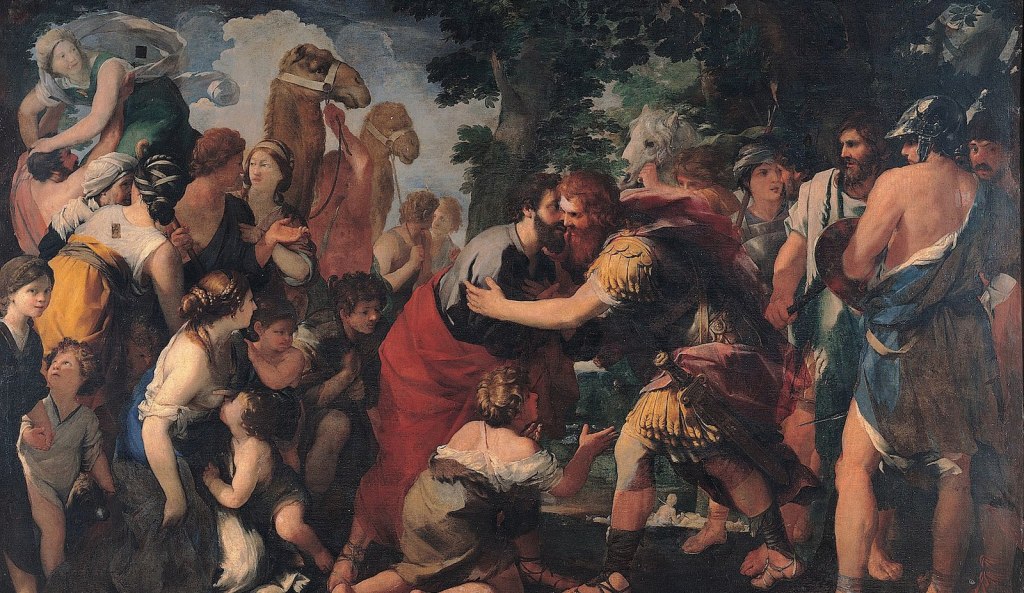
Meeting Between Jacob and Esau by Italian painter Bottalla Raffaellino (1613-1644)

Later that day Jacob met Esau coming with his four hundred men. So, Jacob had his children walk with their mothers. The two servant women, Zilpah and Bilhah, together with their children went first, followed by Leah and her children, then by Rachel and Joseph. Jacob himself walked in front of them all, bowing to the ground seven times as he came near his brother.

But Esau ran toward Jacob and hugged and kissed him. Then the two brothers started crying.

When Esau noticed the women and children he asked, “Whose children are these?”

Jacob answered, “These are the ones the Lord has been kind enough to give to me, your servant.”

Then the two servant women and their children came and bowed down to Esau. Next, Leah and her children came and bowed down; finally, Joseph and Rachel also came and bowed down.

Esau asked Jacob, “What did you mean by these herds I met along the road?”

“Master,” Jacob answered, “I sent them so that you would be friendly to me.”

“But, brother, I already have plenty,” Esau replied. “Keep them for yourself.”

“No!” Jacob said. “Please accept these gifts as a sign of your friendship for me. When you welcomed me and I saw your face, it was like seeing the face of God. Please accept these gifts I brought to you. God has been good to me, and I have everything I need.” Jacob kept insisting until Esau accepted the gifts.

“Let’s get ready to travel,” Esau said. “I’ll go along with you.”

But Jacob answered, “Master, you know traveling is hard on children, and I have to look after the sheep and goats that are nursing their young. If my animals travel too much in one day, they will all die. Why don’t you go on ahead and let me travel along slowly with the children, the herds, and the flocks. We can meet again in the country of Edom.”

Esau replied, “Let me leave some of my men with you.”

“You don’t have to do that,” Jacob answered. “I am happy, simply knowing that you are friendly to me.”

So, Esau left for Edom. But Jacob went to Succoth, where he built a house for himself and set up shelters for his animals. That’s why the place is called Succoth. (Contemporary English Version)

Repentance includes more than saying sorry. It also involves admitting wrong and making things right. Turning from erroneous thinking and forsaking past hurtful actions, lays the groundwork for an earnest attempt at reconciliation. 

For example, the Christian does more than a simple acceptance and acquiescence of Jesus, as if merely adding a bit of Christ to life will dash it up and make it better. Rather, we are invited into the very life of Christ. This life turns us upside-down and inside-out in a new and radical allegiance.

Repentance and reconciliation are a way of life. They are necessary skills requiring development through continual practice and use.

Broken relationships are the stuff of life. So, we need gracious approaches to deal with them so that bitterness does not take root in our souls. Connection and peace between two people are a beautiful thing. They bring emotional health, spiritual wholeness, and life enrichment.

From the get-go, twin brothers Jacob and Esau in the Old Testament book of Genesis had a contentious relationship. Their relations became so bad that Esau had homicidal ideation toward his brother. Neither Esau nor Jacob handled things well. Jacob ended up leaving, finding a wife, growing a family, and becoming wealthy.

Twenty years passed before they came together again.

Jacob, knowing he was about to meet his brother, had an encounter with God. It changed his identity from the old deceiver to the new Israel (Genesis 32:22-31).  In a demonstration of his new identity as Israel, Jacob worked at making amends for his old cheating ways. He sought to give the blessing he had stolen from his brother.

Jacob understandably had some dread in meeting Esau. He had connived and manipulated to take the family birthright and blessing from his brother. Fresh from wrestling with God, Jacob demonstrated a newfound courage and humility. He offered Esau respect, gifts, and honor – reversing his past pattern of disrespect, stealing, and dishonor.

True repentance is making things right. Merely having feelings of remorse is not repentance. To repent involves genuine sorrow; an earnestness to make restitution and reconciliation; an indignation over what happened; and, perhaps most importantly, a deep concern for the person(s) harmed by our wrongdoing (2 Corinthians 7:8-11).

The reconciliation between the brothers was a surprise. Jacob was not expecting Esau’s response. It seems Jacob was bracing for the worse, which explains his high anxiety before the encounter.

Esau’s gracious response was an answer to Jacob’s prayer.  For Jacob, seeing Esau’s face was like seeing the face of God. In fact, he saw both faces and lived! Jacob likely would not have seen his brother’s face until he had first seen God’s. His divine experience prepared the way for the human encounter.

We all experience times when relationships unravel and need to be mended. Jacob procrastinated for twenty years before working at reconciliation with his brother. What made the difference for Jacob was trusting God, who always works out divine promises, despite our human foibles. 

May you know and experience the God who reconciles and restores, and in so doing, extend that same earnestness to others.

Merciful God, I confess that I have sinned against you and against others through my own fault by thought, word and deed in things done and left undone. Especially I confess that I have _____.  I therefore repent; for these and all my sins I am terribly sorry and pray for forgiveness. I firmly intend to make amends and seek for help. I ask for strength to serve you in newness of life through Jesus Christ, my Lord, in the power of your Holy Spirit. Amen.

Luke 12:57-59 – Seek Reconciliation

“Why don’t you judge for yourselves what is right? As you are going with your adversary to the magistrate, try hard to be reconciled on the way, or your adversary may drag you off to the judge, and the judge turn you over to the officer, and the officer throw you into prison. I tell you, you will not get out, until you have paid the last penny.” (New International Version)

Relational problems and conflicts are endemic to the human condition. And, along with it, comes our anger.

Sometimes, I wonder if some church buildings have an aisle down the middle, is so that one group of people can avoid associating with the other group, like some childhood bedroom squabble where a line is drawn that the other is not to cross.

I also wonder if all schoolteachers’ lounges are a hot mess of anger. I’ve certainly been in plenty that are. And I don’t really have to wonder if most families have relatives they are estranged from – sometimes for years, even decades. Lord knows I’ve counseled plenty of them.

It’s inevitable that any group of people, complete with individual sinful natures, whether a church, a neighborhood, a family, or a workplace, will experience relational difficulties. After all, we live in a fallen world with a bunch of fallen people.

Relationships are important to God. And we need them. We cannot live without them because we’ve been created in the image and likeness of a relational God. So, God is concerned that we have good relations with one another.

Jesus is in the business of stripping away the layers of self-righteousness and peeling back the built up human rationalizations toward our sour relations with one another. At the heart of it all is our contempt for others and our misplaced anger. The only real solution to it is reconciliation.

Anger in and of itself is neither bad nor good; it just is. It’s a normal human emotional response to injustice. Yet, how we express our anger is very much an ethical affair.

Bitterness, nursing a grudge, bearing resentment, saying speeches to somebody in our heads we will never give, and flipping the finger at someone behind their back is the sort of angry response that completely sours relationships and drives wedges between folks.

Those inner attitudes are the factory where the anger will eventually come out sideways in verbal or even physical violence toward another.

Harboring resentment that comes out in name-calling kills people. And when we verbally decapitate people, there is a mess to clean up. Judgement is the lot for people-bashing. (Matthew 5:21-26)

“The holiness of God is at war with all bitterness and hatred and hurting. And where this holiness collides with our hostility the crash is called the wrath of God. God’s wrath is God’s war of love against everything that unnecessarily hurts others. God’s love would not be love if it did not work to remove all that ungraciously hurts. The wrath of God is the proof of the love of God; God’s love is a love that is not merely sentimental, for it grapples with inhumane forces.”

Frederick Dale Bruner

If you think to yourself that you have a right to nurse a grudge because that other person deserves it, you need to know that your hatred will not go unnoticed by God. 

If you have ever wished anyone was dead, hated anyone, treated anyone with contempt and belittled them; then, you have assassinated that person in your heart and come under the judgment of God.

And that’s the reason why we are to work hard at making things right with others.

There is no need for you to live with regret for the rest of your life because of stubbornly refusing to reconcile, and to have to stand before your Creator someday with nothing but hatred and contempt for another person.

Whenever personal relations go wrong, nine cases out of ten, immediate action will usually mend the problem.  But the longer it goes, the harder it is to reconcile. The problem grows and festers. Eventually, if reconciliation is not sought, it eventually spirals out of control. Then, there is full blown bitterness in which more people will be hurt. 

Make sure that no one misses out on God’s grace. Make sure that no root of bitterness grows up that might cause trouble and pollute many people.

Hebrews 12:15, CEB

Bitterness becomes gangrene of the soul. It poisons us within and ends up making trouble for others. Its better to reconcile than to have God amputate a part of you. So, seek amends.

If you become angry, do not let your anger lead you into sin, and do not stay angry all day. Don’t give the Devil a chance…. Get rid of all bitterness, passion, and anger. No more shouting or insults, no more hateful feelings of any sort. (Ephesians 4:26-27, 31, GNT)

We always have a choice when relationships are strained: Deal with it immediately, or let it fester. Maybe the reason why so many folks live without peace is that they have chosen unwisely.

Choose wisely, my friend.

Lord God, bring us together as one people, reconciled with you and reconciled with each other – healed, forgiven, and spreading peace rather than enmity, as you called us to do, through Jesus Christ our Lord. Amen.