On the Lam(b) (Genesis 31:1-21)

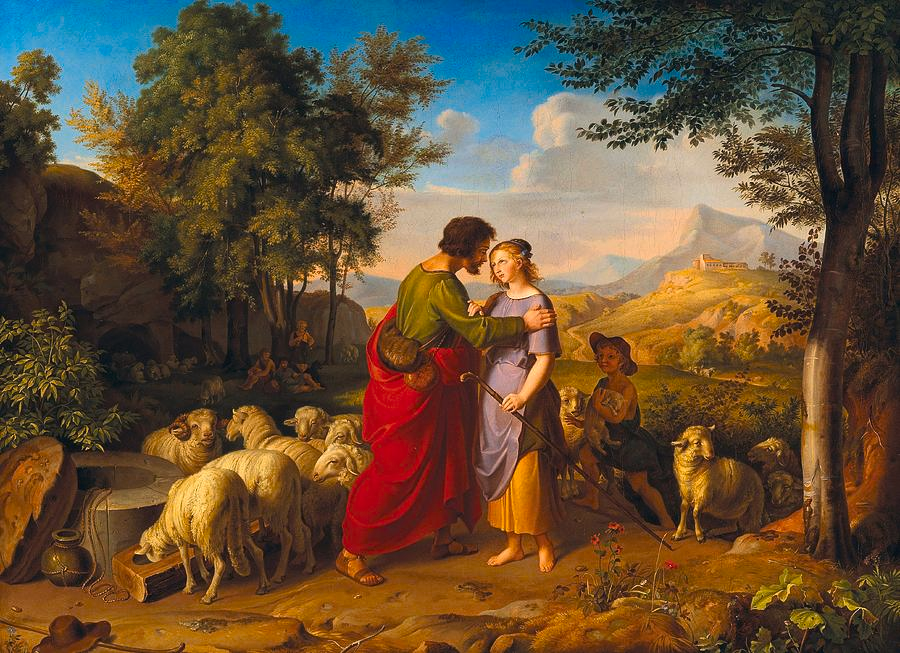
Jacob Flees Laban, illustration from Bible Pictures and What They Teach Us, by Charles Foster, 1897

Jacob heard that Laban’s sons were complaining, “Jacob is now a rich man, and he got everything he owns from our father.” Jacob also noticed that Laban was not as friendly as he had been before. One day the Lord said, “Jacob, go back to your relatives in the land of your ancestors, and I will be with you.”

Jacob sent for Rachel and Leah to meet him in the pasture where he kept his sheep, and he told them:

“Your father isn’t as friendly with me as he used to be, but the God my ancestors worshiped has been on my side. You know that I have worked hard for your father and that he keeps cheating me by changing my wages time after time. But God has protected me. When your father said the speckled sheep would be my wages, all of them were speckled. And when he said the spotted ones would be mine, all of them were spotted. That’s how God has taken sheep and goats from your father and given them to me.

Once, when the flocks were mating, I dreamed that all the rams were either spotted or speckled. Then God’s angel called me by name. I answered, and he said, “Notice that all the rams are either spotted or speckled. I know everything Laban is doing to you, and I am the God you worshiped at Bethel, when you poured olive oil on a rock and made a promise to me. Leave here at once and return to the land where you were born.”

Rachel and Leah said to Jacob:

There’s nothing left for us to inherit from our father. He treats us like foreigners and has even cheated us out of the bride price that should have been ours. So do whatever God tells you to do. Even the property God took from our father and gave to you really belongs to us and our children.

Then Jacob, his wives, and his children got on camels and left northern Syria for the home of his father Isaac in Canaan. Jacob took along all his flocks, herds, and other property.

Before Rachel left, she stole the household idols while Laban was out shearing his sheep.

Jacob tricked Laban the Aramean by not saying that he intended to leave. When Jacob crossed the Euphrates River and headed for the hill country of Gilead, he took with him everything he owned. (Contemporary English Version)

Moving and changing are a part of life. Change and movement are built into all creation, from the seasons of the year to our physical bodies over time. Some changes and moves we deem as good, and others, not so much. Yet, whether good or bad, any switch or shift in life can be difficult to cope with.

Whatever the circumstance, God stands behind everything, working out good and divine purposes. There are times and seasons in our lives where we can get lost in our own stories. Ultimately, however, our transitions from one place to another are really about our individual stories fitting into the larger story of God.

Whenever we are unable to see how our own story and the story of God fit together, it’s an opportunity to exercise faith and trust in God. Listening to God, and responding to God’s call to move and change, will at times be difficult, due to the uncertainty of our future.

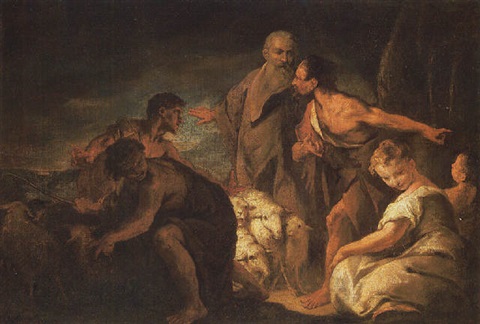
Jacob Urges Leah and Rachel to Flee from Laban, by Pieter Symonsz Potter, 1638

In today’s Old Testament lesson, Jacob has served his father-in-law Laban for twenty years. Now, he hears the call of God to move – and that move is both good and fraught with anxiety. Jacob and his family are on the lam, literally moving their lambs and sheep and everything they own to avoid pursuit and confrontation.

The principal actor and center of the story is not Jacob, but God. The narrative is primarily about God, with Jacob as the supporting actor in the story.

God was watching over and protecting Jacob. The Lord was following through on a promise of land and descendants given to Jacob’s grandfather, Abraham – to make him into a great nation so that all people-groups on earth would be blessed. 

So then, the story of Jacob is merely one piece in the grand unfolding drama of God’s redemption. This drama would eventually and ultimately find its fulfillment in the person and work of Jesus.

Jacob had in-law issues. His relationship with his father-in-law had always been tenuous, and was morphing into trouble. Laban’s attitude had changed toward his son-in-law, probably due to Jacob’s increasing wealth, and Laban’s decreasing assets.

So, God showed up and told Jacob to return to the land of his fathers. Along with the call to make a change came a promise of God’s continued presence with Jacob. The grace given to Abraham when calling him out of Ur was renewed with more grace when calling Jacob back to the land of his father and grandfather.  It is in God’s nature to be gracious and to heap grace upon grace.

Jacob heeded call of the Lord and began laying plans to move back to Canaan. But how to tell his family about this? What are his wives going to say? After all, he’s talking about moving away with teenagers still in the tent.

With some anxiety, Jacob called his wives, Rachel and Leah, out to the fields to talk. Jacob laid out the story of himself and Laban, which he framed more as a contrasting story between God and Laban:

  • Laban’s attitude changed, whereas God’s attitude does not change. God is not fickle.
  • Laban was unreliable, reneging on promises, but God is reliable and trustworthy, keeping divine promises.
  • Laban kept changing his mind, yet God stays the same, yesterday, today, and forever.
  • Laban saw only self-interest; however God sees everyone and shows solidarity with the oppressed.

This same God is concerned for us and will not renege on promises. God is providentially working out a good  agenda and concern for this earth, and we can bank on it.

The response from Jacob and Rachel to Laban was some tricky thievery. Jacob stealthily took his family and ran away from the situation. Rachel straight up stole Laban’s household gods.

(Note: Old Testament narratives do not usually tell us whether something is bad or good but instead allows the story to unfold and speak for itself so that we can see the ethics working out). 

Jacob and Rachel had a less than stellar response to God’s grace. We do not know exactly what the household gods are, or why Rachel stole them. What we do know is that there was a bit of pagan practice mixed in with worship of the one, true God.

Our circumstances will forever be changing, and God may ask us to move and go do something somewhere else. Yet, no matter the situation, and how different our surroundings may become, God does not change, and is here with us; and, at the same time, is continually moving to accomplish good purposes.

Loving God, you have made the whole of human life in your image; each one of us shaped in love. Your goodness is ever-present within us all. Yet, there is so much evil and pain in our world; it comes at us from every direction.

Teach us how to rediscover your love within us and to use that love as a force for good. Help us to turn our hearts toward the world in hope, praying for each other and regarding each other as a treasure, so that we might be the light which darkness can never overcome, through Jesus Christ our Lord. Amen.

Family Drama (Genesis 29:15-28)

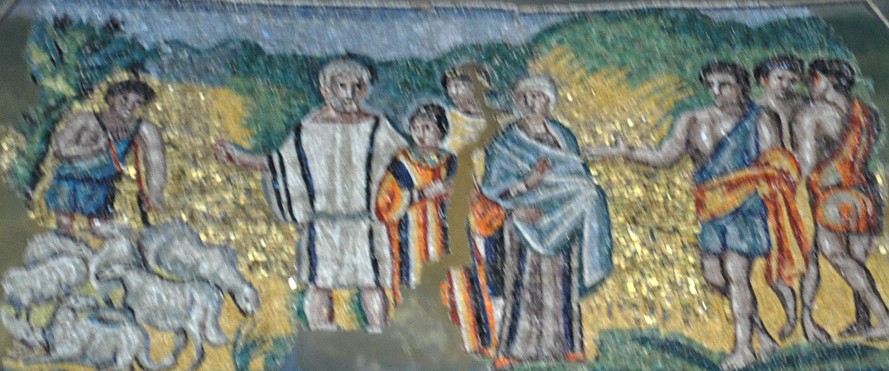
Jacob works to gain Rachel’s hand, 5th century mosaic, Basilica of Santa Maria Maggiore, Rome

Laban said to him [Jacob] “Just because you are a relative of mine, should you work for me for nothing? Tell me what your wages should be.”

Now Laban had two daughters; the name of the older was Leah, and the name of the younger was Rachel. Leah had weak eyes, but Rachel had a lovely figure and was beautiful. Jacob was in love with Rachel and said, “I’ll work for you seven years in return for your younger daughter Rachel.”

Laban said, “It’s better that I give her to you than to some other man. Stay here with me.” So Jacob served seven years to get Rachel, but they seemed like only a few days to him because of his love for her.

Then Jacob said to Laban, “Give me my wife. My time is completed, and I want to make love to her.”

So Laban brought together all the people of the place and gave a feast. But when evening came, he took his daughter Leah and brought her to Jacob, and Jacob made love to her. And Laban gave his servant Zilpah to his daughter as her attendant.

When morning came, there was Leah! So Jacob said to Laban, “What is this you have done to me? I served you for Rachel, didn’t I? Why have you deceived me?”

Laban replied, “It is not our custom here to give the younger daughter in marriage before the older one. Finish this daughter’s bridal week; then we will give you the younger one also, in return for another seven years of work.”

And Jacob did so. He finished the week with Leah, and then Laban gave him his daughter Rachel to be his wife. (New International Version)

There’s no drama quite like family drama. Love and hate, unity and inequality, privileged and powerless, gender and patriarchy, altruism and selfishness, all combine for a strange brew we call “family.” It seems you can’t live with them, or without them.

In a love story for the ages, the lonely Jacob meets the lovely Rachel. It was a divine appointment, and quite literally, a match made in heaven. (Genesis 29:1-14)

Although the romance appears to lead to a happy and better days, it is anything but. The family dynamics are at play, and it leads to plenty of dysfunctional stuff. Just as Jacob the deceiver successfully wrangled a blessing away from his brother for himself, Rachel’s father Laban did his own bit of deception.

Having promised Rachel to Jacob, the elder daughter Leah replaces her sister and is found in the marriage bed in the morning after the wedding. Oy! It was Laban’s doing. He had Jacob over a barrel.

The whole situation ended up creating an unhealthy competition between the two sisters for the affection of their husband. So much for living happily ever after.

A lot of this story exposes the gap between the ancient biblical world and our own contemporary cultural context. The patriarchal and tribal society within the book of Genesis assumes that marriage is first and foremost an alliance between men involving the exchange of women. This is anything but a commitment between individuals intending to share their lives together. Laban and Jacob work out the marriage price of seven years of labor without any consultation of the bride(s)-to-be.

What’s more, polygamy seems a given. We get no objections to multiple women being married to one man. And this is typically how Old Testament narratives work – they give us the story, without moral comment, and let that story speak for itself about the ethics involved. The consequences to the decisions and actions are meant to demonstrate the morality or immorality of it all.

There remains, however, a tender love story inside all the drama. Despite all the deceit and masculine posturing for position, Jacob was madly in love with Rachel and would do anything for her – including working fourteen years in unjust conditions.

As in most family affairs, all of this is terribly complicated. Jacob’s singular love for Rachel, and Laban’s finagling, strands the older sister Leah in a loveless marriage. Even with God’s enablement of giving Leah many children, the tragedy of the family drama continued. Rachel envied her elder sister’s fertility, as she herself desperately tried to conceive. It’s all a quite convoluted way to realizing the blessing of God to Abraham’s descendants.

The casual introduction of servant women in this narrative raises all sorts of issues concerning social class, slave and domestic labor, and reproductive rights – not to mention such realities as sexual trafficking and abuse with which we still wrestle in the twenty-first century.

Despite the distance between the ancient world and our own, we have a lot in common with people of the past. We are far from perfect. Families are messy and often broken. We hurt each other intentionally and unintentionally. We act in our own best interest and against the greater good of others. We forget to ask those with less power about decisions that impact their lives.

To look in on this family reality show in Genesis is to look straight into human brokenness. And yet, through all of Jacob’s family drama, God’s purposes were advanced. Jacob had been promised he would have a multitude of descendants, and it was through the unloved Leah and her servant Zilpah that eight of the twelve tribes of Israel trace their descent.

Even the deceitfulness of Laban and Jacob cannot stand in the way of God’s purposes. Human sin may delay the realization of God’s promises, but our human foibles shall never overrule the sovereignty and providence of God’s good plans for humanity.

God of compassion, whose Son Jesus Christ, the child of Mary, shared the life of a home in Nazareth, and on the cross drew the whole human family to himself: Have mercy on us all, especially on our families of origin and all the various family situations we find ourselves within.

Strengthen us in our daily living, so that in joy and in sorrow we may know the power of your presence to bind together and to heal, through Jesus Christ our Lord, the power of the Holy Spirit. Amen.

A Divine Appointment (Genesis 29:1-14)

Jacob and Rachel at the well, by Friedrich Wilhelm Müller (Kirchditmold 1801–1889)

Then Jacob continued on his journey and came to the land of the eastern peoples. There he saw a well in the open country, with three flocks of sheep lying near it because the flocks were watered from that well. The stone over the mouth of the well was large. When all the flocks were gathered there, the shepherds would roll the stone away from the well’s mouth and water the sheep. Then they would return the stone to its place over the mouth of the well.

Jacob asked the shepherds, “My brothers, where are you from?”

“We’re from Harran,” they replied.

He said to them, “Do you know Laban, Nahor’s grandson?”

“Yes, we know him,” they answered.

Then Jacob asked them, “Is he well?”

“Yes, he is,” they said, “and here comes his daughter Rachel with the sheep.”

“Look,” he said, “the sun is still high; it is not time for the flocks to be gathered. Water the sheep and take them back to pasture.”

“We can’t,” they replied, “until all the flocks are gathered and the stone has been rolled away from the mouth of the well. Then we will water the sheep.”

While he was still talking with them, Rachel came with her father’s sheep, for she was a shepherd. When Jacob saw Rachel daughter of his uncle Laban, and Laban’s sheep, he went over and rolled the stone away from the mouth of the well and watered his uncle’s sheep. Then Jacob kissed Rachel and began to weep aloud. He had told Rachel that he was a relative of her father and a son of Rebekah. So she ran and told her father.

As soon as Laban heard the news about Jacob, his sister’s son, he hurried to meet him. He embraced him and kissed him and brought him to his home, and there Jacob told him all these things. Then Laban said to him, “You are my own flesh and blood.” (New International Version)

Jacob meets Rachel at the well, by Paolo Fiammingo, c.1585

Jacob was a homebody. Unlike his twin brother Esau, who loved the outdoors and was often away hunting, Jacob preferred to hang around home with his mother – which is probably why Rebekah preferred him over his brother. It’s also why the two of them succeeded in a plan to deceive Isaac and steal the family blessing from Esau.

In Esau’s bitterness over not being blessed by his father, he began laying plans of his own: to kill his brother Jacob in revenge. This came to the attention of Rebekah, who then warned Jacob to flee to her family of origin in Paddan-Aram.

The boy who was attached to his mother and stayed at home, was now a man on the run, in need of a new life. Jacob was alone. One can only imagine the fear and apprehension, the grief and loneliness, of being on his own in a strange place. But God was with him. And the Lord graciously assured Jacob of the divine presence and promises.

Since God was with Jacob and was going to accomplish divine purposes through him, the Lord set up a divine appointment.

Upon arriving at a well, Jacob discovers some shepherds who know his uncle. And then, along comes Rachel with a flock of sheep. God’s providential guidance is evident in leading both Jacob and Rachel to this place and for this time.

Jacob’s mother, Rebekah, was the brother of Laban and the father of Rachel. In the lives of both Rebekah and her son Jacob, Laban ran out to greet and be involved in the divine appointments. (Genesis 24) The narratives differ, however, in that Abraham’s servant had wealth to share in bringing Isaac and Rebekah together; yet Jacob showed up without two pennies to rub together.

And whereas, on both occasions a future bride comes to a well, Rebekah and Rachel differ greatly in their betrothal times. Rebekah’s marriage was quickly arranged; Rachel’s marriage is uncertain and everything is nebulous on how things will shake out with Jacob.

The divine appointment has happened. God’s protection, presence, and guidance are with Jacob. Yet, at this point in the narrative, everything seems up in the air. Will Jacob marry Rachel? Are there going to be numerous descendants? How in the world is Jacob going to return to the land which was promised?

Though this initial foray into the unknown has had a divine stamp on it, Jacob will soon discover that there are many obstacles to negotiate before the promises of God are fulfilled.

And that is the way of us all. Sometimes things come easy and effortless. At other times, it’s a hard slog. In the scope of a life, there are extended seasons of tedious and mundane work – punctuated with times of amazement, even miracle, letting us know there is a God still watching.

You never quite know what’s around the corner of your life – whether good or bad. Yet, the real issue is trust.

The thing about divine appointments is that God is the sovereign ruler of the universe – which means that everything is in the Lord’s hands. All of life, and all events, are providentially bent for divine purposes. Both good and trouble are appointed.

If we believe the Lord is good, right, and just – all the time and that there is never a time when God is bad or capricious – then we are able to accept all circumstances as being from the hand of God. We will trust, even though we don’t know what’s coming next.

The Apostle Paul had it right by saying that “every detail in our lives of love for God is worked into something good.” (Romans 8:28, MSG)

What would your life look like by adopting this perspective God and all events you encounter?

Gracious God, you alone know what my real needs are. You love me more than I myself know how to love. Help me to see my real needs which are hidden from me. I am afraid to ask for either a cross or consolation, so I wait on you; my heart is open to you. Visit me and help me for the sake of your great mercy. Strike me and heal me, cast me down and raise me up, according to your good will. I put all my trust in you. Amen.

Genesis 31:22-42 – On the Run

Jacob and Laban by Nicola Grassi
Jacob and Laban by Italian painter Nicola Grassi (1682-1748)

On the third day Laban was told that Jacob had fled. Taking his relatives with him, he pursued Jacob for seven days and caught up with him in the hill country of Gilead. Then God came to Laban the Aramean in a dream at night and said to him, “Be careful not to say anything to Jacob, either good or bad.”

Jacob had pitched his tent in the hill country of Gilead when Laban overtook him, and Laban and his relatives camped there too. Then Laban said to Jacob, “What have you done? You’ve deceived me, and you’ve carried off my daughters like captives in war. Why did you run off secretly and deceive me? Why didn’t you tell me, so I could send you away with joy and singing to the music of timbrel and harp? You didn’t even let me kiss my grandchildren and daughters goodbye. You have done a foolish thing. I have the power to harm you; but last night the God of your father said to me, ‘Be careful not to say anything to Jacob, either good or bad.’ Now you have gone off because you longed to return to your father’s household. But why did you steal my gods?”

Jacob answered Laban, “I was afraid, because I thought you would take your daughters away from me by force. But if you find anyone who has your gods, that person shall not live. In the presence of our relatives, see for yourself whether there is anything of yours here with me; and if so, take it.” Now Jacob did not know that Rachel had stolen the gods.

So, Laban went into Jacob’s tent and into Leah’s tent and into the tent of the two female servants, but he found nothing. After he came out of Leah’s tent, he entered Rachel’s tent. Now Rachel had taken the household gods and put them inside her camel’s saddle and was sitting on them. Laban searched through everything in the tent but found nothing.

Rachel said to her father, “Don’t be angry, my lord, that I cannot stand up in your presence; I’m having my period.” So, he searched but could not find the household gods.

Jacob was angry and took Laban to task. “What is my crime?” he asked Laban. “How have I wronged you that you hunt me down? Now that you have searched through all my goods, what have you found that belongs to your household? Put it here in front of your relatives and mine and let them judge between the two of us.

“I have been with you for twenty years now. Your sheep and goats have not miscarried, nor have I eaten rams from your flocks. I did not bring you animals torn by wild beasts; I bore the loss myself. And you demanded payment from me for whatever was stolen by day or night. This was my situation: The heat consumed me in the daytime and the cold at night, and sleep fled from my eyes. It was like this for the twenty years I was in your household. I worked for you fourteen years for your two daughters and six years for your flocks, and you changed my wages ten times. If the God of my father, the God of Abraham, and the Fear of Isaac, had not been with me, you would surely have sent me away empty-handed. But God has seen my hardship and the toil of my hands, and last night he rebuked you.” (NIV)

Jacob’s in-law issues did not magically disappear when he sneaked out of town with his entire family. I am glad God is faithful and acts on our behalf even when we are fearful with little faith. Far too often we do the right thing in the wrong way. It is far too easy to run away from people we don’t like. Yet, it is rarely so simple. Sometimes we plain need divine intervention to deal with people in our lives.

To Jacob’s credit, he obeyed God and headed back to the land of Canaan. However, he did it in a deceitful way which avoided confrontation. Out of fear of facing his father-in-law Laban and the worry of what might happen, Jacob got out of Dodge. It seems Jacob’s wife Rachel also acted out of fear by taking her father’s idols. Fear can cause us to have some skewed ideas and do some stupid things which get us in trouble.

“According to most studies, people’s number one fear is public speaking. Number two is death. Death is number two. Does that sound right? This means to the average person, if you go to a funeral, you’re better off in the casket than doing the eulogy.” –Jerry Seinfeld

Laban found out what was going on with Jacob and was anything but a happy camper. He went after the upstart Jacob with gusto and finally caught up to him. Despite having the power and ability to deal severely with Jacob, Laban backs off because Jacob finally found his voice and took his father-in-law to task. Embedded in Jacob’s rehearsal of their relationship is the God who intervened and took care of Jacob when Laban didn’t.

Jacob Confront Laban by Jan Steen, 1669
Jacob Confronts Laban by Dutch painter Jan Steen, 1669

The lengthy dialogue between Jacob and Laban was a power struggle: Laban wanted to keep the status quo authority as family head over Jacob’s family; but Jacob asserted himself as having his own distinct household.  In the end, they ended-up on equal footing because of God’s intervention.  Whereas Laban had his own intentions for Jacob and his family, God had other plans.  It was God who enriched Jacob with a wealth of flocks and herds, even as he was being oppressed and intimidated by Laban.

The same God, who was with Jacob, is with you and me:

  • God is with us through difficulty, oppression, and injustice.

Now, it is commendable if, because of one’s understanding of God, someone should endure pain through suffering unjustly. But what praise comes from enduring patiently when you have sinned and are beaten for it? But if you endure steadfastly when you’ve done good and suffer for it, this is commendable before God. (1 Peter 2:19-20, CEB)

  • God does not give up on his people. We Christians are often living contradictions, like Jacob, who acknowledge God and give him glory but at the same time act out of fear and insecurity. Out of the compost of human sin, the sovereign God accomplishes his will.

Christ died for us when we were unable to help ourselves. We were living against God, but at just the right time Christ died for us… while we were still sinners, and by this God showed how much he loves us. (Romans 5:6, 8, ERV)

  • God cares both about what we do, and about why and how we do it. Ethics is the difference between morality and legality; and, between what I ought to do, and what is required of me. Jacob did what was demanded of him by God; yet, he did it out of fear along with unwise methods.

Anything that is not done in faith is sin. (Romans 14:23b, GW)

  • God’s intervention is needed. Without divine help, we are hopelessly lost. Furthermore, we continue to need God so we can deal with the unpredictable attempts of others to control us and push us into a mold outside of trusting in God.

Give all your worries to God because he cares about you. (1 Peter 5:7, NCV)

  • God instills confidence in us. After twenty hard years of service, Jacob returned to the land of Canaan prosperous and more confident in God than ever. Jacob’s trials with Laban gave him a growing sense of dependence on God. Jacob struggled, suffered, and endured – and came out the stronger for it.

You know that when your faith is tested, your endurance has a chance to grow. So, let it grow, for when your endurance is fully developed, you will be perfect and complete, needing nothing. (James 1:3-4, NRSV)

God loves us enough to not always give us an easy out because he is concerned for our walk of faith and our education in grace. So, may you discover the intervening God and exercise trust through those times when others give you a hard time.

God, grant me the serenity to accept the things I cannot change, the courage to change the things I can, and the wisdom to know the difference. Living one day at a time, enjoying one moment at a time; accepting hardship as a pathway to peace; taking, as Jesus did, this sinful world as it is, not as I would have it; trusting that You will make all things right if I surrender to Your will; so that I may be reasonably happy in this life and supremely happy with You forever in the next. Amen.  –The Serenity Prayer by Reinhold Niebuhr, 1951