
The Wealth and Wisdom of Solomon (2 Chronicles 9:29-31)

King Solomon, by British artist Simeon Solomon, c.1874

Everything else Solomon did while he was king is written in the records of Nathan the prophet, Ahijah the prophet from Shiloh, and Iddo the prophet who wrote about Jeroboam son of Nebat. After Solomon had ruled 40 years from Jerusalem, he died and was buried in the city of his father David. His son Rehoboam then became king. (Contemporary English Version)

The life of King Solomon can be found in the biblical books of 1 Kings (chapters 1-11) and 2 Chronicles (chapters 1-9). Solomon is also traditionally viewed as the author of three biblical books: Ecclesiastes, Proverbs, and Song of Songs.

Solomon was the son of Bathsheba and King David. He is most known for building the first Jerusalem Temple, as well as his immense wealth, wisdom, and numbers of wives.

Although his reign as king was marked by peace and prosperity, it fell apart after his death. Late in his life Solomon succumbed to worshiping many other gods, which the biblical editor connects with the split of the kingdom under his son Rehoboam.

King Solomon presides over the Old Testament as a sort of larger than life individual. He reigned over a united kingdom of Israel and Judah nearly a thousand years before Christ.

Coming to the throne after his father’s death, Solomon carried out a purge. He cunningly did away with his older brother Adonijah, and the commander of the army Joab. Both of them were characters only concerned with themselves and not the overall good of the kingdom. (1 Kings 2:13-46)

Once firmly ensconced in power, Solomon famously asked God for wisdom – after the Lord came to him in a dream and offered to grant the king any wish he wanted. In asking for wisdom instead of riches, glory, or long life, God was pleased to give him a great degree of discerning wisdom that no one before or since would ever have. (1 Kings 3:5-15)

The Judgment of King Solomon, by Frans Floris, c.1547

The proof of King Solomon’s wisdom came in many forms, including the rendering of justice. The biblical story is told of two women who came before the king, both claiming to be the mother of a baby. Solomon called for a sword and said the solution to the dilemma would be to cut the baby in two, and give each half to each woman.

One woman finds the solution agreeable, but the other woman protested, stating that she would give up the child rather than see the baby killed. King Solomon therefore concluded that this woman, not the other, was the child’s mother. (1 Kings 3:16-28)

King Solomon engaged in many building projects, but none more great than the Temple. To this day, Jerusalem continues as the center of Jewish prayer and worship. Indeed, Solomon’s impact is felt all these millennia later.

And then there were the wives. Lots of them. According to scripture, Solomon had 700 wives and 300 concubines (a concubine was a lesser wife who was not born of royalty or nobility). Many of his wives worshiped gods other than the Lord, which is why Solomon eventually allowed idols into the city.

A famous encounter with Solomon included the Queen of Sheba, which is a story told in both 1 Kings and 2 Chronicles. The country of Sheba, in the south of the Arabian peninsula, heard about Solomon’s renown. The queen decided to travel to Jerusalem with a large entourage in order to meet him for herself.

The Visit of the Queen of Sheba to King Solomon, by Edward Poynter, 1890

The queen was overwhelmed with what she saw and experienced; and was so impressed with Solomon’s wisdom and wealth that she gifted him with spices, precious gems, and gold from her own country. All sorts of various Jewish stories came out of this original biblical account.

The many wives of Solomon included women from the nations God commanded the Israelites not to marry, because they would lead their husbands astray to worship foreign gods. And that is exactly what happened, even to the wisest man in the world.

Because of this, we get some different takes on Solomon’s spiritual commitment in scripture and according to tradition. On the one hand, Solomon is presented as fully devoted to God, and careful to worship the Lord and communicate divine precepts. Yet, on the other hand, the Bible doesn’t hedge from stating that Solomon committed evil in God’s sight and was not loyal like his father David.

In truth, we are all a bit of a mix of sinner and saint, showing steadfast loyalty in many ways, along with a curious bent toward indulging our desires and letting them carry us to unfaithful places.

Yet, no one can doubt King Solomon’s influence and legacy on the religious world. His writings and collection of wise sayings, along with the colorful stories, are still read and retold by Jews and Christians to this day.

The biblical text tells us that after ruling for four decades, King Solomon was laid to rest in Jerusalem. He was the last ruler of a united Jewish kingdom. Because of this, and his legendary wisdom and wealth, Solomon’s reign is remembered by many as a golden era in history.

But whatever you think about the story of Solomon’s life, his legacy of proverbial sayings and experiential truth can continue to inform and teach us. Our lives will never come close to Solomon’s material riches, but perhaps we can gain something of the immaterial blessings through his wisdom.

Almighty God, I humbly ask that You grant me wisdom to make sound choices and decisions. Open my eyes to see Your truth clearly. Give me spiritual discernment to distinguish right from wrong. Help me not rely solely on my own limited understanding, but trust in Your wisdom to guide my steps. Grant me a heart eager to gain wisdom from Your Word and wise counselors. Let Your wisdom shape my thoughts, words, and actions each day. Amen.

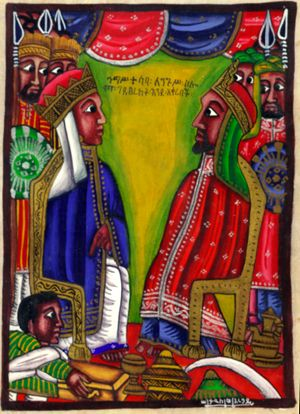
Be Wise and Beware (1 Kings 10:1-13)

Ethiopian depiction of the Queen of Sheba and King Solomon

The Queen of Sheba heard how famous Solomon was, so she went to Jerusalem to test him with difficult questions. She took along several of her officials, and she loaded her camels with gifts of spices, jewels, and gold. When she arrived, she and Solomon talked about everything she could think of. He answered every question, no matter how difficult it was.

The Queen was amazed at Solomon’s wisdom. She was breathless when she saw his palace, the food on his table, his officials, his servants in their uniforms, the people who served his food, and the sacrifices he offered at the Lord’s temple. She said:

Solomon, in my own country I had heard about your wisdom and all you’ve done. But I didn’t believe it until I saw it with my own eyes! And there’s so much I didn’t hear about. You are wiser and richer than I was told. Your wives and officials are lucky to be here where they can listen to the wise things you say.

I praise the Lord your God. He is pleased with you and has made you king of Israel. The Lord has always loved Israel, so he has given them a king who will rule fairly and honestly.

The Queen of Sheba gave Solomon more than four tons of gold, many jewels, and more spices than anyone had ever brought into Israel.

In return, Solomon gave her the gifts he would have given any other ruler, but he also gave her everything else she wanted. Then she and her officials went back to their own country.

King Hiram’s ships brought gold, juniper wood, and jewels from the country of Ophir. Solomon used the wood to make steps for the temple and palace, and harps and other stringed instruments for the musicians. It was the best juniper wood anyone in Israel had ever seen. (Contemporary English Version)

The ancient Sabeans were a wealthy people. The kingdom of Sheba was geographically located on the southwest corner of the Arabian peninsula (present day Yemen). They were ideally situated to control all the trade in and out of the Red Sea.

Since the Sabeans were a maritime people, the Queen of Sheba made it a habit to engage in trade missions and relations with other kingdoms. King Solomon was making quite a name for himself, and his nation, through his own extensive trade endeavors. It was inevitable that the two would meet.

Solomon had wisdom and wealth because of the divine gift given to him by the Lord. It’s wonderful to have a gracious gift given by God. Most of us can relate to desiring spiritual gifts and blessings from the God we serve.

Yet, what doesn’t usually get talked about is that every divine gift given to us carries with it not only opportunities to bless the world, but also the temptation to avoid proper stewardship and use the gift for personal aggrandizement.

Slowly, over time, it can become rather easy to slip into a mode of getting more and more, of expanding influence, seeking greater honor and accolades, and increasing wealth to exorbitant extremes. For those who know the biblical storyline of Solomon, this is precisely what happened to him. Perhaps in today’s Old Testament lesson, we begin to get a glimpse of the beginnings of that slippery slope into the bottomless abyss of more.

The Queen of Sheba and King Solomon meet

The Queen of Sheba, who herself was one of the wealthiest and most influential monarchs of her day, knew what affluence looked like. So, for her to be breathless over what she observed in Solomon’s kingdom must have been over-the-top abundance and riches.

It’s telling that many contemporary Westerners can read this account and see no problem with it. In fact, some even seem to believe this is something to aspire to – to be just like King Solomon, as if this is what God wants for us.

Yet, it could be that the writer and historian of the biblical kings was leading us to a different conclusion, placing Solomon in the unfavorable light of abusing his divine gift.

After all, it’s clear Solomon used his wisdom and wealth for himself in ways that went well beyond the simple meeting of needs. Solomon was a really smart guy, familiar with God’s Law, so he knew what Moses said about all this stuff:

The king should not have many horses, especially those from Egypt. The Lord has said never to go back there again. And the king must not have a lot of wives—they might tempt him to be unfaithful to the Lord. Finally, the king must not try to get huge amounts of silver and gold.

The official copy of God’s laws will be kept by the priests of the Levi tribe. So, as soon as anyone becomes king, he must go to the priests and write out a copy of these laws while they watch. Each day the king must read and obey these laws, so that he will learn to worship the Lord with fear and trembling and not think that he’s better than everyone else.

If the king completely obeys the Lord’s commands, he and his descendants will rule Israel for many years. (Deuteronomy 17:16-20, CEV)

But Solomon ended up not heeding any of these warnings. And so, it ought to have been no surprise that, after Solomon’s death, the kingdom became divided and was never the same again.

Sheba’s Queen is the one who seemed to have both her head and her heart in the right place. She’s the one who blesses Yahweh and reminds Solomon about the need to rule with integrity and justice. The Queen was able to affirm Solomon’s gift, while at the same time reminding him of what that gift is truly for.

The wise person knows there is always a shadow side to every good gift we have. If we fail to acknowledge this, and not pay attention to it, we will find ourselves doing as much harm as we do benefit.

Generous and loving God, all we are and all that we have is a gift from you. In faith and love, help us to do your will. We offer to you this day all the facets of our lives, whether it be at home, at work, or at school. We seek to be patient, merciful, generous, and holy. Give us the wisdom and insight to understand your will for us and the fervor to carry out our good intentions. We offer to you our gifts of time, abilities, and possessions as a true act of faith, to reflect our love for you and our neighbors. Help us to reach out to others as you have reached out to us. Amen.