Leadership Matters (2 Kings 9:30-37)

Jehu Commanding Jezebel’s Death, by Philip Galle, c.1561

Jehu then went to Jezreel. When Jezebel heard of it, she put on her eye shadow and arranged her hair. She looked down out of the window. When Jehu came through the gate, she said, “Do you come in peace, Zimri, you master murderer?”

Jehu looked up to the window and said, “Who’s on my side? Anyone?” Two or three high officials looked down at him. Then he said, “Throw her out!” So they threw her out of the window. Some of her blood splattered against the wall and on the horses, and they trampled her. 

Jehu then went in to eat and drink. He said, “Deal with this cursed woman and bury her. She was, after all, a king’s daughter.” They went to bury her, but they couldn’t find her body. Only her skull was left, along with her hands and feet. They went back and reported this to Jehu.

He said, “This is the Lord’s word spoken through his servant Elijah from Tishbe: Dogs will devour Jezebel’s flesh in the area of Jezreel. Jezebel’s corpse will be like dung spread out in a field in that plot of land in Jezreel, so no one will be able to say, This was Jezebel.” (Common English Bible)

“Jezebel” is not a common name for a reason. Few parents would ever give their child such a moniker. Jezebel is portrayed in Old Testament Scripture as a pagan priestess who cared nothing for Israel’s one true God; and would do anything to get her way – even if it meant fabricating false witnesses and committing murder (1 Kings 21). Here name is used synonymously in the New Testament with spiritual prostitution and opposition to God (Revelation 2:20).

Jezebel was from the city of Tyre, and married King Ahab. She introduced her husband and his nation to the chief Canaanite god Baal. Jezebel promoted the worship practices of Baal. She brought to Israel 450 prophets of Baal, and 400 prophets of Asherah. What’s more, Jezebel’s commitment to Baal led her to persecute and kill the prophets of God (1 Kings 18:4, 13).

Jehu was a military man, called by God through the prophet Elisha:

“This is what the Lord, the God of Israel, says: ‘I anoint you king over the Lord’s people Israel. You are to destroy the house of Ahab your master, and I will avenge the blood of my servants the prophets and the blood of all the Lord’s servants shed by Jezebel. The whole house of Ahab will perish. I will cut off from Ahab every last male in Israel—slave or free. I will make the house of Ahab like the house of Jeroboam son of Nebat and like the house of Baasha son of Ahijah. As for Jezebel, dogs will devour her on the plot of ground at Jezreel, and no one will bury her.’”  (2 Kings 9:6-10, NIV)

Eventually, Jehu made his way to Jezebel – and she knew full well that he intended on killing her. So, Jezebel readied by presenting herself as beautiful as possible. It seems that she intended on seducing or currying favor with Jehu so that she might continue in the royal court. But Jehu wasn’t having it.

The new king of Israel, Jehu, in seeing Jezebel, didn’t even bother to go up to her when she showed herself out of the upper level latticed window. He simply asked where the loyalty is, from those attending her. The eunuchs responded by throwing Jezebel out the window to her death. Thus, the details of Elijah’s earlier prophecy came to pass in a gruesome way.

In my reading of the story this time around, I wondered how many people are in jobs who are working for someone they see continually doing selfish and unfair things. My mind gravitated toward the eunuchs – Jezebel’s servants – who daily dealt with her. I wondered:

  • Were the eunuchs ever disturbed by Jezebel’s actions?
  • Did they ever get angry over all the injustice they saw? Or, were the eunuchs just like their mistress, having no regard for the many lives she destroyed?
  • What was the nature of their loyalty? Was it forced, or was it just shrewd?
  • Did the eunuchs dispose of their mistress because they finally saw a way out, or did they toss her out the window as a mere watching out for themselves and wanting to be on the winner’s side?

The text never tells us about the life or motives of the eunuchs. Yet, I imagine they most likely saw the situation for what it was at the time. And I suspect they had a sense that Jezebel’s reign of injustice needed to be finished.

In saying this, I’m in no way advocating for dislodging an unjust and unfair leader by violent means. But what I am saying is that, if one has a strong sense of goodness within them, its distressing to see a bad leader act in sinister and malevolent ways day after day. Consider the following statistics from the Niagara Institute:

57% of all workers have left a job in their lifetime because of bad leadership. 32% say they have considered leaving a job due to poor management, and/or due to unbearable working conditions.

69% of workers would pay better attention to their work if they were treated with more respect by their employers. 79% of employees have quit a job in their lifetime due to a lack of appreciation.

96% of employees said that management showing empathy would make them want to stay with the company. Moreover, management thinks they’re doing a good job, with 92% of managers saying that their company is empathetic; whereas only 50% of employees agree.

35% of employees say their direct manager is their biggest source of stress at work.

Over 120,000 deaths every year may be attributed to how U.S. organizations manage their employees. This doesn’t even account for the physical and mental toll an ineffective leader can take over a period of time.

Maybe Jezebel’s eunuchs knew their own deaths were just a matter of time.

I’ve been on both ends of being an employee/worker and a leader/manager. I can say that I have suffered abuse in both roles. Yet, in my judgment, the onus on making a workplace a good and positive environment is on management.

Whatever role we occupy in this life, it is everyone’s responsibility to ensure that there is no injustice; and that integrity and fairness are ubiquitous. Leaders are especially called to exhibit what is good, right, and just in everything they do.

Let’s all be willing to hold one another accountable for how we work and live together in this world. If not, we’ll keep having stories like Jehu and Jezebel.

“A Blessing for Leaders,” by John O’Donohue

May you have the grace and wisdom

To act kindly, learning

To distinguish between what is

Personal and what is not.

May you be hospitable to criticism.

May you never put yourself at the center of things.

May you act not from arrogance but out of service.

May you work on yourself,

Building up and refining the ways of your mind.

May those who work for you know

You see and respect them.

May you learn to cultivate the art of presence

In order to engage with those who meet you.

When someone fails or disappoints you,

May the graciousness with which you engage

Be their stairway to renewal and refinement.

May you treasure the gifts of the mind

Through reading and creative thinking

So that you continue as a servant of the frontier

Where the new will draw its enrichment from the old,

And you never become a functionary.

May you know the wisdom of deep listening,

The healing of wholesome words,

The encouragement of the appreciative gaze,

The decorum of held dignity,

The springtime edge of the bleak question.

May you have a mind that loves frontiers

So that you can evoke the bright fields

That lie beyond the view of the regular eye.

May you have good friends

To mirror your blind spots.

May leadership be for you

A true adventure of growth.

A Calling Is a Sacred Responsibility (2 Kings 9:1-13)

King Jehu

The prophet Elisha called to a member of the group of prophets, “Get ready, take this jug of oil with you, and go to Ramoth-Gilead. When you arrive there, look for Jehu, Jehoshaphat’s son and Nimshi’s grandson. Go to him, then pull him away from his associates, taking him to a private room. Take the jug of oil and pour it on his head. Then say, ‘This is what the Lord has said: I anoint you king of Israel.’ Then open the door, and run out of there without stopping.”

So the young prophet went to Ramoth-Gilead. He came in, and the military commanders were sitting right there. He said, “Commander, I have a word for you.”

“For which one of us?” Jehu asked.

The young prophet said, “For you, Commander.”

So Jehu got up and went inside. The prophet then poured oil on his head and said to him, “This is what the Lord, Israel’s God, says: I anoint you king over the Lord’s people, over Israel. You will strike down your master Ahab’s family. In this way I will take revenge for the violence done by Jezebel to my servants the prophets and to all the Lord’s servants. Ahab’s whole family will die. I will eliminate from Ahab everyone who urinates on a wall, whether slave or free, in Israel. I will make Ahab’s dynasty like the dynasty of Jeroboam, Nebat’s son, and like the dynasty of Baasha, Ahijah’s son. And as for Jezebel: The dogs will devour her in the area of Jezreel. No one will bury her.” Then the young prophet opened the door and ran.

Jehu went out to his master’s officers. They said to him, “Is everything okay?

Why did this fanatic come to you?”

Jehu said to them, “You know the man and the nonsense he talks.”

“That’s a lie!” they said. “Come on, tell us!”

Jehu replied, “This is what he said to me: ‘This is what the Lord says: I anoint you king of Israel.’”

Then each man quickly took his cloak and put it beneath Jehu on the paved steps. They blew a trumpet and said, “Jehu has become king!” (Common English Bible)

The biblical books of 1 & 2 Kings (originally one book of Kings) tells of the kingdoms of Israel and Judah over a five-hundred year period from c.960-586 B.C.E. The dynasties of the house of Omri and the house of Jehu were the longest lasting in Israel.

The books of First and Second Kings are primarily concerned with an evaluation of the 20 kings of Judah and the 19 kings of Israel. Of greatest concern was whether the particular king was loyal to God, or not. If the king tolerated worship of other gods besides Yahweh, and established sacrifices outside of Jerusalem, then that king was evaluated as doing evil in the eyes of the Lord.

This judgment of the kings is consistent with Deuteronomic laws of sole loyalty to God, and the importance of a central location for all Jewish people to worship (in Jerusalem).

To understand why it was so important for Jehu to be anointed with a mission is to know something of the house of Omri, and in particular, the king Ahab and his queen Jezebel. They are both conveyed to us in the biblical text as a power couple who want what they want, without a lot of concern about the subjects of their kingdom.

Jezebel was a follower of Baal and Asherah, not Yahweh. She provided for hundreds of their prophets. Her husband the king was fine with this situation. Jezebel was a clear enemy of God’s prophets, and killed hundreds of them, so that there were only a few left, including Elijah and Elisha (1 Kings 18:13).

Ahab and Jezebel’s powerful misuse of authority is relayed in the story of Naboth (1 Kings 21). Ahab wanted to buy Naboth’s vineyard, which was adjacent to his own land. But Naboth refused to sell, mainly because the land was his family’s ancient generational inheritance.

Jezebel went to work and arranged false witnesses to claim that Naboth had cursed both God and King (which was the ultimate sign of treason in Israel). As a result, Naboth was wrongly stoned to death; and Ahab unjustly confiscated his property.

Elijah prophesied that Ahab’s descendants would die, his dynasty will perish, and that Jezebel would be eaten by dogs (1 Kings 21:17-24). In our story for today, this is alluded to in the reference of God eliminating all that belong to Ahab who “urinate on a wall,” that is, unjustly marking the territory of another as their own property.

Indeed, it all shook-out according to prophecy. Ahab died in battle. Then, Ahab and Jezebel’s son Ahaziah succeeded him as king. Young Ahaziah died two years into his reign, and his brother Jehoram became king. Jehoram was then killed by Jehu. After this, some of Jezebel’s own palace officials tossed her out a window to her death, and dogs descended on her carcass – all to Elijah’s earlier prophecy.

Injustice, unrighteousness, abuse of power, and selfish concerns are ugly nasty business. These sorts of attitudes and behaviors ruin people, and keep others locked into patterns of poverty and powerlessness. God is not okay with any of it.

Whenever we are in the middle of oppression and/or authoritative people abusing their power for their own benefit, its hard to maintain our sense of rightness and goodness. Yet, we must. In such times, patience and perseverance is needed without resorting to attempts of paying back evil with evil.

What’s more, we can find ways of tapping into the spiritual power of God within us, in order to resist and subvert unjust authority with righteousness. To some degree, everyone can do something by employing nonviolent resistance tactics like networking, protest, persuasion, non-cooperation, and speaking out through either speech or writing.

Only those who possess nothing can be entrusted with everything. Systemic evil isn’t changed from the top, because those at the top benefit from the system. Rather, structural evil is transformed through grass roots efforts from the bottom up. What’s more, individuals rarely change from the outside-in, but rather from the inside-out.

A ruling establishment is not always necessarily wrong. Yet, it takes a lot of willing accountability and plenty of intentional soul searching for administrations to remain on the straight and narrow.

Such realities characterized Jehu. He was a non-descript military man. There was nothing, in particular, which distinguished him as having a special calling from God.

Yet, although Jehu fulfilled his calling, he added to the call; the Lord was not pleased with Jehu’s form of violent bloodshed, and so, put an end to Jehu’s house, just as Omri’s house had been purged from Israel.

Power and authority will do that to a person – which is why leaders must be continuously vigilant to guard against developing a thick ego and following their pride.

And so do we. Anyone who receives a call from God has a sacred responsibility and trust to fulfill that calling with competence, care, and conscientiousness.

Almighty God, direct me in all my activity with Your grace, wisdom, and help, so that in all I do and say may glorify Your holy Name; through Jesus Christ our Lord, in the power of the Holy Spirit. Amen.

1 Kings 18:1-18 – Faith at Work

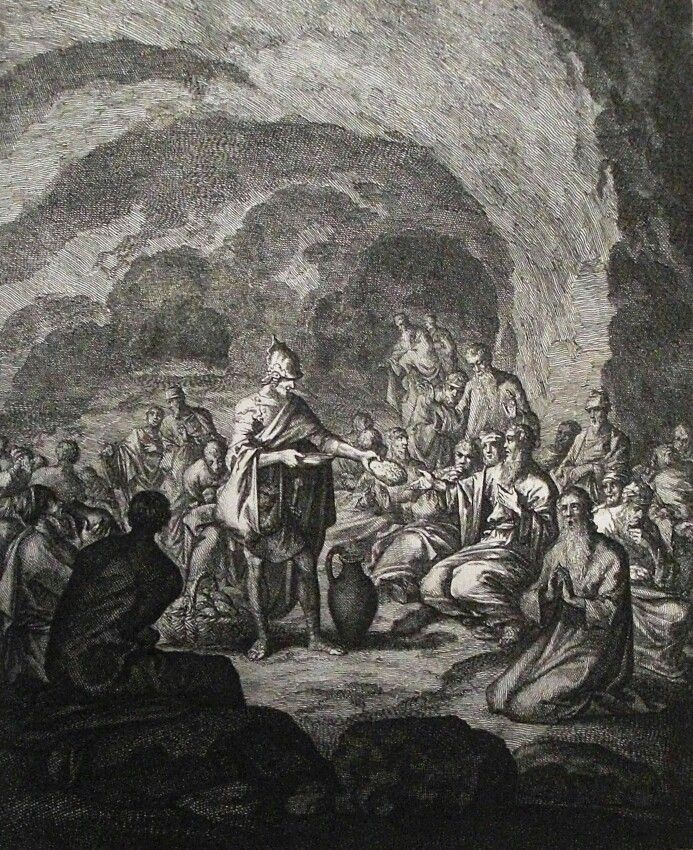
Obadiah Takes the Prophets to a Cave by Dutch engraver, Caspar Luyken (1672-1708)

For three years no rain fell in Samaria, and there was almost nothing to eat anywhere. The Lord said to Elijah, “Go and meet with King Ahab. I will soon make it rain.” So, Elijah went to see Ahab.

At that time Obadiah oversaw Ahab’s palace, but he faithfully worshiped the Lord. In fact, when Jezebel was trying to kill the Lord’s prophets, Obadiah hid one hundred of them in two caves and gave them food and water.

Ahab sent for Obadiah and said, “We have to find something for our horses and mules to eat. If we don’t, we will have to kill them. Let’s look around every creek and spring in the country for some grass. You go one way, and I’ll go the other.” Then they left in separate directions.

As Obadiah was walking along, he met Elijah. Obadiah recognized him, bowed down, and asked, “Elijah, is it really you?”

“Yes. Go tell Ahab I’m here.”

Obadiah replied:King Ahab would kill me if I told him that. And I haven’t even done anything wrong. I swear to you in the name of the living Lord your God that the king has looked everywhere for you. He sent people to look in every country, and when they couldn’t find you, he made the leader of each country swear that you were not in that country. Do you really want me to tell him you’re here?

What if the Lord’s Spirit takes you away as soon as I leave? When Ahab comes to get you, he won’t find you. Then he will surely kill me.

I have worshiped the Lord since I was a boy. I even hid one hundred of the Lord’s prophets in caves when Jezebel was trying to kill them. I also gave them food and water. Do you really want me to tell Ahab you’re here? He will kill me!

Elijah said, “I’m a servant of the living Lord All-Powerful, and I swear in his name that I will meet with Ahab today.”

Obadiah left and told Ahab where to find Elijah.

Ahab went to meet Elijah, and when he saw him, Ahab shouted, “There you are, the biggest troublemaker in Israel!”

Elijah answered:You’re the troublemaker—not me! You and your family have disobeyed the Lord’s commands by worshiping Baal.” (CEV)

Obadiah was the overseer in charge of King Ahab’s palace in Samaria of ancient Israel. To put it mildly, Ahab was a rascal. Old Testament stories frequently and purposefully contrast characters so that we will easily discern ethical differences between good and evil. Here we have a clear contrast between the godly and faithful Obadiah and the downright wicked royal couple of Ahab and Jezebel.

Whereas Obadiah was trying to preserve life and went to great lengths to do so, Ahab and Jezebel were doing everything in their sinister power to destroy life. The entire drama plays out like an episode of House of Cards. Ahab and Jezebel were a real king and queen who were thoroughly selfish and evil in all their dealings. Ahab, enabled and emboldened by his pagan wife, did away with the true worship of God and established the worship of Baal in the land of Israel. 

This did not mean, however, that God was absent or inactive. Rather, the Lord was working behind the scenes to undermine the systemic evil in the kingdom through his servant, Obadiah, who was devoted to God. Obadiah was neither a prophet nor a priest. He was simply a man working in an ungodly kingdom, doing the best he could to serve the Lord. 

Elijah may have had the prophetic voice and power, but Obadiah was the backstage administrator, daily cobbling together a living for hundreds of people without any support from the royal pain-in-the-butts.

Our ordinary everyday vocations and jobs have been ordained by God to use us where we are. Instead of lamenting our limitations or wishing the situation were different, we all have an opportunity for God to work through us in our current positions and stations in life. 

Every one of us has the daily opportunity to integrate our faith and our work through connecting biblical ethics to concrete applications at our jobs; seeing our workplaces as mission fields; interpreting our work through a Christian worldview; discerning our vocation as a calling from God; and, knowing our work is a means for God to transform and sanctify us.

So, how do you view your job?  How might you connect your faith and your work?  How does what you do reflect the nature and character of God?  In what ways do you think God wants to use you in your workplace?

Sovereign God, you cause nations and institutions to rise and fall; you set up leaders to rule and put them down.  Take my life and my work and use it in redemptive ways that glorify the name of Jesus and exemplify the power of the Holy Spirit.  Amen.