Wisdom for Life (Proverbs 11:1-31)

The Lord detests dishonest scales,
    but delights in an accurate weight.
When pride comes, so does shame,
    but wisdom brings humility.
Integrity guides the virtuous,
    but dishonesty ruins the treacherous.
Riches don’t help in the day of wrath,
    but righteousness rescues from death.
The righteousness of the innocent makes their path straight,
    but the wicked fall in their wickedness.
Those who do right are saved by their righteousness,
    but the untrustworthy are caught by their own desires.
When the wicked die, their hope perishes.
    Yes, any hope based on money perishes.
The righteous are saved from distress,
    and the wicked take their place.
The godless destroy their neighbors by their words,
    but the righteous are saved by their knowledge.
When the righteous succeed, a city rejoices;
    when the wicked perish, there are shouts of joy.
A city is honored by the blessing of the virtuous;
    it is destroyed by the words of the wicked.
Whoever despises their neighbor lacks sense;
    a sensible person keeps quiet.
A slanderer walks around revealing secrets,
    but a trustworthy person keeps a confidence.
Without guidance, a people will fall,
    but there is victory with many counselors.
Guaranteeing the debt of a stranger brings big trouble,
    but the one who refuses to shake hands will be secure.
A gracious woman gains honor;
    violent men gain only wealth.
Kind persons benefit themselves,
    but cruel people harm themselves.
The wicked earn false wages,
    but those who sow righteousness receive a true reward.
The righteous are headed toward life,
    but those who pursue evil, toward death.
The Lord detests a crooked heart,
    but he favors those whose path is innocent.
The evil person will surely not go unpunished,
    but the children of the righteous will escape.
Like a gold ring in a pig’s nose
    is a beautiful woman who lacks discretion.
The desires of the righteous end up well,
    but the expectations of the wicked bring wrath.
Those who give generously receive more,
    but those who are stingy with what is appropriate will grow needy.
Generous persons will prosper;
    those who refresh others will themselves be refreshed.
People curse those who hoard grain,
    but they bless those who sell it.
Those who look for good find favor,
    but those who seek evil—it will come to them.
Those who trust in their wealth will wither,
    but the righteous will thrive like leafy trees.
Those who trouble their family will inherit the wind.
    The fool will be servant to the wise.
The fruit of the righteous is a tree of life,
    and the wise gather lives.
If the righteous receive their due on earth,
    how much more the wicked and sinners? (Common English Bible)

The good and the bad, the wise and the foolish, the righteous and the wicked. When it comes to proverbial wisdom, there are two kinds of people: Those who take a right, just, and good path of life; and those who take the wrong exit, practice injustice, and embrace being bad.

We are all, of course, a strange amalgam of sinner and saint. Everyone has some altruism, along with a devious bent. So, life really comes down to our choices. Will our decision-making be wise, or foolish?

This is where the Book of Proverbs helps us. It lays out a prudent course of action for us, so that we can gain a perspective on the consequences of those actions, whether good or bad.

We have to carefully weigh our decisions and consider the likely outcomes of the choices we make.

As we decide, keep in mind that honesty is the best policy (11:1-4); choices have consequences (11:5-6); certain choices lead to rewards (11:7-10); good brings good, and bad brings bad (11:11-31).

Honesty Is the Best Policy

Making the decision to be honest in all things is what builds our capacity to resist evil. Poor choices often come from simply giving in, because we don’t have our resistance to saying “no” built up yet.

Humility enables us to keep our minds on the task at hand, rather than compromise on our integrity in order to achieve something we believe we need or want. The humble person understands that all things are a gift from God – and that the Lord can give, and the Lord can take away. Humility teaches us to say, “Blessed be the name of the Lord.”

When we are emptied of self-promotion, and filled with honest humility, righteousness results. And the righteous person automatically and reflexively denies all evil and wickedness.

Choices Have Consequences

Just because no one sees it, doesn’t mean there won’t be consequences. And just because there was no lightning strike from God immediately after a transgression, doesn’t mean that God’s judgment isn’t coming later.

I talk to far too many people, in my line of work as a hospital chaplain, who are filled with regret about some decision they made earlier in their life. Because now they are experiencing the physical consequences of that choice (and the emotional and relational consequences, as well).

A set of choices made earlier in life not only have real consequences later that one can see and feel; those decisions also erode the ability to make sound decisions in the present. It is a tough uphill struggle to gain some spiritual and emotional health, whenever any reserve of righteousness was not properly developed and maintained.

Certain Choices Lead to Rewards

Conversely, however, consistently good decisions, made over a stretch of time, provide solid spiritual and emotional dividends from which we can draw from in difficult times.

The chief reward for the righteous is that they have a robust life of faith and goodness because of their relationship to the Lord and a good supportive community of persons.

Foolish living leads to punishment; wise living leads to reward. A good life is really a reward itself. That’s because we are meant to live this way, to be merciful and just in all we do, walking humbly with our God. (Micah 6:8)

When the wicked die, that’s it. But when the righteous die, they leave a profound legacy in the form of others who have been encouraged, helped, and loved by their righteousness. They carry on the legacy of good. It makes a big difference.

I cannot imagine any greater reward than to know that I have been faithful to my God, and good to my fellow humanity. Such persons become like a great cloud of witnesses, testifying to the worth of investing in wisdom and humility.

Good Brings Good, Bad Brings Bad

A just and good life inspires others, invigorates groups of people, and leads to holistic health of individuals. Purity of heart is beneficial to the individual, and is contagious to the community.

A foolish life trusts in their own bad attitudes and personal opinions – and then they will wonder why they don’t get anywhere in life, and nobody wants to be around them.

King Solomon himself, gatherer of the biblical proverbs, knew all too well about both the good and the bad, and their eventual outcomes.

Solomon was quite humble and wise at the beginning of his reign. He did everything his father David asked of him, and more. But his wild success as king gradually brought him to acquire more stuff, more wives, and to fudge on the responsibilities and requirements of being king.

If a guy like King Solomon, who was the wisest person who ever lived, can ignore his own nation’s God and Holy Scripture to get whatever he wanted, then how much more do we, who have less wisdom, need the grace of loving people speaking truth to our hearts?

The people we surround ourselves with, no matter who we are, is vitally important. Everyone needs loving persons around them who will tell them what they need to hear in a spirit of love and grace. 

None of us do well with success unless we have humble and wise persons close to us who have the gumption and the grace to speak into our lives to help us, not hurt us. When we don’t have that, things go sideways.

I encourage you to go back and read Proverbs chapter 11 again, slowly, letting its wisdom seep into you. Also, a good practice is to read a chapter of Proverbs each day for the next month; and to occasionally, in the future, come back to this practice.

May the proverbial biblical wisdom fill your heart and your mind, so that you are able to make sage decisions in all of the various circumstances you encounter in this life. Amen.

A View of Suffering (Job 36:1-23)

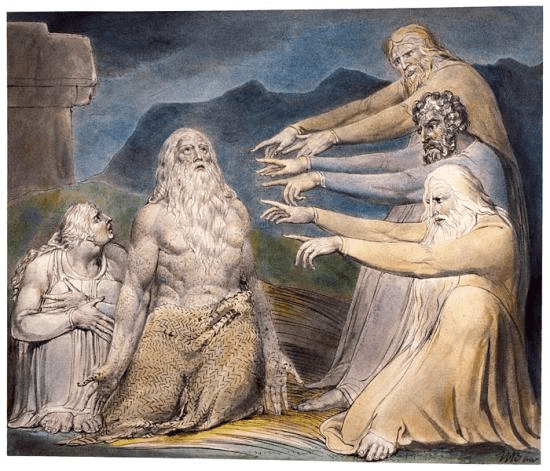
The Wrath of Elihu,” by William Blake (1757-1827)

Elihu continued:

“Bear with me a little longer and I will show you
    that there is more to be said in God’s behalf.
I get my knowledge from afar;
    I will ascribe justice to my Maker.
Be assured that my words are not false;
    one who has perfect knowledge is with you.

“God is mighty, but despises no one;
    he is mighty, and firm in his purpose.
He does not keep the wicked alive
    but gives the afflicted their rights.
He does not take his eyes off the righteous;
    he enthrones them with kings
    and exalts them forever.
But if people are bound in chains,
    held fast by cords of affliction,
he tells them what they have done—
    that they have sinned arrogantly.
He makes them listen to correction
    and commands them to repent of their evil.
If they obey and serve him,
    they will spend the rest of their days in prosperity
    and their years in contentment.
But if they do not listen,
    they will perish by the sword

    and die without knowledge.

“The godless in heart harbor resentment;
    even when he fetters them, they do not cry for help.
They die in their youth,
    among male prostitutes of the shrines.
But those who suffer he delivers in their suffering;
    he speaks to them in their affliction.

“He is wooing you from the jaws of distress
    to a spacious place free from restriction,
    to the comfort of your table laden with choice food.
But now you are laden with the judgment due the wicked;
    judgment and justice have taken hold of you.
Be careful that no one entices you by riches;
    do not let a large bribe turn you aside.
Would your wealth or even all your mighty efforts
    sustain you so you would not be in distress?
Do not long for the night,
    to drag people away from their homes.
Beware of turning to evil,
    which you seem to prefer to affliction.

“God is exalted in his power.
    Who is a teacher like him?
Who has prescribed his ways for him,
    or said to him, ‘You have done wrong’? (New International Version)

Job’s “friends” scorn him, painting by William Blake

I’m just going to go ahead and say it: Elihu was a jerk. His worldview wasn’t big enough to accommodate for Job’s awful suffering as anything but a chastisement from God.

Elihu embodied the proud person, full of himself, believing that he knows how the world works. But, in reality, he knows jack squat. The best thing Elihu did in the book of Job was to keep his mouth shut. The silence was actually helpful.

After Job lost everything and everyone dear to him (except his wife) he was understandably in tremendous grief. His lament needed to be heard – not responded to with the rebuttal of an ignoramus. Unfortunately, Elihu didn’t keep his mouth closed. He seems like a mere windbag, speaking a lot of words and saying nothing.

To be fair, Elihu gets a lot of information right; it’s just that his reasoning is narrow and misguided. He rightly affirms that God has incomparable power, and is the One who is able to punish the wicked and grant justice to the oppressed.

Yet, Elihu assumes – in his apparent black-and-white world – that anyone afflicted with such terrible events as Job is under the correction of God. The Lord is disciplining the person and teaching them a lesson about the error of their ways, he reasons.

That sort of logic betrays a very contractual sort of relationship with God – as if the Lord is only the high and transcendent plantation boss who singularly serves to maintain discipline and fealty amongst the ranks of inferiors. Elihu ignored the immanence of God in coming close to the brokenhearted and providing release for those in captivity.

In such a bifurcated world of a high God and low humanity, there are really only two choices whenever someone is in a situation like Job: either turn from your erroneous ways and serve God; or don’t, and die under the punishment of God.

But the book of Job challenges us on that kind of thinking and belief. The hard circumstances of people cannot neatly be categorized into the need for repentance – nor can a life of ease and wealth be considered a mark of divine favor.

Elihu was leaning toward viewing Job as a rebellious man who needed to admit his sin and submit to God. Yet, Job (and God!) knew better than this. And that is perhaps one of the most difficult aspects of horrible human suffering – that the sufferer must contend with persons who look at them askance as if they have done some egregious sin which offended God.

We know, as readers of the biblical book, that there was no wickedness or sin involved in Job’s suffering. Instead, there were unseen forces behind the scenes causing that suffering. In fact, just the opposite was at work: Job was suffering because of his incredible righteousness, and not by any wrongdoing on his part.

Most situations are complex and defy simple explanations or solutions. It is foolish to make assumptions based upon circumstantial evidence. Wanting quick and easy answers to the problems we face as humans is the path of simpletons.

In contrast to nice and neat mental categories, there are loving believers who are devoted to faith and patience, knowing that there can be more going on than what it seems on the surface. Listening and understanding is the path to wisdom, whereas entrenched opinions – offered as certainty of belief – is a way of dying in ignorance.

“Life’s but a walking shadow; a poor player, that struts and frets his hour upon the stage, and then is heard no more: it is a tale told by an idiot, full of sound and fury, signifying nothing.”

William Shakespeare, Macbeth

If we keep a focus on being helpful to the other, then we are less likely to offer unhelpful, even harmful, words. Knowing that life is much bigger than we can realize, is one good step toward that end.

O Lord our heavenly Father, whose blessed Son came not to be served, but to serve: We ask you to bless all who, following in his steps, give themselves to the service of others; endue them with wisdom, patience, and courage, that they may strengthen the weak and raise up those who fall, and, being inspired by your love, may worthily minister to the suffering, the friendless, and the needy, for the sake of him who laid down his life for us, your Son our Savior Jesus Christ. Amen.

Psalm 149 – Praise and Punishment

Church stained glass windows sword dividing

Praise the Lord!
Sing to the Lord a new song,
his praise in the assembly of the faithful.
Let Israel be glad in its Maker;
let the children of Zion rejoice in their King.
Let them praise his name with dancing,
making melody to him with tambourine and lyre.
For the Lord takes pleasure in his people;
he adorns the humble with victory.
Let the faithful exult in glory;
let them sing for joy on their couches.
Let the high praises of God be in their throats
and two-edged swords in their hands,
to execute vengeance on the nations
and punishment on the peoples,
to bind their kings with fetters
and their nobles with chains of iron,
to execute on them the judgment decreed.
This is glory for all his faithful ones.
Praise the Lord! (NRSV)

The initial question that arises with me is this: Is this a psalm of praise to the Lord, or an imprecatory psalm encouraging the punishment of the wicked? Well, perhaps the obvious answer is “yes.” I suppose what I am really struggling with is that out of all the one-hundred fifty psalms in the psalter, only this one has this unique combination of vocal praise and punishing action.

The psalm begins much like many psalms of praise but takes the unexpected turn of a call to a war-like operation to execute vengeance on enemies. I freely admit that I do not know quite what to make of this strange amalgam. I wonder along with the venerable Old Testament scholar Walter Brueggemann who said, “One cannot tell whether this is a responsibility to fend off oppressors or a temptation to gather imperial power.”

Perhaps my wrestling with this psalm is really the struggle with history itself. The Holy Scriptures do not shy away from the realism of its times and often offers historical events and human attitudes with unvarnished narratives. The Bible, and especially the psalmist, will not let us sanitize the past as some idyllic bygone era of divine drama to be envied. Instead, we receive the liberation of God’s people with all its harsh truth.

So, it could be that is why I also loathe seeing some mass market crosses which look ornately beautiful, as if Christ’s death was some pleasant affair. Deliverance from sin, death, and hell came at an awful price. Jesus absorbed all the foulness and degradation of a tortuous ignoble death. In other words, he was a bloody mess, publicly displayed for all to jeer at and be repulsed by.

What is more, for the Christian, perhaps the sagest approach to today’s psalm is unabashedly choosing to view it through Christocentric lenses. Christ is the strong man who has bound the ruler of this dark world with iron chains and secured our liberation from a hellish existence. And the Lord will return, the nations of the earth will be judged, and the faithful will reign with Christ forever.

Even if I read a bit too much into the psalm by interpreting it Christologically, it still leaves the intention of the imprecation open as to its true nature. In other words, the psalm simply does not tell us the trajectory of the curse which comes out of the praise. We are left to wonder in what kind of direction it goes. The Christian tradition of reading psalms and seeing Jesus in them might be our best guide.

Whichever way we choose to examine this unique psalm, the thing which we do know is that it unequivocally stands as a defiance of the nations and peoples of the earth who oppose the living God. Resistance to injustice, unrighteousness, and evil is encouraged by this psalm. The only ruler of this earth who has absolute power is God; and, anyone or any group which attempts to gain and grab such power for themselves is to be resisted. For the harsh reality of living on this created yet fallen earth is that violent and insolent people still desire total control and will do just about anything to get it and keep it.

Almighty and sovereign God, we, your people, ask in the Name of your most precious Son, Jesus Christ, our risen and ascended Lord, to look upon the good desires of your humble servants, and stretch forth the right hand of your power to be our defense against evil in all its insidious forms. And do not lead us into temptation, but deliver us from the evil one. For yours is the kingdom and the power and the glory forever. Amen.