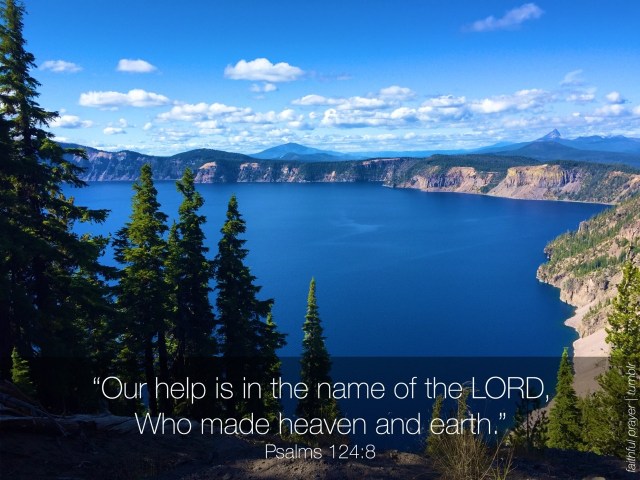
Psalm 124 – Our Help

Our Help

If the Lord hadn’t been for us—
let Israel now repeat!—
if the Lord hadn’t been for us,
when those people attacked us
then they would have swallowed us up whole
with their rage burning against us!
Then the waters would have drowned us;
the torrent would have come over our necks;
then the raging waters would have come over our necks!

Bless the Lord
because he didn’t hand us over
like food for our enemies’ teeth!
We escaped like a bird from the hunters’ trap;
the trap was broken so we escaped!

Our help is in the name of the Lord,
the maker of heaven and earth. (CEB)

“Our help is in the name of the Lord who made heaven and earth.”  These are the words for which I begin nearly every worship service in church.  It is a call to worship the God who is above all and sees all – and can do something about the adversity and trouble we face in the world.  When confronted with a new day, our attention needs some direction in the positive way of acknowledging God.

Our ultimate help is in the Lord.  Our fears about the future, our insecurities of what will happen, and our anxieties about all the upcoming stuff we must face can be transformed with the biblical perspective of acknowledging our need for God.  The Lord is our most prescient support.  That virtual meeting you have been dreading; that conversation you have been avoiding; or, that deadline that has been looming over your head; these and all situations can only find their proper perspective in light of the God who helps.

I am a believer in making daily affirmations of faith in God. That is, affirming the truth about God, even if I don’t feel like it, each and every day so that some solid robust theology is at the forefront of my mind, and the attributes of God sink firmly into my heart.  For faith does not simply come because of signing off on a checklist of beliefs.  Rather, faith arises as a response to the recognition that God is good – all the time – and that he helps those who look to him.

There are a lot of things we do not know: what will happen tomorrow; how a situation will shake out in the end; whether a relationship will flower or wither; and, a million other things which can weigh down our hearts with anxiety. However, there is one sure truth we can count on right now and for every minute into the future: God is with us. God’s ever-present help remains the constant ballast in a sea of changing circumstances.

Indeed, “If God is on our side, can anyone be against us?… I am sure that nothing can separate us from God’s love—not life or death, not angels or spirits, not the present or the future, and not powers above or powers below. Nothing in all creation can separate us from God’s love for us in Christ Jesus our Lord!” (Romans 8:31, 38-39, CEV)

Creator God, you are the ever-present One who provides everything I need for life and godliness.  I need your help today and everyday so that I can confidently do your will.  I stand with full assurance of faith because I serve the Lord Jesus, who is benevolent and always does what is right and just.  Amen.

Psalm 130 – Waiting in Hope

waiting

Out of the depths I cry to you, Lord;
Lord, hear my voice.
Let your ears be attentive
to my cry for mercy.

If you, Lord, kept a record of sins,
Lord, who could stand?
But with you there is forgiveness,
so that we can, with reverence, serve you.

I wait for the Lord, my whole being waits,
and in his word I put my hope.
I wait for the Lord
more than watchmen wait for the morning,
more than watchmen wait for the morning.

Israel, put your hope in the Lord,
for with the Lord is unfailing love
and with him is full redemption.
He himself will redeem Israel
from all their sins. (NIV)

This psalm is the miserable cry of a nobody from nowhere. Yet, because the Lord is attentive to the righteous, the cry penetrates heaven and is received. The psalmist only wants to serve God with a new beginning and fresh obedience – and he will wait and hope for liberation from his misery.

We typically use the term “hope” in a wishful thinking sort of way. That is because we are not quite sure if things will shake-out like we want.  But biblical hope is not wishful thinking.  Rather, it is a confident expectation of what is to come. Hope is like anticipating the seasons.  In the dead of winter when it is bitter cold with little sunshine, we hope, and not wish, for Spring because we know it is coming.  It might come in early March, maybe in late April. The trees will bud, the grass will turn green, and the temperature will warm – you can bet your britches on it.

This old world might be messed up and broken right now, but it will not always be this way.  Because of the person and work of Jesus Christ, there is hope, the confident expectation that deliverance from sin, death, and hell will be fully realized. We are saved from the bondage of sin through the cross and resurrection of Christ.  We are delivered into an inheritance which can never perish, spoil, or fade – kept in heaven for us until the time is right. Meanwhile, we hope with the confident expectation of Christ’s coming again.

Praise be to the God and Father of our Lord Jesus Christ! In his great mercy he has given us new birth into a living hope through the resurrection of Jesus Christ from the dead, and into an inheritance that can never perish, spoil, or fade. This inheritance is kept in heaven for you, who through faith are shielded by God’s power until the coming of the salvation that is ready to be revealed in the last time. In all this you greatly rejoice, though now for a little while you may have had to suffer grief in all kinds of trials. (1 Peter 1:3-6, NIV)

Until our hope is fully realized, we cry out to God and watch for his deliverance. Regarding our salvation, it is accurate to say that we have been saved (from the realm of sin); we are currently being saved (through being made holy in this life); and, we will be saved (when Jesus returns). Liberation from both our personal struggles and the evil machinations of this world is an ongoing process that will only reach its complete fulfillment at the end of the age.

That is why we experience such a weird existence on this earth, a strange amalgam of good and bad.  We not only get mixed messages from the world, but also internally, within our souls, we experience the struggle between right and wrong.  Outwardly, we suffer in all kinds of earthly grief from others who do not understand us.  Inwardly, we have the silent pain and terrible wrestling of wanting to forgive but desiring revenge; of seeking to be gracious but seething with anger; of looking to express kind words but having hate speech blurt out instead.

It will not always be this way. We have a living hope.  Jesus has risen from death. He is alive. He is coming back to judge the living and the dead.  He will take us to be with him forever.  It is the confident expectation of unhindered relationship, with no obstacles of difficult people, and without any systemic evil from organizational structures giving us a hard time.

MLK hope quote

Hope is real. It is just as real as anything we will ever know this side of heaven. We might not always find what we are looking for in this life, yet, in the next life, we shall find the life that is truly life in Jesus Christ, who is our hope. Until then, we are to wait neither idly nor passively. Instead, it is sage for us to do the following:

Occupy the time. One of the best ways to avoid becoming anxious while waiting is to do what we are on this earth to do: be a blessing to others.

Bless those who persecute you; bless and do not curse. Rejoice with those who rejoice; mourn with those who mourn. Live in harmony with one another. Do not be proud but be willing to associate with people of low position. Do not be conceited…. Do not be overcome by evil but overcome evil with good. (Romans 12:14-16, 21, NIV)

Don’t try too hard. Trying to use willpower to squelch anxiety will only prompt even greater anxiety. Accept that we will have to wait and that we are not privy to God’s timetable.

Give all your worries and cares to God, for he cares about you. (1 Peter 3:7, NLT)

Wait with other people. Waiting with others through talking about our shared hope helps redeem our time in the here and now.

Be still in the presence of the Lord and wait patiently for him to act. Don’t worry about evil people who prosper or fret about their wicked schemes. (Psalm 37:7, NLT)

Think of patience as compassion. Becoming impatient about something in life is entirely normal and happens to all of us. Our impatience is a stress response to a situation. Learning to be more patient is a way of being more compassionate to ourselves and others.

Therefore, as God’s chosen people, holy and dearly loved, clothe yourselves with compassion, kindness, humility, gentleness, and patience. (Colossians 3:12, NIV)

Lord God Almighty, your hope arises with each dawn, pushing back the rubble of our lives. Each new day reminds us of your grace as you paint hope across the sky. Into the deafening cry of hopelessness, you whisper love that catches and holds us. There is no end, just new beginnings. No finish, just new starts. Into your resurrection we follow you into hope. You are alive in the world and in us. So, we carry your hope within our spirits always. Help us to lift our eyes and experience Christ’s resurrection hope arise in our lives through Jesus our Lord. Amen.


Psalm 133 – The Blessing of Unity and Harmony

Ascend to Jerusalem by Dan Livni
“Ascend to Jerusalem” by Dan Livni

Oh, how wonderful, how pleasing it is
when God’s people all come together as one!
It is like the sweet-smelling oil that is poured over the high priest’s head,
that runs down his beard flowing over his robes.
It is like a gentle rain from Mount Hermon falling on Mount Zion.
It is there that the Lord has promised his blessing of eternal life. (ERV)

Unity, solidarity, and harmony are a beautiful blessing. Disunity, division, and fragmentation are an ugly curse. Within all families and faith communities are a diverse bunch of people – which brings the potential of both wonderful fellowship and disagreeing fights.

Today’s reading is a psalm of ascent. It is one of a group of psalms the Israelites would say and sing together as they made their pilgrimage to Jerusalem and ascended the temple mount to worship the Lord. Their common purpose and shared experience led to a blessed unity among all the worshipers.

The metaphors the psalm uses are meant to convey the feeling and impact of a unified people’s blessing as one harmonious bunch. The reference to oil communicates abundance and extravagant blessing beyond expectation. The gentle rain or the dew pictures the giving of life to a parched landscape. The psalm is a celebration of life’s simple pleasures, enjoyed with friends and family.

People created in the image of God are hard-wired for community. Rather than existing in isolation, doing our own thing, and keeping to ourselves, the Lord’s intention for humans is to be close enough to one another to rejoice with those experiencing joy and to weep with those mourning a loss. True community requires unity and harmony.

To live in harmony with one another means we regard everyone the same way by not playing favorites, being condescending, or giving more weight to one group more than another. It is a willingness to interact, work, and play with all kinds of people – not just those whom we like or help us get ahead in life. We are designed by our Creator to live and work together in common purposes. In fact, it takes a great deal of effort.

Be completely humble and gentle; be patient, bearing with one another in love.  Make every effort to keep the unity of the Spirit through the bond of peace (Ephesians 4:2-3, NIV).

Think about what we have in Christ: the encouragement he has brought us, the comfort of his love, our sharing in his Spirit, and the mercy and kindness he has shown us. If you enjoy these blessings, then do what will make my joy complete: Agree with each other and show your love for each other. Be united in your goals and in the way you think. In whatever you do, do not let selfishness or pride be your guide. Be humble, and honor others more than yourselves. Do not be interested only in your own life, but care about the lives of others too (Philippians 2:1-4, ERV). 

If we desire the enjoyment of blessed relationships we will engage in genuine conversation, focused listening, and equal dialogue; simply stating opinions at each other will not do the trick.

Yes, we are to work at unity and harmony because we can have a nasty tendency to think better of ourselves than what is true, and of others what is not so good.  We might inflate our positive qualities and abilities, especially in comparison to other people.  Numerous research studies have revealed the propensity to overestimate ourselves.

For example, when one research study asked a million high school students how well they got along with their peers, none of the students rated themselves below average. As a matter of fact, 60% of students believed they were in the top 10%; and, 25% rated themselves in the top 1%.

College professors were just as biased about their abilities – 2% rated themselves below average; 10% were average and 63% were above average, while 25% rated themselves as truly exceptional. Of course, this is statistically impossible. One researcher summarized the data this way: “It’s the great contradiction: the average person believes he is a better person than the average person.”

Christian psychologist Mark McMinn contends that this study reveals our pride. He writes, “One of the clearest conclusions of social science research is that we are proud. We think better of ourselves than we really are, we see our faults in faint black and white rather than in vivid color, and we assume the worst in others while assuming the best in ourselves.”

Where sinful pride rules, disharmony runs amok within a community. The acid test of harmonious love is how we treat the lowly. One of the great preachers in church history, St. John Chrysostom (the fourth century Bishop of Constantinople) had this to say:

“If a poor man comes into your church behave like him and do not put on airs because of your riches.  In Christ there is no rich or poor.  Do not be ashamed of him because of his outward dress but receive him because of his inward faith.  If you see him in sorrow, do not hesitate to comfort him, and if he is prospering, do not feel shy about sharing in his pleasure.  If you think you are a great person, then think others are also.  If you think they are humble and lowly, then think the same of yourself.”

We cannot function apart from harmony. Consider a tuning fork. It delivers a true pitch by two tines vibrating together. Muffle either side, even a little, and the note disappears. Neither tine individually produces the pure note. Only when both tines vibrate is the correct pitch heard.  Harmony is not a matter of give and take and compromise to make each other happy or satisfied.  Harmony comes through a common mission and purpose which engages in shared experiences of loving and caring for others.

My Christian convictions and tradition tell me that the Word of God is applied by the Spirit of God through the people of God.  We are to embrace community.  We are to do life together.  We are to view everyone as my brother or sister. After all, we are our brother’s keeper.

So, let us ascend the hill of the Lord together. Let us worship God together with glad and sincere hearts. Let us be mindful of all our brothers and sisters, no matter who they are.


Psalm 28 – To Be, or Not to Be

David pelted with stones
David being pelted with stones, by unknown Slovakian artist, 1937

I cry out to you, Lord.
You are my rock; don’t refuse to hear me.
If you won’t talk to me,
I’ll be just like those going down to the pit.
Listen to my request for mercy when I cry out to you,
when I lift up my hands to your holy inner sanctuary.
Don’t drag me off with the wicked and those who do evil;
the type who talk nice to their friends
while evil thoughts are in their hearts!
Pay them back for what they’ve done!
Pay them back for their evil deeds!
Pay them back for their handiwork!
Give back to them exactly what they deserve!
Because they have no regard for what the Lord has done,
no regard for his handiwork,
God will tear them down and never rebuild!

Bless the Lord
because he has listened to my request for mercy!
The Lord is my strength and my shield.
My heart trusts him.
I was helped, my heart rejoiced,
and I thank him with my song.
The Lord is his people’s strength;
he is a fortress of protection for his anointed one.
Save your people, God!
Bless your possession!
Shepherd them and carry them for all time! (CEB)

The biblical character David, in frustration and agony, cried out for help, for God to hear his prayers. And, when his prayer was heard, David gave exuberant praise to the Lord for listening to him. We are not told specifically of how that prayer was answered and what happened between the request and the response. It seems the juicy details are left out on purpose, so that maybe we would not get lost in the retribution but stick with the fact that there was a desperate need and the Lord stepped in and did something about it.

As I pondered this psalm and its lack of life-detail, I wondered about David’s situation: Could it be that David gave God praise just for being heard by him?  Was David cured in some way, or was he healed from the need to be healed?  Was there even any actual deliverance that occurred?  Did David come to praise God despite a lack of deliverance?  Was David’s joy in his relationship with God conditional, or unconditional?

Hamlet
Hamlet, played by actor Matt Amendt in the Pittsburgh Public Theater, 2018

William Shakespeare’s Hamlet (c.1601 C.E.) put the question this way: “To be, or not to be, that is the question.” Hamlet’s soliloquy went on to say:

“Whether ’tis nobler in the mind to suffer
The slings and arrows of outrageous fortune,
Or to take arms against a sea of troubles,
And by opposing end them? To die: to sleep;
No more; and by a sleep to say we end
The heartache and the thousand natural shocks
That flesh is heir to, ’tis a consummation
Devoutly to be wish’d. To die, to sleep;
To sleep: perchance, to dream: ay, there’s the rub;
For in that sleep of death what dreams may come
When we have shuffled off this mortal coil,
Must give us pause: there’s the respect
That makes calamity of so long life;
For who would bear the whips and scorns of time,
The oppressor’s wrong, the proud man’s contumely,
The pangs of despised love, the law’s delay,
The insolence of office and the spurns
That patient merit of the unworthy takes,
When he himself might his quietus make
With a bare bodkin (knitting needle)?”

Hamlet, much like David of old, was miserable and burdened with a profound lack of power to change his circumstances. So, he reflects on life and death in a morbid and melancholy way. It is not that Hamlet was contemplating suicide as much as he meditated on what life truly is and finding some meaning within it. Unlike David, Hamlet cannot find the courage to deal with his frustration and feels stymied with fear of the unknown.

If we are blatantly honest with ourselves, we must admit that far too often we have a particular outcome in mind for God to do.  Our hopes and expectations are tethered to God doing something extremely specific so that, if it does not come to pass (or does not come quickly!) we become discouraged and disillusioned. Like Hamlet, we become lost in the shadows of our thinking and ponder some sort of escape.

So, here is another set of questions I am asking myself: If my adverse circumstances do not change, can I praise God anyway?  Can I, like David, take joy in simply being heard?  Can I find gratitude in all situations?  Do I only express thanks and praise to God when things are going my way?  Am I open to whatever God wants to do in my life, even if it is not what I would choose?  Do I feel that I am above having to put up with the wickedness of this world?  Am I expecting heaven on earth, or am I willing to suffer as Jesus did?

I honestly believe the answers to those questions will determine the trajectory of our Christian experience. For the identity and meaning of all persons is found in the divine.

I praise you, O God, in the good and the bad, the easy and the difficult, the failures and the victories.  You are Lord over all things.  You are my strength and shield in every circumstance.  When I am weak, I am strong. I can do all things through Christ who strengthens me.  Amen.