Psalm 78:1-4, 12-16 – Remember and Learn

My friends, I beg you
    to listen as I teach.
I will give instruction
    and explain the mystery
    of what happened long ago.
These are things we learned
    from our ancestors,
    and we will tell them
    to the next generation.
We won’t keep secret
    the glorious deeds
    and the mighty miracles
    of the Lord….

God made a path in the sea
    and piled up the water
    as he led them across.
He guided them during the day
    with a cloud,
    and each night he led them
    with a flaming fire.
God made water flow
from rocks
he split open
    in the desert,
    and his people drank freely,
    as though from a lake.
He made streams gush out
    like rivers from rocks. (CEV)

This is a psalm designed to recall historical events for the theological education of ourselves and the next generation. Through passing on eventful stories from the past to future generations, God’s people continue to remember and realize robust divine action in the world. In recalling stories of care and deliverance, God’s commandments are kept. Putting trust in a powerful and benevolent deity brings assurance and encouragement.

Using the psalter as a means of recollecting past events is a sage way of edifying God’s people and living into the command of the Law, according to Moses:

These are the commands, decrees and laws the Lord your God directed me to teach you to observe in the land that you are crossing the Jordan to possess, so that you, your children and their children after them may fear the Lord your God as long as you live by keeping all his decrees and commands that I give you, and so that you may enjoy long life. Hear, Israel, and be careful to obey so that it may go well with you and that you may increase greatly in a land flowing with milk and honey, just as the Lord, the God of your ancestors, promised you.

Hear, O Israel: The Lord our God, the Lord is one. Love the Lord your God with all your heart and with all your soul and with all your strength. These commandments that I give you today are to be on your hearts. Impress them on your children. Talk about them when you sit at home and when you walk along the road, when you lie down and when you get up. Tie them as symbols on your hands and bind them on your foreheads. Write them on the doorframes of your houses and on your gates.

When the Lord your God brings you into the land he swore to your fathers, to Abraham, Isaac and Jacob, to give you—a land with large, flourishing cities you did not build, houses filled with all kinds of good things you did not provide, wells you did not dig, and vineyards and olive groves you did not plant—then when you eat and are satisfied, be careful that you do not forget the Lord, who brought you out of Egypt, out of the land of slavery. (Deuteronomy 6:1-12, NIV)

Since psalms are meant to be recited repeatedly throughout one’s spiritual life, doing so inoculates the worshiper from faithless rebellion and counteracts temptations toward trusting in idols. It is a preservative, giving life, purpose, and wholeness. Regular spiritual consumption of the psalms provides a pattern of instruction which molds and maintains the soul so that, when hard situations arise, the supports are there to hold up under the adversity.

The life that is truly life, and life for those who come after us, comes through intentional remembrance and learning. Today’s psalm is a fitting invitation to set our hope in God, remember God’s wonderful works, and keep God’s commands.

Psalm 119:97-104 – God the Teacher

I deeply love your Law!
    I think about it all day.
Your laws never leave my mind,
    and they make me much wiser
    than my enemies.
Thinking about your teachings
    gives me better understanding
    than my teachers,
and obeying your laws
makes me wiser
    than those
    who have lived a long time.
I obey your word
    instead of following a way
    that leads to trouble.
You have been my teacher,
    and I won’t reject
    your instructions.
Your teachings are sweeter
    than honey.
    They give me understanding
    and make me hate all lies. (CEV)

We live in a wonderful, complex, beautiful, broken, and upside-down world. The information we access, the choices we make, and the networking we engage in all require a great deal of wisdom.  Throw into the mix the reality that most things rarely go as we plan, and you have a recipe for disappointment and/or frustrating anger.  So, is there a path, a way of approaching this world that can help us navigate all its twists and trials?  Yes, there is a light through it all. Today’s psalm informs us how to proceed.

Wisdom in the Old Testament is the ability to take revealed truth and put it into concrete daily practice. So then, a life marked by the love and study of God’s Word brings both right living and enjoyment. God is our teacher and faithfully guides us into grateful living through his promises and commands. We can put ourselves in a position to sit at the master’s feet and receive gracious instruction for life.

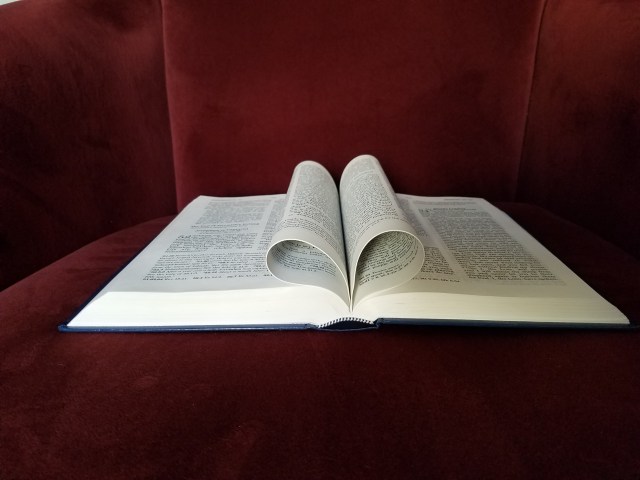
Lectio Divina is one way of doing just that: allowing God to teach us through his Holy Word. Lectio Divina is an ancient Latin term which means “spiritual reading.”  It means to read Holy Scripture not just to know its contents, but to experience its power to restore, heal, transform, provide wisdom, and draw close to God. 

Lectio Divina is a simple way to prayerfully read the Bible, meditate on its message, and listen for what God may be saying for us to do.  It can be done privately, or with a small group of people.  The goal for the Christian is to become more Christ-like.

Lectio Divina is based upon reading a selected text of Scripture three times. Each reading is followed by a period of silence after which each person is given the opportunity to briefly share what they are hearing as they listen to God (if done in a group).

First Reading

During the first reading, read the text aloud twice. Read slowly and carefully. The purpose of the first reading is for each person to hear the text and to listen for a word, phrase or idea that captures their attention. As group members recognize a word, phrase, or idea, they are to focus their attention on it, repeating it within their minds several times.

Second Reading

During the second reading, read the text again. This time, listeners are to focus their attention on how the selected word, phrase or idea speaks to their life that day. What does it mean for you today? How is Christ, the Word, speaking to you about your life through this word, phrase, or idea? What is Christ, the Word, speaking to you about your life through this word, phrase, or idea? After the reading, a brief period of silence is observed and then group members share briefly what they have heard.

Third Reading

Read the text again. This time, listeners are to focus on what God is calling them to do or to become. Experiencing God’s presence changes us. It calls us to something. During this final reading, focus on what God is calling you to do or to be.  After the third reading, there is a period of silence, then group members share what they are being called to do or to be.

The psalms, especially Psalm 119, are meant to be read over-and-over again, to be used for prayer, worship, and study. Devoting ourselves to the psalms and grafting them into our lives is one of the best practices we can do to live a healthy and happy spiritual life.

Almighty God extend your goodness to me according to your Holy Word. Teach me knowledge and good judgment because I trust your commands. I seek to obey your wondrous Word. You are good, and what you do is always good. Teach me your decrees through Jesus Christ my Lord in the wisdom of your Holy Spirit. Amen.

Psalm 105:1-6, 37-45 – Remember the Wonderful

O give thanks to the Lord, call on his name,
    make known his deeds among the peoples.
Sing to him, sing praises to him;
    tell of all his wonderful works.
Glory in his holy name;
    let the hearts of those who seek the Lord rejoice.
Seek the Lord and his strength;
    seek his presence continually.
Remember the wonderful works he has done,
    his miracles, and the judgments he has uttered,
O offspring of his servant Abraham,
    children of Jacob, his chosen ones….

Then he brought Israel out with silver and gold,
    and there was no one among their tribes who stumbled.
Egypt was glad when they departed,
    for dread of them had fallen upon it.
He spread a cloud for a covering,
    and fire to give light by night.
They asked, and he brought quails,
    and gave them food from heaven in abundance.
He opened the rock, and water gushed out;
    it flowed through the desert like a river.
For he remembered his holy promise,
    and Abraham, his servant.

So he brought his people out with joy,
    his chosen ones with singing.
He gave them the lands of the nations,
    and they took possession of the wealth of the peoples,
that they might keep his statutes
    and observe his laws.
Praise the Lord! (NRSV)

Every day I read in the psalms. There are two reasons I do this. First, the psalms are the church’s prayer book.  They are more than reading material; the psalms are meant and designed to be owned for us as prayers. And second, I need their reminders – a lot!

Remembering is a major theme throughout the entirety of Holy Scripture. It is just part of the human condition, fallen and forgetful as we are, to lose sight of what has taken place in the past. Today’s psalm invites us to seek the Lord through remembering all the good and wonderful works he has done.

For Israel, remembering meant continually having Passover in front of them. God redeemed his people out of Egyptian slavery and into a good Promised Land. They were to never forget God’s miracle through the Red Sea, his protection over them from other nations, and his provision of food and necessities in the desert.

We are to remember because we are made in God’s image and likeness. God remembers. God has an ongoing reminder in his divine day timer: fulfill the promises I made; keep the covenant I initiated with the people, even when they’re stinkers and forget who I am.

God does not forget. God always keeps his promises. For the Christian, all God’s promises are remembered and fulfilled in the person and work of Jesus Christ. Deliverance from sin, death, and hell; the gift of the Holy Spirit; and ongoing presence and provision are given to us graciously and freely by the God who loves and cares for his people. For us, remembering means coming to the Lord’s Table, entering the once for all loving sacrifice of Christ on our behalf.

One of the reasons I write and journal about my life and Scripture is to remember. Sometimes I forget. There are times when I am overwhelmed with life and it feels as if God has forgotten me. In such times, I look back into my journal and see what God has done. And I also peer into the psalms and see that God is active in his big world, always attentive to working what is just, right, and good in his people.

May your daily spiritual journey cause you to remember the Lord Jesus, to have him always before you.

“Now We Remain” by David Haas

We hold the death of the Lord deep in our hearts.

Living, now we remain with Jesus, the Christ.

Once we were people afraid, lost in the night.

Then, by your cross, we were saved;

dead became living, life from your giving.

Something which we have known, something we’ve touched,

what we have seen with our eyes;

this we have heard; life-giving Word.

He chose to give of himself, become our bread.

Broken that we might live.

Love beyond love, pain for our pain.

We are the presence of God; this is our call.

Now to become bread and wine; food for the hungry, life for the weary,

for to live with the Lord, we must die with the Lord.

Amen.

Psalm 114 – A Mighty God

Mono Crater by Chiura Obata
Painting by American artist Chiura Obata (1885-1975)

God brought his people
out of Egypt,
that land
with a strange language.

When the sea looked at God,
it ran away,
and the Jordan River
flowed upstream.
The mountains and the hills
skipped around like goats.

Ask the sea why it ran away
or ask the Jordan
why it flowed upstream.
Ask the mountains and the hills
why they skipped like goats!

Earth, you will tremble,
when the Lord God of Jacob
comes near,
because he turns solid rock
into flowing streams
and pools of water. (CEV)

I’m a metaphor guy. I like word pictures, analogies, and illustrations. Maybe that’s one reason I resonate with the Old Testament. The Hebrew mind revels in story, symbol, similitude, and even the occasional sarcasm. The turn-of-phrase is something which connects well with me – which is why I like today’s psalm. The language is freighted with metonymy and personification.

This psalm is a poetic response to the Jewish Passover and exodus out of slavery to freedom. It is a brief song of thanksgiving which nicely recounts the Israelite experience from Egypt to the Promised Land. At the behest of a mighty God, the Red Sea parted when the people left Egypt, and the Jordan River stopped its flowing when the people entered the Promised Land.

It’s a whole lot more powerful to say, “When the sea looked at God, it ran away,” than it is to say, “The Red Sea parted.” God is so mighty, so powerful, so large and sovereign that we must use the full extent of language to even begin to describe his wonderful works. A big God with awesome capability needs some wordsmithing worthy of his greatness.

Not only does the sea flee from its place, the river turns back, the mountains and hills shake and skip. To try and somehow capture the immensity of God, the psalmist used language which communicates that even inanimate objects come alive and fulfill his divine bidding.

It is one thing to make a flat statement such as, “Put your trust in God,” and it is quite another matter to open up the tool of language and allow it to picture a divine Being so amazing that nothing nor anyone can possibly stand in his way. And this very same God works for us, not against us.

The Lord God almighty, Creator of heaven and earth, has taken his formidable power and granted us a pinch of it – because that’s all we really need. Jesus, intimately familiar with his mighty heavenly Father, commented:

If your faith is as big as a mustard seed, you can say to this mulberry tree, “Dig yourself up and plant yourself in the ocean!” And the tree will obey you. (Luke 17:6, ERV)

For assuredly, I say to you, whoever says to this mountain, “Be removed and be cast into the sea,” and does not doubt in his heart, but believes that those things he says will be done, he will have whatever he says. (Mark 11:23, NKJV)

All of creation conspires together to participate in the great liberating and saving acts of God for his people. And if that wasn’t enough, we have been given his Holy Spirit to be with us forever – uprooting trees and moving mountains to accomplish the good and loving plan of God here on earth as it is always done in heaven.

Mighty God you invite us to be with you, to have a place near you. Your presence is joy, light, and comfort. Your nearness is holy, awesome, and wonderful. In the play of sunlight through rainbows, in the sounds of music and laughter, in the beauty of creation and the taste of bread and wine, your presence is known. Your saving presence surrounds us, whether we are fearful or joyful, laughing or crying. You invite us, welcome us, forgive us and renew us with fresh hope and new life. You love us into your presence. We bless and thank you. We praise and adore you. We enjoy being with you, in the name, the spirit and the presence of Jesus. Amen