Psalm 27 – Waiting Patiently

The Waiting Room by South African artist Gerard Sekoto (1913-1993)

The Lord is my light and my salvation—
    so why should I be afraid?
The Lord is my fortress, protecting me from danger,
    so why should I tremble?
When evil people come to devour me,
    when my enemies and foes attack me,
    they will stumble and fall.
Though a mighty army surrounds me,
    my heart will not be afraid.
Even if I am attacked,
    I will remain confident.

 The one thing I ask of the Lord—
    the thing I seek most—
is to live in the house of the Lord all the days of my life,
    delighting in the Lord’s perfections
    and meditating in his Temple.
For he will conceal me there when troubles come;
    he will hide me in his sanctuary.
    He will place me out of reach on a high rock.
Then I will hold my head high
    above my enemies who surround me.
At his sanctuary I will offer sacrifices with shouts of joy,
    singing and praising the Lord with music.

 Hear me as I pray, O Lord.
    Be merciful and answer me!
My heart has heard you say, “Come and talk with me.”
    And my heart responds, “Lord, I am coming.”
Do not turn your back on me.
    Do not reject your servant in anger.
    You have always been my helper.
Don’t leave me now; don’t abandon me,
    O God of my salvation!
Even if my father and mother abandon me,
    the Lord will hold me close.

 Teach me how to live, O Lord.
    Lead me along the right path,
    for my enemies are waiting for me.
Do not let me fall into their hands.
    For they accuse me of things I’ve never done;
    with every breath they threaten me with violence.
Yet I am confident I will see the Lord’s goodness
    while I am here in the land of the living.

Wait patiently for the Lord.
    Be brave and courageous.
    Yes, wait patiently for the Lord. (NLT)

The message of the Advent season is perfectly and succinctly encapsulated in this heartfelt psalm to wait patiently for the Lord. Oh, how impatient we can be as people!  Not only do we anticipate the celebration of Christmas with the coming Christ child, but we long for deliverance, courage, help, strength, and, of course, patience.

The way to wait patiently is through hope. And hope is one of those things which needs to be continually be fortified. Whatever it is that we desire to see realized – the return of a wayward son or daughter; revitalization and revival within the church; courage to face the high wall of adversity; protection and deliverance from mean-spirited people; an end to pandemic; freedom from racism and injustice – whatever the situation we long for, patience is to be our breakfast every morning to help us through each day, living one day at a time, putting one foot forward.

Apart from patience and faith in God, we will lose our spiritual zeal and settle for a mediocre existence with tepid relationships and lukewarm engagement of the world. God desires more for us than simply having a marriage in which two people only exist under the same roof; for church to be more than buildings, budgets, and butts in the pews; for our work to be more than a necessary evil to make a living; for our lives to be more than fear, worry, and anxiety; more than broken dreams, messed up relationships, and situations gone sideways.

The confident expectation of hope neither eliminates trouble from our lives nor magically makes everything better. Deep faith, like the psalmist expressed, does not change reality – but it does change us. The way in which we view and handle our troubles is understood differently through the filter of faith and the lens of hope. The mammoth adversity in our lives is no longer feared because of settled trust in God; the danger which lurks about has no teeth to hold us when we are secure in the Lord.

The actions we ourselves take toward God amidst the fallen nature of this world are to wait and hope, be strong and take courage. It is precisely when we are totally discombobulated that these actions are to take effect. “I believe…” and “I have confidence…” become the beginning pronoun and verbs to every sentence we utter. So, let us flesh out those words:

I believe the Lord is the Light which keeps me safe and illumines my path.

I believe the Lord is my Fortress, a castle to protect me.

I believe the Lord is an Army surrounding me, defending my life.

I believe the Lord is the Rock of my salvation, keeping me secure.

I believe the Lord is a Parent who holds me close and does not let go.

I believe the Lord is the righteous, just, and good Judge, always extending grace and mercy to me.

Therefore, I have confidence and courage to engage the world, knowing God has my back.

I have confidence God will handle malevolent persons, systemic evil, and sinister forces on my behalf.

I have confidence I can approach God, since God’s character is always gracious and loving.

I have confidence to pray with authority, understanding God is the Sovereign of the universe.

I have confidence better days are ahead, that the Christ is soon coming.

I have confidence God bends to attentively listen to me praying.

I have confidence God is neither angry at me nor hidden from me.

I have confidence God shall lead me, guide me, and teach me in the way I ought to go.

Rather than losing heart, we can be strengthened with solid theology. Making daily affirmations of faith, persevering in hope, and performing small acts of love are our daily tasks while we wait and watch….

Almighty and everlasting God, the One who sees, knows, and protects, by the power of your Holy Spirit, you are refining us, purifying our discipleship, pulling us into following Jesus in this scary new world of uncertainty. Grant us mercy and grace to trust you more deeply, for the only secure place is with you, our light and our salvation, the stronghold of our life. We pray in the name of Jesus, the first-born of your new creation, and our hope, our life. Amen.

Psalm 27 by British songwriter and producer Jonathan Ogden

Psalm 85:1-2, 8-13 – Giving the Good

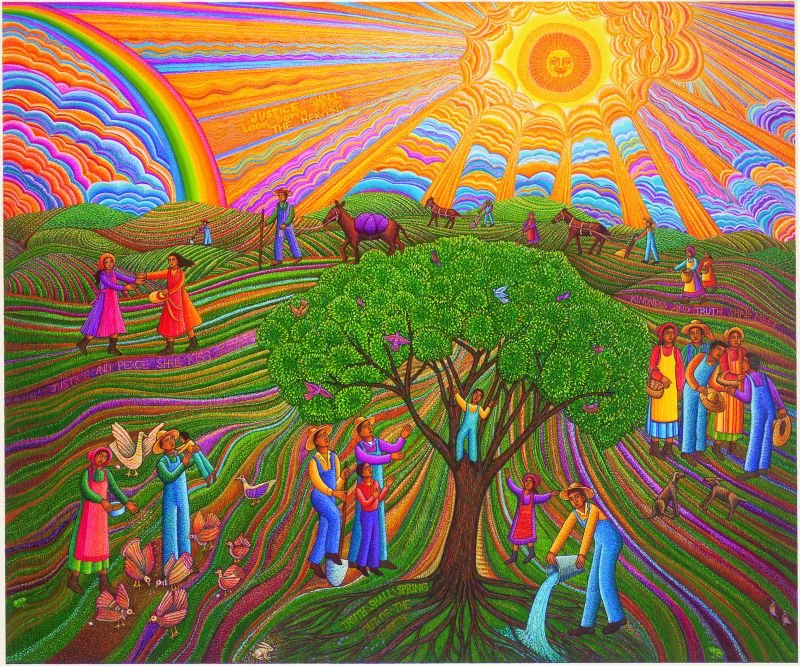
Psalm 85 by American artist John August Swanson

Lord, you were favorable to your land;
    you restored the fortunes of Jacob.
You forgave the iniquity of your people;
    you pardoned all their sin….

Let me hear what God the Lord will speak,
    for he will speak peace to his people,
    to his faithful, to those who turn to him in their hearts.
Surely his salvation is at hand for those who fear him,
    that his glory may dwell in our land.

Steadfast love and faithfulness will meet;
    righteousness and peace will kiss each other.
Faithfulness will spring up from the ground,
    and righteousness will look down from the sky.
The Lord will give what is good,
    and our land will yield its increase.
Righteousness will go before him,
    and will make a path for his steps. (NRSV)

Steadfast love, faithfulness, righteousness, and peace are terms which all spiritual folks need to be familiar with as well as experience. Steadfast love and faithfulness have its ground in God’s chesed, the divine covenant loyalty and kindness which always holds on, even despite people’s fickle commitment. Righteousness and peace are primarily relational terms which communicate a harmonious way of being with others and all creation.

This psalm says God will give exactly what the people have prayed for. It is a blessing given by the Lord to those who long for wholeness, integrity, and unhindered connection with God and God’s creation. And it is in the metaphors surrounding the words which give us such a beautiful picture of the blessing realized.

This is neither a general nor generic blessing from God Almighty. It is personal. In the grand immensity of the universe, the Creator God bends and condescends not only to all humanity but also to the individual. God’s steadfast love and faithfulness will meet to bless you and me. The Lord will come alongside and conform a divine blessing to our life. God’s grace will stick to us like glue in the form of right relationships and unity.

All of God’s attributes and character shall work in a seamless whole to bring divine acceptance and assistance to our lives. The good news here is that our struggles to be right and live right amidst terrible conditions of pandemics and people’s petulance have a vindication of divine sanction and enablement.

So, take a big breath and exhale, allowing the worries and anxieties of adverse situations to be expelled from our weary spirits. The Lord will give what is good. Today’s psalm is a wonderful reminder that salvation is not limited to a coming life; it is also deliverance in this present world we inhabit, basking in the Lord’s love and shalom and enjoying the good gifts God wants to give us right now.

Gracious God speak peace to your people. Through your Son, the Lord Jesus, we turn to you in our hearts, knowing your steadfast love and faithfulness, your righteousness and peace goes before us, with us, and behind us. In Christ, our salvation is at hand. May we reflect your goodness, as we respond to you with heart, soul, mind, and strength. This we pray in the name of the One who is your peace, your salvation—Jesus Christ. Amen.

Psalm 79 – Facing Trauma

Raise Up by Hank Willis Johnson in the Nova Southeastern University Art Museum, Fort Lauderdale, Florida

Our God, foreign nations
    have taken your land,
    disgraced your temple,
    and left Jerusalem in ruins.
They have fed the bodies
of your servants
    to flesh-eating birds;
    your loyal people are food
    for savage animals.
All Jerusalem is covered
    with their blood,
    and there is no one left
    to bury them.
Every nation around us
    sneers and makes fun.

Our Lord, will you keep on
    being angry?
    Will your angry feelings
    keep flaming up like fire?
Get angry with those nations
that don’t know you
    and won’t worship you!
They have gobbled down
Jacob’s descendants
    and left the land in ruins.

Don’t make us pay for the sins
    of our ancestors.
    Have pity and come quickly!
    We are completely helpless.
Our God, you keep us safe.
    Now help us! Rescue us.
    Forgive our sins
    and bring honor to yourself.

Why should nations ask us,
    “Where is your God?”
Let us and the other nations
    see you take revenge
    for your servants who died
    a violent death.

Listen to the prisoners groan!
Let your mighty power save all
    who are sentenced to die.
    Each of those nations sneered
    at you, our Lord.
Now let others sneer at them,
    seven times as much.
    Then we, your people,
    will always thank you.
We are like sheep
    with you as our shepherd,
    and all generations
    will hear us praise you. (CEV)

Yes, you are in the right place. No, this is not yesterday’s post. The Revised Common Lectionary Daily Scripture readings include a psalm reading every day. What is more, the same psalm is read three days in a row. This is because psalms are designed to be repeatedly used. So, today, I continue reflecting on this psalm….

The psalmist was full of emotion as he crafted his words. Reflecting on the tragic and horrific takeover of Jerusalem and its destruction, he cried out in spiritual and emotional pain concerning the trashing of God’s temple and Name, and the physical and verbal violence executed on the people. The psalmist wanted the victimization to stop and the victimizers to feel God’s wrath.

This psalm is raw and real, an expression of the true self. Here there is no pie-in-the-sky positive thinking with singing about always looking on the bright side of life. It is agonizing grief in all its misery and disgrace. Thus, therein lies the path to healing: To connect with the true self, refusing the pretensions of the false self, expressing the real lived feelings and thoughts of honest wounds.

Illumination by American sculptor Paige Bradley

The alternative only presses further pain into the soul. The false self, seeking to takeover and make one feel better, engages in a devil’s pact by ignoring the aching spiritual doubt and emotional injury within to have temporary reprieve from the troubled spirit. The road to renewed and lasting happiness comes not through the false self but the true self’s recognition of the event(s) in all their foulness and degradation. It is a hard road to walk, yet we must travel it if we are to live in the light of truth, joy, and peace.

You and I will not find God in the false self. One of the great tragedies of the human condition is that, when having experienced trauma, we hustle to obtain something we already possess. We might believe God is not there, or simply does not care. As one becomes alienated from the Lord, there increasingly becomes self-distancing. Disconnected from life-giving divinity, self-loathing gradually replaces self-awareness, and thus, self-compassion.

If at any point, we begin to associate and then fuse self with our traumatic experience(s) then the inner person weakens and becomes detached from the spiritual resources needed to heal. We are not our events. We are people created in God’s image and inherently worthy of love, compassion, kindness, goodness, and healing. We were not made for death and destruction but for life and connection.

The demonic termites of contempt might eat away at our humanity, yet there is always a way to exterminate them – through telling our story, as the psalmist did, with emotional flavor and full honesty. The true self is there; we just might need to dig a little deeper to find her.

So, if you notice that you tend to avoid planning for self-care; engage regularly in self-pity; or, swear at yourself under your breath with self-hatred; then it is high time for the false self to quit calling the shots and to bring up the true self. Internal conflict is not resolved through avoidance; it comes through external voicing of one’s story to another who listens with care.

The psalmist spoke to both God and God’s people. His story came from the gut, the place where both deep loathing and deep compassion come from. If one has already been tortured by a traumatic experience, the torture will continue from the false self unless the true self asserts herself and seeks awareness, mercy, and healing.

Stories are meant to be told. And they need to be uttered when the storyteller is ready and not when the listener is. Through the voicing of their ordeal, victims of human-inflicted suffering need to hear that God is just and will right the wrong things in this world. They need some hope of healing and some assurance that their injury will not go unanswered.

This can be tricky business because the act of proclaiming one’s story and the reception of that message by another might easily become a vengeful justification for intolerance and malicious retribution. Therefore, the psalmist appealed to God, not fellow humans, for justice. We are to leave room for God’s wrath without taking matters into our own hands. (Romans 12:17-21)

So, avoid isolation from God, others, even yourself. Seek help, both divine and human. Tell your story when you are ready. Face the terrible pain. These are the things the psalmist did to deal with his own trauma. The true self acknowledges this and, with full awareness, steps into the future with faith.

Lord Christ, you came into the world as one of us, and suffered as we do. As I go through the trials of life, help me to realize that you are with me at all times and in all things; that I have no secrets from you; and that your loving grace enfolds me for eternity. In the security of your embrace I pray. Amen.

Psalm 79 – Unbearable Pain

The nations have come into your inheritance, God!
    They’ve defiled your holy temple.
    They’ve made Jerusalem a bunch of ruins.
They’ve left your servants’ bodies
    as food for the birds;
    they’ve left the flesh of your faithful
    to the wild animals of the earth.
They’ve poured out the blood of the faithful
    like water all around Jerusalem,
    and there’s no one left to bury them.
We’ve become a joke to our neighbors,
    nothing but objects of ridicule
    and disapproval to those around us.

How long will you rage, Lord? Forever?
    How long will your anger burn like fire?
Pour out your wrath on the nations
        who don’t know you,
    on the kingdoms
        that haven’t called on your name.
They’ve devoured Jacob
    and demolished his pasture.
Don’t remember the iniquities of past generations;
    let your compassion hurry to meet us
    because we’ve been brought so low.
God of our salvation, help us
    for the glory of your name!
Deliver us and cover our sins
    for the sake of your name!
Why should the nations say,
    “Where’s their God now?”
Let vengeance for the spilled blood of your servants
    be known among the nations before our very eyes!
    Let the prisoners’ groaning reach you.
With your powerful arm
    spare those who are destined to die.
Pay back our neighbors seven times over,
    right where it hurts,
    for the insults they used on you, Lord.
We are, after all, your people
    and the sheep of your very own pasture.
We will give you thanks forever;
    we will proclaim your praises
    from one generation to the next. (CEB)

The setting behind today’s Psalm is the destruction of the temple and a conquering army who proudly gloats over their victory. This is a prayer, an angry cry for God to step in and act on behalf of the humiliated people. The psalm is more than a simple plea for help; it is a deeply passionate appeal. As a child of the 1960’s, my phrase for the psalmist’s entreaty is, “God, stick it to the man!”

There is no polite knock at the side door of God’s house in the face of such evil. This is a pounding on the front door with the demand for God to do something about this terrible trouble. For the psalmist, the incongruence between who God is and what has happened to God’s people is inconceivable and unacceptable. To profane God’s temple is to profane God; and to kill and maim God’s people is to flip the middle finger at God. The psalmist is beside himself and overwhelmed with emotion.

There is something very instructive here that we ought not miss. When we have been brutalized, victimized, and/or demoralized, we just want someone, especially the Lord we serve, to take notice and feel what we are feeling. Never underestimate the power of empathy and solidarity. To feel alone and bereft of help is an awful feeling.

Perhaps the psalmist’s prayer offends some sensibilities. I wonder, for those who find the language difficult, have ever had a daughter raped or a house destroyed by fire or seen a person killed without mercy in front of their own eyes. Methinks they have not. The feelings of helpless despair and sheer anger defy human words. These are not casual affronts but malicious destructions of property and people.

We need someone to affirm the raw ruthlessness of it all, to have some understanding of the impossible place we are in with such wanton cruelty. When our very support is ripped from our lives, the madness within is too much to bear. Who will rescue us from this body of death?

God is big enough to handle our rage and our hurt. The Lord is available and hears our desperate voice of prayer. Yet, God is not always going to directly and immediately answer on the terms we stipulate. God acts out of God’s own providence and justice, and not from our expectations. And that is a good thing, not a bad thing.

God sees, knows, and feels with us. The realization of this enables us to recenter and reorient ourselves around faith, hope, and love. New life is never a gift in a vacuum; it comes out of agonizing struggle in reckoning with the existing evil.

So, when someone goes through a hellish experience, we are to exercise our capacity to listen and witness the horrible spiritual pain of the person. Healing hurts: it is not a pleasant affair. We are to hang in there and walk alongside another in their hour of need, even when their vitriol seems over the top to us. For only in telling our story to another will any of us find relief and renewed hope.

The psalms permit us to use language appropriate to what has happened to us. They also allow us to move beyond the venom to the God who restores broken lives.

Lord Jesus Christ, by your patience in suffering you hallowed earthly pain and gave us the example of obedience to your Father’ will: Be near me in my time of weakness and pain; sustain me by your grace, that my strength and courage may not fail; heal me according to you will; and help me always to believe that what happens to me here is of little account if you hold me in eternal life, my Lord and my God. As the Lord Jesus cried out on the cross, I cry out to you in pain, O God my Creator. Do not forsake me. Grant me relief from this suffering and preserve me in peace, through Jesus Christ my Savior, in the power of the Holy Spirit. Amen.