Psalm 145 – Some Solid Robust Theology

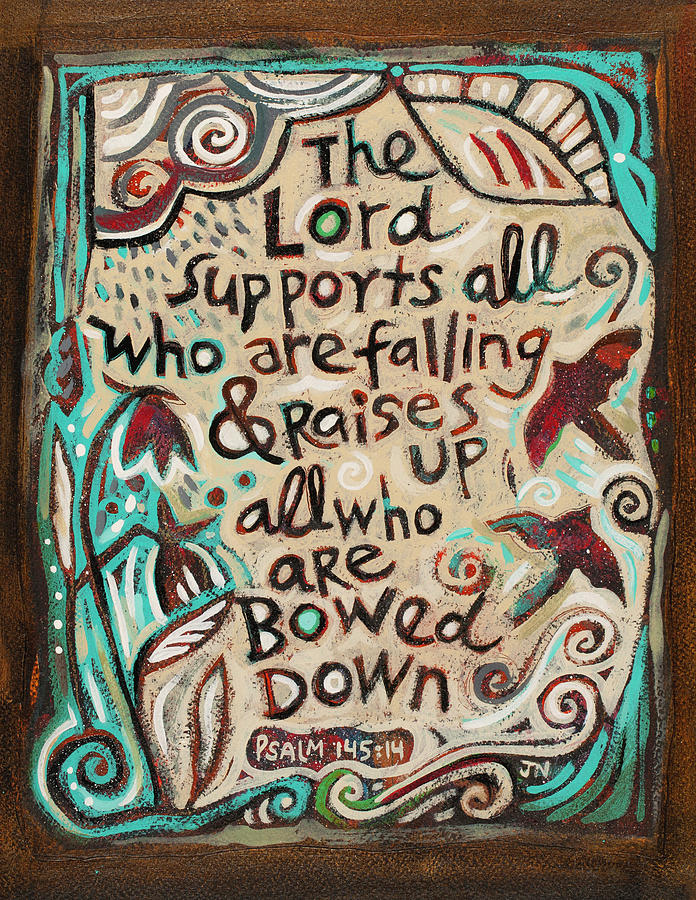
Psalm 145:14 by Jen Norton

I will praise you,
my God and King,
    and always honor your name.
I will praise you each day
    and always honor your name.
You are wonderful, Lord,
    and you deserve all praise,
because you are much greater
    than anyone can understand.

Each generation will announce
to the next
    your wonderful
    and powerful deeds.
I will keep thinking about
your marvelous glory
    and your mighty miracles.
Everyone will talk about
    your fearsome deeds,
    and I will tell all nations
    how great you are.
They will celebrate and sing
    about your matchless mercy
    and your power to save.

You are merciful, Lord!
    You are kind and patient
    and always loving.
You are good to everyone,
    and you take care
    of all your creation.

All creation will thank you,
    and your loyal people
    will praise you.
They will tell about
    your marvelous kingdom
    and your power.
Then everyone will know about
    the mighty things you do
    and your glorious kingdom.
Your kingdom will never end,
    and you will rule forever.

Our Lord, you keep your word
    and do everything you say.
When someone stumbles or falls,
    you give a helping hand.
Everyone depends on you,
and when the time is right,
    you provide them with food.
By your own hand
    you satisfy
    the desires of all who live.

Our Lord, everything you do
    is kind and thoughtful,
    and you are near to everyone
    whose prayers are sincere.
You satisfy the desires
    of all your worshipers,
    and you come to save them
    when they ask for help.
You take care of everyone
who loves you,
    but you destroy the wicked.

I will praise you, Lord,
    and everyone will respect
    your holy name forever. (Contemporary English Version)

These days, everywhere I go there is high anxiety, even downright fear. In my city, the highest murder rate in its history marked the past year. In the hospital for which I am the chaplain, the coronavirus with all its deathly strains is bringing grief and bereavement to many families. Within many churches, their future viability is in question, and parishioners wonder about the future.

When there seems to be no light at the end of the tunnel, with apprehension and stress as the very air we breathe, there is an angle to the whole situation the psalmist wants us to consider. We are to give weight and consideration to some solid robust theology.

Everyone has a theology. All persons have some sort of understanding of a god, G-d, or no god at all. In the hard circumstances of life, it might seem as if our theology isn’t serving us well. We may feel as if G-d is aloof, distant, or just plain disinterested. So, let’s pay attention to the psalmist. Notice his theology….

The Lord saves… is merciful… powerful… kind… patient… loving… and good. G-d keeps divine promises… helps… gives… provides… protects… and is near to those who humbly seek the divine. In short, the Lord cares for all creation and all creatures, including you and me, and tackles injustice like a hefty linebacker on a string-bean running back.

Yes, G-d deserves all praise, glory, and honor because standing behind all the anxiety of the age is a very large deity who acts with good purpose.

Let this psalm (and the entire psalter) buoy you up with good solid theology because the Lord is righteous in all dealings and is present to all who call for help. G-d hears. G-d responds. Perhaps neither according to our idea of timeliness nor to our expectation. Yet, deliverance is at hand, even if it comes in a form different than we were anticipating.

I am taking time to read today’s psalm several times over, to let it awash my soul with significant doses of truth and mercy. There are simply times when all of us need to remember and be reminded that there is a G-d in heaven who is willing and able, as well as a friend close at hand. 

True human satisfaction does not come through personal ingenuity or accumulation of more knowledge or more stuff.  Rather, our deepest desires and needs are fulfilled in the G-d who cares.

Anxiety, stress, fear, and apprehension don’t simply melt away. We, like the psalmist, need to practice the active verbs within the text: I will praise you… I will always honor your name… I will keep thinking about your marvelous glory and miracles… I will tell all nations how great you are… because the Lord saves and satisfies.

May that be your experience today, and every day.

Mighty G-d, you are both far and near, totally above us, yet close at hand.  Preserve me with your mighty power so that I might not fall into sin, nor be overcome by adversity. But in all I do direct me to the fulfilling of your purposes through Jesus Christ, my Lord.  Amen.

Psalm 36:5-10 – Steadfast Love

Your steadfast love, O Lord, extends to the heavens,
    your faithfulness to the clouds.
Your righteousness is like the mighty mountains,
    your judgments are like the great deep;
    you save humans and animals alike, O Lord.

How precious is your steadfast love, O God!
    All people may take refuge in the shadow of your wings.
They feast on the abundance of your house,
    and you give them drink from the river of your delights.
For with you is the fountain of life;
    in your light we see light.

O continue your steadfast love to those who know you,
    and your salvation to the upright of heart! (New Revised Standard Version)

Love suffers. Every parent knows this. Because of a parent’s committed and faithful love toward a child, they feel not only the joys but also the sorrows and pain of their children. I can say that this feeling does not go away, even with adult children. And it is compounded with grandchildren. Just as our love is big enough to hold multiple children and grandchildren, so our capacity for experiencing deep emotion for their welfare is equally large.

True love is sacrificial. It is willing to suffer anything on behalf of the beloved. God’s steadfast love is immensely large, holding both the joy of witnessing our lives as well as the pain of watching us make unhealthy decisions which damage us and each other.

God’s people, walking in the way of love, quickly discover that it is simultaneously walking in the way of suffering. From Old Testament times through the New Testament and into the present day, the faithful have always experienced suffering as a central part of their piety and devotion in showing steadfast love. 

The medieval mystics of the Church understood well the connection between suffering and love. They could not imagine a Christian life without hardship, difficulty, and persecution. Thomas à Kempis, a sort of pastor to pastors, wrote in the fifteenth century these words:

“Sometimes it is to our advantage to endure misfortunes and adversities, for they make us enter into our inner selves and acknowledge that we are in a place of exile and that we ought not to rely on anything in this world.  And sometimes it is good for us to suffer contradictions and know that there are those who think ill and badly of us, even though we do our best and act with every good intention….  When men ridicule and belittle us, we should turn to God, who sees our innermost thoughts, and seek His judgment….  It is when a man of good will is distressed, or tempted, or afflicted with evil that he best understands the overwhelming need he has for God, without whom he can do nothing….  It is in such times of trial that he realizes that perfect security and full peace are not to be found in this world.”

Thomas à Kempis, The Imitation of Christ

And yet, it is because of love that suffering is transformed and endured as something wholly other than sheer pain or hurt. Thomas à Kempis went on to say:

“Love is a mighty power, a great and complete good; Love alone lightens every burden and makes the rough places smooth. It bears every hardship as though it were nothing and renders all bitterness sweet and acceptable. The love of Jesus is noble and inspires us to great deeds; it moves us always to desire perfection. Love aspires to high things and is held back by nothing base. Love longs to be free, a stranger to every worldly desire, lest its inner vision become dimmed, and lest worldly self-interest hinder it, or ill-fortune cast it down…. Love knows no limits, but ardently transcends all bounds. Love feels no burden, takes no account of toil, attempts things beyond its strength; love sees nothing as impossible, for it feels able to achieve all things. Love therefore does great things; it is strange and effective; while he who lacks love faints and fails.”

Thomas à Kempis, The Imitation of Christ

In this season of Epiphany, we remember that Jesus is the light of the world. God became flesh and blood to experience the full range of the human condition – both joys and sorrows in a love so committed to us that it led to a cruel cross of suffering.

Salvation has come to all peoples because of God’s steadfast love – a love that never lets go no matter the circumstances.

Almighty God, whose Son our Savior Jesus Christ is the light of the world: Grant that your people, illumined by your Word and Sacrament, may shine with the radiance of Christ’s glory, that he may be known, worshiped, and obeyed to the ends of the earth; through Jesus Christ our Lord, who with you and the Holy Spirit lives and reigns, one God, now and forever. Amen.

Ephesians 5:15-20 – Speak to One Another with Psalms, Hymns, and Spiritual Songs

Be very careful, then, how you live—not as unwise but as wise, making the most of every opportunity, because the days are evil. Therefore, do not be foolish, but understand what the Lord’s will is. Do not get drunk on wine, which leads to debauchery. Instead, be filled with the Spirit, speaking to one another with psalms, hymns, and songs from the Spirit. Sing and make music from your heart to the Lord, always giving thanks to God the Father for everything, in the name of our Lord Jesus Christ. (New International Version)

As you likely well know, an inebriated person tends to say and do things that they do not typically say or do when they’re sober. The Apostle Paul’s point about being filled with the Spirit is that, instead of doing and saying stupid things, we are so filled with God that we do things and say things that we would not typically do and say if we were not filled with God – that is, good things. 

Apart from being full of God’s Spirit, we tend toward mumbling, not singing; worry, not making music in our hearts; and complaining and arguing, not giving thanks. Half-filled Christians practice a half-hearted Christianity. They’re only half-baked in their service and devotion to Christ.

Why sing? 

Because singing is part of being filled with the Spirit of God. Singing happens when we experience God’s overflowing grace in our lives through the blessings of being chosen, adopted, and redeemed into God’s new community. (Ephesians 1:3-11)

Music is powerful. It’s not only a means of expressing praise and commitment to Christ and each other, it is also a powerful means of being impressed. For example, when we first teach kids the alphabet, we teach it in a song. Trying to teach letters in a rote fashion typically doesn’t work well for pre-school kids. Words set to music is why we still remember words from old TV shows, because those words were set to a catchy tune.  Music is why an Alzheimer’s patient cannot remember her daughter’s name but can flawlessly sing all four verses of Amazing Grace.

Singing is an offering and a sacrifice of praise to God (Hebrews 13:15). And singing is also a vehicle whereby we are taught, encouraged, and built up in the community of believers. We sing to God, one another, and even ourselves.

Church music, then, is to be both a means of praising God and a practice of encouraging each other. We do it through psalms, hymns, and spiritual songs.

Psalms

The word “psalm” helps us rightly think of the biblical book of Psalms. Singing the psalms is an ancient practice, going all the way back to the Israelites singing psalms in the temple and synagogue. The early church maintained this practice, especially as a means of being faithful to praying without ceasing. 

However, over time, medieval congregations began neglecting the practice. In fact, the congregations eventually gave up most singing altogether. Almost all the singing was done by church choirs and professional musicians employed by the state (no separation of church and state) to write, compose, and perform in worship services. 

Five-hundred years ago, with the Reformation, Martin Luther reinstituted congregational singing. He gave music back to the people. One of the results of this change was putting the book of psalms to song – the Psalter.  For many Protestant denominations, the Psalter became the primary means of singing. The Psalter chiefly set prayers to song. It was both a means of expressing prayer to God and learning Scripture.


Hymns

There have always been hymns in the church. Yet, it was not until the Reformation that hymns began to be written and sung by congregations. For the Reformers, hymns were used to teach sound doctrine and theology, as well as a means of confessing the faith together

Spiritual Songs

Spiritual songs are the present day equivalent of praise and worship choruses, or what some refer to as contemporary songs. These are songs purposefully designed to be emotional expressions of praise to God and to give powerful testimony for what God has done or is doing.

So, what?

Quick review:

  • Psalms are used to pray and learn Scripture.
  • Hymns are used to teach us sound doctrine and confess the faith together.  
  • Spiritual songs are an important way of expressing praise to God and being encouraged in the faith. 

Therefore, church music is to serve as both a revelation from God, and as a response from God’s people.

There are two important deductions from this verse:

  1. A variety of songs is inferred and expected.
  2. Paul commanded their use.

The reason worship style is such a hot topic in a lot of churches is because we all have our personal preferences.  And yet, if we are to be faithful to today’s New Testament lesson, we will not just lock in on what I want. 

Truth be told, we are selfish people when it comes to music. We want what we want, and we don’t care what somebody else wants. And we will persist in that self-absorbed spirit until somebody calls us on it. That somebody is the Apostle Paul. The Word of God calls us to encompass psalms, hymns, and spiritual songs – all three of them – in our worship.

I have a good friend who is an accomplished church musician and worship pastor. I once asked him how I can lead a worship service among such a variety of preferences concerning music. He answered my question with a question: “How highly do people, including and especially your musicians, value the unity of the church?  Do they love each other so much that they can allow for a wider range of style, and do so without vocally complaining about it?”

My friend went on to say, “When I arrived at one church as their pastor, some people were in a rather bad habit of saying very openly, ‘Oh I hate that song,’ or, ‘If I hear this song one more time I’m walking out.’ What I tried to do was teach people that this is not the most loving or mature approach and does little to build up the rest of the Body of Christ.”

If a group of people are being faithful to Scripture, and doing their best musically, then – if the music seems lifeless, dull, or strange to us – the real issue isn’t style but our hearts.       

Is that heart filled with the Spirit of God? If it is, then we will speak to one another using the Psalter, using time-honored hymns, and utilizing fresh contemporary praise songs. And the result will be the Body of Christ, the Church, built up in the faith.

Gracious God, give us grace to take to heart the great dangers we are in by our unhappy divisions about music.  Take away all hatred and prejudice, and whatever else may hinder us from godly union and concord; that, as there is but one body and one Spirit, one hope of our calling, one Lord, one faith, one baptism, one God and Father of us all, so we may from this time forward be all of one heart and of one soul, united in one holy bond of peace, and may with one mind and one mouth glorify you, through Jesus Christ our Lord. Amen.

Psalm 72 – Justice and Righteousness

Give the king your justice, O God,
    and your righteousness to a king’s son.
May he judge your people with righteousness,
    and your poor with justice.
May the mountains yield prosperity for the people,
    and the hills, in righteousness.
May he defend the cause of the poor of the people,
    give deliverance to the needy,
    and crush the oppressor.

May he live while the sun endures,
    and as long as the moon, throughout all generations.
May he be like rain that falls on the mown grass,
    like showers that water the earth.
In his days may righteousness flourish
    and peace abound, until the moon is no more.

May he have dominion from sea to sea,
    and from the River to the ends of the earth.
May his foes bow down before him,
    and his enemies lick the dust.
May the kings of Tarshish and of the isles
    render him tribute,
may the kings of Sheba and Seba
    bring gifts.
May all kings fall down before him,
    all nations give him service.

For he delivers the needy when they call,
    the poor and those who have no helper.
He has pity on the weak and the needy,
    and saves the lives of the needy.
From oppression and violence he redeems their life;
    and precious is their blood in his sight.

Long may he live!
    May gold of Sheba be given to him.
May prayer be made for him continually,
    and blessings invoked for him all day long.
May there be abundance of grain in the land;
    may it wave on the tops of the mountains;
    may its fruit be like Lebanon;
and may people blossom in the cities
    like the grass of the field.
May his name endure forever,
    his fame continue as long as the sun.
May all nations be blessed in him;
    may they pronounce him happy.

Blessed be the Lord, the God of Israel,
    who alone does wondrous things.
Blessed be his glorious name forever;
    may his glory fill the whole earth.
Amen and Amen.

The prayers of David son of Jesse are ended. (New Revised Standard Version)

Today’s psalm is a prayer of King David – beseeching the Lord to help him rule with justice and righteousness – because G-d is just and right in all divine dealings with humanity.

“Justice” in the Old Testament is neither fairness nor the good being rewarded and the wicked punished. Rather, justice (Hebrew משפט, pronounced “mish-pot”) in its most basic sense is caring for the poor. A society is “just” to the degree in which every person has enough for the basic necessities of life and is lifted up as persons worthy of care and respect.

So, the way in which David measured his kingly rule was not by how big of an army he had, or how much gold there was in the royal treasury. Rather, a successful rule for David was measured by whether the interests of the poor were defended and provided for.  

A similar word to justice, “righteousness,” is neither some sort of smug godliness nor a sense of superior piety. Instead, righteousness (Hebrew צדקה pronounced “zed-a-ka”) is a relational term of being in sync with G-d and G-d’s ways. It works itself out in a philanthropic spirit of giving what is needed – both physically and spiritually – through acts of mercy such as forgiveness, debt relief, friendship, charity, etc.

Together, justice and righteousness are concerned for giving needed resources with a compassionate spirit of relationship. It seeks to meet the holistic needs of underprivileged people.

Psalm 72 is read in this Christian liturgical season of Christmas (December 25-January 5) because the celebration of the Christ child entering humanity gives great hope for the poor, the needy, the indigent, and all those who struggle to daily survive grinding situations of hardship and adversity.

This is why, when Jesus announced his earthly ministry, he made it clear the nature of that work would be upholding and extending justice and righteousness:

“The Spirit of the Lord is upon me,
    because he has anointed me
        to bring good news to the poor.
He has sent me to proclaim release to the captives
    and recovery of sight to the blind,
        to let the oppressed go free,
to proclaim the year of the Lord’s favor.” (Luke 4:18-19, NRSV)

The least, the lost, the lonely, and the lame have a champion – a Divine Advocate who will take up their cause and ensure they are treated as deserving human beings, with adequate care of both body and soul. Done properly, our living a just and right life requires we share compassion and empathy along with the monetary and physical resources.

“Whoever gives justice to the poor with a sour expression and in a surly manner, even if he gives a thousand gold pieces, loses his merit. One should instead give cheerfully and joyfully and empathize with him in his sorrow.”

Maimonides (1138-1204, C.E.)

Both the hand and the heart are always involved in biblical justice and righteousness. That way both the giver and the recipient benefit. Whereas the poor receive money or other material assistance, the donor receives the merit of sharing in G-d’s work.

So then, righteousness and justice involve giving assistance with the hand as well as encouragement with the mouth so that needs are met with no residual bitterness of heart.

Each of you should give what you have decided in your heart to give, not reluctantly or under compulsion, for God loves a cheerful giver. And God is able to bless you abundantly, so that in all things at all times, having all that you need, you will abound in every good work. As it is written:

“They have freely scattered their gifts to the poor;
    their righteousness endures forever.” (2 Corinthians 9:7-9, NIV)

May you know the joy and celebration of both giving and receiving with a grateful heart, attuned to the blessings of a generous G-d who stands behind it all.