Psalm 31:9-16 – Lord, Have Mercy

Christ in Gethsemane by Michael O’Brien

Have mercy on me, Lord, for I am in distress.
    Tears blur my eyes.
    My body and soul are withering away.
I am dying from grief;
    my years are shortened by sadness.
Sin has drained my strength;
    I am wasting away from within.
I am scorned by all my enemies
    and despised by my neighbors—
    even my friends are afraid to come near me.
When they see me on the street,
    they run the other way.
I am ignored as if I were dead,
    as if I were a broken pot.
I have heard the many rumors about me,
    and I am surrounded by terror.
My enemies conspire against me,
    plotting to take my life.

But I am trusting you, O Lord,
    saying, “You are my God!”
My future is in your hands.
    Rescue me from those who hunt me down relentlessly.
Let your favor shine on your servant.
    In your unfailing love, rescue me. (New Living Translation)

One of my parishioners from years ago had seen hard combat in Italy during World War II. He saw his best friend killed, right next to him. I still remember his story and what he said in conclusion to it, in his own sage way: “In my experience, war is a very poor way of dealing with problems.”

And yet, we sometimes find ourselves embedded in circumstances we neither wanted nor asked for. Just ask the Ukrainians. No one puts their name on a sign-up sheet for suffering. Yet not a one of us can avoid it. 

Pain comes in all kinds of forms. Maybe the worst kind of suffering is the wound inflicted from others looking down at you when you’re already experiencing trouble and damaged emotions. 

Whether it is an ethnic or racial group of people facing ridicule, anger, and even beatings or death; or whether it is refugees trying to survive the ravages of war, the physical effects of pain can oftentimes be secondary to the primary hurt experienced within the spirit. 

“Suffering is part of the human condition, and it comes to us all. The key is how we react to it, either turning away from God in anger and bitterness or growing closer to Him in trust and confidence.”

Billy Graham

The Old Testament character, David, knew first-hand about suffering through hard circumstances. There were times when he felt completely overwhelmed by the evil machinations of people trying to take his life. If we could put ourselves in David’s sandals, we can understand why he was worn-out to the point of not sleeping, not eating well, even with a hint of paranoia. 

David responded to his seemingly impossible situation by entrusting himself to God. He truly believed he was in the Lord’s hands – and that fact was David’s go-to truth. 

Crossing over into the New Testament Gospels, Jesus uttered his last words on the cruel cross from this today’s psalm: “Father, into your hands I commit my spirit” (Luke 23:46). 

The cross was an obvious place of extreme bodily pain. That wretched pain, however, was dwarfed by the great spiritual pain of holding the entire world’s hurts and their curse of separation. The stress of both body and soul must have been crushing for Jesus. 

Yet, there was a strength of assurance, for Jesus, in the eye of that pain – the confidence of knowing he was in good hands, just like David’s confidence a millennium before.

There are times in life when we all struggle with why particular afflictions happen to us, in whatever form they might take in us. 

It is in the situation of being forgotten by others that we are most remembered by God.

It is within the crucible of trouble that God is the expert in deliverance.

It is when others revile us, say terrible things about us, and talk behind our backs that God comes alongside and whispers words of grace and steadfast love to us. 

It is whenever life is downright hard that we see a soft-hearted God standing to help us and hold us. 

While we are feeling our awful suffering, God is carefully crafting within us resilience through the rejection, empathy in our loneliness, purpose because of the trauma, forgiveness out of the shame, courage from having been failed, and self-awareness in the wake of emotional devastation. 

The biblical psalms are the consummate place to go when we are most in need. They provide the means to lift heartfelt prayers whenever our own words fail us. 

The psalms give us structure and meaning when the world around us makes no sense. 

The psalms do not always give us answers to our most vexing questions; they do, however, point us to the God who is attentive to the least, the lost, and the lonely.

Together, as people sharing the human condition of suffering, we cry out, “Lord, have mercy. Christ, have mercy. Lord, have mercy on us and grant us your peace. Amen.” 

Psalm 20 – May the Lord Grant All Your Requests

Psalm 20:4-5, Common English Bible

May the Lord answer you when you are in distress;
    may the name of the God of Jacob protect you.
May he send you help from the sanctuary
    and grant you support from Zion.
May he remember all your sacrifices
    and accept your burnt offerings.
May he give you the desire of your heart
    and make all your plans succeed.
May we shout for joy over your victory
    and lift up our banners in the name of our God.

May the Lord grant all your requests.

Now this I know:
    The Lord gives victory to his anointed.
He answers him from his heavenly sanctuary
    with the victorious power of his right hand.
Some trust in chariots and some in horses,
    but we trust in the name of the Lord our God.
They are brought to their knees and fall,
    but we rise up and stand firm.
Lord, give victory to the king!
    Answer us when we call!
(New International Version)

There are times when a present situation seems nonsensical. It’s just downright confounding. There’s a disconnect between the contemporary present moment and the ancient biblical past. How do we pull ancient Scripture and the wisdom of the past into the here and now?

We look to the psalms and pray them, out loud, multiple times, every day.

In the crucible of life’s challenges and the struggles of daily living, we might too quickly neglect the grace, relevance, and truth of God’s Word to us. 

The psalms are both prayer and worship directed to God. Many of those prayers are for oneself. Others, like today’s psalm, are intercessions for others.

It is my sincere and ardent desire that you will experience a good life, even when that life has a bevy of challenges, stresses, and difficulties baked into it. And so:

May the Lord answer you in the stress of your life.

May the name of the ever-living, ever-present God protect you.

May the Lord send you help from the holy habitation, and give you support from heaven itself!

May God almighty remember all the ways you have given and served.

May the Lord be pleased with everything you have sacrificed on behalf of divine purposes and plans.

May God grant your heart’s deep longing and carry out every good plan you conceive.

May we together shout for joy when you overcome incredible pressure, and in the name of God throw a big ol’ party because of answered prayer!

May the Lord bring to fruition every one of your prayers.

I have supreme confidence that God’s people shall be delivered from trouble. The Lord will answer from heaven with the full force of saving power. Some put their ultimate trust in military might. Others place faith in financial security. But the people of God trust in the name of the Lord our God.

We may collapse and fall. There might be obstacles galore. Stress and pressure may be our constant companions. No matter. We get up and stand again with confidence. The Lord will save us. God will answer when we call.

For the Christian, all of God’s good promises are realized in Jesus. Ultimate help and deliverance come from Christ. Even more, Jesus came to give victory to all people everywhere….

Thanks be to God, who gives us this victory through our Lord Jesus Christ! As a result of all this, my loved brothers and sisters, you must stand firm, unshakable, excelling in the work of the Lord as always, because you know that your labor isn’t going to be for nothing in the Lord. (1 Corinthians 15:57-58, CEB)

Everyone who has been born from God has won the victory over the world. Our faith is what wins the victory over the world. Who wins the victory over the world? Isn’t it the person who believes that Jesus is the Son of God? (1 John 5:4-5, GW)

The Lord wants to grant our requests. God is on our side. There is help from heaven. It is available to us – if we but ask….

 “Continue to ask, and God will give to you. Continue to search, and you will find. Continue to knock, and the door will open for you.” (Matthew 7:7, ERV)

“From now on, whatever you request along the lines of who I am and what I am doing, I’ll do it. That’s how the Father will be seen for who he is in the Son. I mean it. Whatever you request in this way, I’ll do.” (John 14:13-14, MSG)

“The Christian ideal has not been tried and found wanting; it has been found difficult and left untried.”

G.K. Chesterton

Perseverance in prayer is needed. Lifting a request to God isn’t a one-time event. It is okay, even encouraged, to persist in prayer….

Jesus told them a story showing that it was necessary for them to pray consistently and never quit. He said, “There was once a judge in some city who never gave God a thought and cared nothing for people. A widow in that city kept after him: ‘My rights are being violated. Protect me!’

“He never gave her the time of day. But after this went on and on he said to himself, ‘I care nothing what God thinks, even less what people think. But because this widow won’t quit badgering me, I’d better do something and see that she gets justice—otherwise I’m going to end up beaten black-and-blue by her pounding.’”

Then the Master said, “Do you hear what that judge, corrupt as he is, is saying? So, what makes you think God won’t step in and work justice for his chosen people, who continue to cry out for help? Won’t he stick up for them? I assure you, he will. He will not drag his feet. But how much of that kind of persistent faith will the Son of Man find on the earth when he returns?” (Luke 18:1-8, MSG)

Giving voice to our needs and wants to God is the first step toward having our sincere requests answered. And the psalms can help us realize it.

Lord Christ, you came into the world as one of us, and suffered as we do. As I go through the trials of life, help me to realize that you are with me at all times and in all things; that I have no secrets from you; and that your loving grace enfolds me for eternity. In the security of your embrace, I pray. Amen.

Psalm 126 – Planting in Tears and Harvesting with Joy

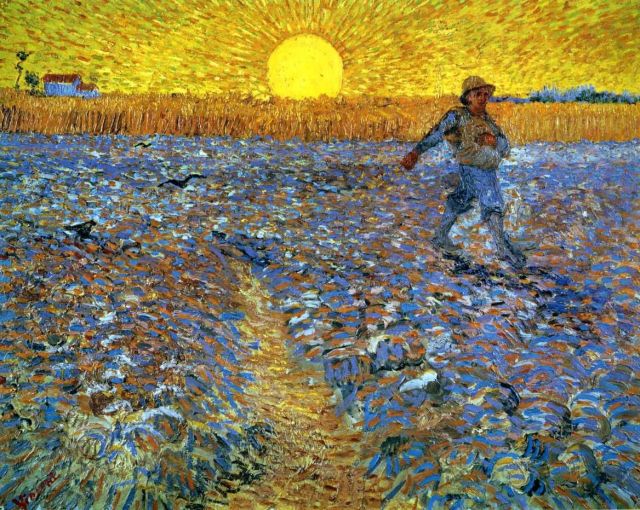
The Sower, by Vincent Van Gogh, 1881

When the Lord brought back his exiles to Jerusalem,
    it was like a dream!
We were filled with laughter,
    and we sang for joy.
And the other nations said,
    “What amazing things the Lord has done for them.”
Yes, the Lord has done amazing things for us!
    What joy!

Restore our fortunes, Lord,
    as streams renew the desert.
Those who plant in tears
    will harvest with shouts of joy.
They weep as they go to plant their seed,
    but they sing as they return with the harvest. (New Living Translation)

Many people are familiar with the phrase, “You reap what you sow.” Although the saying is typically referred to in the context of avoiding poor decisions (Galatians 6:7) the principle is woven throughout Holy Scripture in other scenarios, as well, as it is in today’s psalm.  

Sowing and reaping are, of course, agricultural terms. Farmers and gardeners tend to the soil through tilling, planting, cultivating, weeding, and eventually harvesting. The images of farming and the growth of plants serve as fitting metaphors for the spiritual life. Growth does not occur quickly. Instead, constant and vigilant attention to one’s spirit eventually brings a harvest of good works and godly attitudes. 

Jesus said, “My food is to do what the one who sent me wants me to do. My food is to finish the work that he gave me to do.” (John 4:34, ERV)

In a culture which values immediacy and having things now, the slow growth of the spiritual life can be a difficult principle to grasp. We may think that whenever we sin – with no immediate lightning to zap us – that therefore what we did must not have been so bad. 

Eventually, however, our implanted seeds will sprout and become visible to all. Conversely, we might believe whenever we dedicate ourselves to altruistic service, and then see no immediate results, that we must be doing something wrong. So, we may easily become discouraged and give up.

Sow for yourselves righteousness; reap steadfast love. Break up your fallow ground; for it is time to seek the Lord, that he may come and rain righteousness upon you. (Hosea 10:12, NRSV)

The psalmist reminds us of the need for patience. Just as it takes continual watering to reap a harvest in the field, so the Christian’s life of weeping and tears, of tilling deeply into the things of God, is the necessary work to eventually spot a sprout, see growth, and finally bear fruit. 

The tedious cultivating and weeding of our souls is the task before us. If we are patient and consistent, we will realize a harvest of righteousness. 

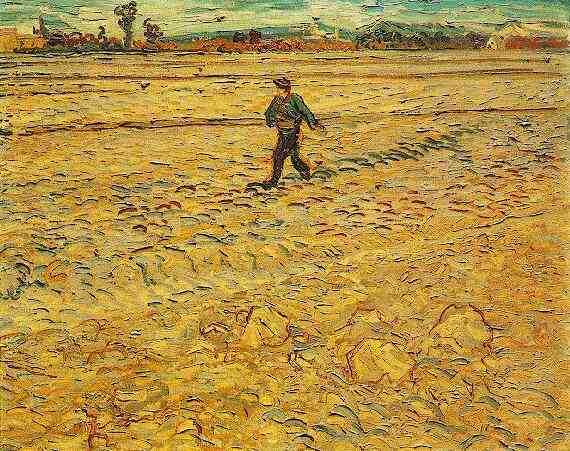
The Sower, by Vincent Van Gogh, 1888

Jesus taught his Beatitudes to help us understand that righteousness, peace, and joy come through connecting with our poverty of spirit; mourning over personal and corporate sin; embracing humility and meekness; hungering and thirsting after righteousness.

Only through the blood, sweat, and tears of spiritual agony will we come through to the deep happiness of seeing the Lord accomplish great things in our lives. In other words, joy is neither cheap nor easy. It is the fruit of many tears.

Spiritual farming involves sound practices of sowing and reaping. There is suffering before glory, tears before joy, lament before healing.

Just as a farmer cannot take short-cuts in the planting and cultivating process if he wants to have a bounteous and delicious harvest, so there is no getting around the painful work of grieving our changes and losses.

Avoiding the hard work of spiritual farming leads to a bogus harvest where we bite into a fresh ear of sweet corn only to discover a mouthful of worms.

Remember this: The person who plants a little will have a small harvest, but the person who plants a lot will have a big harvest.

2 Corinthians 9:6, NCV

The bulk of our lives are played out in the liminal space between sowing and reaping. The farmer plants and waits, attentive to the land and the weather until the time of harvest. We, too, exist in a time of patience. So, we pray, recalling past harvests and anticipate that with God’s good help, we will enjoy abundance.

This in-between time is often characterized by tears.

As she stood behind him at his feet weeping, she began to wet his feet with her tears. Then she wiped them with her hair, kissed them and poured perfume on them. (Luke 7:38, NIV)

I grew up on an Iowa farm. I only saw my father cry twice in my life. The first time, I was just a boy, two days after my eighth birthday – a devastating hailstorm destroyed the crops that had been planted just six weeks before. Despite farm equipment and technological savvy, the farmer is still at the mercy of the weather.

And we will always be at the mercy of God. Because God is good, just, and fair, the Lord does great and benevolent things. To be blessed, we need to embrace the dog days of summer in all its banality and its tears until we reach the time of reaping. There is joy, and it is coming, if we do the work of spiritual farming and wait patiently.

Likely, none of us awake in the morning, sit up on the edge of the bed, and say to ourselves, “Well, let’s see, I think I’ll cry and be sorrowful today.” We might do that with joy, but not with sadness. It can be easier to gravitate toward the fulfillment of dreams, laughter, and happiness than tears and weeping.

Yet, if we want to experience authentic joy, the path to it is through crying because it is our tears which find a better way.

“Normality is a paved road: It’s comfortable to walk, but no flowers grow on it.”

Vincent Van Gogh

Whether it comes from a certain denominational tradition, ethnic background, or family of origin dynamics, there are many Christians who love to emphasize Jesus as Victor and camp in resurrection power – while eschewing Christ as the man of sorrows, acquainted with grief and sadness.

By viewing only one dimension of Christ’s redemptive work, pastoral care often falls far short of true help. Trying to engineer cheerfulness and create solutions to a person’s genuine grief is, at best, not helpful, and at worst, damaging to their soul. It only leads to cheap inauthentic joy.

Sincerely singing spontaneous songs of joy, with a sense of abundant satisfaction, comes through suffering and sorrow. There must be a crucifixion before there is a resurrection. In the agrarian culture of ancient Israel, the metaphor of sowing a reaping connected well to the importance of planting tears and allowing them to flower later into an abundant harvest of joy.

Perhaps in contemporary American culture, a more apt metaphor would be financial investing and cashing out. The investment we put into attending to our grief with expressions of lament through tears, will eventually get a return, and we shall be able to cash out with a rich bounty of joy.

Easter is coming. Resurrection and new life will occur. The journey of Lent, with seeds repentance carefully planted, watered with tears, shall bring an abundant harvest of joy.

Gratias Deo. Thanks be to God.

Psalm 32 – Don’t Waste Away

Blessed is the one
    whose transgressions are forgiven,
    whose sins are covered.
Blessed is the one
    whose sin the Lord does not count against them
    and in whose spirit is no deceit.

When I kept silent,
    my bones wasted away
    through my groaning all day long.
For day and night
    your hand was heavy on me;
my strength was sapped
    as in the heat of summer.

Then I acknowledged my sin to you
    and did not cover up my iniquity.
I said, “I will confess
    my transgressions to the Lord.”
And you forgave
    the guilt of my sin.

Therefore, let all the faithful pray to you
    while you may be found;
surely the rising of the mighty waters
    will not reach them.
You are my hiding place;
    you will protect me from trouble
    and surround me with songs of deliverance.

I will instruct you and teach you in the way you should go;
    I will counsel you with my loving eye on you.
Do not be like the horse or the mule,
    which have no understanding
but must be controlled by bit and bridle
    or they will not come to you.
Many are the woes of the wicked,
    but the Lord’s unfailing love
    surrounds the one who trusts in him.

Rejoice in the Lord and be glad, you righteous;
    sing, all you who are upright in heart! (New International Version)

Depression is downright awful. It is the leading cause of disability in the Unites States among people ages 15-45. More sobering is the fact that two-thirds of all persons with depression have not yet sought help.

The psalmist was once one of those persons. When he kept silent, it was as if his bones went limp and wasted away inside him. The emotional pain of such an experience transcends our language.

David, the psalmist, had every reason to feel deeply about the circumstances of his life. He had been both the victim and even the perpetrator in all kinds of very troubling situations. Yet, as the king of Israel and Judah, he kept the stiff-upper-lip of stubbornly holding everything inside. 

The very word “depression” literally means to depress or stuff the emotions down inside and keep them tightly held within, not allowing them to see the light of day. Deep inside, those feelings don’t just go away. Instead, they sit, not going anywhere, and eventually rot the soul.

“It’s so difficult to describe depression to someone who’s never been there, because it’s not sadness. I know sadness. Sadness is to cry and to feel. But it’s that cold absence of feeling — that really hollowed-out feeling.”

J. K. Rowling

There was a time in my past in which I was so good at stuffing my feelings that one night when my neighbor had a blow-out of a party at two o’clock in the morning, I actually felt no anger. Just so you know: That’s not healthy. I had an anger problem. Not the kind where you explode, but just the opposite – the kind where you stuff every unwanted feeling in the book.

Recovery, for me, meant first recognizing that I was depressed and had a lot to be angry about. Next, I began to let myself feel the past situations of my life. And I need to tell you that what was inside me wasn’t at all pretty. 

Like a wound that needs peroxide, dealing with depression hurt like hell. But I couldn’t heal without it. I couldn’t go around it or avoid it; I had to go through it. 

Finally, I learned to not only identify my feelings, but take charge of them. I discovered I could choose to say how I feel without apology, and I could say it all in a way that helped others, as well as myself. Like David of old, I had to get what was inside on the outside.

The Christian season of Lent is an appropriate time to do this sort of internal work. This is no time to sit on neglected feelings or stuff emotions. It may seem as if opening up will cause internal shame, outward regret, or judgment from others.

But that would be a lie.

Shame cannot survive the light of day; regret typically happens when we fail to do something; and millions of others are struggling with the very same sort of things you are.

What’s more, God is patiently awaiting for us to break our silence and tell what’s troubling us. With the Lord, there is bountiful grace, unconditional forgiveness, and emotional healing.

I don’t believe depression is a sin which needs to be confessed but rather a terrible condition of the spirit that must be named and dealt with. So, if you are experiencing:

  • Feelings of sadness or a depressed mood that lingers for weeks, even months
  • A loss of interest or pleasure in activities once enjoyed
  • Changes in appetite — weight loss or gain unrelated to dieting
  • Trouble sleeping or sleeping too much
  • A loss of energy or increased fatigue
  • An increase in useless activity (e.g., hand-wringing or pacing) or slowed movements and speech
  • Feelings of worthlessness, shame, or guilt
  • Difficulty thinking, concentrating, or making decisions
  • Thoughts of death or suicide

Then, it is high time to get help. A place to start can be with the Substance Abuse and Mental Health Services Administration’s National hotline at 1-800-662-HELP (4357) or online at findtreatment.samhsa.gov

It is also wise to speak with a trusted family member or friend about the need for help and support, as well as a safe faith leader, pastor, or chaplain. There is no reason for anyone to have to live with crushing emotional and/or spiritual pain day after day.

Gracious God, your stamp of approval is on the penitent – those who are brutally honest with the inner self and receive your mercy. I will not keep silent. I will declare to you the current state of my life and not run away from the ugliness within. Through the gracious Name of Jesus, I pray with thanksgiving. Amen.