Psalm 121 – The Divine Helper

I lift up my eyes to the hills—
    from where will my help come?
My help comes from the Lord,
    who made heaven and earth.

He will not let your foot be moved;
    he who keeps you will not slumber.
He who keeps Israel
    will neither slumber nor sleep.

The Lord is your keeper;
    the Lord is your shade at your right hand.
The sun shall not strike you by day,
    nor the moon by night.

The Lord will keep you from all evil;
    he will keep your life.
The Lord will keep
    your going out and your coming in
    from this time on and forevermore. (New Revised Standard Version)

Not a one of us gets off this planet without needing help – a lot of help! Even people who are in helping professions or who identify themselves primarily as helpers need help themselves.

There is no such thing as complete, total, and irrevocable independence. We as humans are hard-wired by our Creator for community. We only find our greatest fulfillment within interdependent relationships, and only discover our highest happiness in a dependent relationship to God.

To need others, and especially God, is not a weakness. It’s a sign of sage awareness and confident strength whenever we assess that help is needed. Only the fool goes it alone, believing they can pull themselves up by their bootstraps. “God helps those who help themselves,” was originated by Ben Franklin, not Holy Scripture.

So, the real question is: To whom and to where do we go for help? Who do we consult? With whom do we collaborate?

The most important step any of us can make is to realize that our own personal resources are inadequate, and that we admit, “I need help with this.” The next most important step is to go to the right source for that help.

The psalmist insists that the Lord is our helper, our keeper. Keeping is a large part of helping. God as our Divine Keeper means that the Lord watches over us, guards our lives, and seeks to preserve us from harm, wrongdoing, injustice, and oppression.

The very identity of God is wrapped up in being a Protector, Guard, and Watchkeeper. The Lord shields and shelters us, much like a mother hen over her chicks. God watches over us, just as a watchman keeps guard over a city at night when the residents are sleeping. And since the Lord is everywhere present, there is a continual divine presence in all of our life journeys. The dangers of both the day and the night are no match for the God who is our Keeper.

The promises of safety in today’s psalm are not meant to suggest that those who walk in the shelter of God will never endure harm or that nothing ill will ever befall them. The Psalter knows all too well that the wicked are everywhere and that they thrive unjustly.

Rather, these divine promises are general promises—they are blessings God does for those who rely on the Lord, call upon God’s name, and seek divine help. We are to have a continual awareness of God’s presence in this world. Although we are not inoculated from pain, God is always with us in our hurt and bewilderment.

It can be hard to ask for help. Our pride, stubbornness, and independence might cause us to experience harm rather than seek assistance.

Be specific about the help needed. The following are some “helpful” ways of approaching God by answering some basic newsgathering type questions. The goal isn’t to convince the Lord to help us, but rather to enable us in connecting with what we truly need and being specific about God’s assistance for us or for others:

Who? 

Who needs help? Clarify if the help is for yourself, another, or a group of people.

When Jesus had entered Capernaum, a centurion came to him, asking for help. “Lord,” he said, “my servant lies at home paralyzed, suffering terribly.”

Jesus said to him, “Shall I come and heal him?”

The centurion replied, “Lord, I do not deserve to have you come under my roof. But just say the word, and my servant will be healed. (Matthew 8:5-8, NIV)

How? 

How will God’s action help? God is an expert listener. Tell the story of what you have tried already and where you fall short.

Jesus asked the boy’s father, “How long has he been like this?”

“From childhood,” he answered. “It has often thrown him into fire or water to kill him. But if you can do anything, take pity on us and help us.”

“‘If you can’?” said Jesus. “Everything is possible for one who believes.”

Immediately the boy’s father exclaimed, “I do believe; help me overcome my unbelief!” (Mark 9:21-24, NIV)

Why? 

Why are you soliciting God’s help? Explain what’s going on and the reasons why you believe the Lord is the One to help. Mention the divine attributes and actions of God, as well as your own personal connection.

Then Asa called to the Lord his God and said, “Lord, there is no one like you to help the powerless against the mighty. Help us, Lord our God, for we rely on you, and in your name we have come against this vast army. Lord, you are our God; do not let mere mortals prevail against you.” (2 Chronicles 14:11, NIV)

Where? 

Where is the help needed? Is it a geographical location, a specific spot in the human body, or a place such as a building or home?

Jesus left the synagogue and went to the home of Simon. Now Simon’s mother-in-law was suffering from a high fever, and they asked Jesus to help her. So, he bent over her and rebuked the fever, and it left her. She got up at once and began to wait on them. (Luke 4:37-39, NIV)

When? 

When do you need help? Immediately? Tomorrow? At a specific time?

O Lord, God of my salvation,
    when, at night, I cry out in your presence,
let my prayer come before you;
    incline your ear to my cry.

For my soul is full of troubles,
    and my life draws near to Sheol. (Psalm 88:1-3, NRSV)

What? 

What, exactly, is the need? Spell out what you want in detail, holding nothing back. Don’t be concerned about the words or saying it right. Speak in your own plain language.

Help, O Lord, for the godly are fast disappearing!
    The faithful have vanished from the earth!
Neighbors lie to each other,
    speaking with flattering lips and deceitful hearts.
May the Lord cut off their flattering lips
    and silence their boastful tongues. (Psalm 12:1-3, NLT)

May you find the help you need today and every day, in Jesus’ name. Amen.

Psalm 122 – A Spiritual Journey

I was glad when they said to me,
“Let’s go to the house of the Lord.”
Our feet are standing inside your gates, Jerusalem.
Jerusalem is built to be a city
where the people are united.
All of the Lord’s tribes go to that city
because it is a law in Israel
to give thanks to the name of the Lord.
The court of justice sits there.
It consists of princes who are
David’s descendants.

Pray for the peace of Jerusalem:
“May those who love you prosper.
May there be peace inside your walls
and prosperity in your palaces.”
For the sake of my relatives and friends, let me say,
“May it go well for you!”
For the sake of the house of the Lord our God,
I will seek what is good for you. (God’s Word Translation)

The spiritual life is a pilgrimage—a journey of constant growth, sacrifice, and faith in what we cannot see. As both pilgrims and disciples, we continually move and learn.

The biblical psalms of ascent (Psalms 120-134) were sung by worshipers as they made the journey to Jerusalem for the annual feasts, and up the temple mount to unite together in worship.

Many pilgrims spent hours and/or days walking to the holy city. In the great anticipation of collective worship, the people quoted and sang the several psalms of ascent together. They enjoyed the journey.

I once spent some time reading the journals of several medieval Christian pilgrims who went to various holy sites in Europe, and some who even made the trek all the way to Jerusalem – on foot. Early in their journals, they mostly wrote about the anticipation of reaching their destination. These pilgrims went into great detail about the hospitality they encountered, and friends made along the way.

I was struck, however, with the profound lack of space and detail devoted to visiting the actual holy site – especially when they returned home and reflected on their experiences. The vast majority of pilgrims had the journey itself as their most memorable time.

Of course, we all can worship individually and personally anywhere and anyplace. Yet, if we want to have worship experiences which truly shape our spiritual lives, then we will need to have plenty of corporate encounters with fellow pilgrims on the same path as us.

Within today’s psalm, we are told that part of Israel’s decree in approaching the Lord is to give thanks. The Jewish pilgrims were to have an attitude of gratitude when they came to Jerusalem and the house of God. Each pilgrimage to Jerusalem was to have a marked expression of thanksgiving to God for giving them a place to worship and a land to dwell within.

I cannot help but wonder if attending church services would be much more appreciated and impactful if we took the mental and emotional posture of gratitude when approaching worship. 

Within some church buildings and sacred spaces there is a flight of stairs that one must ascend to reach the sanctuary. Slowly going up the stairs, we can give thanks for one thing in each step. Even if you attend a church with a zero entry, you can still give thanks to God while walking from the parking lot to the building. 

The point is that the worship of God needs some thought and intent behind it. Simply showing up and flopping down in a seat – almost daring the worship leaders and/or pastor to bless them – is far from the imagination the psalmist had for approaching a sovereign God.

Pilgrimage is about more than a long walk. It’s about the soul in community with others and God.

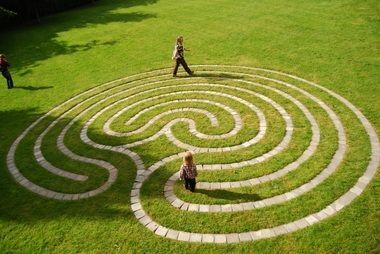
One way of being a pilgrim close to home is through walking a Labyrinth – an ancient practice of the Church meant for spiritual centering, contemplation, and prayer.

Entering the serpentine path of a Labyrinth, one walks slowly while quieting the mind and focusing on a spiritual question or prayer. A Labyrinth is not a maze. It has only one winding path to the center and back out. 

The wisdom of the Labyrinth is that it reflects the way life actually is – that our lives are not about the destination but about the long circuitous journey. The Christian life is consistently described in the New Testament as a road or a way. We walk with Jesus.

Labyrinths can be found within some church buildings, on church grounds, in hospitals, or park spaces. There are also “finger” Labyrinths. Rather than physically walking, the pilgrim can slowly trace the path on a paper or small Labyrinth object with a finger. 

You might also get creative and make your own homemade Labyrinth within a space of your home or out in the yard. labyrinthsociety.org has free printable Labyrinths, as well as a virtual Labyrinth walk.

The Labyrinth is not meant to be a race to the center; it only “works” if we move at a pace which enables us to meditatively pray, paying attention to what God is doing within us. Generally, there are four stages to the walk:

  • Releasing on the way toward the center – letting go of all that weighs us down in the Christian life.  “Let’s throw off any extra baggage, get rid of the sin that trips us up, and fix our eyes on Jesus, faith’s pioneer and perfecter.” (Hebrews 12:1-2, CEB)
  • Receiving in the center – accepting the love God has for you. Jesus said, “Ask and you will receive, so that your joy may be complete.” (John 16:24, NRSV)
  • Returning through following the path back out – integrating what you have received for the life of the world. “I will give them a heart to know me, God. They will be my people and I will be their God, for they will have returned to me with all their hearts.” (Jeremiah 24:7, MSG)
  • Responding to the love of God through gratitude – thus finding joy, even in the most troubling of circumstances. “O give thanks to the Lord, for he is good; his steadfast love endures forever!” (Psalm 118:1, NRSV)

The penitent heart will resonate deeply with the psalms as worship liturgy. This is because liturgical practices impress the spirit and bring spiritual freedom.

Walking together in a common spiritual journey is like going through a gate into a new reality and rejoicing with all the other redeemed pilgrims who are walking the road to Jerusalem.

Lord Jesus Christ, you call me to follow you, and I choose to walk with you. Open the eyes of my heart to see my life in a new way. With each step I take, help me to be open to change. As I walk this pilgrimage, give me the grace to journey deliberately and patiently. Amen.

Psalm 118:1-2, 14-24 – Jesus Is the Cornerstone

Jesus the Cornerstone by Gloria Ssali

O give thanks to the Lord, for he is good;
    his steadfast love endures forever!

Let Israel say,
    “His steadfast love endures forever….”

The Lord is my strength and my might;
    he has become my salvation.

There are glad songs of victory in the tents of the righteous:
“The right hand of the Lord does valiantly;
    the right hand of the Lord is exalted;
    the right hand of the Lord does valiantly.”
I shall not die, but I shall live,
    and recount the deeds of the Lord.
The Lord has punished me severely,
    but he did not give me over to death.

Open to me the gates of righteousness,
    that I may enter through them
    and give thanks to the Lord.

This is the gate of the Lord;
    the righteous shall enter through it.

I thank you that you have answered me
    and have become my salvation.
The stone that the builders rejected
    has become the chief cornerstone.
This is the Lord’s doing;
    it is marvelous in our eyes.
This is the day that the Lord has made;
    let us rejoice and be glad in it. (New Revised Standard Version)

God is the expert on turning our song of lament into a song of victory.

From the Christian perspective of the Lord’s resurrection from death, it is a great song of celebration. The horrid torture and death of Christ on Friday turned to wonderful rejoicing on Sunday with a risen Lord. Life is now different with an empty tomb. The stone the builders rejected is now the head cornerstone.

Our worship is transformed. Instead of offering the blood of bulls and goats, like the select group of the Old Testament priests did, we are now all priests who now offer spiritual sacrifices because Jesus took care of the sin issue once for all. 

Christians continually offer to God their worship of Christ and live a holy life in grateful response to Christ’s death and resurrection.

Jesus is our cornerstone, the center of life and worship. Priority for the Christian faithful is allowing God to build us into a community of faith that worships Jesus with lives dedicated to knowing him and making him known.

Christian worship is the expression of a relationship in which God the Father reveals himself and his love in Christ, and by his Holy Spirit gives grace, to which we respond in faith, gratitude, and obedience. 

That means all of life (and not just a Sunday morning worship service) is to be a daily rhythm of God’s revelation to us, and our response to God in faith, thanksgiving, and an obedient life.

People, at their core, exists for worship. For the Christian, worship is grounded in the triune God and centered in Christ. Worship is the heart and life response to the revelation of God in Christ. Encounters and experiences of God’s revelation to humanity, and our response, form us into faithful disciples.

Author and Pastor Emeritus, Stuart Briscoe, once told the following story: 

“Many years ago, during the Cold War, I traveled to Poland for several weeks of itinerant ministry. One winter day my sponsors drove me in the dead of night to the middle of nowhere. I walked into a dilapidated building crammed with one hundred young people. I realized it was a unique opportunity. Through an interpreter I preached on maintaining Christ as the center of our lives as Christians.

Ten minutes into my message, the lights went out. Pitch black. My interpreter urged me to keep talking. Unable to see my notes or read my Bible, I continued. After I had preached in the dark for twenty minutes, the lights suddenly blinked on, and what I saw startled me: Everyone was on their knees, and they remained there for the rest of my message. The next day I commented on this to one man, and he said, ‘After you left, we stayed on our knees most of the night. We wanted to make sure we were remaining in Christ and centering our lives in him.’”

Since Jesus is the cornerstone, the center of our devotion, worship does not center in a style or an outcome. We may too often evaluate worship on whether or not it works, or if it emotionally moves us because of a particular musical or liturgical style. Whenever worship is designed for our tastes and preferences, Jesus Christ, as the center of worship, can easily be lost. 

With Christ as the chief cornerstone, the true object of worship, all kinds of differing styles can be pleasing to God. Worship itself is to be evaluated not by the satisfaction of personal preference, but by its acceptance by God.

Firmly built on Christ the cornerstone, worship becomes less about gaining truth, and more about letting truth gain us and capture us. The more we pay attention to the presence of Jesus Christ through song, prayer, Scripture, and sacrament, the more we will experience the centrality and power of God. True worship captures God’s heart and passion for the world. Jesus becomes very precious to us when we align ourselves to him as the cornerstone of our faith and worship.

So, brothers and sisters, because of God’s mercies, I encourage you to present your bodies as a living sacrifice that is holy and pleasing to God. This is your appropriate priestly service.

Romans 12:1, CEB

We build our lives on Jesus, the cornerstone of our faith, every day. Pleasing worship is both the responsibility and the privilege of every believer. We are embodied beings; we speak through vocal chords; we move with our legs; we act with our arms; we cannot communicate nor do the will of God apart from our bodies. 

Jesus, as the cornerstone upon which all is supported, means that acceptable worship can happen anywhere. Everywhere can become a sanctuary and a sacred space – home, neighborhood, and marketplace – as well as church. In all these locations, Christian discipleship will prove itself.

So then you are no longer strangers and aliens, but you are citizens with the saints and also members of the household of God, built upon the foundation of the apostles and prophets, with Christ Jesus himself as the cornerstone. In him the whole structure is joined together and grows into a holy temple in the Lord; in whom you also are built together spiritually into a dwelling place for God.

Ephesians 2:19-22, NRSV

Several years ago, a man named Matt had an aunt who had struggled for years to make ends meet. When her health started to decline, she was forced to sell her fifty acres of property to pay for health care. As an act of kindness, Matt traveled to Massachusetts and bought the land from his aunt for the appraised value of $50,000. While exploring the land to see about building a house, he discovered outcroppings of stone ledges.

Matt contracted a geologist, who surveyed the land and informed him the stone was actually Goshen stone, a type of mica used for sidewalks, patios, and landscapes. At the time, it sold for $100 a ton – and Matt had about 24 million tons on the land. The appraised value on the surface was $50,000, but some experts estimated that the land was possibly worth up to $2 billion.

Jesus is the precious cornerstone. He is much too valuable to be left in a church building. And there is so much more to him than surface appearances. Let God drill deep into your life and show you the infinite worth of Jesus Christ. Explore him. Worship him. Offer your very life to him. Shape yourself around him. Center all things completely in and around Jesus. Discover just how precious he is. Let your love be long for Christ.

Lord Jesus, Son of God, Son of Humanity, have mercy upon us.

Psalm 31:1-4, 15-16 – Holy Saturday

I take refuge in you, Lord.
    Please never let me be put to shame.
        Rescue me by your righteousness!
Listen closely to me!
    Deliver me quickly;
        be a rock that protects me;
        be a strong fortress that saves me!
You are definitely my rock and my fortress.
    Guide me and lead me for the sake of your good name!
Get me out of this net that’s been set for me
    because you are my protective fortress….

My future is in your hands.
    Don’t hand me over to my enemies,
    to all who are out to get me!
Shine your face on your servant;
    save me by your faithful love! (Common English Bible)

Holy Saturday is a quiet place sandwiched between the ignominy of the Cross and the celebration of Resurrection – a day of solitude, silence, and stillness. 

This isn’t a particularly popular day. People don’t rave about Holy Saturday. Many Christians haven’t even a thought that this day could have any significance. Yet, this very day has its place in the scheme of the Christian life.

Whenever Christians quickly jump to triumphal language about victory and speak little-to-nothing about suffering, then we are left with a cheap grace which has been purchased with the counterfeit currency of velocity. 

Today is meant for us to get of our heads and wrap our hearts around the important reality that Jesus Christ was truly and bodily dead in the grave. 

It was real suffering on Good Friday, and it is a real death on Holy Saturday. There is no movement. All is silent and still. Jesus is in the solitude of a dark tomb. 

There’s no getting around this: If we want a Resurrection Day with all its celebration and glory, then we cannot circumvent Holy Saturday with its quiet and somber sadness. 

Holy Saturday must be observed if we are to experience real and practical freedom from the bondage of shame. And shame is powerful. It keeps a person locked within themselves, alone with their secrets hidden far from others.

Far too often we may try and cope with our shameful words or actions through promising to work harder, pledging to have greater willpower, or complaining that life is unfair. None of this gets to the root of our shame.

Unlike guilt, which our conscience identifies as specific behaviors to repent of, shame is the message of our inner critic who obnoxiously decries that we are somehow flawed, not enough, and inherently lacking intelligence, courage, or volition.

Shame is the insidious mechanism which interprets bad events as we ourselves being bad.

Shame is the vampire who lives in the shadows and feeds on secrets – which is why the posture of shame is to hide our face in our hands. If shame persists, we withdraw from others and experience grinding loneliness. 

Therefore, the path out of shame is to openly name our shame and tell our stories. In other words, nailing the stake of vulnerability into the heart of shame, and exposing it to the light, causes it to disintegrate and vaporize.

In contrast to the unhealthy hiding of ourselves within prison walls of shame is seeking refuge and hiding ourselves in God. Even a cursory look at today’s psalm evidences an open and vulnerable person who wants nothing to do with shame. The psalmist unabashedly and without shame is quite forward in presenting his wants to God.

The psalms are meant for repeated use, to be voiced aloud again and again. In doing this simple activity, we shame-proof our lives. God’s face shines upon us and takes away the shadows of shame. It is no coincidence that Jesus forsook the shame of the cross through publicly uttering the words of this psalm: “Into your hands I commit my spirit.” (Luke 23:46)

Unchecked verbal violence will eventually lead to physical violence.

If wordy persecution comes from others, the primary tactic will most likely be shaming the people such persons want to control. Such enemies will frame a justification for violence because the people for whom they are leveling shame are “bad,” even “monsters.” If the verbal persecution comes from within, the shame can reach a critical mass of suicidal ideation and perhaps outright attempts at ending one’s life.

There is no existing with the living death of shame. But the good news is that we don’t have to. Instead, we can live in the strong fortress and the rock of refuge which is God.

The Lord traffics in redeeming mercy and steadfast love, not in the demeaning judgment of shame. We can flee to God and find grace to help us in our time of need. There is no shame in reaching out for help. We all need deliverance from something. It’s a matter of whether we are open to ask for it, or not.

Holy Saturday is here for you to know that Jesus Christ absorbed all of the world’s massive shame, yesterday, on Good Friday. Christ died. And the shame he took on, died with him. It is no more and will rise no more.

But someone will rise….

Father God, into your hands I commit my spirit – everything I am and all that I hope to be – so that Jesus Christ might be exalted in me through the power of your Holy Spirit. I choose to leave shame where it belongs – nailed to the cross. With your divine enablement, I shall walk in newness of life through expressing my needs and wants with courage, confidence, and candor. May it be so according to your steadfast love. Amen.