
Pain, Stress, and Chickens (Psalm 32)

A modern mosaic of a mother hen protecting her chicks—on the altar of Dominus Flevit Church on the Mount of Olives, Jerusalem

Oh, what joy for those
    whose disobedience is forgiven,
    whose sin is put out of sight!
Yes, what joy for those
    whose record the Lord has cleared of guilt,
    whose lives are lived in complete honesty!
When I refused to confess my sin,
    my body wasted away,
    and I groaned all day long.
Day and night your hand of discipline was heavy on me.
    My strength evaporated like water in the summer heat.

Finally, I confessed all my sins to you
    and stopped trying to hide my guilt.
I said to myself, “I will confess my rebellion to the Lord.”
    And you forgave me! All my guilt is gone.

Therefore, let all the godly pray to you while there is still time,
    that they may not drown in the floodwaters of judgment.
For you are my hiding place;
    you protect me from trouble.
    You surround me with songs of victory.

The Lord says, “I will guide you along the best pathway for your life.
    I will advise you and watch over you.
Do not be like a senseless horse or mule
    that needs a bit and bridle to keep it under control.”

Many sorrows come to the wicked,
    but unfailing love surrounds those who trust the Lord.
So rejoice in the Lord and be glad, all you who obey him!
    Shout for joy, all you whose hearts are pure! (New Living Translation)

The body knows the truth of what is happening in the spirit. Our physical selves carry the weight of our mental thoughts and emotional feelings.

Our bodies have their way of making sounds of protest and pain if our spirits are silent. For example, physical weariness and tiredness can be a lighthouse, alerting us to pay attention to our inner suffering.

In other words, stated positively, pain and stress are a gift.

“I imagine one of the reasons people cling to their hates so stubbornly is because they sense, once hate is gone, they will be forced to deal with pain.”

James Baldwin

What is stress?

Stress is any type of change that causes physical, emotional, mental, or spiritual strain. Stress is a normal reaction to everyday pressures. However, stress can become unhealthy when it upsets our daily functioning and ability to live well. Stress itself is neither good nor bad. The issue is the appropriate amount of tension we need to live a healthy life.

Where do you typically carry stress in your body?

Whenever we are under a great deal of stress – and are having difficulty either recognizing it or managing it – the body gives us clues about how to pay attention to that stress. Our mental, emotional, relational, and spiritual issues usually show up in the body as physical problems.

Why do individuals handle stress differently?

The combination of past trauma, abuse, and neglect within families and communities is unique to the individual – as well as variations in personality traits and inherited genetics.  In other words, how we deal with stress is a result of both nature and nurture.

What are some common connections between stress and the body?

  • Shoulders: Feeling overwhelmed through carrying the weight of the world’s problems.
  • Gut (stomach and intestines): Feeling anxious for not letting go of a problem.
  • Vomiting or diarrhea: Feeling emotionally sick about a situation and wanting to be rid of it once and for all.
  • Hemorrhoids or constipation: Straining or working very hard to make something happen in your life and it doesn’t come to pass.
  • Headache: Feeling afraid through overthinking that something bad will happen.
  • Chest/heart: Feeling angry or sad through either trauma or secondary trauma.
  • Lungs: Feeling suffocated, like you cannot breathe, because of difficult circumstances, e.g. asthma
  • Spine/knees/hips: Feeling discouraged and wanting to give up because you cannot take one more step.
  •  

How can I deal with my stress in a healthy way?

  1. Let go. Ask for help. Talk to God, as well as a friend, faith leader, or other about why you are stressed.
  2. Reach out. Connect with family members. Get involved in a faith community. Volunteer in an organization you care about.
  3. Eat well. Make healthy choices about food. Find someone or a group of people who share your nutrition goals.
  4. Meditate. Focus on the present moment because there is only now. Read Scripture. Pray.
  5. Walk. Take daily strolls through nature. Walk the dog. Walk with a friend. Walk with the Lord.
  6. Read. Read or listen to a good book. Do it with a cup of coffee or tea.

“The truth is that stress doesn’t come from your boss, your kids, your spouse, traffic jams, health challenges, or other circumstances. It comes from your thoughts about your circumstances.”

Andrew Bernstein

The psalmist went on to release his silence and give voice to his spiritual stress and emotional pain, thus finding relief.

Who is the stress reliever?

God. The Lord is akin to a mother hen who protects her chicks.

My youngest daughter once had a pet chicken named “Gina” (I have no idea why she named the chicken this). Gina would lay an egg or two and keep them warm and nestled underneath herself. Indeed, the eggs were in a special hiding place, protected from outside forces.

My daughter also sang to Gina (which helped her to lay more eggs) and made sure she had plenty of space to find grubs, worms, shrews, and other delectables from the ground. Gina wasn’t the only pet chicken; there were others, too. Chickens are very social and require other chickens to be happy; a solitary hen is likely to not lay any eggs, at all.

Whenever we are “chicken” and run about with anxiety and fear, God gathers us together with other believers, protects us from trouble, surrounds us with songs of deliverance, and makes sure we have everything we need for life and godliness in this present age.

The Lord will take care of us – no matter the situation, the stress, or the pain it produces.

Blessed heavenly Father and Mother Hen, your Divine presence, power, provision, and protection gives us grace and truth. May this season of Lent – a time of repentance and faith – bring us the blessing of your forgiveness and the joy of salvation, through Jesus Christ our Lord. Amen.

How Can I Live a Pure Life? (Psalm 119:9-16)

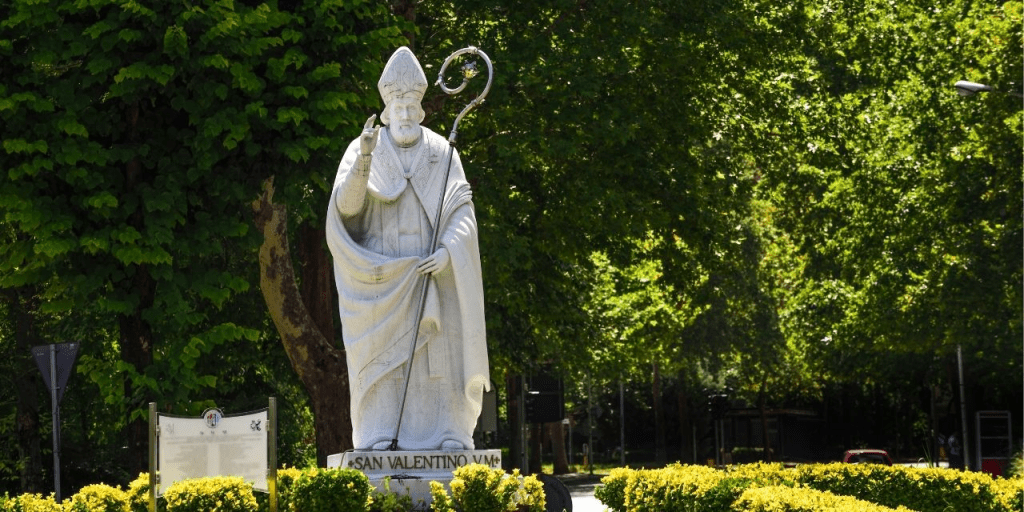
Statue of Saint Valentine in Terni, Umbria, Italy

How can a young person live a pure life?
    By obeying your word.
I try with all my heart to serve you.
    Help me obey your commands.
I study your teachings very carefully
    so that I will not sin against you.
Lord, you are worthy of praise!
    Teach me your laws.
I will repeat the laws we have heard from you.
I enjoy following your rules
    as much as others enjoy great riches.
I will study your instructions.
    I will give thought to your way of life.
I enjoy your laws.
    I will not forget your word. (Easy-To-Read Version)

There was an actual Saint Valentine (c.226-269 C.E.) who lived and served as a Bishop in Rome. The Roman Emperor of the time, Claudius II, was vehemently opposed to Christianity. Claudius forbad Christian marriages from taking place – which was something Bishop Valentine was unwilling to do, and was supposedly jailed for his refusal to stop performing Christian weddings. Hence, one of the reasons for Valentine being the patron saint of lovers.

That’s certainly one way of helping to keep young Christians pure. I, in fact, have more than once advocated on behalf of a young couple in love. Their parents, who wanted a large wedding and plenty of time to prepare for it, simply didn’t realize what they were asking of their kids and how much that put them in an awkward position.

To be pure means to be holy or set apart for a special or specific purpose. Christians are to be completely devoted to their Lord and Savior, Jesus Christ. In order to do that, they will need to pay particular attention to God’s commands and Christ’s teachings.

The Will

The whole person must be involved in obeying the teachings given to us. It begins with our will. Notice that the psalmist sets his resolve toward this great task by stating:

  • I will repeat (out loud) the divine laws I hear
  • I will study God’s instructions
  • I will give thought to my way of life with Yahweh
  • I will not forget the Lord’s words

I have considered my ways
    and have turned my steps to your statutes.
I will hasten and not delay
    to obey your commands. (Psalm 119:59-60, NIV)

We need strong affirmations toward engaging our will toward reading aloud, studying, and remembering biblical commands, so that we will succeed in our quest for purity and holiness.

The Emotions

Our affections also need to be involved. We are emotional creatures, having been formed by a Creator with deep feelings. Therefore, our own emotions are meant to be acknowledged and engaged. The psalmist enjoys God’s Law and is emotionally draw to it’s beauty and light.

Oh, how I love your law!
    I meditate on it all day long.
Your commands are always with me
    and make me wiser than my enemies. (Psalm 119:97-98, NIV)

We need strong feelings toward desiring God’s Word, so that there will be effective action toward a life of purity. Overall, we do what we want. Continually doing something we don’t really want to do ends up being either legalistic or loathsome.

The Body

Our bodies are the vehicles to doing and accomplishing God’s will on this earth. Thus, our physical selves must be animated toward the good, the right, and the just. The psalmist worshiped and praised God.

I, by your great love,
    can come into your house;
in reverence I bow down
    toward your holy temple. (Psalm 5:7, NIV)

Hear my cry for mercy
    as I call to you for help,
as I lift up my hands
    toward your Most Holy Place. (Psalm 28:2, NIV)

Our bodies need to move in physical rhythms of praise and worship to God, so that there will be purity of life. Holiness needs hands and feet to walk into the way of the Lord and obey God’s commands.

Philosophies of Purity

There are some unsound approaches to becoming pure and remaining holy:

  1. It’s up to me. God is too far away, maybe even absent altogether. This is a philosophy which ignores the gut. Yet, if we seek to connect with our innards, we’ll discover quickly that purity is not all on me. I am the vine; you are the branches. If you remain in me and I in you, then you will produce much fruit. Without me, you can’t do anything. (John 15:5, CEB)
  2. Follow your heart. Doing this has significance; however, if that’s the exclusive approach to purity, the mind gets left behind and the heart ends up vulnerable to deceit. The heart is deceitful above all things, and desperately sick; who can understand it? (Jeremiah 17:9, ESV)
  3. Knowledge is power. Yes, of course it is; but by itself, knowledge puffs up. We need the affections, particularly love, or else we become brains-on-a-stick, denigrating the body as superfluous to spirituality. Knowledge puffs up, but love builds up. (1 Corinthians 8:1b, NRSV)
  4. Control everything. There are certainly forces in operation in this world; yet we are never called to try and manipulate them. We may will ourselves to do many things, yet God has control of all things. Humanity is called to self-control, which takes up all our energy because it’s no easy feat. For the grace of God has appeared that offers salvation to all people. It teaches us to say “No” to ungodliness and worldly passions, and to live self-controlled, upright and godly lives in this present age. (Titus 2:11-12, NIV)

A sound philosophy of being holy and pure recognizes that we need divine help in strengthening our faith; the assistance of others who can walk alongside us and provide encouragement; and the engagement of our entire person, utilizing all our faculties in order to live a life of purity. Obedience to God’s Word is vital to a holy life; and to obey requires our entire selves.

There is to be a marriage between God’s commands and human obedience. The world may forbade this, but much like St. Valentine, we’ll let love have its way – and not the ruler of this present evil age.

How To Get Through Difficulty (Psalm 119:105-112)

Your word is a lamp
that gives light
    wherever I walk.
Your laws are fair,
and I have given my word
    to respect them all.
I am in terrible pain!
Save me, Lord,
    as you have promised.
Accept my offerings of praise
    and teach me your laws.
I never forget your teachings,
although my life is always
    in danger.
Some merciless people
    are trying to trap me,
but I never turn my back
    on your teachings.
They will always be
my most prized possession
    and my source of joy.
I have made up my mind
to obey your laws forever,
    no matter what. (Contemporary English Version)

Attitude. Affection. These are the two qualities that stand out to me in today’s Psalm lesson. The psalmist is a person who is determined to hold onto God’s Law because it is his heart’s delight.

Our attitudes and our affections are meant to fit together like a hand in a glove. Our attitudes help us push through suffering to realize better days. And our affections drive us forward, allowing us to experience joy in the present moment as we await our hope of ultimate deliverance.

Commitments are fluid, always moving – so they need to be continually rehearsed and refreshed. We are constantly either fulfilling our promises or reneging on them. There is really no such thing as a one-time vow.

Vows need reinforcement from our attitudes and our affections. Otherwise, they languish on the trash heap of good intentions. This is one reason why the Psalms are designed for constant use.

Spiritually healthy habits must be embedded in our lives, well before any suffering and hard times roll in.

If our normal daily routines involve regular sustenance of God’s Word, then we have a breadth and a depth of robust theology to draw upon when the going gets rough. Furthermore, the sheer force of habit brings us back again and again to the treasure chest of divine instruction, informing our decisions and illuminating the treacherous road ahead.

The psalter is designed to reframe our difficult situations. Especially when a person’s life hangs in the balance, we can view hard and awkward circumstances through the window of the Psalms. Although circumstances change, and we never quite know what to expect, God’s Law remains our ballast and our rock.

Circumstances may change but divine love and morality are unchanging. Jesus Christ is the same yesterday, today, and forever. The Spirit is always with us, through each wave of hardship.

Life is a journey, an exploration into the unknown of the future. The path is shadowy and unclear. We are unsure of what is around the bend. God’s instructions and promises are like a forever energized flashlight, helping us navigate forward. Maybe Jesus had today’s Psalm in mind when he said:

“I am the light of the world. Whoever follows me will never walk in darkness but will have the light of life.” (John 8:12, NRSV)

In Christianity, the Word is embodied in Jesus Christ; he is both the example and fulfillment of all God’s good promises.

A sequence of four metaphors runs through our verses for today:

  1. My feet. With Jesus as Word and Light, we have a constant companion walking alongside us for the journey.
  2. My mouth. There is an intercessor who takes our wordy or malformed prayers and presents them before our heavenly Father
  3. My hands. We do God’s will, despite adverse circumstances, by observing the Master who washed the feet of others.
  4. My heart. In desiring God’s decrees and commands, our hearts find their rest in the One who loved us and gave himself for us.

Our attitudes and affections are transformed into sustainable faith for the long journey.

Our hope is made sure through the promises of God.

Our love finds a resting place in the person of Jesus.

Faith, hope, and love are the shoes enabling us to walk the long uphill road, as well as absorbing the shock as we run with abandon downhill – into the loving arms of God.

I encourage you to find what works best for you in developing helpful spiritual habits. In reading the Bible, I often take the following approach using the acronym S.O.A.P:

Scripture

• Open your Bible and slowly, meditatively, read the portion of Scripture in your reading plan for today.

• Write the reference of what you read in a journal along with the date.

• As you read, ask God’s Spirit to highlight the verse(s) that speak to your life and write it in your journal.

Observation

• Make observations about what you just read and write them in your journal.

• Think about: What is going on? What is the context?  Who are the people being spoken to? What is the background or setting for this verse?

• Paraphrase and write this scripture down in your journal, in your own words.

• What do you think God is saying to you in this scripture?

Application

• Personalize what you have read by asking yourself how it relates to your life right now.

• Ask yourself how you can apply what you just read to your own life and write it in your journal.

• Ask yourself how your life will be different or changed as a result of God speaking to you in this Scripture.

Prayer

• Write out a prayer to God in your journal.

• Your prayer should relate to the verse that you highlighted. It could be asking for help, thanking God, etc. Write down what your heart desires to say to God in response to his Word.

May the words of your mouth, the meditations of your heart, the work of your hands, and the movement of your feet be to the glory of Jesus Christ. Amen.

How To Live Well (Psalm 112:1-9)

By Stushie Art

Praise the Lord!
    Those who honor the Lord,
    who adore God’s commandments, are truly happy!
Their descendants will be strong throughout the land.
    The offspring of those who do right will be blessed;
    wealth and riches will be in their houses.
    Their righteousness stands forever.
They shine in the dark for others who do right.
    They are merciful, compassionate, and righteous.
Those who lend generously are good people—
    as are those who conduct their affairs with justice.
Yes, these sorts of people will never be shaken;
    the righteous will be remembered forever!
They won’t be frightened at bad news.
    Their hearts are steady, trusting in the Lord.
Their hearts are firm; they aren’t afraid.
    In the end, they will witness their enemies’ defeat.
They give freely to those in need.
    Their righteousness stands forever.
    Their strength increases gloriously. (Common English Bible)

To live well is to obey well. Well, that’s a thought! And a deep subject it is.

It’s a matter of whether we’ll take our cues for living from S. Hiney Wells or his brother, Russ T. Wells.

S. Hiney tells us this:

“Listen, my friends, the Lord’s commands are not made for drudgery. They’re how to be happy in this here life. Obeying what God says leads to blessings of family, security, contentment, and peace. God’s never failed to keep bacon in my frying pan, folks to help me out in a pinch, and a heap of hope for when I’m lower than a snake’s belly in a wagon rut.”

Russ T. tells us:

“Well, the world ain’t shiny at all. It’s all dark and covered in rust so thick you’d think nuthin’ good’s been used fer a coon’s age.”

S. Hiney responds: “Well, Russ T., there’s certainly a powerful lot of darkness everywhere; but that don’t mean there’s no light! Even a few little lightnin’ bugs helps us to see where we are in the night.”

Russ T. retorts: “Well, S. Hiney, them little bugs don’t help none when I’m brinin’ away in pickle barrel so full of vinegar that I don’t know whether I’m in the field or the henhouse.”

S. Hiney: “Well, now, fortunately we’ve got more than a few matches in our pockets. God’s own light shines so bright that it lights up the whole earth, a world-illuminating light that keeps every old fox away from the barn.”


Russ T.: “Well, that’d be mighty nice. But if that light’s so all-powerful, I ought to be able to see my hand in front of my face! All’s I see is a bunch o’ nasty weasels lurkin’ about, givin’ me a headache bigger than the Ozark Mountain Daredevils singin’ and playin’ on my tin roof while I’m tryin’ to sleep.”

S. Hiney: “Well, Russ T., I see it every time I lend money without any expectation of interest or return. I see it in my neighbor’s generous hand and sharing her prize winnin’ tomatoes and blue ribbon apple pies. And I mostly saw it with our dear mama’s teaching to “give until it’s gone, boys, not until it hurts,” rest her soul.

Russ T.: “I obeyed mama, bless her heart; she was one of the good ones. And I certainly didn’t wanna be on her bad side!”

S. Hiney: “Me, too. Her words of affirmation felt a lot better than those times when I was disobedient and found a willow switch on my behind! So, Russ T., were you happy listening to mama and doing what she said?”

Russ T.: “Well, now, I reckon I was. Things was a lot simpler and a lot less complicated when I listened to her. Whenever I didn’t, I felt like I was a polecat in the chicken house, like I didn’t much belong.”

S. Hiney: “My heart’s calculatin’ that your true love, the Lord God, is presently waitin’ on you to shake all that rust off so that he can give you a good shine on that soul of yours. But yer goin’ to have to listen, to obey what you hear, brother.”

Maybe because we tend to be all or nothing people, we often get hung up on either being perfect or being a failure. In reality, we are neither. We’re just simple folk trying to do our best in loving and serving the Lord with an obedient heart.

Christianity takes its cues in reading the psalms from Christ’s illumination. Jesus embodied the ideals of humanity, having neither material wealth nor actual physical descendants; yet he distributed gifts more generously than anyone ever did; and he has more spiritual progeny than anybody else.

Following in the way of Christ, we live in such a way that it is possible to be:

  • Poor and rich
  • Compassionate and competent
  • Gentle and shrewd
  • Gracious and tough
  • Giving and receiving
  • Faithful and doubting
  • Light and dark
  • Happy and sad
  • Vulnerable and powerful
  • Confident and scared
  • Brave and hesitant
  • Generous and just
  • Consistent and unpredictable
  • Mindful and forgetful
  • Weak and strong
  • Loving and questioning
  • Open to change and immovable

Living well means obeying well enough to see the best in others, seek the common good of everyone, and be resilient to deal with our personal foibles and the unforeseen pitfalls we sometimes experience.

What will you do when you’re in a pickle?

O God, whose blessed Son came into the world that he might destroy the works of the devil and make us children of God and heirs of eternal life: Grant that, having this hope, we may purify ourselves as he is pure; that, when he comes again with power and great glory, we may be made like him in his eternal and glorious kingdom; where he lives and reigns with you and the Holy Spirit, one God, for ever and ever. Amen.