Monday of Holy Week (Psalm 36:5-11)

The Via Dolorosa (Latin: the way of sorrows) is a narrow path through the streets of the Old Jerusalem, the final route traveled by Jesus of Nazareth on the way to his crucifixion.

Your steadfast love, O Lord, extends to the heavens,
    your faithfulness to the clouds.
Your righteousness is like the mighty mountains;
    your judgments are like the great deep;
    you save humans and animals alike, O Lord.

How precious is your steadfast love, O God!
    All people may take refuge in the shadow of your wings.
They feast on the abundance of your house,
    and you give them drink from the river of your delights.
For with you is the fountain of life;
    in your light we see light.

O continue your steadfast love to those who know you
    and your salvation to the upright of heart!
Do not let the foot of the arrogant tread on me
    or the hand of the wicked drive me away. (New Revised Standard Version)

The desert journey is almost over. The sojourn with Jesus in his life and ministry will soon culminate in the ultimate experience of sorrow and joy. The Christian season of Lent is nearly at the end. We are in it’s final days, known as Holy Week.

We have a Holy Week because of love. There is yet another journey we must take, along the Via Dolorosa to the hill of Golgotha, because of God’s steadfast love.

Love suffers. Every parent knows this. Because of a parent’s committed and faithful love toward a child, they feel not only the joys but also the sorrows and pain of their children. I can say that this feeling does not go away, even with adult children. And it’s compounded with grandchildren. Just as our love is big enough to hold multiple children and grandchildren, so our capacity for experiencing deep emotion for their welfare is equally large.

Holy Week reminds us that God’s committed parental love suffers. It is because of God’s immense and steadfast love that there is a road to the cross and a tortured death for Jesus. The cost of our salvation involves a very bloody affair. Deliverance comes at the price of horrible violence. Jesus Christ lived and died for us, because of love.

He suffered much because he loved much.

God’s people, walking in the way of love, quickly discover that it is simultaneously walking in the way of suffering. From Old Testament times through the New Testament era and into the present day, the faithful have always experienced suffering as a central part of their piety and devotion in showing steadfast love. 

The medieval mystics of the Church understood quite well the connection between suffering and love. They could not imagine a Christian life without hardship, difficulty, and persecution. Thomas à Kempis, a sort of pastor to pastors, wrote in the fifteenth century:

“Sometimes it is to our advantage to endure misfortunes and adversities, for they make us enter into our inner selves and acknowledge that we are in a place of exile and that we ought not to rely on anything in this world.  And sometimes it is good for us to suffer contradictions and know that there are those who think ill and badly of us, even though we do our best and act with every good intention….  When men ridicule and belittle us, we should turn to God, who sees our innermost thoughts, and seek His judgment….  It is when a man of good will is distressed, or tempted, or afflicted with evil that he best understands the overwhelming need he has for God, without whom he can do nothing….  It is in such times of trial that he realizes that perfect security and full peace are not to be found in this world.”

Thomas à Kempis, The Imitation of Christ

And yet, it is because of love that suffering is transformed and endured as something wholly other than sheer pain or hurt. Thomas à Kempis went on to say:

“Love is a mighty power, a great and complete good; Love alone lightens every burden and makes the rough places smooth. It bears every hardship as though it were nothing and renders all bitterness sweet and acceptable. The love of Jesus is noble and inspires us to great deeds; it moves us always to desire perfection. Love aspires to high things and is held back by nothing base. Love longs to be free, a stranger to every worldly desire, lest its inner vision become dimmed, and lest worldly self-interest hinder it, or ill-fortune cast it down…. Love knows no limits, but ardently transcends all bounds. Love feels no burden, takes no account of toil, attempts things beyond its strength; love sees nothing as impossible, for it feels able to achieve all things. Love therefore does great things; it is strange and effective; while he who lacks love faints and fails.”

Thomas à Kempis, The Imitation of Christ

Holy Week’s message is certainly one of suffering love. Jesus went to the greatest lengths possible to give Divine steadfast love to humanity. So, let us not shy away from the cross, but journey with Jesus to Golgotha, embracing the love of God for us. In so doing, we will find the inner resources needed to love the world, even in all its unloveliness.

Grant, we pray, almighty God, that, though in our weakness we fail, we may be revived through the Passion of your Only Begotten Son. Who lives and reigns with you in the unity of the Holy Spirit, God, for ever and ever. Amen.


Guide Me By Your Good Spirit (Psalm 143)

Listen to my prayer, Lord!
    Because of your faithfulness, hear my requests for mercy!
    Because of your righteousness, answer me!
Please don’t bring your servant to judgment,
    because no living thing is righteous before you.

The enemy is chasing me,
    crushing my life in the dirt,
        forcing me to live in the dark
            like those who’ve been dead forever.
My spirit is weak inside me—
    inside, my mind is numb.

I remember the days long past;
    I meditate on all your deeds;
    I contemplate your handiwork.
I stretch out my hands to you;
    my whole being is like dry dirt, thirsting for you.

Answer me, Lord—and quickly! My breath is fading.
    Don’t hide your face from me
        or I’ll be like those going down to the pit!
Tell me all about your faithful love come morning time,
    because I trust you.
Show me the way I should go,
    because I offer my life up to you.
Deliver me from my enemies, Lord!
    I seek protection from you.
Teach me to do what pleases you,
    because you are my God.
Guide me by your good spirit
        into good land.
Make me live again, Lord, for your name’s sake.
    Bring me out of distress because of your righteousness.
Wipe out my enemies because of your faithful love.
    Destroy everyone who attacks me,
        because I am your servant. (Common English Bible)

Many Westerners tend to think about sin as bad individual actions which are quite personal. However, sin is much bigger than that. Primarily, sin is a force, a power in this universe which weighs on every molecule within it. None of us can escape having to deal with it.

For persons like the psalmist, they strive to be good and live a just life, yet they are continually dogged by others who have given into the “dark side.” The wicked discern the force of sin in the world, and then decide to move with it – believing that good guys finish last.

Yet, there is another powerful force in the universe – and it’s a greater power than sin.

Everywhere we look, we see a bad spirit. And that sinful spirit is behind the injustice, oppression, war, conflict, ignorance, and avarice which exists in every nation, community, and even home. Entrenched opinions, yelling at each other, the refusal to consider evidence, and narrow thinking have permeated our societies and pitted people against one another.

This evil spirit of the age is captured in the Apostle Paul’s words as he reflected on this and other psalms:

As it is written:

“There is no one righteous, not even one;
    there is no one who understands;
    there is no one who seeks God.
All have turned away,
    they have together become worthless;
there is no one who does good,
    not even one.”
“Their throats are open graves;
    their tongues practice deceit.”
“The poison of vipers is on their lips.”
    “Their mouths are full of cursing and bitterness.”
“Their feet are swift to shed blood;
    ruin and misery mark their ways,
and the way of peace they do not know.”
    “There is no fear of God before their eyes.”

Now we know that whatever the law says, it says to those who are under the law, so that every mouth may be silenced and the whole world held accountable to God. Therefore no one will be declared righteous in God’s sight by the works of the law; rather, through the law we become conscious of our sin. (Romans 3:10-20, NIV)

The psalmist doesn’t want to be a part of the sinful force and the bad spirit. He, instead, knows that sometimes he’s part of the problem, along with being a victim of sin, and thus, knows he needs deliverance from this awful power.

Promises to do better and personal willpower won’t cut it, when it comes to changing a life and a society. Rather, we must tap into a good spirit, which is ultimately, the Spirit.

Even though all have been both victim and victimizer, and fall short of God’s glory, all are justified freely by God’s grace through the redemption that came by Christ Jesus. (Romans 3:23-24)

Once we were blocked from prayer because of obstacles existing unaware among us and within us. But now we see the world for how it’s been touched by foulness and degradation, so we pray.

The spirit of the age will fail us. Our own spirit will be fickle. God’s Spirit, however, is continually living and active with the force of grace and mercy.

In our fear, it’s okay, even good, to flee from evil. Yet, we must complete the process by not only fleeing from the bad spirit, but also fleeing to God’s Spirit.

Prayer, then, becomes our lifeline. It’s our connection to what is right, just, and good. In Christianity, the Spirit is the one who conforms us to the glory of God and the image of Jesus. The Spirit is our Teacher, Guide, and Advocate, keeping us on God’s good path.

We need to live according to the Spirit – which is a continual journey of removing obstacles to faith and allowing God’s good gifts to awaken within us.

My counsel is this: Live freely, animated and motivated by God’s Spirit. Then you won’t feed the compulsions of selfishness. For there is a root of sinful self-interest in us that is at odds with a free spirit, just as the free spirit is incompatible with selfishness. These two ways of life are contrary to each other, so that you cannot live at times one way and at times another way according to how you feel on any given day. Why don’t you choose to be led by the Spirit and so escape the erratic compulsions of a law-dominated existence? (Galatians 5:16-18, MSG)

Yes, sin is a powerful force, manifesting itself in a host of bad spirits all around us. But grace is greater than all sin, and God’s good Spirit shall overwhelm and overcome all evil.

Visit this place, O Lord, we pray, and drive far from it the snares of the enemy; may your holy angels dwell with us and guard us in peace, and may your blessing be always upon us, through Jesus Christ our Lord. Amen.

Listen! (Psalm 81)

Shout for joy to God our defender;
    sing praise to the God of Jacob!
Start the music and beat the tambourines;
    play pleasant music on the harps and the lyres.
Blow the trumpet for the festival,
    when the moon is new and when the moon is full.
This is the law in Israel,
    an order from the God of Jacob.
He gave it to the people of Israel
    when he attacked the land of Egypt.

I hear an unknown voice saying,
“I took the burdens off your backs;
    I let you put down your loads of bricks.
When you were in trouble, you called to me, and I saved you.
    From my hiding place in the storm, I answered you.
    I put you to the test at the springs of Meribah.
Listen, my people, to my warning;
    Israel, how I wish you would listen to me!
You must never worship another god.
I am the Lord your God,
    who brought you out of Egypt.
Open your mouth, and I will feed you.

“But my people would not listen to me;
    Israel would not obey me.
So I let them go their stubborn ways
    and do whatever they wanted.
How I wish my people would listen to me;
    how I wish they would obey me!
I would quickly defeat their enemies
    and conquer all their foes.
Those who hate me would bow in fear before me;
    their punishment would last forever.
But I would feed you with the finest wheat
    and satisfy you with wild honey.” (Good News Translation)

I have a wife and three daughters. They talk – a lot! When my girls were small, it was hard to get their attention long enough for them to hear anything I was saying. So I oftentimes cupped my hands to their little faces so they couldn’t look around and get distracted. Then, I would speak, with them looking me straight in the eye.

It’s hard to listen. And listening seems to be a lost art and a skill we no longer care to develop. Maybe that’s because we’re obsessed with hearing ourselves talk. There’s so much chatter about so many things that we rarely even remember much of what we said; and a lot of those words get uttered before we even think. 

What’s more, when other people talk, most of it seems like a bunch of gibberish, due to our lack of focused attention. Perhaps we need an adult version of the hand-cupping we do with kids.

We really need the wisdom to know when to speak and when to be quiet. Whenever being quiet is required, it’s for the purpose of listening. And whenever words and noise are needed, it’s to praise God with our mouths and our musical instruments.

In this day and age, folks get so worked up to express their opinions, and say what they want to say, that the virtue of listening is not at all valued. However, God puts a premium on taking the stance of listening. 

The more you talk, the more likely you are to sin. If you are wise, you will keep quiet. (Proverbs 10:19, GNT)

Another reason listening is not well-practiced is that we esteem being busy and constant activity, to such a degree, that taking the time for silence long enough to listen is not of value to us. But if God’s people are going to hear the voice of the Lord, we must be still and silent, long enough to listen to what’s being said to us.

And yet another reason we eschew listening is that we are uncomfortable with silence, and seek to fill any quiet space with noise so as to not have to deal with what is really going on inside of us. Since God often speaks within the stillness and quietness of things, we’ll never hear, because our inner dialogue is drowning the words we need to listen to. (1 Kings 19:11-12)

I have a friend (I’ll call him Elmer) who spent eighteen hours in complete silence, without any talking whatsoever, in order to listen to God. You might think that Elmer is a monkish sort of introvert who likes that sort of thing. However, he’s actually an extrovert who lives in the inner city and comes from a large family. 

Elmer simply came to the point of understanding that he was so busy moving from one thing to another, and constantly talking, to the point that he was drowning-out the voice of the Lord. Here’s what Elmer said about his time of silence: 

“Those eighteen hours of silence were the loudest hours I have ever experienced. My mind was so noisy and so filled with stuff that it nearly drove me nuts. But after many hours passed, as the noise started to fade away, I could begin to hear the still small voice of God.” 

Elmer discovered that he was a person who kept pushing and projecting his agenda onto God. His lack of listening led to an inability to obey. After Elmer’s experience, he determined to start including times of solitude and silence into his everyday life, even if for only ten minutes, so he could listen to what God wants rather than tell God what to do.

The Lord came and stood there, and called as he had before, “Samuel! Samuel!” Samuel answered, “Speak; your servant is listening.” (1 Samuel 3:10, GNT)

Any fool can babble on about their gripes and opinions. In Holy Scripture, however, human speech is generally viewed as being overrated. Instead, silence and solitude, listening and learning, are the virtues practiced by Jesus; the kingdom of God cannot operate without them.

Therefore, we must take up the shield of faith with which to extinguish all the flaming arrows of the evil one who wants to keep us trapped in either a cycle of constant chatter without listening, or continual silence without acting upon what we hear from God. 

We must be quiet for the purpose of listening to God. Then, when we hear the Lord speak, we must act in faith to say and do what we are called to.

God of silence and of all sound, help me to listen! Enable me to be patient and wait for your still small voice calling me. Give me attentive ears that can separate the noise from the sounds that are you. Today help me to hear you anew so that I may obey with wisdom and obedience. Amen.

The Divine Helper (Psalm 121)

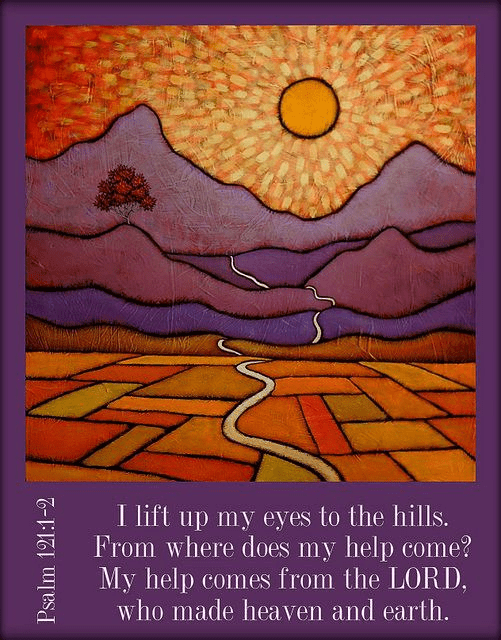
I lift up my eyes to the mountains—
    where does my help come from?
My help comes from the Lord,
    the Maker of heaven and earth.

He will not let your foot slip—
    he who watches over you will not slumber;
indeed, he who watches over Israel
    will neither slumber nor sleep.

The Lord watches over you—
    the Lord is your shade at your right hand;
the sun will not harm you by day,
    nor the moon by night.

The Lord will keep you from all harm—
    he will watch over your life;
the Lord will watch over your coming and going
    both now and forevermore. (New International Version)

Not a one of us gets off this planet without needing help – a lot of help! Even people who are in helping professions or who identify themselves primarily as helpers need help themselves.

There is no such thing as complete, total, and irrevocable independence. We humans are hard-wired by our Creator for community. That means we can only find our greatest fulfillment within interdependent relationships; and, furthermore, discover our highest happiness in a dependent relationship to God.

To need others, and especially to need God, is not a weakness; it’s a sign of strength. To have an awareness that help is needed allows us to make wise and confident choices. Only the fool goes it alone, believing they can pull themselves up by their bootstraps. “God helps those who help themselves,” was originally said by Benjamin Franklin, not Holy Scripture.

So, the question becomes: To whom and to where do we go for help? Who do we consult? With whom do we collaborate?

The most important step any of us can make is to realize that our own personal resources, although important and necessary, are inadequate. Therefore, we must admit, “I need help with this.” The next step is to go to the right source for that help.

The psalmist insists that the Lord is our helper, our keeper. Keeping is a large part of helping. God as our Divine Keeper means that the Lord watches over us, guards our lives, and seeks to preserve us from harm, wrongdoing, injustice, and oppression.

The very identity of God is wrapped up in being a Protector, Guard, and Watchkeeper. The Lord shields and shelters us, much like a mother hen over her chicks. God watches over us, just as a watchman keeps guard over a city at night when the residents are sleeping. And since the Lord is everywhere present, there is a continual divine presence in all of our life journeys. The dangers of both the day and the night are no match for the God who is our Keeper.

The promises of safety in today’s psalm are not meant to suggest that those who walk in the shelter of God will never endure harm or that nothing ill will ever befall them. The Psalter knows all too well that the wicked are everywhere and that they thrive unjustly.

Rather, these divine promises are general promises—they are blessings God does for those who rely on the Lord, call upon God’s name, and seek divine help. We are to have a continual awareness of God’s presence in this world. Although we are not inoculated from pain, God is always with us in our hurt and bewilderment.

It can be hard to ask for help. Our pride, stubbornness, and independence might cause us to experience harm rather than seek assistance. Be specific about the help needed. The following are some “helpful” ways of approaching God by answering some basic newsgathering type questions. The goal isn’t to convince the Lord to help us, but rather to enable us in connecting with what we truly need and being specific about God’s assistance for us or for others:

Who needs help?

Be clear and specific if the help is for yourself, another, or a group of people.

When Jesus had entered Capernaum, a centurion came to him, asking for help. “Lord,” he said, “my servant lies at home paralyzed, suffering terribly.”

Jesus said to him, “Shall I come and heal him?”

The centurion replied, “Lord, I do not deserve to have you come under my roof. But just say the word, and my servant will be healed. (Matthew 8:5-8, NIV)

How will God’s intervention help?

God is an expert listener. Tell the story of what you have tried already and where you fall short.

Jesus asked the boy’s father, “How long has he been like this?”

“From childhood,” he answered. “It has often thrown him into fire or water to kill him. But if you can do anything, take pity on us and help us.”

“‘If you can’?” said Jesus. “Everything is possible for one who believes.”

Immediately the boy’s father exclaimed, “I do believe; help me overcome my unbelief!” (Mark 9:21-24, NIV)

Why are you asking for God’s help?

Explain what’s going on and the reasons why you believe the Lord is the One to help. Mention the divine attributes and actions of God, as well as your own personal connection.

Then Asa called to the Lord his God and said, “Lord, there is no one like you to help the powerless against the mighty. Help us, Lord our God, for we rely on you, and in your name we have come against this vast army. Lord, you are our God; do not let mere mortals prevail against you.” (2 Chronicles 14:11, NIV)

Where is the help needed?

Is it a geographical location, a specific spot in the human body, or a place such as a building or home?

Jesus left the synagogue and went to the home of Simon. Now Simon’s mother-in-law was suffering from a high fever, and they asked Jesus to help her. So, he bent over her and rebuked the fever, and it left her. She got up at once and began to wait on them. (Luke 4:37-39, NIV)

When do you need help?

Immediately? Tomorrow? At a specific time?

O Lord, God of my salvation,

    when, at night, I cry out in your presence,

let my prayer come before you;

    incline your ear to my cry.

For my soul is full of troubles,

    and my life draws near to Sheol. (Psalm 88:1-3, NRSV)

What, exactly, is the need?

Spell out what you want in detail, holding nothing back. Don’t be concerned about the words or saying it right. Speak in your own plain language.

Help, O Lord, for the godly are fast disappearing!

    The faithful have vanished from the earth!

Neighbors lie to each other,

    speaking with flattering lips and deceitful hearts.

May the Lord cut off their flattering lips

    and silence their boastful tongues. (Psalm 12:1-3, NLT)

The help you and I need is in the name of the Lord who made heaven and earth. We only need to ask, and it will be given; seek, and we will find; knock, and the answer will open to us.

I Cannot Do This Alone

A Prayer by Dietrich Bonhoeffer

O God, early in the morning I cry to you.
Help me to pray and to concentrate my thoughts on you;
I cannot do this alone.
In me there is darkness, but with you there is light;
I am lonely, but you do not leave me; I am feeble in heart, but with you there is help;
I am restless, but with you there is peace. In me there is bitterness, but with you there is patience;
I do not understand your ways, but you know the way for me….
Restore me to liberty, and enable me to live now, that I may answer before you and before men.
Lord whatever this day may bring, Your name be praised. Amen.