Let Me Tell You What God Has Done For Me (Psalm 66:8-20)

Praise our God, all peoples,
    let the sound of his praise be heard;
he has preserved our lives
    and kept our feet from slipping.
For you, God, tested us;
    you refined us like silver.
You brought us into prison
    and laid burdens on our backs.
You let people ride over our heads;
    we went through fire and water,
    but you brought us to a place of abundance.

I will come to your temple with burnt offerings
    and fulfill my vows to you—
vows my lips promised and my mouth spoke
    when I was in trouble.
I will sacrifice fat animals to you
    and an offering of rams;
    I will offer bulls and goats.

Come and hear, all you who fear God;
    let me tell you what he has done for me.
I cried out to him with my mouth;
    his praise was on my tongue.
If I had cherished sin in my heart,
    the Lord would not have listened;
but God has surely listened
    and has heard my prayer.
Praise be to God,
    who has not rejected my prayer
    or withheld his love from me! (New International Version)

“God made humans because God loves stories.”

Elie Wiesel

The Church’s Prayer Book

Those of us who utilize the Revised Common Lectionary Daily Readings are familiar with having a psalm each day. In addition, the same psalm is repeated three consecutive days, following the pattern of Thursday, Friday, and Saturday readings preparing for Sunday – and Monday, Tuesday, and Wednesday readings reflecting on Sunday. The Psalter has such a prominent place in the readings because it is viewed as the Church’s Prayer Book.

Within the book of Psalms, we have the full range of human experience and emotion. Much like athletes in weight training, putting in their reps (repetitions), so the Christian is to use the weighty Psalms with repeated use for spiritual growth and development. Prayer and praise, lament and celebration, are necessary equipment for the strengthening of faith and a healthy Christian life.

Psalms of Praise and Thanksgiving

Today’s psalm is a song of thanksgiving for the community of worshipers approaching the temple and offering their sacrifices to God. Together, as the people of God, they proclaim what God has done for them. Through hardship and difficulty, they have realized abundance and joy. Personal witness and testimony are given to the congregation for answered prayer so that all may rejoice together in God’s steadfast and unfailing love.

Expressing celebration is important. Without it, our spirits are famished and find it difficult to be patient and persevere. With celebration, our spiritual muscles flex with joy and are in shape for the trials and tribulations which lie ahead. Corporate affirmation and personal appreciation are meant to work together in a grand profession of faith in God’s good guidance and help.

“Come and listen and I will tell you what God did for me,” benefits both the individual and the group. If all we ever hear and experience is hardship, our faith muscle will be overused and give out. We need stories to celebrate. We need to hear testimonies of God’s enduring love.

So, what has God done for you? What celebrations do we have today? Are you willing to share your story?

Ritual Celebration

Celebrations are necessary because they highlight the things most important to us. And it is okay to make them regular rituals – which is why I care about attending to the Christian Year with it’s centrality of Jesus and the movements of Advent, Christmas, Epiphany, Lent, Easter(tide), Ascension, Pentecost, and “Ordinary” Time.

Ritual celebration is, of course, not unique to Christianity. Rituals are part of being human. At it’s heart, ritual is a form of celebration, of remembering to observe significant events, special seasons, and daily routines. Each ritual observance is a re-telling of meaningful stories for an individual, family, or group of people.

Observing ritual celebrations:

  • Re-enforces our values.
  • Gives us a sense of belonging.
  • Marks time for us in meaningful ways.
  • Forms daily habits in us.
  • Reminds of us of who we are and what our purpose in this world is.
  • Helps us express our emotions in a healthy way.
  • Adds new stories to our lives.
  • Connects us to our spiritual ancestors and bonds us to one another.
  • Builds close relationships and trust.
  • Heals us from traumatic events.

Not observing ritual celebrations:

  • Causes a lack of identity and purpose.
  • Creates loneliness and confusion.
  • Hollows out our lives and sucks our souls of joy.

Sharing stories, and paying attention to rituals, are a primary connection between the individual and the community, a place where our identities and our values are reinforced and transformed into a force for good in the world.

Both the smallest and biggest of celebrations are appropriate, along with everything in between. While writing at my desk, a majestic male red wing blackbird perched himself on the bush in front of the window. Being only a few feet from him, I could see his feathers in detail and his glorious preening for the benefit of the females.

You are wonderful, Lord,
    and you deserve all praise,
because you are much greater
    than anyone can understand.

Each generation will announce
to the next your wonderful
    and powerful deeds.
I will keep thinking about
your marvelous glory
    and your mighty miracles.
Everyone will talk about
    your fearsome deeds,
and I will tell all nations
    how great you are.
They will celebrate and sing
about your matchless mercy
    and your power to save. (Psalm 145:3-7, CEV)

On a much grander scale, today I gathered with a family at the bedside of their loved one to grieve his death, and to also remember and celebrate his life for the gift he had been to so many. Together we were able to say, “Let the whole world bless our God and loudly sing his praises.”

We pray. God answers. We rejoice. If we don’t rejoice in the company of others, then we eventually forget – which then makes the next hardship even harder.

The practice of telling our story is the means by which we come to understand our faith. Testimony not only declares what we believe, but is also the vehicle that shapes our belief. The psalmist issues an invitation for people to come and hear, and he will tell what God has done. The story, the psalmist’s testimony of faith, is a simple one, essentially saying: I prayed to God. God listened. God answered. Praise be to God! And I will now tell you about God.

Tell a Story

When the Bible speaks about God, it most often does so by telling a story of what God has done. The Bible, as a whole, follows the pattern of a story: creation, fall, redemption, and new creation.

Beginning in the Old Testament, we get stories of God’s creative activity, humanity’s fall into sin, and God’s response of covenant and promise. The Lord calls Abraham and Sarah and their ancestors to a special relationship with a special purpose to reclaim all the world to it’s intended design.

The story continues with the Exodus from Egypt, the giving of God’s divine commandments, the wandering in the wilderness, the conquest of the land, the monarchy and finally the exile.

The New Testament picks up the story, telling about Jesus as the fulfillment of the Old Testament promises and spelling out the meaning of his death and resurrection.

The book of Acts continues the grand story of redemption and of what God has done, climaxing in the life, death and resurrection of Jesus. The apostles further the story by spreading good news of great joy: in Jesus Christ, there is grace, forgiveness, purpose, faith, hope, and love for all people everywhere.

In all the storytelling, remember to celebrate the mighty acts of God and declare what the Lord has done for you.

Creator God, because of your abundant love, you chose to bring light and order into the formless void, to create a world of unsurpassed beauty; and you saw that it was good. We ask that you continue to recreate the world with that same attentive love, to bring light into today’s ever increasing chaos and darkness. Replenish our hearts so that we too can renew the face of the earth, through Christ our Lord. Amen.

It Just Won’t Do… (Psalm 16)

Protect me, Lord God!
    I run to you for safety,
and I have said,
    “Only you are my Lord!
Every good thing I have
    is a gift from you.”

Your people are wonderful,
    and they make me happy,
but worshipers of other gods
    will have much sorrow.
I refuse to offer sacrifices
of blood to those gods
    or worship in their name.

You, Lord, are all I want!
You are my choice,
    and you keep me safe.
You make my life pleasant,
    and my future is bright.

I praise you, Lord,
    for being my guide.
Even in the darkest night,
    your teachings fill my mind.
I will always look to you,
as you stand beside me
    and protect me from fear.
With all my heart,
I will celebrate,
    and I can safely rest.

I am your chosen one.
You won’t leave me in the grave
    or let my body decay.
You have shown me
    the path to life,
and you make me glad
    by being near to me.
Sitting at your right side,
    I will always be joyful. (Contemporary English Version)

The psalmist is profoundly glad to be with God and God’s people – but not with worshipers of other gods.

We live in an age where there are many people who are glad about God – they have a deep sense of spirituality and rely upon prayer. But they are not at all glad about the church or any sort of organized religion. They want nothing to do with it.

Why? Because they’ve had a bad, even traumatic, experience with gathered worshipers. Their experience has been one of observing worshipers offer blood sacrifices to a god they aren’t familiar with.

Unfortunately, the spiritually wounded are walking among us, too numerous to count. And this is mostly why church attendance in the Western world has dropped precipitously. After all, nobody wants to be a part of something where a pastor or priest preys upon innocent people; where a congregation seeks more people just to get money for their building; or where the people justify hate toward others in the name of religion.

I don’t want that either. Namely, because I have seen and experienced those things myself within various faith communities. Persons who know me well have sometimes expressed, “Why do you keep pastoring churches? Why put yourself in that position again and again?” For me, it’s a simple, yet heartfelt answer. I typically respond with sincerity, “The church is a whore, but I still love her.”

For me, it won’t do to simply retreat into a privatized religion and forget about the church and God’s people; Christianity is communal, not just personal. I can no more forsake the family of God and my spiritual DNA any more than I could deny my family of origin and my biological DNA.

I’m not suggesting that any of us put up with bad behavior and folks acting like a stupid cow instead of a person. Instead, I am insisting that a well-rounded worship of God requires the individual to be intimately connected with a community of redeemed persons.

Holy Scripture knows nothing of a solitary independent believer who has no links to God’s people. And, I might add, it just won’t do to have a virtual social media presence but never actually interact with people in the flesh. That’s not old fashioned; it’s biblical wisdom.

At some point, we must trust God. If we put our life out there by driving on a highway every day; and if we take risks with investing money or starting something new; then it only makes spiritual sense that we also trust God to take care of us and protect us in dealing with not only the world, but also with the church and God’s people.

We might believe that joy comes from getting everything we want, or being alone and living as a hermit in the woods, or surrounding ourselves with animals instead of people; yet, we were created by God for community, and so, we shall only find joy in the context of community.

The path to death is littered with the remains of people who thought that separation from others (or particular persons) was the path to life. The forces of darkness still use the tactic of divide and conquer because it works. But if God’s people focus on what unites us, and we choose to lock arms in love, no matter what, we will learn that the hard path of life is worth it.

It won’t do, for church folk to belittle others who have run from organized religion; and conversely, it won’t do, for those far from the community, to play armchair quarterback and criticize everything the church does.

We really need to open our clenched fists of ensconced hermeneutical approaches, pet preachers, beloved programs, isolationist ways, heady cerebral thoughts, and petty pride, so that we can then hold hands with our sisters and brothers in humble trust and faith.

In this Christian season of Eastertide, we have the perspective of understanding that it takes a cross to have a resurrection, that there must be suffering before glory, and that sorrow always precedes joy. We now need to take the next step, by a willingness to put in the blood, sweat, and tears necessary for both a good relationship with God and a robustly helpful relationship with God’s people.

So, what will you choose? And what will you do?

God of all, we pray as one, that we may be one, just as the Lord Jesus prayed we may be one in him. Your son Jesus compels us to be reconciled to one another. May our spirits be joined to your Holy Spirit, so that we may witness to the visible unity of your Church. May we all recognize that we are truly one with you – Father, Son, and Holy Spirit – and grow together in peace. We ask this in the name of Jesus our risen Lord. Amen.

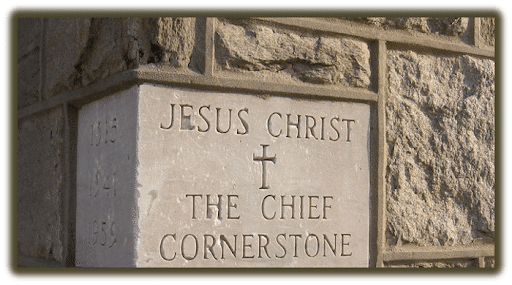
Jesus Is the Cornerstone (Psalm 118:1-2, 14-24)

Give thanks to the Lord, for he is good;
    his love endures forever.

Let Israel say:
    “His love endures forever….”

The Lord is my strength and my defense;
    he has become my salvation.

Shouts of joy and victory
    resound in the tents of the righteous:
“The Lord’s right hand has done mighty things!
    The Lord’s right hand is lifted high;
    the Lord’s right hand has done mighty things!”
I will not die but live,
    and will proclaim what the Lord has done.
The Lord has chastened me severely,
    but he has not given me over to death.
Open for me the gates of the righteous;
    I will enter and give thanks to the Lord.
This is the gate of the Lord
    through which the righteous may enter.
I will give you thanks, for you answered me;
    you have become my salvation.

The stone the builders rejected
    has become the cornerstone;
the Lord has done this,
    and it is marvelous in our eyes.
The Lord has done it this very day;
    let us rejoice today and be glad. (New International Version)

Jesus The Cornerstone, by Gloria Ssali, 2016

Indeed, today we rejoice with gladness and celebrate that Christ is risen! Christians have a firm foundation of faith that gives us strength and stability.

Everyone’s life is constructed on some sort of foundational support. If we consider a building, it’s foundation has four cornerstones. For us as people, those stones consist of the body, the mind, the emotions, and the spirit. Each of these stones is holding up the one building of our life, and so therefore, they each need our attention in order to be well maintained.

Physical

Jesus is the

Mental Spiritual

Cornerstone

Emotional

We can neither treat them as if they are different sizes (which then would never hold up the building of our life) nor as of different importance.

For example, if we get a crack in the physical stone of our life, it is insufficient to examine the mental stone and try to repair the crack through positive thinking or mindfulness. Or, if our emotional stone is damaged, it won’t get fixed by focusing on the spirit stone by only praying.

These days, a lot of people have had bad, even traumatic, religious experiences, and so they’ve jettisoned the spirit cornerstone altogether. And as their building begins to collapse, they wonder why this is all happening.

The spirit cornerstone is Jesus. We need him. We need his whole entire life – not just parts of it. Christ is not a tool that we can use and then store in the garage for next time; he’s the whole garage, and the entire hardware store. We can no more set him aside than we can set aside our lungs or our heart.

So, why do so many resist facing the cracked and damaged stones? Why resist, or even reject, Jesus? Why do so many Christians want the victory of this Resurrection Day without the hard suffering of Good Friday?

Because we are still coming to grips with what it takes to live into the victory of the Cross – yes, the Cross. There’s no new life without a death. If we want a miracle, we need to die – die to our expectations, dreams, desires, and anything we believe we need, other than Jesus.

The builders rejected the stone because it was too hard. But the reality is that you cannot build on a foundation of marshmallows. Love isn’t actually soft, but hard; it’s permanent, like solid marble; it’s not going anywhere. We need that firm base of love to construct a soul that’s worth living.

Christ’s earthly life had incredible times of miraculous healings, provisions of food and necessities, and relational connections. But that’s only part of it. There was also hardship, adversity, rejection, mockery, torture, abuse, and death. When the Apostle Paul considered it all, he said:

But whatever were gains to me I now consider loss for the sake of Christ. 

What is more, I consider everything a loss because of the surpassing worth of knowing Christ Jesus my Lord, for whose sake I have lost all things.

I consider them garbage, that I may gain Christ and be found in him, not having a righteousness of my own that comes from the law, but that which is through faith in Christ—the righteousness that comes from God on the basis of faith. 

I want to know Christ—yes, to know the power of his resurrection and participation in his sufferings, becoming like him in his death, and so, somehow, attaining to the resurrection from the dead. (Philippians 3:7-11, NIV)

Both suffering and resurrection go together for a spiritually sound life, free of cracks and damage. A new life is fresh, hopeful, and full of promise – and it’s downright hard; there is nothing easy about it. We don’t get to pick and choose which parts of Jesus we want – we must take him wholesale just as he is, the entire thing.

It’s from the person and work of Jesus Christ as our cornerstone – both his cross and resurrection – that a new building is being built into a spiritual house which is the place of hospitality for the entire world.

As you come to him, the living Stone—rejected by humans but chosen by God and precious to him—you also, like living stones, are being built into a spiritual house to be a holy priesthood, offering spiritual sacrifices acceptable to God through Jesus Christ. For in Scripture it says:

“See, I lay a stone in Zion,
    a chosen and precious cornerstone,
and the one who trusts in him
    will never be put to shame.”

Now to you who believe, this stone is precious. But to those who do not believe,

“The stone the builders rejected
    has become the cornerstone,”

and,

“A stone that causes people to stumble
    and a rock that makes them fall.”

They stumble because they disobey the message—which is also what they were destined for.

But you are a chosen people, a royal priesthood, a holy nation, God’s special possession, that you may declare the praises of him who called you out of darkness into his wonderful light. Once you were not a people, but now you are the people of God; once you had not received mercy, but now you have received mercy. (1 Peter 2:4-10, NIV)

Jesus is our cornerstone, the center of life and worship. Our priority as believers, is allowing God to build us into a community of faith that worships Jesus with lives dedicated to knowing him and making him known.

Christian worship is the expression of a relationship in which God the Father reveals himself and his love in Christ, and by his Holy Spirit gives grace, to which we respond in faith, gratitude, obedience, and love to one another and the world. 

People, at their core, exist for worship. Firmly built on Christ the cornerstone, worship becomes less about gaining truth, and more about letting truth gain us and capture us. The more we pay attention to the presence of Jesus Christ through song, prayer, Scripture, and sacrament, the more we will experience the centrality and power of God. Jesus becomes very precious to us when we align ourselves to him as the cornerstone of our faith and worship.

I urge you, brothers and sisters, in view of God’s mercy, to offer your bodies as a living sacrifice, holy and pleasing to God—this is your true and proper worship (Romans 12:1, NIV)

Jesus, as the cornerstone upon which all is supported, means that acceptable worship can happen anywhere. Everywhere can become a sanctuary and a sacred space – home, neighborhood, and marketplace – as well as church. In all these locations, Christian discipleship will prove itself.

Several years ago, a man named Matt had an aunt who had struggled for years to make ends meet. When her health started to decline, she was forced to sell her fifty acres of property to pay for health care. As an act of kindness, Matt traveled to Massachusetts and bought the land from his aunt for the appraised value of $50,000. While exploring the land to see about building a house, he discovered outcroppings of stone ledges.

Matt contracted a geologist, who surveyed the land and informed him the stone was actually Goshen stone, a type of mica used for sidewalks, patios, and landscapes. At the time, it sold for $100 a ton – and Matt had about 24 million tons on the land. The appraised value on the surface was $50,000, but experts estimated that the land was worth up to $2 billion.

Jesus is the precious cornerstone. He is much too valuable to be left in on a piece of property undiscovered. And he’s also much too needed to merely remain in a church building. He’s the cornerstone who has the resurrection power to be the foundation for all the world. So, let’s let him.

Almighty God, who through your only Son Jesus Christ overcame death and opened to us the gate of everlasting life: Grant that we, who celebrate with joy the day of the Lord’s resurrection, may be raised from the death of sin by your life-giving Spirit; through Jesus Christ our Lord, who lives and reigns with you and the Holy Spirit, one God, now and forever. Amen.

Holy Saturday (Psalm 31:1-4, 15-16)

In you, O Lord, I seek refuge;
    do not let me ever be put to shame;
    in your righteousness deliver me.
Incline your ear to me;
    rescue me speedily.
Be a rock of refuge for me,
    a strong fortress to save me.

You are indeed my rock and my fortress;
    for your name’s sake lead me and guide me;
take me out of the net that is hidden for me,
    for you are my refuge….

My times are in your hand;
    deliver me from the hand of my enemies and persecutors.
Let your face shine upon your servant;
    save me in your steadfast love. (New Revised Standard Version)

Holy Saturday is a quiet place sandwiched between the ignominy of the Cross and the celebration of Resurrection – a day of solitude, silence, and stillness. 

This isn’t a particularly popular day. People don’t rave about Holy Saturday. Many Christians haven’t even a thought that this day could have any significance. Yet, this very day has its place in the scheme of the Christian life.

Whenever Christians quickly jump to triumphal language about victory, and speak little-to-nothing about suffering, then we are left with a cheap grace which has been purchased with the counterfeit currency of velocity. 

Today is meant for us to get of our heads and wrap our hearts around the important reality that Jesus Christ was truly and bodily dead in the grave. 

It was real suffering on Good Friday, and it’s a real death on Holy Saturday. There’s no movement. All is silent and still. Jesus is in the solitude of a dark graveyard tomb. 

There’s no getting around this: If we want Resurrection Day with all its celebration and glory, then we cannot circumvent Holy Saturday with its quiet silence and somber sadness. 

Holy Saturday must be observed if we are to experience real and practical freedom from the bondage of shame. And shame is powerful. It keeps a person locked within themselves, alone with their secrets hidden far from others.

Far too often we may try and cope with our shameful words or actions through promising to work harder, pledging to have greater willpower, or complaining that life is unfair. None of this gets to the root of our shame.

Unlike guilt, which our conscience identifies as specific behaviors to repent of, shame is the message of our inner critic who obnoxiously decries that we are somehow flawed, not enough, and inherently lacking intelligence, courage, or volition.

Shame is the insidious mechanism which interprets bad events we experience as the result of our own badness. In other words, we didn’t just do something bad – we ourselves are bad. We reason (wrongly) that if we were good, bad things wouldn’t happen to us.

If that were true, we would need a serious re-interpretation of Jesus, who suffered terribly and was killed. In actuality, he’s lying in a cold grave because of the power of evil in the world, and not because he was personally culpable.

Shame is the vampire who lives in the shadows and feeds on secrets – which is why the posture of shame is to hide our face in our hands. If shame persists, we withdraw from others and experience grinding loneliness. 

Therefore, the path out of shame is to openly name our shame and tell our stories, that is, nailing the stake of vulnerability into the heart of shame, and exposing it to the light, causes it to disintegrate and vaporize.

In contrast to the unhealthy hiding of ourselves within prison walls of shame is seeking refuge and hiding ourselves in God. Even a cursory look at today’s psalm evidences an open and vulnerable person who wants nothing to do with shame. The psalmist unabashedly and without shame is quite forward in presenting his wants to God.

The psalms are meant for repeated use, to be voiced aloud again and again. In doing this simple activity, we shame-proof our lives. God’s face shines upon us and takes away the shadows of shame. It is no coincidence that Jesus forsook the shame of the cross through publicly uttering the words of this psalm: “Into your hands I commit my spirit.” (Luke 23:46)

Unchecked verbal violence will eventually lead to physical violence.

If wordy persecution comes from others, the primary tactic will most likely be shaming the people such persons want to control. Such enemies will frame a justification for violence because the people for whom they are leveling shame are “bad,” even “monsters.” If verbal persecution comes from within, the shame can reach a critical mass of suicidal ideation and perhaps outright attempts at ending one’s life.

We cannot long co-exist with the living death of shame. But the good news is that we don’t have to. Instead, we can live in the strong fortress and the rock of refuge which is God.

The Lord traffics in redeeming mercy and steadfast love, not in the demeaning judgment of shame. We can flee to God and find grace to help us in our time of need. There is no shame in reaching out for help. We all need deliverance from something. It’s a matter of whether we are open to ask for it, or not.

Holy Saturday is here for you to know that Jesus Christ absorbed all of the world’s massive shame, yesterday, on Good Friday. Christ died. And the shame he took on, died with him. It’s no more and will rise no more.

But someone will rise….

Father God, into your hands I commit my spirit – everything I am and all that I hope to be – so that Jesus Christ might be exalted in me through the power of your Holy Spirit. I choose to leave shame where it belongs – nailed to the cross. With your divine enablement, I shall walk in the newness of life through expressing my needs and wants with courage, confidence, and candor. May it be so according to your steadfast love. Amen.