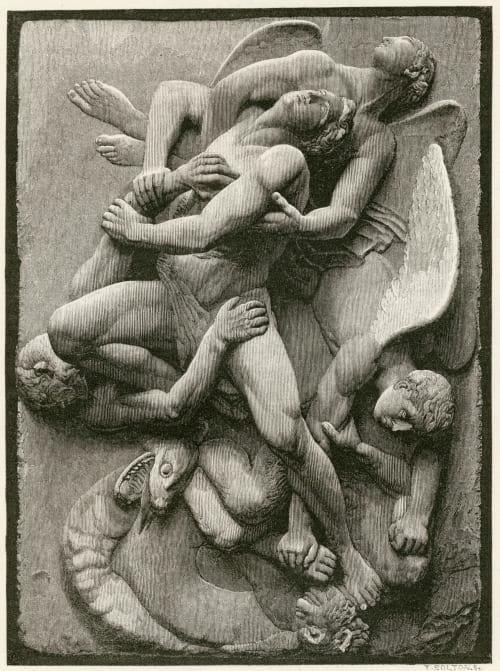
Naming and Forsaking Evil (Psalm 83:1-4, 13-18)

Deliver Us From Evil, by John Flaxman (1755-1826)

God, don’t shut me out;
    don’t give me the silent treatment, O God.
Your enemies are out there whooping it up,
    the God-haters are living it up;
They’re plotting to do your people in,
    conspiring to rob you of your precious ones.
“Let’s wipe this nation from the face of the earth,”
    they say; “scratch Israel’s name off the books.”
And now they’re putting their heads together,
    making plans to get rid of you….

My God! I’ve had it with them!
    Blow them away!
Tumbleweeds in the desert waste,
    charred sticks in the burned-over ground.
Knock the breath right out of them, so they’re gasping
    for breath, gasping, “God.”
Bring them to the end of their rope,
    and leave them there dangling, helpless.
Then they’ll learn your name: “God,”
    the one and only High God on earth. (The Message)

The psalms are the church’s prayer book. Many of the psalms are laments; and many of them are worshipful songs of praise. And there are also the “imprecatory” (pronounced im-PRECK-a-tory) psalms. To “imprecate” means to invoke evil upon someone; it is to pronounce a curse. 

The reason for the imprecatory psalm is that it is not any person’s place to engage in revenge or retaliation. Instead, for people who are genuinely caught in the crosshairs of evil and have sinful persons dogging them, prayer is their most effective recourse; an appeal to God is their best chance at survival and hope.

Sometimes you have to tell it like it is. There’s a time to do your best in putting up a good face and dealing with people who never stop gossiping, slandering, and trying to get their way. But there is also a time to call such behavior “evil” and cry out to God for help.

There are a lot of folks who consider imprecatory psalms a problem because of their detailed expressions of imprecation, of cursing. Yet, such psalms refuse to put a positive spin on malevolent motives, wicked words, and destructive actions.

Desperate people utter desperate prayers. Their unflinching sense of injustice will not allow them to sugarcoat the villainous plans of corrupt people.

Evil is never toppled with tepid prayers from wimpy worshipers. Rather, nefarious agendas are thwarted in the teeth of specific, focused, and intense prayers directed with spiritual precision and passion to the very core of diabolical forces.

We need not be shy about being real with God, even with praying imprecatory prayers. There really are people in this world, maybe even in your own life, that have malicious intent against you or others. Our job is not personal revenge, but to entrust ourselves to the God who fights for the poor, the oppressed, and the needy against the arrogant and the powerful. Let your prayers, then, reflect your life.

Along with psalms of praise lifted during times of celebration, so imprecatory psalms are not to be ignored but need to be uttered equally loud as prayers to almighty God in seasons of desperate evil.

If you have a gut feeling deep down that wicked people are running amok, then use this psalm as a prayer against the darkness which seeks to envelop the earth.

Jesus Christ will build his church and the gates of hell shall not overcome it (Matthew 16:18). The picture Jesus portrayed is one of faithful believers equipped with righteousness and justice storming the gates of hell, not shying away from it. Baked within the Lord’s words were the promise that evil atrocities will not have the day – that God’s people will not be destroyed or overwhelmed because of demonic and satanic power.

There is a time to flee and then there is a time to engage. I am suggesting that the chief way of mitigating evil is to punch it in the mouth with imprecatory psalms prayed with righteous flavor and focused directly against the powers of this present darkness. Why pray, out of all the things we could do, in order to deal with the evil of this world?…

For we do not wrestle against flesh and blood, but against principalities, against powers, against the rulers of the darkness of this age, against spiritual hosts of wickedness in the heavenly places. (Ephesians 6:12, NKJV)

Spiritual problems require spiritual implements to solve. And the tool of imprecatory psalms is a major way of pushing back the dark forces of this world, as well as the means of spiritual assertiveness against all forms of heinous acts and acerbic words from depraved people and evil systems.

God’s wrath is an expression of God’s love – because God is not okay with evil taking root in the lives and institutions of humanity. Prayer is our privilege of coming to the God who upholds justice and righteousness. For if God is for us, who can be against us?

Almighty God, hear me in the day of my trouble and send help from your holy sanctuary and strengthen my faith. Do not let me amble down the path of temptation, but deliver me from the evil one.

Holy Spirit, breathe your enablement into me and inspire me with a passion for goodness, truth, justice, and righteousness.

Lord Jesus be present with me in your risen power and protect me from harm and from everything that hinders your healing presence in this world. You overcame the forces of Satan, redeemed the world, then ascended to the Father.

Blessed Holy Trinity – Father, Son, and Sprit – the God whom I serve: May you be with me and within me; before me and behind me; on my right and on my left; above me and beneath me; and around me always, for the sake of your glory. Amen.


To Be, or Not to Be (Psalm 28)

Only you, Lord,
    are a mighty rock!
Don’t refuse to help me
    when I pray.
If you don’t answer me,
    I will soon be dead.
Please listen to my prayer
    and my cry for help,
as I lift my hands
    toward your holy temple.

Don’t drag me away, Lord,
    with those cruel people,
who speak kind words,
    while planning trouble.
Treat them as they deserve!
    Punish them for their sins.
They don’t pay any attention
    to your wonderful deeds.
Now you will destroy them
    and leave them in ruin.

I praise you, Lord,
    for answering my prayers.
You are my strong shield,
    and I trust you completely.
You have helped me,
and I will celebrate
    and thank you in song.

You give strength
    to your people, Lord,
and you save and protect
    your chosen ones.
Come save us and bless us.
Be our shepherd and always
    carry us in your arms. (Contemporary English Version)

Today’s Psalm, in the Revised Common Lectionary, is alongside the Old Testament story of Joseph and his brothers in the book of Genesis. While out caring for the vast flocks of sheep and goats, Joseph’s brothers hatched a cabal against their younger sibling. They tossed him into an empty cistern (a deep water well) and intended to leave him for dead.

But when a caravan came along, heading to Egypt, the brothers decided on yet another diabolical plan. So, they brought Joseph out of the cistern and sold him into slavery. And, if that weren’t enough, the hateful brothers kept rolling out the devious scheming by making it look like a wild animal killed Joseph, so that they could hide their shameful guilt from Jacob, their father.

So, we are invited to view the psalm from Joseph’s perspective of frustration and agony, crying out to God. Then, praising the Lord for listening and saving his life – even if it meant becoming a servant in a foreign country.

Although becoming a slave was certainly not an ideal situation, Joseph faced a desperate need, even death, and the Lord saved him from it. And Joseph was encouraged and emboldened by the reality that God was with him, no matter where, nor what the situation.

Joseph, along with the original craftsman of the psalm, David, gave praise to God for hearing their prayers. Whereas we may get lost in anger and want retribution, perhaps our orientation is best directed toward offering praise to God for being with us and saving us from certain death.

This raises several questions, at least for me, about being in situations where I experience being heard by God, protected from ultimate harm, yet still left between a-rock-and-hard-place:

  • Can I praise God just for being heard and listened to? 
  • Do I really need to be healed or delivered? Or do I actually need to be delivered from the need for deliverance? 
  • What if I don’t get everything I pray for? Am I expecting to receive something God never promised? 
  • Will I offer praise and thanksgiving, even if God is silent? 
  • Is my joy in a relationship with God either conditional, or unconditional?

William Shakespeare’s Hamlet (c.1601 C.E.) put the question this way: “To be, or not to be, that is the question.” Hamlet’s soliloquy went on to say:

“Whether ’tis nobler in the mind to suffer
The slings and arrows of outrageous fortune,
Or to take arms against a sea of troubles,
And by opposing end them? To die: to sleep;
No more; and by a sleep to say we end
The heartache and the thousand natural shocks
That flesh is heir to, ’tis a consummation
Devoutly to be wish’d. To die, to sleep;
To sleep: perchance, to dream: ay, there’s the rub;
For in that sleep of death what dreams may come
When we have shuffled off this mortal coil,
Must give us pause: there’s the respect
That makes calamity of so long life;
For who would bear the whips and scorns of time,
The oppressor’s wrong, the proud man’s contumely,
The pangs of despised love, the law’s delay,
The insolence of office and the spurns
That patient merit of the unworthy takes,
When he himself might his quietus make
With a bare bodkin [knitting needle]?”

Like Joseph left for dead in an empty cistern, Hamlet was miserable and burdened with a profound lack of power to change his circumstances. So, he reflected on life and death in a morbid and melancholy way. It’s not that Hamlet had suicidal ideation, as much as he meditated on what life truly is, and tried to find some meaning within it.

Unlike Joseph, Hamlet cannot find the courage to deal with his frustration and feels stymied with fear of the unknown. He became lost in the injustice of it all.

If we are blatantly honest with ourselves, we much too often have a particular outcome in mind that we want or expect God to do. 

Our hopes become tethered to God doing something extremely specific so that, if it does not come to pass, or does not come quickly, or doesn’t happen as we want, then discouragement, disillusionment, and even depression may settle down in our souls like a lead weight. 

Like Hamlet, we become lost in the shadows of our thinking and ponder some sort of escape.

So, here is another set of questions I am asking myself: 

  • If my adverse circumstances do not change, can I praise God anyway? 
  • Can I, like David, take joy in simply being heard? 
  • Can I find gratitude in all situations? 
  • Do I only express thanks and praise to God when things are going my way? 
  • Am I open to whatever God wants to do in my life, even if it is not what I would choose? 
  • Do I feel that I am above having to put up with the wickedness of this world? 
  • Am I expecting heaven on earth, or am I willing to suffer as Jesus did? 

I honestly believe the answers to those questions will largely determine the trajectory of our spiritual development, our emotional maturity, our mental thoughts, and our overall religious experience.

I praise you, O God, in the good and the bad, the easy and the difficult, the failures and the victories. You are Lord over all things. You are my strength and shield in every circumstance. When I am weak, then I am strong. I can do all things through Christ who strengthens me. Amen.

Remember God, for God Has Remembered Us (Psalm 105:1-11, 45b)

Give thanks to the Lord;
    call upon his name;
    make his deeds known to all people!
Sing to God;
    sing praises to the Lord;
    dwell on all his wondrous works!
Give praise to God’s holy name!
    Let the hearts rejoice of all those seeking the Lord!
Pursue the Lord and his strength;
    seek his face always!
Remember the wondrous works he has done,
    all his marvelous works, and the justice he declared—
    you who are the offspring of Abraham, his servant,
        and the children of Jacob, his chosen ones.

The Lord—he is our God.
    His justice is everywhere throughout the whole world.
God remembers his covenant forever,
    the word he commanded to a thousand generations,
        which he made with Abraham,
        the solemn pledge he swore to Isaac.
God set it up as binding law for Jacob,
    as an eternal covenant for Israel,
    promising, “I hereby give you the land of Canaan
    as your allotted inheritance….”

Praise the Lord! (New Revised Standard Version)

Human thoughts and actions respond to divine thoughts and actions. We remember because God remembers. We act because God acts in history. We give because the Lord first gave to us.

The psalmist calls us to act and to think – and it’s all a response to God’s merciful attention to God’s people. Notice the imperative verbs which call us to use our words, emotions, and actions, so that we press spiritual truth into our minds and hearts, and do not forget our experiences. They all, from a Christian perspective, have their fulfillment in the person and work of Jesus.

Give thanks to the Lord

Give thanks in all circumstances; for this is God’s will for you in Christ Jesus. (1 Thessalonians 5:18, NIV)

Make known God’s deeds

“Righteous Father, though the world does not know you, I know you, and they know that you have sent me. I have made you known to them, and will continue to make you known in order that the love you have for me may be in them and that I myself may be in them.” (John 17:25-26, NIV)

Sing praises to the Lord

For I tell you that Christ has become a servant of the Jews on behalf of God’s truth, so that the promises made to the patriarchs might be confirmedand, moreover, that the Gentiles might glorify God for his mercy. As it is written:

“Therefore I will praise you among the Gentiles;
    I will sing the praises of your name.”

Again, it says,

“Rejoice, you Gentiles, with his people.” (Romans 15:8-10, NIV)

Dwell on God’s works

Let the message of Christ dwell among you richly as you teach and admonish one another with all wisdom through psalms, hymns, and songs from the Spirit, singing to God with gratitude in your hearts. (Colossians 3:16, NIV)

Give praise to God’s holy name

Now on his way to Jerusalem, Jesus traveled along the border between Samaria and Galilee. As he was going into a village, ten men who had leprosy met him. They stood at a distance and called out in a loud voice, “Jesus, Master, have pity on us!”

When he saw them, he said, “Go, show yourselves to the priests.” And as they went, they were cleansed.

One of them, when he saw he was healed, came back, praising God in a loud voice. He threw himself at Jesus’ feet and thanked him—and he was a Samaritan.

Jesus asked, “Were not all ten cleansed? Where are the other nine? Has no one returned to give praise to God except this foreigner?” Then he said to him, “Rise and go; your faith has made you well.” (Luke 17:11-19, NIV)

Pursue the Lord

Flee the evil desires of youth and pursue righteousness, faith, love and peace, along with those who call on the Lord out of a pure heart. (2 Timothy 2:22, NIV)

Seek God’s face

And without faith it is impossible to please God because anyone who comes to him must believe that he exists and that he rewards those who earnestly seek him. (Hebrews 11:6, NIV)

Remember God’s works and God’s justice

“Why do you look for the living among the dead? He is not here; he has risen! Remember how he told you, while he was still with you in Galilee: ‘The Son of Man must be delivered over to the hands of sinners, be crucified and on the third day be raised again.’” (Luke 24:5-7, NIV)

We are to remember because God remembers. The Lord has an ongoing reminder in the divine day timer: Fulfill the promises I made. Keep the covenant I initiated with the people, even when they are stinkers and forget who I am.

God does not forget. The Lord keeps divine promises.

For the Christian, all God’s promises are remembered and fulfilled in the person and work of Jesus Christ.  Deliverance from sin, death, and hell; the gift of the Holy Spirit; and, ongoing divine presence and provision are given to us graciously and freely by the God who loves and cares for people. 

For Christians everywhere, remembering means coming to the Lord’s Table, entering into the once for all loving sacrifice of Christ on our behalf. It is here that we remember to give thanks and praise, seek and sing. In doing so, we make invisible realities visible, and the divine character of God known to amongst the nations.

God and Father of all, and of Jesus Christ our Lord, as you remember your dear Son, remember us. Grant us peace in our time and a longing for the day when people of every language, race, and nation will be brought into the unity of Christ’s kingdom, where there shall be endless praise, singing, thanksgiving, and joy in the Holy Spirit. This we ask in your holy Name, because of your great glory, and for the sake of Christ’s rule and reign over the earth, now and forever. Amen.

Known by God (Psalm 139:13-18)

You are the one
who put me together
    inside my mother’s body,
and I praise you because of
the wonderful way
    you created me.
Everything you do is marvelous!
    Of this I have no doubt.

Nothing about me
    is hidden from you!
I was secretly woven together
    out of human sight,
but with your own eyes you saw
    my body being formed.
Even before I was born,
you had written in your book
    everything about me.

Your thoughts are far beyond
    my understanding,
much more than I
    could ever imagine.
I try to count your thoughts,
but they outnumber the grains
    of sand on the beach.
And when I awake,
    I will find you nearby. (Contemporary English Version)

We don’t really know God, as much as we are known by God.

And God knows us intimately, down to each individual chromosome in our DNA strand.

For me, the incredible thing about this very detailed knowledge about each one of us is that God still wants to discover even more about us, as well as to be known by us.

Yes, the cosmic Ruler of the universe wants to share in a relationship with you and me – to be known and to know – and delights in the whole process of perceiving us.

Perhaps this is why my highest aspiration in life is to know Christ better. This has been true of me throughout the entirety of my Christian life across the decades. Which is why one of my favorite places in the Bible (which, by the way, is God’s self-revealing knowledge of the divine nature) is from a fellow believer who aims for the same thing:

“Nothing is as wonderful as knowing Christ Jesus my Lord. I have given up everything else and count it all as garbage. All I want is Christ and to know that I belong to him…. All I want is to know Christ and the power that raised him to life. I want to suffer and die as he did, so that somehow I also may be raised to life.” (Philippians 3:8-11, CEV)

This sort of knowing is much more than intellectual understanding or cerebral information; it’s an experiential knowledge that requires the dialogue and interaction of a lived relationship with another. Love is the glue which bonds this kind of reciprocal knowing of two persons. Sheer learning, without love – which fuels relational discovery – is counterproductive.

“All of us know something…. But knowledge makes us proud of ourselves, while love makes us helpful to others. In fact, people who think they know so much don’t know anything at all. But God has no doubts about who loves him.” (1 Corinthians 8:1-3, CEV)

What we know about ourselves is weird and conflicting. Many of us know we are good persons doing good work in the world. And yet, we also know many of the dark places in our hearts, and this knowledge is a source of shame to us.

This was also true of the psalmist. He knew that he was a bundle of contradictions within a single person. However, he was willing to be vulnerable before God, knowing that the Lord sees him completely for who he is – including all of those shadowy places within.

Immaculate Conception Cathedral in Pucallpa, Peru

In fact, God does some of the best divine work in the dark. A masterful weaving of your body and soul was done in the deepest part of your mother’s physical self. Life truly is a hand crafted one-of-a-kind gift, given to us by God.

There are, of course, parts of us we really like – and parts of us we don’t like and maybe even despise – which may cause us to question the goodness and/or care of God by the way we were formed. It’s easy to fixate on what’s wrong, as if we have the right to a particular body. Yet, none of us are owed anything from the Creator.

But, my friend, I ask, “Who do you think you are to question God? Does the clay have the right to ask the potter why he shaped it the way he did? Doesn’t a potter have the right to make a fancy bowl and a plain bowl out of the same lump of clay?” (Romans 9:20-21, CEV)

Today’s psalm suggests to us that each individual human person, you and me, are God’s best work of art. There is no beauty quite like that designed and made by God. Beauty takes our breath away and elicits awe and wonder from us. We are made in the image and likeness of a beautiful God – so beautiful that if we were to actually see God, the sheer beauty would undo us.

God even treasures us at our worst. Although spiritual growth and development is a lifetime project, we don’t engage in it in order for God to take notice and accept us. It isn’t a self-improvement plan. Rather, our spiritual growth is to help us be in a position to know Christ better – just as flower opens to the sun for energy. God delights in spiritually forming us, as well as the creative process in physically making us.

The Lord’s thoughts of us are continual. God is immanently near and close to us. And this is the bedrock foundation of our faith – that we are known by a good God who cares about every hair on our head, or in my case, every molecule of my being.

The psalmist’s God is a God worth getting to know. This is a God who is with us when we fall asleep at night, and who is there when we awake, having kept watch over us throughout the dark after-hours. “I am awake. I’m still with you!” says the Lord as we are greeted for each new day.

So, may you truly know this God who knows you deeply and intimately.

May you come to know and love yourself, just as you are known and loved by God.

And may the grace of Jesus Christ, the love of God the Father, and the abiding encouragement of the Holy Spirit be with you, now and forever. Amen.