All Saints Day (Psalm 34:1-10, 22)

I will praise the Lord at all times;
my mouth will continually praise him.
I will boast in the Lord;
let the oppressed hear and rejoice.
Magnify the Lord with me.
Let us praise his name together.
I sought the Lord’s help and he answered me;
he delivered me from all my fears.
Look to him and be radiant;
do not let your faces be ashamed.
This oppressed man cried out and the Lord heard;
he saved him from all his troubles.
The angel of the Lord camps around
the Lord’s loyal followers and delivers them.
Taste and see that the Lord is good.
How blessed is the one who takes shelter in him.
Fear the Lord, you chosen people of his,
for those who fear him lack nothing.
Even young lions sometimes lack food and are hungry,
but those who seek the Lord lack no good thing…

The Lord rescues his servants;
all who take shelter in him escape punishment. (New English Translation)

In all times and every place throughout history God has specialized in taking imperfect and broken people and transforming their lives. On the Christian Calendar, November 1 is the day each year to remember the saints who have gone before us. This day is meant to be an intentional way of not forgetting the people, friends, and family – as well as long-dead historical saints – who made a significant impact in our spiritual lives.

All Saints Day is more than a focus on extraordinary persons; it highlights the work of ordinary Christians who faithfully lived their lives. We give thanks for the gift of how they lived their faith every day. We also remember that all believers in Jesus are united and connected through the cross.

Remembering is a prominent theme in Holy Scripture. Over one-hundred times we are told to remember God’s covenant and actions on behalf of people; to remember the needy and those less fortunate; and to remember the important people who influenced us in our journey of faith.

Remember your leaders, who spoke the word of God to you.  Consider the outcome of their way of life and imitate their faith. (Hebrews 13:7, NIV)

We are to be inspired now in the present with the actions of faithful saints of the past. They serve as a model of faithfulness, so that we will persevere in our Christian lives and not give up. Through biblical stories of very human persons being used of God, as well as reading biographies of godly people, we can gain motivation for patience and perseverance until Jesus returns.

Who were the people in your life that went out of their way to communicate God’s love to you with both words and actions? Who were those persons who labored behind the scenes in prayer so that you and others would know Jesus? 

If any of those persons are still around, and you know where they are, remember them. Drop them a note. Express to them a simple thank you for their influence in your life. You will not only encourage that person – it will help you remember and re-engage with something in your life you may have forgotten or have just taken for granted for too long.

We are not to live our Christian lives in isolation from others, as if we do not need them. You and I are here today because someone influenced us in the way of Jesus. And we will continue to persevere and thrive in the faith when we remember those who have gone before us and allow those here in the present to journey with us along this road of faith.

Today is all about remembrance. We remember answered prayer and salvation. We recollect the people who gave us the life-giving gospel message in both word and deed. We remember the death of Christ and recall that he said he is coming back.

The psalmist recalled his rescue and pulled it forward into the present so that all God’s worshipers could taste and see that the Lord is good. This is exactly what the Apostle Peter did for a church which needed to recall and remember the mighty acts of God:

Like newborn babies, crave pure spiritual milk, so that by it you may grow up in your salvation, now that you have tasted that the Lord is good. As you come to him, the living Stone—rejected by humans but chosen by God and precious to him—you also, like living stones, are being built into a spiritual house to be a holy priesthood, offering spiritual sacrifices acceptable to God through Jesus Christ. (1 Peter 2:2-5, NIV)

Our memories are accessed through symbols and with taste and sight. God uses symbols to reveal himself to us.  For example, when God wanted to show us the ugliness of sin and the cost of forgiveness, the Lord told the Israelites to kill an animal and sprinkle its blood on their clothing and on the altar.

That sounds awful. Yet, worshipers never walked away from the experience scratching their heads and wondering what it was all about. That’s because they encountered and tasted the drama of sin and redemption. Their senses saw it, felt it, smelled it, and tasted the meat from it. 

Symbols have power. We cannot know God with only our minds; we’re more than brains on a stick. People need ordinary events, like shared meals, that include symbols and rituals. 

Every year faithful Jews gather to remember and re-enact the Passover – the story of how they were enslaved in Egypt, oppressed by Pharaoh, and set free by God.  To this day pious Jews still remember the Passover by eating and drinking together and telling stories.

We need both words and sacraments. Therefore, holidays like Thanksgiving and Christmas involve both verbal expressions of gratitude and love, and particular actions of love in giving gifts and sharing food. Together, it all connects us to God, to one another, and to a history of God’s people. 

Jesus met his disciples in the Upper Room to celebrate Passover together. Jesus energized their time together by filling it with words and symbols of love and redemption. Christ told the disciples about his upcoming death and acted symbolically. “Take and eat – this is my body….  Take this cup – drink from it, all of you.” (Luke 22:7-20)

Rather than sitting around, analyzing the bread, and discussing the wine’s vintage, the disciples ate and drank.  They tasted real food and drink. They also tasted real spiritual food. It’s one thing to speak of God’s presence, and it’s another thing to experience that presence through an ordinary shared ritual of bread and cup.

God is good. Jesus is our Emmanuel, God with us. Christ is present with us through our ritual of fellowship and food. When the sixteenth-century Reformer John Calvin was asked how Jesus is present to us at the Lord’s Supper he explained: “Now if anyone asks me how this takes place I shall not be ashamed to confess that it is a secret too lofty for either the mind to comprehend or my words to declare….  I rather experience it than understand it.”

The taste of bread reminds us of the incarnation of Christ, and Christ’s humiliation and death. The taste of drinking the cup reminds us of the sacrifice of Christ, the drops of blood which Jesus sweated in Gethsemane, and the beatings, floggings, nails, and crown of thorns that caused the bleeding.

Tasting the bread and cup when we celebrate communion reminds us that our sins are forgiven, we are united to Christ, and we are united together. 

There are historical events which are just that. Then, there are past actions which linger with continual results into the present. The incarnation, life, death, resurrection, ascension, and glorification of the Lord Jesus are past redemptive events which continue to exert powerful force into the here and now.

Saints throughout church history have moved the message of Christ along and demonstrated for us that the past lives in the person of Jesus Christ.

Along with them, we proclaim that Christ has died, Christ has risen, Christ is coming again. And God has something planned for those who have gone before us, along with us, so that together we will experience the perfect righteousness of Christ forever. (Hebrews 11:39-40)

We are encouraged through word and sacrament to proclaim the good news of Jesus Christ until he comes again. Let us respond to God’s wooing invitation to eat and drink, to taste and see that the Lord is good through faith, hope, and love. Let us find in God our refuge and strength, our ever-present help.

Soli Deo Gloria

Our Dwelling Place (Psalm 90:1-6, 13-17)

Lord, you have been our dwelling place
    in all generations.
Before the mountains were brought forth
    or ever you had formed the earth and the world,
    from everlasting to everlasting you are God.

You turn us back to dust
    and say, “Turn back, you mortals.”
For a thousand years in your sight
    are like yesterday when it is past
    or like a watch in the night.

You sweep them away; they are like a dream,
    like grass that is renewed in the morning;
in the morning it flourishes and is renewed;
    in the evening it fades and withers…

Turn, O Lord! How long?
    Have compassion on your servants!
Satisfy us in the morning with your steadfast love,
    so that we may rejoice and be glad all our days.
Make us glad as many days as you have afflicted us
    and as many years as we have seen evil.
Let your work be manifest to your servants
    and your glorious power to their children.
Let the favor of the Lord our God be upon us
    and prosper for us the work of our hands—
    O prosper the work of our hands! (New Revised Standard Version)

Out of the 150 psalms we have in the biblical psalter, only this one is attributed to Moses. At Mount Sinai, when God was entering into covenant with the Israelites, the Lord had Moses come up the mountain to receive the Law. Meanwhile, the people began to rebel and became idolatrous.

And God was angry with them – so angry that the Lord was ready to do away with them all, and start from scratch with Moses. Yet, at that time, Moses interceded for the people and implored God saying:

“O Lord, why does your wrath burn hot against your people, whom you brought out of the land of Egypt with great power and with a mighty hand? Why should the Egyptians say, ‘It was with evil intent that he brought them out to kill them in the mountains and to consume them from the face of the earth’? Turn from your fierce wrath; change your mind and do not bring disaster on your people. 

Remember Abraham, Isaac, and Israel, your servants, how you swore to them by your own self, saying to them, ‘I will multiply your descendants like the stars of heaven, and all this land that I have promised I will give to your descendants, and they shall inherit it forever.’” (Exodus 32:11-13, NRSV)

Moses prayed for God to turn and change his mind. And, amazingly, God did.

In a terrible event of the golden calf experience, Moses had the wherewithal to step back and see the larger perspective.

And it is this view of time which governs the prayer of Psalm 90. This psalm sees the transience of human life and the permanence of an eternal God.  From this perspective, we gain wisdom in order to pray as we ought. The center of Moses’ prayer states:

For all our days pass away under your wrath;
    our years come to an end like a sigh.
The days of our life are seventy years
    or perhaps eighty, if we are strong;
even then their span is only toil and trouble;
    they are soon gone, and we fly away.

Who considers the power of your anger?
    Your wrath is as great as the fear that is due you.
So teach us to count our days
    that we may gain a wise heart. (Psalm 90:9-12, NRSV)

Today’s psalm lesson is a genuine prayer that begs for divine wisdom so that we may live with an eternal perspective. Armed with such a view, the psalmist prays for divine mercy so that our lives may be redeemed and we might know joy. And from wisdom and mercy, prayer is offered for divine blessing upon the work of our hands.

God’s presence ought to cause the people’s acknowledgment and obedience. If it doesn’t, then that presence can turn to wrath. This is precisely why we need wisdom to live rightly – to seek the Lord and know the spiritual laws of the universe. Ignorance leads to death, but wisdom to life.

We do not always live as we ought – which is why we need to seek grace and mercy from God. The psalmist trusts that God can redeem times of evil and the darkness of the human heart. The Lord is able to overcome for us what we cannot overcome for ourselves. God can (and will, in God’s own good time) deliver us from our unhealthy spiritual condition.

Moses led the people out of Egyptian slavery. But it was God who delivered the Israelites and was present with them always. Eventually, Moses died because God took him (Deuteronomy 34:5). And, at that time, the people had not yet entered the Promised Land; they were landless and homeless.

God, however, was their true dwelling place; the presence of God was there and continues to be there. The Lord has not taken a vacation. The Lord’s presence and power is still operative in this world. It’s the perspective of eternity.

Home, for the believer, is God. The Lord is our dwelling place, with us no matter where we go. God is the One who keeps redeeming our time, blessing us with joy, and prospering our work.

“O God, Our Help in Ages Past” by Isaac Watts, 1719, verses 1-3

O God, our Help in ages past,
our Hope for years to come,
our Shelter from the stormy blast,
and our eternal Home.

Under the shadow of Thy throne
Thy saints have dwelt secure;
sufficient is Thine arm alone,
and our defense is sure.

Before the hills in order stood,
or earth received its frame,
from everlasting Thou art God,
to endless years the same.

Idolatry Is the Tail Wagging the Dog (Psalm 106:1-6, 19-23)

Praise the Lord!
    O give thanks to the Lord, for he is good,
    for his steadfast love endures forever.
Who can utter the mighty doings of the Lord
    or declare all his praise?
Happy are those who observe justice,
    who do righteousness at all times.

Remember us, O Lord, when you show favor to your people;
    help us when you deliver them,
that we may see the prosperity of your chosen ones,
    that we may rejoice in the gladness of your nation,
    that we may glory in your heritage.

Both we and our ancestors have sinned;
    we have committed iniquity, have done wickedly…

They made a calf at Horeb
    and worshiped a cast image.
They exchanged the glory of God
    for the image of an ox that eats grass.
They forgot God, their Savior,
    who had done great things in Egypt,
wondrous works in the land of Ham,
    and awesome deeds by the Red Sea.
Therefore he said he would destroy them—
    had not Moses, his chosen one,
stood in the breach before him,
    to turn away his wrath from destroying them. (New Revised Standard Version)

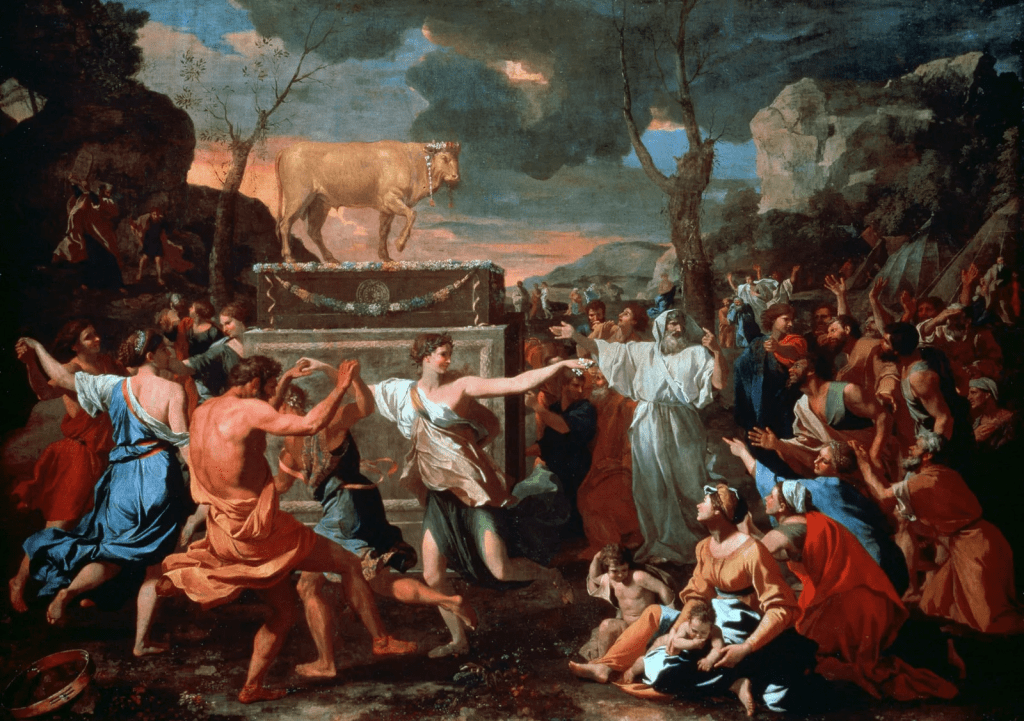
Adoration of the Golden Calf, by Nicolas Poussin (1594-1665)

When it comes to sin, especially the sin of idolatry, it’s imperative that we name it for what it is. It will do no good to fudge on it by saying that so-and-so struggles with it more than me, or that it’s not as bad as assault or murder.

No, we must call sinful idolatry just that, because the problem of idolatry is at the heart of humanity’s spiritual struggle. The first of the Ten Commandments frames it and names it squarely:

“I am the Lord your God who brought you out of slavery; do not worship other gods.” (Exodus 20:2-3, NRSV)

And the second commandment straight up prohibits any manufacturing or worshiping of idols:

“You shall not make for yourself an idol, whether in the form of anything that is in heaven above or that is on the earth beneath or that is in the water under the earth. You shall not bow down to them or serve them….” (Exodus 20:4-5, NRSV)

In the New Testament Gospels, Jesus also drew sharp lines between God and idolatry:

“No one can serve two masters, for a slave will either hate the one and love the other or be devoted to the one and despise the other. You cannot serve God and wealth.” (Matthew 6:24, NRSV)

The early church fathers (and mothers) forsook dependence on anything or anyone other than the one true God. Idolatry is an obsessive and fruitless search to satisfy a legitimate need in an illegitimate manner by giving oneself to someone or something other than the true object of the heart’s longing.

“You have made us for yourself, O Lord, and our heart is restless until it rests in you.”

St. Augustine

None of this means that the material and physical world is somehow bad – that money, possessions, food, books, nature, and other people are objects to avoid – because they are most certainly not! The problem arises whenever we seek to replace God with the things God made, God’s own creation.

By seeking to save our souls and fill the emptiness in our spirits with more and more wealth, or more and better jobs, or more time and expense for reading, or just about any other activity or possession there is, those things which were given for our use and enjoyment and to be stewarded well by us, end up becoming the users and our masters.

Inanimate objects, ideas, and activities begin calling the shots and giving the commands about what we should do and not do. What we own, now owns us. Even the poor can succumb to idolatry through the sin of covetousness by wanting things they do not have in the belief that wealth and possessions will make their lives whole and worthy. But this breaks the tenth commandment:

“You shall not covet your neighbor’s house; you shall not covet your neighbor’s wife, male or female slave, ox, donkey, or anything that belongs to your neighbor.” (Exodus 20:17, NRSV)

Nature and all the earth were formed by the Creator. And, as such, they too, give glory to God and recognize they themselves are not to be worshiped.

The heavens are telling the glory of God,
    and the firmament proclaims his handiwork.
Day to day pours forth speech,
    and night to night declares knowledge. (Psalm 19:1-2, NRSV)

Genuine wealth, prosperity, happiness and peace are found in the Creator of all good things. It is God who will:

  • wipe every tear from our eyes (Isaiah 25:1-9)
  • provide protection and guidance through the hard times of life (Isaiah 54:17)
  • be present with us as we walk through the valley of despair and ascend the mountain of celebration and joy (Psalm 23)

The reason idolatry is so insidious and difficult to name is that our affections are typically on a good thing which God has created and given for us. It’s just that, over time and through an extended process, the tail begins to wag the dog. For example:

  • Humanity serves the Sabbath instead of the Sabbath serving humanity
  • Parishioners venerate a church building instead of the church building being a tool for ministry
  • People are slaves to their hobbies instead of the hobby serving the person
  • Spouses worship one another instead of worshiping the God who brought them together
  • Groups let their traditions hold them with an iron grip, instead of traditions being held loosely by groups

It could (and does) happen to each one of us. And when it does, we need the wisdom and humility to see it for what it has become. Then, confess it as idolatry, and accept the forgiveness which is freely available from the Divine.

Almighty and everlasting God: Not to us, but to your name we give glory, for the sake of your steadfast love and your faithfulness! Yet because of the idolatry in our hearts, we have strayed far from you. We have disobeyed your commandments; we have trusted our own judgement; and we wonder why we feel distant from you. We have worshipped idols of silver and gold—and idols of self and comfort. Forgive us for not loving you as we ought, not obeying you as we were taught, and not trusting that our forgiveness has been bought. Amen.

Facing Our Sadness (Psalm 42)

As a deer longs for a stream of cool water,
    so I long for you, O God.
I thirst for you, the living God.
    When can I go and worship in your presence?
Day and night I cry,
    and tears are my only food;
all the time my enemies ask me,
    “Where is your God?”

My heart breaks when I remember the past,
    when I went with the crowds to the house of God
    and led them as they walked along,
    a happy crowd, singing and shouting praise to God.
Why am I so sad?
    Why am I so troubled?
I will put my hope in God,
    and once again I will praise him,
    my savior and my God.

Here in exile my heart is breaking,
    and so I turn my thoughts to him.
He has sent waves of sorrow over my soul;
    chaos roars at me like a flood,
    like waterfalls thundering down to the Jordan
    from Mount Hermon and Mount Mizar.
May the Lord show his constant love during the day,
    so that I may have a song at night,
    a prayer to the God of my life.

To God, my defender, I say,
    “Why have you forgotten me?
Why must I go on suffering
    from the cruelty of my enemies?”
I am crushed by their insults,
    as they keep on asking me,
    “Where is your God?”

Why am I so sad?
    Why am I so troubled?
I will put my hope in God,
    and once again I will praise him,
    my savior and my God. (Good News Translation)

Sadness. Every human on planet earth knows the feeling. Since we are emotional creatures, profound sadness – even to the point of depression and/or despondency – will happen.

Despite the universal nature of discouragement and tears, many Christians buck the sadness. Far too many believers focus so exclusively on victory in Jesus through his resurrection, ascension, and glorification that they use religion as their denial when unwanted emotions like sadness come banging at the doorstep of their soul.

So, I most emphatically say: Depression is not sin. To be discouraged is not the Enemy. Experiencing sadness is neither wrong nor selfish. Quite the opposite, in fact.

It is necessary to sit with our emotions and feel the breadth and depth of them. Both our spiritual and emotional health come through an awareness and robust engagement with our feelings. To refuse to feel is to put the stiff arm to God.

The psalmist does anything but deny his feelings. He brings them before the Lord and spreads them out before the Divine. Why am I discouraged? Why am I restless? Why the sadness? Could it be that God has forgotten me? Where is the Lord? Is God angry with me? Are my troubles the result of divine wrath?

To blandly say we have never uttered or thought such questions is a telltale sign of denial. The bottom line for many folks is that they do not want to feel these emotions because it complicates their lives. Besides, discouragement and sadness hurt. “Why feel,” we reason, “when it only brings pain?”

Oh my, the avoidance of pain. And there is no pain quite like emotional and spiritual pain. Much like an open wound which needs a liberal application of painful peroxide, our spiritual wounds must sting with the salve of emotional feeling. Healing is neither cheap, easy, nor painless. It typically hurts like hell.

The psalmist’s own pain revolved around feelings of alienation from God, being cut off from fellow worshipers, and harassed by others around him. Understandably, he experienced despondency and loneliness. The psalmist wondered if anyone, including God, even cared what he was going through. In other words, he is desperate for God to show up.

Here’s a simple observation about this psalm: The psalmist did not get any answers to the several questions he posed. He even repeated them, to no avail. The only form of comfort the psalmist received was to remember what God had done in the past. Somehow, someway, this will help with the difficulties of the present.

There are times in life when we must recall what we know about God, ourselves, and others. If the Lord has delivered in the past, God can do it again. If others helped before, perhaps they will be present in the here and now. And just maybe, even likely, you and I will discover a resilient spirit within. We already possess everything we need to not only survive but to grow and thrive in life.

Hope arises from holding the big picture of the past, present, and future together at the same time. When present circumstances are difficult, and it appears we are about to be swallowed up into the now, we must hold the past and future along with it, in careful tension. Then, we shall find the enablement to keep going.

Trust in the future, and a confident expectation of hope is born from the trustworthiness of the past. A prayerful song in our heart will carry us through till our hope is realized.

Almighty and merciful God, you heal the broken-hearted, and turn the sadness of the sorrowful to joy. Let your fatherly goodness be upon all whom you have made. Remember in pity all those who are this day destitute, homeless, elderly, infirm, or forgotten. Bless the multitude of your poor. Lift up those who are cast down.

Mightily befriend innocent sufferers and sanctify to them the endurance of their wrongs. Cheer with hope all who are discouraged and downcast, and by your heavenly grace preserve from falling those whose poverty tempts them to sin. Though they are troubled on every side, suffer them not to be distressed; though they are perplexed, save them from despair. Grant this, O Lord, for the love of him who for our sakes became poor, your Son our Savior Jesus Christ.