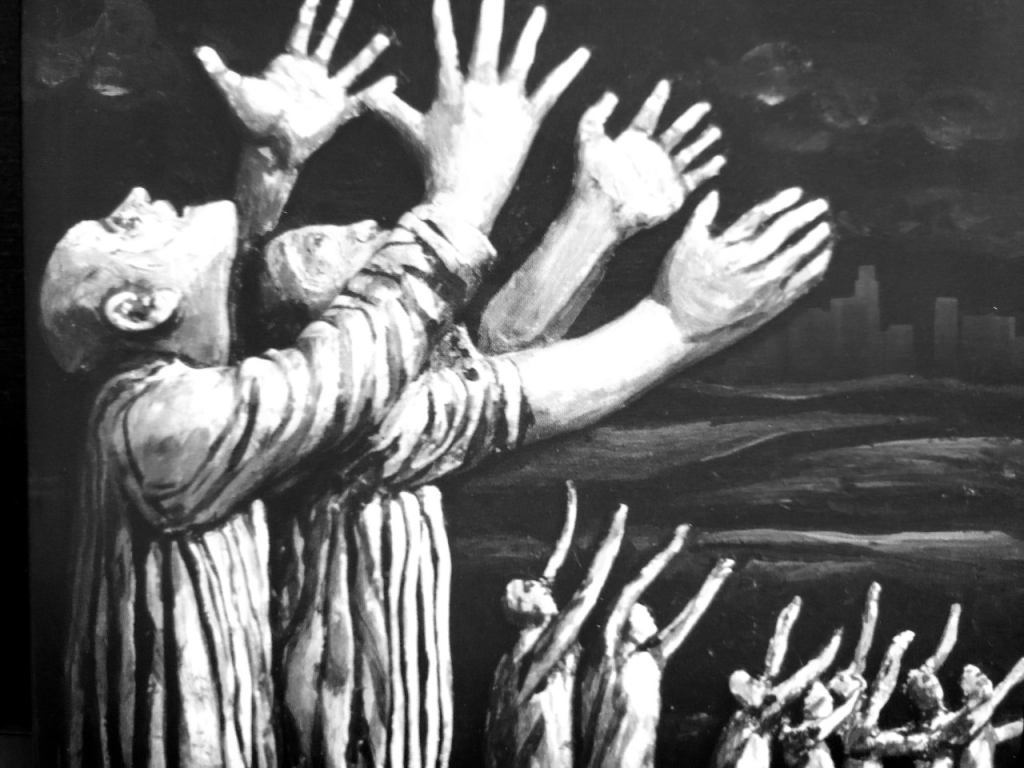
Psalm 6 – Our Tears Find a Better Way

Please, Lord,
    don’t punish me when you are angry;
    don’t discipline me when you are furious.
Have mercy on me, Lord,
    because I’m frail.
Heal me, Lord,
    because my bones are shaking in terror!
My whole body is completely terrified!
        But you, Lord! How long will this last?
Come back to me, Lord! Deliver me!
    Save me for the sake of your faithful love!
No one is going to praise you
    when they are dead.
Who gives you thanks
    from the grave?

I’m worn out from groaning.
    Every night, I drench my bed with tears;
    I soak my couch all the way through.
My vision fails because of my grief;
    it’s weak because of all my distress.
Get away from me, all you evildoers,
    because the Lord has heard me crying!
The Lord has listened to my request.
    The Lord accepts my prayer.
All my enemies will be ashamed
    and completely terrified;
    they will be defeated
    and ashamed instantly. (Common English Bible)

“Don’t ever discount the wonder of your tears. They can be healing waters and a stream of joy. Sometimes they are the best words the heart can speak.”

William Paul Young, The Shack

Sometimes, even oftentimes, our tears find a better way.

It seems as if many folks don’t know this. Whenever someone is distraught, discouraged, or in the throes of despair, the advice given to them is often unhelpful, and even hurtful.

“You just need to be strong,” “Keep your chin up, I’m sure you have a lot to be thankful for,” and “Don’t cry, everything will work out okay,” are statements which betray we are uncomfortable with tears and are unsure what to do with them in others.

It can also be worse than that, with exhortations which only harm and don’t assist. “Dry up those tears or I’ll give you something to really cry about,” “Being sad and depressed like that is a sin, you know,” and “God wants you to be happy, so just put a smile on your face and fake it until you make it,” are a misuse of words and an abuse of language’s power.

So, I say again: Our tears find a better way.

To hold back our tears, to stuff our sadness and grief, does not make it go away. It’s still in there. And, if left there for too long, will come out sideways in harming others or even ourselves.

Whenever we put away our tears, we’re setting aside God’s most powerful means of healing, health, and wholeness. Tears are the conduit of integrating body and soul, where what’s going on inside is expressed on the outside.

Often, you don’t even need words when you have tears. The presence of the tears themselves becomes a form of language. They’re just there, and they are beautiful. Tears are evidence of brokenness, and more importantly, of healing and of strength, not weakness.

Tears are the body’s release valve for stress, sadness, grief, anxiety, and frustration. Like the ocean, tears are saltwater. They protectively lubricate the eyes, remove irritants, and contain antibodies that fight pathogenic microbes.

Dr. William Frey is a biochemist and an expert on human tears at the University of Minnesota. He states that our bodies produce three kinds of tears: reflex, continuous, and emotional. Each kind has different healing roles. Reflex tears allow the eyes to flush noxious particles when they’re irritated by smoke or exhaust. Continuous tears are produced regularly to keep our eyes lubricated and protected from infection.

Emotional tears were the experience of the psalmist. Whereas reflex tears are 98% water, emotional tears contain stress hormones that get excreted from the body through crying. Emotional crying stimulates the production of endorphins – the hormone necessary for happiness and a decrease of pain.

As the only creatures carrying God’s image and likeness within us, humans alone shed emotional tears. And that’s because God cries.

Jesus wept. Real tears. Emotional tears. Tears of genuine feeling and solidarity with the community, lamenting at the death of a dear friend, Lazarus.

“The Teacher is here,” Martha said, “and is asking for you.” When Mary heard this, she got up quickly and went to him. Now Jesus had not yet entered the village but was still at the place where Martha had met him.When the Jews who had been with Mary in the house, comforting her, noticed how quickly she got up and went out, they followed her, supposing she was going to the tomb to mourn there.

When Mary reached the place where Jesus was and saw him, she fell at his feet and said, “Lord, if you had been here, my brother would not have died.”

When Jesus saw her weeping, and the Jews who had come along with her also weeping, he was deeply moved in spirit and troubled. “Where have you laid him?” he asked.

“Come and see, Lord,” they replied.

Jesus wept. (John 11:28-35, NIV)

The Lord Jesus came to the village three days after Lazarus died. He knew exactly what he was about to do: raise Lazarus from the dead in a miraculous resurrection. Yet, he did not come all smiles stating, “Hey, guys, don’t be sad! Watch what I’m going to do!”

No, instead, Christ participated fully in the sisters’ and the community’s grief. Only until he had done this did he proceed to performing the miracle.

The tears, just as much as the resurrection itself, were redemptive.

There was a time, long ago, when the word “loser” meant exactly what the word says – that someone had lost someone. It was a descriptive word recognizing the aching hole in the heart that one experiences from the death of a loved friend or family member.

Now, however, the word “loser” has taken an insidious twist over the years – meaning someone who hasn’t won, somebody who didn’t have what it took to be a winner. It is now a negative term that nobody wants to wear as a moniker, at all.

Perhaps that is one reason why so many people wear plastic smiles, pretend they are strong, and insist on keeping up appearances… And it is killing us with unprecedented numbers of depression, anxiety, and outright despair with nowhere to place it.

Our tears show us a better way. It was the way of the psalmist. It is the way of our Lord. It is the way of life.

You keep track of all my sorrows.
    You have collected all my tears in your bottle.
    You have recorded each one in your book.

Psalm 56:8, NLT

Beloved God, since all communion with You is prayer, my tears are psalms of petition and canticles of praise to You. The prayer You value greatly and always hear is the prayer of my tears; for You are a compassionate and kind God.

Surely, all truly great prayer rises from deep inside and springs spontaneously to the surface in the form of weeping. Perhaps, then, our tears are the purest and best worship of all.

May Your people not be ashamed of their tears; may they flow naturally and freely to You, my Blessed Redeemer. In times of joy or sorrow, blessed be the tears as the holy prayers of our hearts. Amen.


Psalm 6 – Independence Day Celebration or Mourning?

O Lord, do not rebuke me in your anger
    or discipline me in your wrath.
Be gracious to me, O Lord, for I am languishing;
    O Lord, heal me, for my bones are shaking with terror.
My soul also is struck with terror,
    while you, O Lord—how long?

Turn, O Lord, save my life;
    deliver me for the sake of your steadfast love.
For in death there is no remembrance of you;
    in Sheol who can give you praise?

I am weary with my moaning;
    every night I flood my bed with tears;
    I drench my couch with my weeping.
My eyes waste away because of grief;
    they grow weak because of all my foes.

Depart from me, all you workers of evil,
    for the Lord has heard the sound of my weeping.
The Lord has heard my supplication;
    the Lord accepts my prayer.
All my enemies shall be ashamed and struck with terror;
    they shall turn back and in a moment be put to shame. (New Revised Standard Version)

Methinks we Americans, especially on this our national Independence Day, must remember that this has not always been, nor currently is, a day of celebration for a sizable chunk of people in the United States.

Now before you begin offering some mental pushback that I am pouring cold water on a time-honored holiday, or begin believing I’m not a true patriot, I will simply point out that not only is today’s psalm lesson in the Revised Common Lectionary a lament, but also that I’m a guy with two academic degrees in American history.

If we only look at Independence Day from the perspective of white Northern European heritage persons, then it will seem that, speaking like this, I am not grateful for the blessings of being in this incredible country of my birth and the place I’ve lived my entire life.

But I am not looking from that angle today. I choose to acknowledge that on this day, every year for the past 246 years, today’s psalm has been the lived experience and expression of others who looked to the heavens and asked, “How long, O Lord!?”

A true people of compassion are able to suffer with those who suffer. The people of God really ought to be at the forefront of exhibiting empathy and standing in solidarity with suffering folk.

A patriot is one who acknowledges and affirms all it’s citizens, and not only the ones who look like me, talk like me, and act like me. After all, the original documents of the United States made room for this to be so. Empathy, compassion, and solidarity are intentionally built into our nation’s grand experiment of democracy and government.

“We the people of the Unites States, in order to form a more perfect union, establish justice, insure domestic tranquility, provide for the common defense, promote the general welfare, and secure the blessings of liberty to ourselves and our posterity, do ordain and establish this Constitution for the United States of America.”

Preamble of the United States Constitution

The very fact that the previous quotation is true for some, and not for everyone, is a telling testament to the reality that we need to keep striving to live into our heritage as Americans and ensure that welfare for the common good of all citizens is continually sought, even if done so imperfectly.

Grieving, tears, and lament was the response of the former slave Frederick Douglass.

“The rich inheritance of justice, liberty, prosperity and independence, bequeathed by your [white] fathers, is shared by you, not by me. The sunlight that brought light and healing to you, has brought stripes and death to me [a black man]. This Fourth July is yours, not mine. You may rejoice, I must mourn.”

Frederick Douglass, “What to the Slave is the 4th of July?” (An oration on July 4, 1852)

Mourning and weeping was and continues to be the experience of many Native American peoples.

“While the United States and its settlers claimed its independence from Great Britain, this came at a cost of others, including this land’s Indigenous Peoples that were stolen from their own homelands. This patriotic holiday is nothing to celebrate because freedom cannot come at the cost of another’s freedom. America’s Independence Day is a celebration of imperialism, genocide, and American exceptionalism, and there is no pride in genocide.”

Daisee Francour (Oneida Nation of Wisconsin)

We cannot change history, but we can work towards a better future where all of our rights are respected and we all experience freedom and independence equally. Those with non-European ancestry who today in our nation experience racism and anti-ethnic aggression need to be acknowledged and affirmed as Americans with equal standing and an equal voice alongside the white population.

So, I would argue that both celebration and weeping ought to occur on this day. We should weep for the dreams and lives of indigenous peoples who were destroyed through westward expansion, and even today experience the ongoing effects of cultural genocide.

We ought to acknowledge not only our nation’s blessings, but also our curses which are still seen in exploiting others through envy, greed, sloth, pride, lust, and gluttony.

We, the people of the United States of America, ought to actively seek to live in more simple and less harmful ways. We should offer our voices, not in violent speech and language, but with creative and healing words.

On this American Independence Day, the Church should reaffirm her allegiance and citizenship to Christ and God’s Kingdom and renounce any nationalistic, economic, ethnic, and political divisions which are contrary to the words and ways of Jesus.

All of the citizens of the earth should seek to embrace non-violent, self-sacrificial love on behalf of everyone. Today is an opportunity to affirm that Christ is the Friend of all people, not just some.

No one ought to be wasting away in their grief and languishing in their tears when we have the means to acknowledge their suffering and to do something about it.

Our Father who is in heaven,

uphold the holiness of your name.

Bring in your kingdom

so that your will is done on earth as it’s done in heaven.

Give us the bread we need for today.

Forgive us for the ways we have wronged you,

just as we also forgive those who have wronged us.

And don’t lead us into temptation,

but rescue us from the evil one. (Matthew 6:9-13, CEB)

Psalms 42 & 43 – Longing for Another World

As a deer gets thirsty
    for streams of water,
I truly am thirsty
    for you, my God.
In my heart, I am thirsty
for you, the living God.
    When will I see your face?
Day and night my tears
    are my only food,
as everyone keeps asking,
    “Where is your God?”

Sorrow floods my heart,
    when I remember
leading the worshipers
    to your house.
I can still hear them shout
    their joyful praises.
Why am I discouraged?
Why am I restless?
    I should trust you, Lord.
I will praise you again
because you help me,
    and you are my God.

I am deeply discouraged,
    and so I think about you
here where the Jordan begins
at Mount Hermon
    and at Mount Mizar.
Your vicious waves
    have swept over me
like an angry ocean
    or a roaring waterfall.

Every day, you are kind,
    and at night
you give me a song
as my prayer to you,
    the God of my life.

You are my mighty rock.
    Why have you forgotten me?
Why must enemies mistreat me
    and make me sad?
Even my bones are in pain,
    while all day long
my enemies sneer and ask,
    “Where is your God?”

Why am I discouraged?
Why am I restless?
    I trust you, Lord!
And I will praise you again
because you help me,
    and you are my God…

Show that I am right, God!
Defend me against everyone
    who doesn’t know you;
rescue me from each
    of those deceitful liars.
I run to you for protection.
Why do you turn me away?
Why must enemies mistreat me
    and make me sad?

Send your light and your truth
    to guide me.
Let them lead me to your house
    on your sacred mountain.
Then I will worship
at your altar because you
    make me joyful.
You are my God,
    and I will praise you.
Yes, I will praise you
    as I play my harp.

Why am I discouraged?
Why am I restless?
    I trust you, Lord!
And I will praise you again
because you help me,
    and you are my God. (Contemporary English Version)

Longing is a universal human experience. It is also an integral part of the human condition.

“If we find ourselves with a desire that nothing in this world can satisfy, the most probable explanation is that we were made for another world.”

C.S. Lewis

Before that statement, Lewis spoke of the nature of longing – how all that we experience in this life is not the ultimate object of our desire, of our longing. The beauty and satisfaction we seek:

“was not in them, it only came through them, and what came through them was longing. These things—the beauty, the memory of our own past—are good images of what we really desire; but if they are mistaken for the thing itself they turn into dumb idols, breaking the hearts of their worshipers. For they are not the thing itself; they are only the scent of a flower we have not found, the echo of a tune we have not heard, news from a country we have never yet visited.”

C.S. Lewis, The Weight of Glory

If we follow the path of any pain, any psychological or emotional wounding, it will lead us to this one primal pain: the pain of separation.

That’s because, having been born into this world, we are banished from Paradise and carry the scars of our Edenic estrangement – the separation from God.

Although it may sound counter-intuitive, if we will but embrace this suffering, if we allow it to lead us deep within ourselves, it will take us deeper than any healing this world can offer.

In other words, longing is itself the cure. It is when our hearts break that they become open for the love to come pouring out of it.

The grief we acknowledge and express draws us toward intimacy with the Divine and with others. It brings union, not separation. The problem itself becomes the cure.

“Do not seek for water. Be thirsty.”

Jalāl al-Dīn Muḥammad Rūmī (1207-1273)

The longing for love, belonging, and connection needs to be deeply felt, because it is really the only way of actually loving another. It is in hungering and thirsting – that is, in longing – which leads us to pray and seek to end our separation.

Prayer is the voice we give to our longings.

Naming our sadness for what it is, even our depression, is most necessary. Since we are emotional creatures, profound sadness even to the point of depression and/or despondency will happen.

Yet, despite the universal nature of discouragement, tears, and the longing for better and beauty, many Christians buck the feelings. Far too many believers focus so exclusively on victory in Jesus through his resurrection, ascension, and glorification that they use religion as their denial when unwanted emotions come banging at the doorstep of their soul.

Depression is not sin. To be discouraged is not the Enemy. And our longings are the evidence that this is so. We must sit with our emotions and feel the breadth and depth of them. Both our spiritual and emotional health come through an awareness and robust engagement with our feelings. Refusing to feel is, in reality, putting the stiff arm to God.

The psalmist does anything but deny his feelings. He brings them before the Lord and spreads them out before the Divine. Why am I discouraged? Why am I restless? Why the sadness? Could it be that God has forgotten me? Where is the Lord? Is God angry with me? Are my troubles the result of divine wrath?

To blandly say we have never uttered or thought such questions is a telltale sign of denying our deep longings. The bottom line for many folks is that they do not want to feel discouraged or cry any tears because it complicates their lives. Besides, it hurts!. “Why feel,” we reason, “when it only brings pain?”

Ah, yes, the avoidance of pain. And there is no pain quite like emotional and spiritual pain of separation and longing for things to be different.

Much like an open wound which needs a liberal application of painful peroxide, so our spiritual wounds must sting with the salve of emotional feeling. Healing is neither cheap, easy, nor painless. It typically hurts like hell.

The psalmist’s own pain revolved around feelings of alienation from God, being cut off from fellow worshipers, and harassed by others around him. Understandably, he experienced despondency and loneliness. The psalmist wondered if anyone, including God, even cared what he was going through. In other words, he is desperate for God to show up. So, he prayed as if his life depended on it.

The psalmist did not get answers to his questions. But that was never the point of the asking.

Hope arises from holding the big picture of the past, present, and future together at the same time. When present circumstances are difficult, and it appears we are about to swallowed up into the now, we must hold the past and future along with it, in careful tension.

While we desperately search for a cure, none will be found in this life – at least not in full. We are occasionally and surprisingly graced with glimpses of our deepest longings whenever we experience the kindness of a stranger, an answer to a prayer we uttered years ago, or the peace of an unexpected rest.

Then, our trust reawakens, and we are encouraged to take another step in the long walk of life – a walk in which God is beside us, even if we cannot discern it.

Gracious God, help us to know wonder in our waiting, patience in our wonderings, and a vision of how life is supposed to be lived. May our deepest longing find its satisfaction in you and in the many ways you mercifully hold the world together, through Jesus Christ our Lord. Amen.

Psalm 17 – Prayer in Anxious Times

Listen to what’s right, Lord;
    pay attention to my cry!
Listen closely to my prayer;
    it’s spoken by lips that don’t lie!
My justice comes from you;
    let your eyes see what is right!
You have examined my heart,
    testing me at night.
You’ve looked me over closely,
    but haven’t found anything wrong.
    My mouth doesn’t sin.
But these other people’s deeds?
    I have avoided such violent ways
    by the command from your lips.
My steps are set firmly on your paths;
    my feet haven’t slipped.

I cry out to you because you answer me.
    So tilt your ears toward me now—
    listen to what I’m saying!
Manifest your faithful love in amazing ways
    because you are the one
    who saves those who take refuge in you,
    saving them from their attackers
    by your strong hand.
Watch me with the very pupil of your eye!
    Hide me in the protection of your wings,
        away from the wicked
            who are out to get me,
        away from my deadly enemies
            who are all around me!
They have no pity;
    their mouths speak arrogantly.
They track me down—
    suddenly, they surround me!
    They make their plans to put me in the dirt.
They are like a lion eager to rip its prey;
    they are like a strong young lion lying in wait.

Get up, Lord!
    Confront them!
    Bring them down!
Rescue my life from the wicked—
    use your sword!
Rescue me from these people—
    use your own hands, Lord!
Rescue me from these people
    whose only possession is their fleeting life.
But fill the stomachs of your cherished ones;
    let their children be filled full
    so that they have leftovers enough for their babies.

But me? I will see your face in righteousness;
    when I awake, I will be filled full by seeing your image. (Common English Bible)

This is one of David’s personal psalms of lament. It’s a prayer forged smack in the middle of adversity with unjust adversaries seeking to take his life. 

The psalm is a visceral plea for God to vindicate David and subdue those who wanted to harm him. Today’s psalm is also a heartfelt lament that wickedness exists and often gets its way; it is an expression of grief about the constant threats swirling around David.

There was so much mean and arrogant violence that David prayed God would keep him as the apple of his eye and hide him in the shadow of his wings. 

Indeed, perhaps no better prayer could be said in times when there are people who make untrue accusations and only wish harm to be done to you, that the Lord will keep a continual watchful, focused, and vigilant gaze upon us.

In times when angry simpletons spew their worst and misguided miscreants seek us harm, we need to confidently know: God watches over us with affection and cares for us as a mother hen protects her chicks.

Even before we make the request, neither our predicament nor our hearts are strangers to the Lord. Our human ingenuity and stamina is not enough to overcome intense hardship and adversity. The Lord must be there to help us and to guide our hearts toward the good. Even when the way is painful, later it will bear the fruit of righteousness.

You and I are precious to God. We can run to the Lord when there is trouble. There truly is a benevolent God showing firm commitment to those who seek truth, loving actions, and merciful words. 

When going through a difficult season, in which another or others accuse you of wrongdoing and you know you are innocent, the proper prescription is to pray this very psalm repeatedly at night before bed. For we all know that sleep can be elusive and hard to come by in such difficult circumstances. The palpable stress can make it impossible to tone down the racing thoughts.

Trying to fall asleep through sheer willpower is totally ineffective. Instead, try to stay awake by praying. While it may sound counterintuitive, trying to stay awake through prayer lessens the anxiety around trying to fall asleep. Since falling asleep is an involuntary process, taking our minds off of the task at hand gives the brain the break it needs, and the heart the comfort it needs. 

Perhaps, along with David, you will be able to say that your prayers are answered – that you beheld the face of righteousness and had good sleep. And in the morning, when you awake, you will feel satisfied with having seen the likeness of a God who hears and cares.

Gracious and merciful Lord, you are the holy One who has pity for all our weakness. Put away from us worry and every anxious fear so that at the end of a hard day – in which you saw all of our labor and all our adversities – your compassionate eye will watch over us and your loving hand will hold us as we lay down for rest. And when the night has come, may we receive from you your priceless gift of sleep, through Jesus Christ our Lord. Amen.