How Long, O Lord? (Psalm 13)

No Immediate Relief, by Melani Pyke

How long, O Lord? Will you forget me forever?
    How long will you hide your face from me?
How long must I bear pain in my soul
    and have sorrow in my heart all day long?
How long shall my enemy be exalted over me?

Consider and answer me, O Lord my God!
    Give light to my eyes, or I will sleep the sleep of death,
and my enemy will say, “I have prevailed”;
    my foes will rejoice because I am shaken.

But I trusted in your steadfast love;
    my heart shall rejoice in your salvation.
I will sing to the Lord
    because he has dealt bountifully with me. (New Revised Standard Version)

Faith is more than the mind’s affirmation of theological beliefs. Faith is also visceral, an expression from deep in the gut about what is going on around us. For faith to be truly faith, it needs to hold the whole person, not merely the brain.

Today’s psalm is the reaction of a person of faith to God when the world as they knew it was crumbling and broken. This is a psalm of lament which moves and deepens the faith of the worshiper. When the world around us changes and all seems horribly awry, we understandably become disoriented – we lose our normal bearings and feel confused and lost.

One of the simplest observations we can make about this psalm, along with all psalms of lament, is that, whether the content is ethically pure or not, the words of the psalmist directed toward God reflect the pain and agony of people in the middle of world-shattering circumstances.

In such dire situations, there are no simplistic answers or easy diagnoses of problems. Complicated layers of grief exist, and mere cerebral responses will always fall short of adequately being in the present moment, sitting with emotions, and getting in touch with the gut.

I am leery of folks who quickly affirm trust in God when a terrible event has just occurred. Bypassing the gut and the heart cannot bring a whole person response to that event and will inevitably result in a cheap faith which cannot support the immensity of the situation.

Even worse, it leads to a bootstrap theology where people are expected to pull themselves up in a free-willpower way that is impossible to achieve. Sometimes failure of faith comes not because of a person’s weakness, but because the faith being espoused is not faith, at all.

Biblical faith expresses weakness, need, help, curiosity, and doubt with a healthy dose of emotional flavor and visceral reaction.

If we had just one psalm of lament as an example, that would be enough. Yet, in fact, we have dozens of them, with more sprinkled throughout the entirety of Holy Scripture. We even have a book of the Bible given completely to lamenting a loss, Lamentations, which is a deep reflection of the prophet Jeremiah’s grief.

So, let us now be honest with ourselves and each other. All of us, at one time or another, have given a cry of “How long, O Lord!”

There are times when our prayers seem unheard and unnoticed, as if they only bounce off the ceiling and fall flat. There are hard circumstances which continue to move along unabated with evil seeming to mock us. We long for divine intervention, we long for deliverance, we long for healing – and when it does not come our disappointment and frustration boils over into an unmitigated cry of wondering where God is in all the thick crud.

Whenever a person and/or a group of people are traumatized, not once but over-and-over again, how can we not cry aloud, “How long, O Lord!?”

When despair settles in the spirit, disappointment seeps in the soul, and depression becomes our daily bread, how can we not muster up the voice that yells, “How long, O Lord!?”

Wherever powerful people cause the lives of others to be downtrodden and despised, how can we not scream, “How long, O Lord!?”

When the covert actions of others demean and denigrate, leaving us with private pain which no one sees, how can we not bring forth the words, “How long, O Lord!?”

If you have never uttered this kind of wondering about God, then perhaps a profound disconnect with your own spirit exists. A full-orbed faith names the awful events and situations and sits with the feelings surrounding those events with God.

Psalm 13 is important because it gives us words when the bottom falls out of our lives and everything is upside-down.

This psalm helps us admit that life is not as well-ordered as a simple Sunday School faith may pretend. The psalm acknowledges that life is terribly messy, and the psalmist protests to heaven that this quagmire of injustice is plain unfair. What’s more, this psalm helps move the sufferer to a new place.

God is big enough to handle everything we throw at him — our pain, our anger, our questions, our doubts. Genuine biblical faith is comfortable challenging God. And God is there, listening, even if we cannot perceive it. Just because we might need to endure adversity does not mean there is something wrong with us, or God.

We likely will not get an answer to our “how long?” We will get something else: mercy. Mercy is compassion shown to another when it is within one’s power to punish. If we widen our horizon a bit, we will observe a God who cares:

“The Lord isn’t slow to keep his promise, as some think of slowness, but he is patient toward you, not wanting anyone to perish but all to change their hearts and lives.” (2 Peter 3:9, CEB)

The only thing better than the joy of personal salvation is the joy of many people’s deliverance and collective emancipation. Patience, perseverance, and endurance through hardship will require expressions of faith with words of affirmation along with words of agony. And the psalms help us with both.

Lord God Almighty, I pray for the forgotten and the unseen – the stranger, the outcast, the poor and homeless – may they be remembered and seen by you.

Merciful God, I pray for those who struggle with mental illness, anxiety, depression, and suicidal ideation – may there be resources to help, enough staff employed, and finances given, toward mental health services. May there be basic human kindness available for the hurting.

Compassionate God, I pray for those who wrestle with sorrow – may they know your comfort within the dark thoughts which currently seem to triumph.

Attentive Lord, I pray for the crestfallen and the ones considered fallen by those around them – may they receive your restoration and reconciling grace. Protect them from judgment and shield them with your mercy.

Lord of all creation, I trust in your steadfast love and rely upon your infinite grace. May our tears turn to songs of joy, to the glory of Jesus Christ. Amen.

Praise and Prayer (Psalm 86:11-17)

Teach me your way, Lord,
        so that I can walk in your truth.
    Make my heart focused
        only on honoring your name.
I give thanks to you, my Lord, my God,
    with all my heart,
    and I will glorify your name forever,
    because your faithful love toward me is awesome
    and because you’ve rescued my life
        from the lowest part of hell.

The arrogant rise up against me, God.
    A gang of violent people want me dead.
    They don’t give a thought for you.
But you, my Lord,
    are a God of compassion and mercy;
    you are very patient and full of faithful love.
Come back to me! Have mercy on me!
    Give your servant your strength;
    save this child of your servant!
Show me a sign of your goodness
    so that those who hate me will see it and be put to shame—
        show a sign that you, Lord,
        have helped me and comforted me. (Common English Bible)

Psalms are prayers. And today’s prayer is from David, a guy who knew what it was like to have evil men hate him and pursue taking his life, through no fault of his own. 

I don’t know about you, but, although I have never faced adversity to such a degree as David, I do know something about people who, to put it bluntly, just flat-out hate my guts. It is not a good feeling, and it can be terribly draining emotionally and even spiritually. 

Having disrespectful and rude people who talk behind your back (and sometimes even to your face) is in direct contrast to who God is.

Who is God? What is God’s character?

God is described by David as merciful and gracious, slow to anger and abounding in steadfast love and faithfulness. Whereas insolent people objectify others and do not seek their best interests, God always acts in accord with a basic divine character of love and grace. 

Based upon the nature of God, we can choose to cry out, just like David did, to show us a sign of God’s favor. We can pray for God to provide us with some tangible communication of divine love, given on our level, so that we can grasp and understand it.

For we all, at various points in our life, need help and comfort through hardship and adversity.

Be assured that God hears the cries of the godly. The Lord notices ungodliness and injustice, and will do something about it. 

At the same time we are receiving divine guidance and help, we can trust God to address the insolence that exists around us and toward us.

Why can we trust God? What is the basis of such faith?

Seven times in the psalm, David refers to Yahweh as my Lord. And three times David refers to himself as your servant. This is a relationship – Lord to servant, Creator to creature – and it means the servant can cry out to his Lord and can confidently expect a positive response to his cry.

It is the nature and character of God to be attentive and answer God’s people.

The Lord is merciful and gracious,
    slow to anger and abounding in steadfast love.

Psalm 103:8, NRSV

Because of the divine/human relationship, David can call boldly to God, confident of God’s will and of God’s power to help. The gang of violent people who had it out for David also have no regard for God. So, David is emboldened to pray for divine favor, while at the same time, praying against those that despise him.

Yahweh, the God of David, can deliver us from the lowest parts of hell itself, because God is the expert on deliverance from the worst places that humanity finds themselves in. And so, the Lord is the One who is worthy of praise. Eventually, this reality will ultimately be recognized by all nations.

“Great and amazing are your deeds,
    Lord God the Almighty!
Just and true are your ways,
    King of the nations!
Lord, who will not fear
    and glorify your name?
For you alone are holy.
    All nations will come
    and worship before you,
for your judgments have been revealed.” (Revelation 15:3-4, NRSV)

Praise and petition go together like a hand in a glove. David freely praises God with thanksgiving for the divine character and saving actions – while at the same time, he offers fervent prayer, based upon the understanding that God is good.

David’s impassioned petition is this: Teach me your way, Lord, so that I will walk in truth; and give me an undivided heart to keep on honoring and praising your name. David longed for a completely focused heart on God and God’s will for his life.

“Hear, O Israel: The Lord is our God, the Lord alone. You shall love the Lord your God with all your heart, and with all your soul, and with all your might.” (Deuteronomy 6:4-5, NRSV)

In those times when we feel as if we are between a rock and a hard place, wanting to remain positive, yet also acknowledging life’s crud, we can come to Psalm 86 and adopt it as our own prayer for the day…

Train me, God, to walk straight;
    then I’ll follow your true path.
Put me together, one heart and mind;
    then, undivided, I’ll worship in joyful fear.
From the bottom of my heart I thank you, dear Lord;
    I’ve never kept secret what you’re up to.
You’ve always been great toward me—what love!
    You snatched me from the brink of disaster!
God, these bullies have reared their heads!
    A gang of thugs is after me—
    and they don’t care a thing about you.
But you, O God, are both tender and kind,
    not easily angered, immense in love,
    and you never, never quit.
So look me in the eye and show kindness,
    give your servant the strength to go on,
    save your dear, dear child!
Make a show of how much you love me
    so the bullies who hate me will stand there slack-jawed,
As you, God, gently and powerfully
    put me back on my feet. (The Message)

Good Friday (Psalm 22)

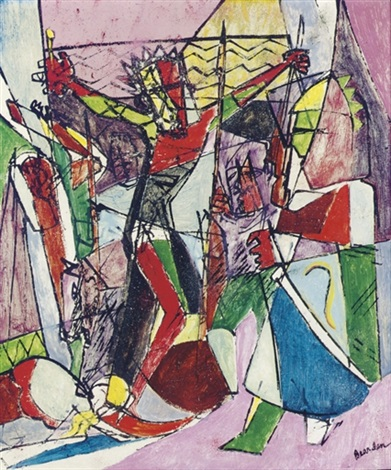
Golgotha – Crucifixion, by Romare Bearden, 1945

My God, my God, why have you forsaken me?
    Why are you so far from helping me, from the words of my groaning?
O my God, I cry by day, but you do not answer;
    and by night but find no rest.

Yet you are holy,
    enthroned on the praises of Israel.
In you our ancestors trusted;
    they trusted, and you delivered them.
To you they cried and were saved;
    in you they trusted and were not put to shame.

But I am a worm and not human,
    scorned by others and despised by the people.
All who see me mock me;
    they sneer at me; they shake their heads;
“Commit your cause to the Lord; let him deliver—
    let him rescue the one in whom he delights!”

Yet it was you who took me from the womb;
    you kept me safe on my mother’s breast.
On you I was cast from my birth,
    and since my mother bore me you have been my God.
Do not be far from me,
    for trouble is near,
    and there is no one to help.

Many bulls encircle me;
    strong bulls of Bashan surround me;
they open wide their mouths at me,
    like a ravening and roaring lion.

I am poured out like water,
    and all my bones are out of joint;
my heart is like wax;
    it is melted within my breast;
my mouth is dried up like a potsherd,
    and my tongue sticks to my jaws;
    you lay me in the dust of death.

For dogs are all around me;
    a company of evildoers encircles me;
they bound my hands and feet.
I can count all my bones.
They stare and gloat over me;
they divide my clothes among themselves,
    and for my clothing they cast lots.

But you, O Lord, do not be far away!
    O my help, come quickly to my aid!
Deliver my soul from the sword,
    my life from the power of the dog!
    Save me from the mouth of the lion!

From the horns of the wild oxen you have rescued me.
I will tell of your name to my brothers and sisters;
    in the midst of the congregation I will praise you:
You who fear the Lord, praise him!
    All you offspring of Jacob, glorify him;
    stand in awe of him, all you offspring of Israel!
For he did not despise or abhor
    the affliction of the afflicted;
he did not hide his face from me
    but heard when I cried to him.

From you comes my praise in the great congregation;
    my vows I will pay before those who fear him.
The poor shall eat and be satisfied;
    those who seek him shall praise the Lord.
    May your hearts live forever!

All the ends of the earth shall remember
    and turn to the Lord,
and all the families of the nations
    shall worship before him.
For dominion belongs to the Lord,
    and he rules over the nations.

To him, indeed, shall all who sleep in the earth bow down;
    before him shall bow all who go down to the dust,
    and I shall live for him.
Posterity will serve him;
    future generations will be told about the Lord
and proclaim his deliverance to a people yet unborn,
    saying that he has done it. (New Revised Standard Version)

Crucifixion, by Romare Bearden, 1947

It’s one thing to be alone because of other’s mocking, yelling, spitting at you, even physically beating you; that, in and of itself, is terribly traumatic. Yet, it’s quite another thing altogether to feel forsaken by one’s God, to experience a deafening divine silence amidst all the human commotion.

There are levels of suffering – and physical suffering is the least of our agony; the experiences of mental, emotional – and I insist, spiritual suffering – is worse than a hundred kidney stones.

“Suffering” is a word many would like to avoid. Simply seeing or hearing the word might make us cringe. Suffering? No thanks. I’ll pass. Yet, something inside us instinctively knows we cannot get around it. Everyone suffers in some way; it’s endemic to the human condition. 

Sometimes, maybe even most times, we are not immediately relieved of suffering because it is meant to have a redemptive purpose to it – that somehow, some way, the awful affliction shall result in eventual blessing to either oneself, another, or perhaps to many.

Miracles are miracles not because they fall from heaven with no connection to what’s happening on this earth. No, miracles occur because of suffering, because something gut-wrenching is happening, because someone or many people are tragically hurt.

Jesus intimately knows suffering, first hand. And he knows what suffering can produce: the deliverance of many.

For Christians everywhere, today is “Good” not because of the pain experienced but because the crucifixion of Jesus Christ means the redemption of the world.

On this Good Friday, followers of Jesus remember and commemorate the events that led up to the cross; unpack those events and interpret them with profound meaning and significance; and worship Jesus with heartfelt gratitude because of the redeeming work of the cross.

It is today that Christians remember the last words of Christ, and recognize the significant impact his death had on the immediate persons around him. Believers also contemplate the lasting results of that singular death as an atoning sacrifice; perfect love; reconciliation between God and humanity; victory over evil; and the redemption of all creation.

For believers, there’s the recognition that something deeply impactful is happening in the egregious suffering of Jesus. Therefore, we acknowledge and remember the anguish of Christ; and also what that horrible torment accomplished.

With such profound meaning, one would think that Good Friday is a hugely observed day for all Christians in every tradition. Yet, for a chunk of churches and Christians, it is not. The cross is not a popular subject. It could be because neither Christian nor non-Christian wants to ponder something so tragically bloody and sad.

“Religious people want visionary experiences and spiritual uplift; secular people want proofs, arguments, demonstrations, philosophy, and science. The striking fact is that neither one of these groups wants to hear about the cross.” 

Fleming Rutledge, The Crucifixion: Understanding the Death of Christ

Indeed, as the Apostle Paul has said, the cross of Christ is “a stumbling block to Jews and folly to Gentiles.” (1 Corinthians 1:23)

A personalized religion which leaves the cross out of the picture (too much violence and sacrifice) might seem appealing, yet will only leave us bereft of the communion of the saints both past and present. Consider the confessional witness of the Church:

Christ suffered “in both body and soul – in such a way that when he sensed the horrible punishment required by our sins ‘his sweat became like great drops of blood falling down on the ground.’ He cried, ‘My God, my God, why have you forsaken me?’ And he endured all this for the forgiveness of our sins. Therefore, we rightly say with the Apostle Paul that we know nothing ‘except Jesus Christ, and him crucified;’ we ‘regard everything as loss because of the surpassing value of knowing Christ Jesus our Lord.’ We find all comforts in his wounds and have no need to seek or invent any other means than this one and only sacrifice, once made, which renders believers perfect forever.”

Belgic Confession, Article 21

And let us consider further the New Testament witness:

“Jesus suffered outside the gate in order to sanctify the people through his own blood. Therefore, let us go forth to him outside the camp, and bear the abuse he endured.” (Hebrews 13:12-13, NIV)

“May I never boast of anything except the cross of our Lord Jesus Christ, by which the world has been crucified to me, and I to the world.” (Galatians 6:14, NRSV)

The extent of Good Friday goes far beyond a day on the calendar; it is the fulcrum upon which all of Christianity hinges.

Because Christ suffered, our suffering has meaning. Each situation of trauma; every case of disease; all suffering, abuse, and hardship makes sense, in the Christian tradition, when they are viewed in solidarity with the cross of Jesus Christ.

So, today, let Christians everywhere contemplate the cross, observe the salvation accomplished through Christ’s death, and offer prayers and petitions for those who need deliverance from the power of evil.

Tuesday of Holy Week (Psalm 71:1-14)

Station 3 of the Stations of the Cross, along the Via Dolorosa in Jerusalem

In you, O Lord, I take refuge;
    let me never be put to shame.
In your righteousness deliver me and rescue me;
    incline your ear to me and save me.
Be to me a rock of refuge,
    a strong fortress to save me,
    for you are my rock and my fortress.

Rescue me, O my God, from the hand of the wicked,
    from the grasp of the unjust and cruel.
For you, O Lord, are my hope,
    my trust, O Lord, from my youth.
From my birth I have leaned upon you,
    my protector since my mother’s womb.
My praise is continually of you.

I have been like a portent to many,
    but you are my strong refuge.
My mouth is filled with your praise
    and with your glory all day long.
Do not cast me off in the time of old age;
    do not forsake me when my strength is spent.
For my enemies speak concerning me,
    and those who watch for my life consult together.
They say, “Pursue and seize that person
    whom God has forsaken,
    for there is no one to deliver.”

O God do not be far from me;
    O my God, make haste to help me!
Let my accusers be put to shame and consumed;
    let those who seek to hurt me
    be covered with scorn and disgrace.
But I will hope continually
    and will praise you yet more and more. (New Revised Standard Version)

Christians take a decided interpretation of seeing Christ in the psalms. For us, we can envision Jesus saying these words of lament in the last days of his earthly life and ministry.

Why lament?

Lament is a significant piece of Lent, and is especially present in these final days of the season, Holy Week. To lament is to offer a public and passionate expression of grief. And it’s not optional but necessary and vital to the Christian experience, not to mention the human condition.

Without lamenting our great losses, our grief comes out sideways, inevitably harming others with our snarky vitriol. Lament gives expression to our deep grief. It enables us to come to grips with what has happened in the past, or happening to us in the present, and within us.

What does it mean to lament?

  • A lament is an expression of personal grief, due to any significant change or loss; it is the normal emotional, spiritual, physical, and relational reaction to that loss.
  • Lamenting is an intentional process of letting go. Relationships, dreams, plans, and people all die. We cannot get them back. Lament helps us find and live into a new identity after the loss or change.
  • Expressing grief through lament is intensely personal; there is no one-size-fits-all. No one else can do our lamentation for us.

How do I lament?

There are many psalms of lament, including our psalm lesson for today. They all have a typical structure to them, including:

  • Addressing God: Crying out for help. Some psalms of lament expand to include a statement of praise or a recollection of God’s intervention in the past. (Psalm 71:1-3)
  • Complaint: Telling God (said with some flavor!) about our problem or experience through a range and depth of emotional, relational, and spiritual reactions to the change or loss. (Psalm 71:4)
  • Confession of Trust: Remaining confident in God despite the circumstances. Beginning to see problems differently. (Psalm 71:5-8)
  • Petition: Proclaiming confidence in God. Appealing to God for deliverance and intervention. Keep in mind that petitioning is not bargaining with God or a refusal to accept loss. Rather, it is a legitimate seeking of help. (Psalm 71:9-13)
  • Words of Assurance: Expressing certainty that the petition will be heard by God. (Psalm 71:14a)
  • Vow of Praise: Vowing to testify in the future to what God will do with praise. (Psalm 71:14b-24)

I encourage and urge you to consider the following spiritual practice in this Holy Week: Set aside some time and craft your own psalm of lament.

Choose an event from your past which created grief for you. It can be recent or from years ago. Using the structure of lament psalms, thoughtfully write out each element as I have outlined it. Then, read it aloud to God. Perhaps even take another step by reading your lament aloud to a trusted family member, friend, or faith leader.

Our grief needs the outlet of lament. Grief which is not expressed ends up sitting heavily in the soul. Eventually, over time, if not acknowledged and spoken aloud, it can easily become putrid and rancid, poisoning our spirit, and compromising our faith.

Sharing your story through lament is biblical, practical, and I insist, necessary. I regularly craft psalms of lament whenever I have events or people who keep sticking with me in my thoughts and in my heart. Here is one example from a few years ago, after a mass shooting in my city:

Lord, in our shock and confusion, we come before you.

In our grief and despair, in the midst of hate,

in our sense of helplessness in the face of violence,

we lean on you. How long, O Lord, must we keep facing this!?

For the families of those who have been killed, we pray.

For the family of the shooter—help us to pray, Lord.

For the communities that have lost members—their anger, grief, fear—we pray.

For the churches striving to be your light in darkness, beyond our comprehension, we pray.

In the face of hatred, may we claim love, Lord.

May we love those far off and those near.

May we love those who are strangers and those who are friends.

May we love those who we agree with and understand,

and even more so, Lord, those who we consider to be our enemies.

Lord, have mercy. Christ, have mercy. Lord, have mercy.

Heal our sin-sick souls, and grant us your peace.

Make these wounds whole, Lord, for you can do it. Amen.