Psalm 121 – The Divine Helper

I lift up my eyes to the hills—
    from where will my help come?
My help comes from the Lord,
    who made heaven and earth.

He will not let your foot be moved;
    he who keeps you will not slumber.
He who keeps Israel
    will neither slumber nor sleep.

The Lord is your keeper;
    the Lord is your shade at your right hand.
The sun shall not strike you by day,
    nor the moon by night.

The Lord will keep you from all evil;
    he will keep your life.
The Lord will keep
    your going out and your coming in
    from this time on and forevermore. (New Revised Standard Version)

Not a one of us gets off this planet without needing help – a lot of help! Even people who are in helping professions or who identify themselves primarily as helpers need help themselves.

There is no such thing as complete, total, and irrevocable independence. We as humans are hard-wired by our Creator for community. We only find our greatest fulfillment within interdependent relationships, and only discover our highest happiness in a dependent relationship to God.

To need others, and especially God, is not a weakness. It’s a sign of sage awareness and confident strength whenever we assess that help is needed. Only the fool goes it alone, believing they can pull themselves up by their bootstraps. “God helps those who help themselves,” was originated by Ben Franklin, not Holy Scripture.

So, the real question is: To whom and to where do we go for help? Who do we consult? With whom do we collaborate?

The most important step any of us can make is to realize that our own personal resources are inadequate, and that we admit, “I need help with this.” The next most important step is to go to the right source for that help.

The psalmist insists that the Lord is our helper, our keeper. Keeping is a large part of helping. God as our Divine Keeper means that the Lord watches over us, guards our lives, and seeks to preserve us from harm, wrongdoing, injustice, and oppression.

The very identity of God is wrapped up in being a Protector, Guard, and Watchkeeper. The Lord shields and shelters us, much like a mother hen over her chicks. God watches over us, just as a watchman keeps guard over a city at night when the residents are sleeping. And since the Lord is everywhere present, there is a continual divine presence in all of our life journeys. The dangers of both the day and the night are no match for the God who is our Keeper.

The promises of safety in today’s psalm are not meant to suggest that those who walk in the shelter of God will never endure harm or that nothing ill will ever befall them. The Psalter knows all too well that the wicked are everywhere and that they thrive unjustly.

Rather, these divine promises are general promises—they are blessings God does for those who rely on the Lord, call upon God’s name, and seek divine help. We are to have a continual awareness of God’s presence in this world. Although we are not inoculated from pain, God is always with us in our hurt and bewilderment.

It can be hard to ask for help. Our pride, stubbornness, and independence might cause us to experience harm rather than seek assistance.

Be specific about the help needed. The following are some “helpful” ways of approaching God by answering some basic newsgathering type questions. The goal isn’t to convince the Lord to help us, but rather to enable us in connecting with what we truly need and being specific about God’s assistance for us or for others:

Who? 

Who needs help? Clarify if the help is for yourself, another, or a group of people.

When Jesus had entered Capernaum, a centurion came to him, asking for help. “Lord,” he said, “my servant lies at home paralyzed, suffering terribly.”

Jesus said to him, “Shall I come and heal him?”

The centurion replied, “Lord, I do not deserve to have you come under my roof. But just say the word, and my servant will be healed. (Matthew 8:5-8, NIV)

How? 

How will God’s action help? God is an expert listener. Tell the story of what you have tried already and where you fall short.

Jesus asked the boy’s father, “How long has he been like this?”

“From childhood,” he answered. “It has often thrown him into fire or water to kill him. But if you can do anything, take pity on us and help us.”

“‘If you can’?” said Jesus. “Everything is possible for one who believes.”

Immediately the boy’s father exclaimed, “I do believe; help me overcome my unbelief!” (Mark 9:21-24, NIV)

Why? 

Why are you soliciting God’s help? Explain what’s going on and the reasons why you believe the Lord is the One to help. Mention the divine attributes and actions of God, as well as your own personal connection.

Then Asa called to the Lord his God and said, “Lord, there is no one like you to help the powerless against the mighty. Help us, Lord our God, for we rely on you, and in your name we have come against this vast army. Lord, you are our God; do not let mere mortals prevail against you.” (2 Chronicles 14:11, NIV)

Where? 

Where is the help needed? Is it a geographical location, a specific spot in the human body, or a place such as a building or home?

Jesus left the synagogue and went to the home of Simon. Now Simon’s mother-in-law was suffering from a high fever, and they asked Jesus to help her. So, he bent over her and rebuked the fever, and it left her. She got up at once and began to wait on them. (Luke 4:37-39, NIV)

When? 

When do you need help? Immediately? Tomorrow? At a specific time?

O Lord, God of my salvation,
    when, at night, I cry out in your presence,
let my prayer come before you;
    incline your ear to my cry.

For my soul is full of troubles,
    and my life draws near to Sheol. (Psalm 88:1-3, NRSV)

What? 

What, exactly, is the need? Spell out what you want in detail, holding nothing back. Don’t be concerned about the words or saying it right. Speak in your own plain language.

Help, O Lord, for the godly are fast disappearing!
    The faithful have vanished from the earth!
Neighbors lie to each other,
    speaking with flattering lips and deceitful hearts.
May the Lord cut off their flattering lips
    and silence their boastful tongues. (Psalm 12:1-3, NLT)

May you find the help you need today and every day, in Jesus’ name. Amen.

Psalm 122 – A Spiritual Journey

I was glad when they said to me,
“Let’s go to the house of the Lord.”
Our feet are standing inside your gates, Jerusalem.
Jerusalem is built to be a city
where the people are united.
All of the Lord’s tribes go to that city
because it is a law in Israel
to give thanks to the name of the Lord.
The court of justice sits there.
It consists of princes who are
David’s descendants.

Pray for the peace of Jerusalem:
“May those who love you prosper.
May there be peace inside your walls
and prosperity in your palaces.”
For the sake of my relatives and friends, let me say,
“May it go well for you!”
For the sake of the house of the Lord our God,
I will seek what is good for you. (God’s Word Translation)

The spiritual life is a pilgrimage—a journey of constant growth, sacrifice, and faith in what we cannot see. As both pilgrims and disciples, we continually move and learn.

The biblical psalms of ascent (Psalms 120-134) were sung by worshipers as they made the journey to Jerusalem for the annual feasts, and up the temple mount to unite together in worship.

Many pilgrims spent hours and/or days walking to the holy city. In the great anticipation of collective worship, the people quoted and sang the several psalms of ascent together. They enjoyed the journey.

I once spent some time reading the journals of several medieval Christian pilgrims who went to various holy sites in Europe, and some who even made the trek all the way to Jerusalem – on foot. Early in their journals, they mostly wrote about the anticipation of reaching their destination. These pilgrims went into great detail about the hospitality they encountered, and friends made along the way.

I was struck, however, with the profound lack of space and detail devoted to visiting the actual holy site – especially when they returned home and reflected on their experiences. The vast majority of pilgrims had the journey itself as their most memorable time.

Of course, we all can worship individually and personally anywhere and anyplace. Yet, if we want to have worship experiences which truly shape our spiritual lives, then we will need to have plenty of corporate encounters with fellow pilgrims on the same path as us.

Within today’s psalm, we are told that part of Israel’s decree in approaching the Lord is to give thanks. The Jewish pilgrims were to have an attitude of gratitude when they came to Jerusalem and the house of God. Each pilgrimage to Jerusalem was to have a marked expression of thanksgiving to God for giving them a place to worship and a land to dwell within.

I cannot help but wonder if attending church services would be much more appreciated and impactful if we took the mental and emotional posture of gratitude when approaching worship. 

Within some church buildings and sacred spaces there is a flight of stairs that one must ascend to reach the sanctuary. Slowly going up the stairs, we can give thanks for one thing in each step. Even if you attend a church with a zero entry, you can still give thanks to God while walking from the parking lot to the building. 

The point is that the worship of God needs some thought and intent behind it. Simply showing up and flopping down in a seat – almost daring the worship leaders and/or pastor to bless them – is far from the imagination the psalmist had for approaching a sovereign God.

Pilgrimage is about more than a long walk. It’s about the soul in community with others and God.

One way of being a pilgrim close to home is through walking a Labyrinth – an ancient practice of the Church meant for spiritual centering, contemplation, and prayer.

Entering the serpentine path of a Labyrinth, one walks slowly while quieting the mind and focusing on a spiritual question or prayer. A Labyrinth is not a maze. It has only one winding path to the center and back out. 

The wisdom of the Labyrinth is that it reflects the way life actually is – that our lives are not about the destination but about the long circuitous journey. The Christian life is consistently described in the New Testament as a road or a way. We walk with Jesus.

Labyrinths can be found within some church buildings, on church grounds, in hospitals, or park spaces. There are also “finger” Labyrinths. Rather than physically walking, the pilgrim can slowly trace the path on a paper or small Labyrinth object with a finger. 

You might also get creative and make your own homemade Labyrinth within a space of your home or out in the yard. labyrinthsociety.org has free printable Labyrinths, as well as a virtual Labyrinth walk.

The Labyrinth is not meant to be a race to the center; it only “works” if we move at a pace which enables us to meditatively pray, paying attention to what God is doing within us. Generally, there are four stages to the walk:

  • Releasing on the way toward the center – letting go of all that weighs us down in the Christian life.  “Let’s throw off any extra baggage, get rid of the sin that trips us up, and fix our eyes on Jesus, faith’s pioneer and perfecter.” (Hebrews 12:1-2, CEB)
  • Receiving in the center – accepting the love God has for you. Jesus said, “Ask and you will receive, so that your joy may be complete.” (John 16:24, NRSV)
  • Returning through following the path back out – integrating what you have received for the life of the world. “I will give them a heart to know me, God. They will be my people and I will be their God, for they will have returned to me with all their hearts.” (Jeremiah 24:7, MSG)
  • Responding to the love of God through gratitude – thus finding joy, even in the most troubling of circumstances. “O give thanks to the Lord, for he is good; his steadfast love endures forever!” (Psalm 118:1, NRSV)

The penitent heart will resonate deeply with the psalms as worship liturgy. This is because liturgical practices impress the spirit and bring spiritual freedom.

Walking together in a common spiritual journey is like going through a gate into a new reality and rejoicing with all the other redeemed pilgrims who are walking the road to Jerusalem.

Lord Jesus Christ, you call me to follow you, and I choose to walk with you. Open the eyes of my heart to see my life in a new way. With each step I take, help me to be open to change. As I walk this pilgrimage, give me the grace to journey deliberately and patiently. Amen.

Psalm 126 – Planting in Tears and Harvesting with Joy

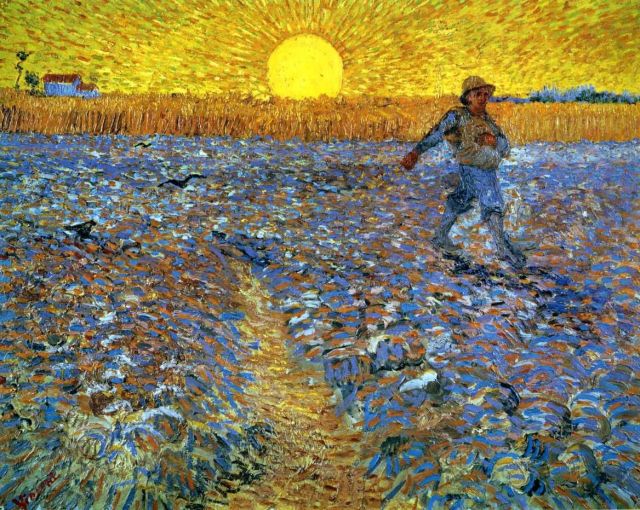
The Sower, by Vincent Van Gogh, 1881

When the Lord brought back his exiles to Jerusalem,
    it was like a dream!
We were filled with laughter,
    and we sang for joy.
And the other nations said,
    “What amazing things the Lord has done for them.”
Yes, the Lord has done amazing things for us!
    What joy!

Restore our fortunes, Lord,
    as streams renew the desert.
Those who plant in tears
    will harvest with shouts of joy.
They weep as they go to plant their seed,
    but they sing as they return with the harvest. (New Living Translation)

Many people are familiar with the phrase, “You reap what you sow.” Although the saying is typically referred to in the context of avoiding poor decisions (Galatians 6:7) the principle is woven throughout Holy Scripture in other scenarios, as well, as it is in today’s psalm.  

Sowing and reaping are, of course, agricultural terms. Farmers and gardeners tend to the soil through tilling, planting, cultivating, weeding, and eventually harvesting. The images of farming and the growth of plants serve as fitting metaphors for the spiritual life. Growth does not occur quickly. Instead, constant and vigilant attention to one’s spirit eventually brings a harvest of good works and godly attitudes. 

Jesus said, “My food is to do what the one who sent me wants me to do. My food is to finish the work that he gave me to do.” (John 4:34, ERV)

In a culture which values immediacy and having things now, the slow growth of the spiritual life can be a difficult principle to grasp. We may think that whenever we sin – with no immediate lightning to zap us – that therefore what we did must not have been so bad. 

Eventually, however, our implanted seeds will sprout and become visible to all. Conversely, we might believe whenever we dedicate ourselves to altruistic service, and then see no immediate results, that we must be doing something wrong. So, we may easily become discouraged and give up.

Sow for yourselves righteousness; reap steadfast love. Break up your fallow ground; for it is time to seek the Lord, that he may come and rain righteousness upon you. (Hosea 10:12, NRSV)

The psalmist reminds us of the need for patience. Just as it takes continual watering to reap a harvest in the field, so the Christian’s life of weeping and tears, of tilling deeply into the things of God, is the necessary work to eventually spot a sprout, see growth, and finally bear fruit. 

The tedious cultivating and weeding of our souls is the task before us. If we are patient and consistent, we will realize a harvest of righteousness. 

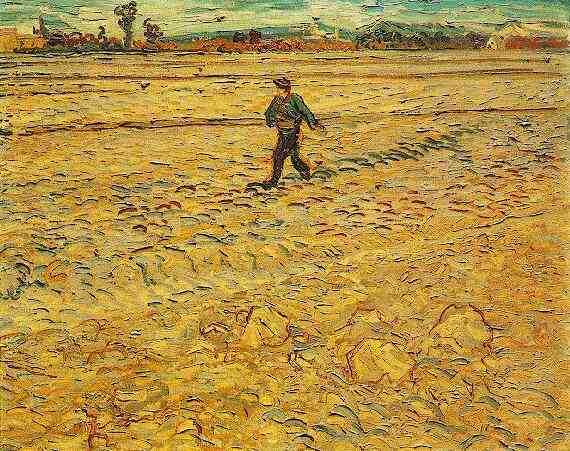
The Sower, by Vincent Van Gogh, 1888

Jesus taught his Beatitudes to help us understand that righteousness, peace, and joy come through connecting with our poverty of spirit; mourning over personal and corporate sin; embracing humility and meekness; hungering and thirsting after righteousness.

Only through the blood, sweat, and tears of spiritual agony will we come through to the deep happiness of seeing the Lord accomplish great things in our lives. In other words, joy is neither cheap nor easy. It is the fruit of many tears.

Spiritual farming involves sound practices of sowing and reaping. There is suffering before glory, tears before joy, lament before healing.

Just as a farmer cannot take short-cuts in the planting and cultivating process if he wants to have a bounteous and delicious harvest, so there is no getting around the painful work of grieving our changes and losses.

Avoiding the hard work of spiritual farming leads to a bogus harvest where we bite into a fresh ear of sweet corn only to discover a mouthful of worms.

Remember this: The person who plants a little will have a small harvest, but the person who plants a lot will have a big harvest.

2 Corinthians 9:6, NCV

The bulk of our lives are played out in the liminal space between sowing and reaping. The farmer plants and waits, attentive to the land and the weather until the time of harvest. We, too, exist in a time of patience. So, we pray, recalling past harvests and anticipate that with God’s good help, we will enjoy abundance.

This in-between time is often characterized by tears.

As she stood behind him at his feet weeping, she began to wet his feet with her tears. Then she wiped them with her hair, kissed them and poured perfume on them. (Luke 7:38, NIV)

I grew up on an Iowa farm. I only saw my father cry twice in my life. The first time, I was just a boy, two days after my eighth birthday – a devastating hailstorm destroyed the crops that had been planted just six weeks before. Despite farm equipment and technological savvy, the farmer is still at the mercy of the weather.

And we will always be at the mercy of God. Because God is good, just, and fair, the Lord does great and benevolent things. To be blessed, we need to embrace the dog days of summer in all its banality and its tears until we reach the time of reaping. There is joy, and it is coming, if we do the work of spiritual farming and wait patiently.

Likely, none of us awake in the morning, sit up on the edge of the bed, and say to ourselves, “Well, let’s see, I think I’ll cry and be sorrowful today.” We might do that with joy, but not with sadness. It can be easier to gravitate toward the fulfillment of dreams, laughter, and happiness than tears and weeping.

Yet, if we want to experience authentic joy, the path to it is through crying because it is our tears which find a better way.

“Normality is a paved road: It’s comfortable to walk, but no flowers grow on it.”

Vincent Van Gogh

Whether it comes from a certain denominational tradition, ethnic background, or family of origin dynamics, there are many Christians who love to emphasize Jesus as Victor and camp in resurrection power – while eschewing Christ as the man of sorrows, acquainted with grief and sadness.

By viewing only one dimension of Christ’s redemptive work, pastoral care often falls far short of true help. Trying to engineer cheerfulness and create solutions to a person’s genuine grief is, at best, not helpful, and at worst, damaging to their soul. It only leads to cheap inauthentic joy.

Sincerely singing spontaneous songs of joy, with a sense of abundant satisfaction, comes through suffering and sorrow. There must be a crucifixion before there is a resurrection. In the agrarian culture of ancient Israel, the metaphor of sowing a reaping connected well to the importance of planting tears and allowing them to flower later into an abundant harvest of joy.

Perhaps in contemporary American culture, a more apt metaphor would be financial investing and cashing out. The investment we put into attending to our grief with expressions of lament through tears, will eventually get a return, and we shall be able to cash out with a rich bounty of joy.

Easter is coming. Resurrection and new life will occur. The journey of Lent, with seeds repentance carefully planted, watered with tears, shall bring an abundant harvest of joy.

Gratias Deo. Thanks be to God.

Psalm 120 – Gaslighting Trouble

Ingrid Bergman and Charles Boyer in the 1944 film, “Gaslight”

I’m in trouble. I cry to God,
    desperate for an answer:
“Deliver me from the liars, God!
    They smile so sweetly but lie through their teeth.”

Do you know what’s next, can you see what’s coming,
    all you bold-faced liars?
Pointed arrows and burning coals
    will be your reward.

I’m doomed to live in Meshech,
    cursed with a home in Kedar,
My whole life lived camping
    among quarreling neighbors.
I’m all for peace, but the minute
    I tell them so, they go to war! (The Message)

I wish we lived in a world where people always speak and live the truth in love, without lying, pretense, or posturing. But we don’t. Not everyone embraces a life of encouraging others through truthful affirmation and selfless acts of service.

In reading today’s psalm, I immediately think of all the patients I’ve seen as a chaplain on my behavioral health unit who have been gaslighted.

“Gaslighting” is a recent term, yet the concept is as old as Satan’s interaction with Adam and Eve in the Garden. The word comes from the 1944 movie, “Gaslight,” starring Charles Boyer and Ingrid Bergman. In the attempt to drive his wife insane, the husband rigs the gaslights of the house so they will flicker at night. Whenever his wife comments on it, her husband flat-out lies and says the lights are not flickering at all. I’ll let you watch the film yourself to see what happens.

A person who “gaslights” uses psychological manipulation to gain and assert control over someone or some group. Gaslighters actively undermine others, using their words against them, plotting nefarious plans for them behind their backs, lying without so much of a blink of an eye, and turning family or friends against someone – all with the insidious agenda of increasing their power over that person and solidifying their dependence from the victim.

All of this gaslighting behavior is done with a smile, said with syrupy words to hook you, rather than help you. That, of course, makes it hard to spot – which is why it is so devilish. If the gaslighter can get you to doubt yourself, your abilities, or your perception of reality, then they can worm themselves into your life and plant their thoughts inside you.

Gaslighters don’t want peace. They want conflict. People at war give them an opportunity to gain more influence and power. Plus, they just plain like to watch others fight amongst themselves. It gives them a sense of control.

Today’s psalm is part of the psalms of ascent – songs used by the community as they walk their pilgrimage to Jerusalem and up the temple mount. The people collectively lament the gaslighting activity of those who oppose and hate them. And they turn to God, who abhors gaslighters, seeking solace and safety from their evil ways.

The gaslighter’s end is certain. They will have to contend with the God who will not be manipulated by anyone. Although it is not our job to punish sinners, it very much is our responsibility to see and avoid gaslighting as much as possible, as well as, God forbid, becoming a gaslighter ourselves. To that end, take note of some of the manipulative marks of gaslighters and patterns of gaslighting:

  • Pitting people against one another. This is done a variety of ways through gossip masked as trying to help, subtle slander, and carefully placed lies.
  • Avoiding responsibility. The gaslighter never owns their words and actions but are experts at blaming others for whatever goes awry.
  • Creating fights and conflicts. Gaslighters chronically avoid the dirty work. They get others riled-up at each other, then sit back and look for an opportunity to seize control over the warring parties.
  • Sucking-up to others. Flattery is a well-worn tool of gaslighters. They are masters at buttering-up people to get what they want.
  • Comparing people. This is just another way of driving a wedge between people. “Why can’t you be like ___?”
  • Mistreating the weak and powerless. The weak have no value for the gaslighter because the powerless have nothing to offer them. So, oppression becomes a means of getting the weak out of the way, like they’re some pesky insect to get rid of.
  • Bragging about accomplishments and stealing other’s. Gaslighters will always take the credit for an accomplishment and then boast about it, all the while badgering the victim.
  • Not keeping promises. Usually there’s a bait and switch where the gaslighter will promise something, then switch the rules or tell a bold-faced lie that they never promised that.

There is much more gaslighting behavior, but you get the drift. The best way to deal with a gaslighter? Get as far away from them as you can, find genuine supportive relationships, and leave them to God.

Today’s psalm can be your prayer to the Lord, offering a heartfelt plea to the Divine Being who does the opposite of gaslighting: strengthening you, giving you power, listening to your voice, and loving you with complete altruistic motives.

Eternal Father, you created us in your own image and likeness, but sin has warped the minds of humanity so that there is much injustice and much carelessness of the rights of other people in this fallen world. I pray you will right every wrong and vindicate those being treated unjustly. Keep us, your people, from trying to take matters into our own hands for vengeance. Give justice and peace to all those who have been cruelly and unfairly treated. May the injustice they have endured be the means to draw them into the saving arms of your grace, through Jesus Christ our Lord. Amen.