Psalm 118:1-2, 19-29 – Gratitude Changes Us

O give thanks to the Lord, for he is good;
    his steadfast love endures forever!

Let Israel say,
    “His steadfast love endures forever….”

Open to me the gates of righteousness,
    that I may enter through them
    and give thanks to the Lord.

This is the gate of the Lord;
    the righteous shall enter through it.

I thank you that you have answered me
    and have become my salvation.
The stone that the builders rejected
    has become the chief cornerstone.
This is the Lord’s doing;
    it is marvelous in our eyes.
This is the day that the Lord has made;
    let us rejoice and be glad in it.
Save us, we beseech you, O Lord!
    O Lord, we beseech you, give us success!

Blessed is the one who comes in the name of the Lord.
    We bless you from the house of the Lord.
The Lord is God,
    and he has given us light.
Bind the festal procession with branches,
    up to the horns of the altar.

You are my God, and I will give thanks to you;
    you are my God, I will extol you.

O give thanks to the Lord, for he is good,
    for his steadfast love endures forever. (NRSV)

Show me a spiritual sourpuss, and I’ll show you a person who lives without daily gratitude toward God and others. But show me a gracious person who liberally gives thanks, and I will show you a person profoundly in touch with God’s steadfast love.

The psalmist chose to give thanks for God’s goodness and faithful love. I wonder how much different each day would be if we began it with the psalmist’s great call to worship: “This is the day the Lord has made; let us rejoice and be glad in it.” 

There is a misguided notion that only certain people have the attitude of gratitude – that some folks are just naturally ornery, and some are just born happy. But the truth is that gratitude and giving thanks is a practice which needs to be carefully cultivated. As it grows and develops, gratitude bears the fruit of joy. 

Thankfulness is a daily decision of faith to have the kind of attitude which pleases God and blesses others.

We now know so much more about the human brain. Research has discovered that the brain is made up of an estimated 100 billion neurons making a total of 100 trillion neural connections. That’s a lot of neural power! Most of those neural pathways are good and healthy. For example, I didn’t have to think about how to tie my shoes this morning because I have a well-developed neural pathway that automatically makes the connection to do it.

However, some of those neural pathways are not good, even unhealthy. There might be connections in our heads which lead to substance abuse when under stress, or to violently lash out when afraid or hurt, or things like plain old procrastination. If you have ever had the experience of telling yourself that you’re not going to respond a particular way, then end up doing it anyway, it is likely you have a well-worn neural pathway which connects certain events to a set of focused actions.

What this all means is that willpower won’t do the trick in changing behavior. That’s because our brains don’t work that way. The good news is that all those neural connections and pathways, like ruts in a gravel road, can fade away and new ones can be developed. Scientists call this “neural plasticity.”

There are practices which can help unhealthy neural connections go away and create new healthy pathways.

One of those practices is gratitude. Giving thanks changes our brain chemistry! Yet, it doesn’t happen overnight. But if we identify three persons or possessions which we are grateful for and say them out loud at least three times a day over the next three months, then we have developed a new neural pathway in our brain.

So, in the future, when we face a stressful event – whereas in the past we might deal with it in an unhealthy way – now our brains reflexively go to a different place and see the situation in a different way than before. And we choose different actions and behaviors.

Readers of this blog know that I continually encourage reading the psalms out loud as prayers to God. If we make this a practice, it will not only change our brains – it will create new spiritual pathways in our souls which fortify us for those times in life when things are tough and hard.

Spiritual practices have a purpose. And when we use those disciplines, we end up developing connections with the Lord which support us and sustain us for a lifetime – not to mention that we become a delight for others to be around instead of being a tedious fart.

Loving God, this is the day you have made; I rejoice in it and am glad that your steadfast love covers all things. Help me to connect every good thing with your gracious hand upon me so that I will not look and act like I was baptized in pickle juice.  To the glory of Jesus Christ, I pray.  Amen.

Psalm 118 – “A Spiritual Pilgrimage”

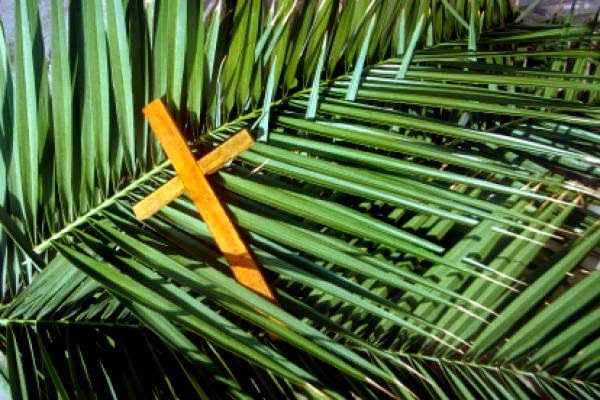
Welcome, friends!  On this Palm Sunday, let us give thanks to the Lord, for he is good; his love endures forever.  Click on the video below to join in the joyful procession….

The following links are for your use and enjoyment:

If you are having any difficulty with the video on this site, you can click TimEhrhardtYouTube to view and listen.

To learn more about the Labyrinth, click How to Walk a Labyrinth for a short guided tour.

Click Give Thanks and allow Filipino singer Janella Salvador to lead you in song.

May we walk and feel the ground of the coming week, that is Holy Week, for it is on this sacred soil that we live and run, work and play, praise and lament.

A Spiritual Pilgrimage

b9793-palm2bsunday

It seems strange sitting here in my home with no anticipation of being around children waving palm leaves.  It feels awkward facing the beginning of Holy Week with the prospect of no physical gatherings of Christian believers.  Perhaps with the exception of this year, every year on Palm Sunday thousands of Christians, from all over the world, gather in the small town of Bethphage, located just two miles outside of Jerusalem – to walk to Jerusalem like Jesus did in his triumphal entry on a donkey.  Many of those pilgrims carry palm and olive branches.  All the people sing hymns as they walk up the Mount of Olives, down into the Kidron Valley, and then up Mount Moriah into the Old City of Jerusalem. It is a worship experience filled with gratitude. “Give thanks to the Lord, for he is good; his steadfast love endures forever!” (Psalm 118:1)

Every year there are others along the pilgrim path appearing out of place for such a joyous journey.  Spread out along the way are Israeli military soldiers wearing full combat gear, carrying automatic weapons over their shoulders and gazing on the spectacle of worshiping Christians before them. Other Israeli Jews look on with a mix of indifference or concern.  Maybe we can imagine that Jesus encountered a similar experience with people laying palm branches along his path; Roman soldiers all around; and, Jews looking on with curiosity.  It might have been easy for Jesus to avoid Jerusalem and not face the cross that he knew was coming at the end of the week.  It might be easy for us to avoid adversity and suffering. Yet, Jesus continued his journey into Jerusalem because of joy and gratitude. Psalm 118 ends like it begins: “O give thanks to the Lord, for he is good, for his love endures forever.”

Joy and gratitude can be our strength in times of adversity.  Yet, it will only come as we join the spiritual pilgrimage.

Psalm 118 is a liturgy for worshipers coming to Jerusalem and the temple from all parts of Israel in order to celebrate Passover.  Like the Christian pilgrims on Palm Sunday, the ancient Jewish worshipers ascended Jerusalem with great anticipation.  They sing of God’s love and remember the deliverance from Egypt and slavery into the freedom of the Promised Land.

The word for “love” throughout Psalm 118 is my favorite word in the Old Testament.  It is a rich word which is difficult to translate in English because the term is so dense with meaning.  The Hebrew word is chesed and the New International Version translates it in various ways:  grace, covenant loyalty, mercy, compassion, kindness, and consistently translated in Psalm 118 as “love.”  It is the kind of love that is graciously given despite whether a person deserves it or not.  It is a steadfast love that holds on and does not let go.

God is a God who consistently gives grace when we fall short; shows unflagging commitment where we are fickle; gives unbounded mercy when we are broken; provides constant compassion when we have been hurt; provides kindness even when we are unkind; and, dispenses enduring love which, for the Christian, finds its ultimate expression in the person of Jesus Christ, our Savior, who embodied “chesed for us so that we might experience life to the full.  Give thanks to the LORD, for he is good; his love endures forever.

We may be under directives to stay at home, yet, we have the gracious opportunity to walk on a spiritual pilgrimage every day to the very heart of God and meet love face to face. How might you and I do that?

Labyrinth

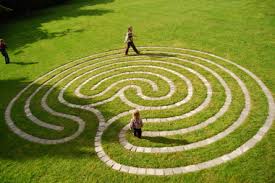
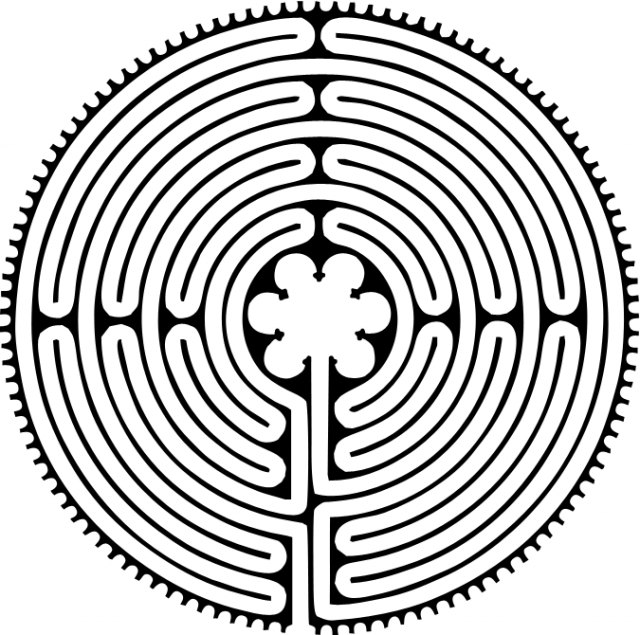
One way is through walking a Labyrinth.  This is an ancient practice of the Church meant for spiritual centering, contemplation, and prayer. Entering the serpentine path of a labyrinth, one walks slowly while quieting the mind and focusing on a spiritual question or prayer.  A labyrinth is not a maze. It has only one winding path to the center and back out.  The wisdom of the Labyrinth is that it reflects life, that is, our lives are not about the destination – life is about the long circuitous journey.  The Christian life is consistently described in the New Testament as a road or a way.  We walk with Jesus.

Although many Labyrinths are typically found within churches, church grounds, or in park spaces (and many or most of these are currently closed) we can utilize “finger” Labyrinths.  Rather than physically walking, you can slowly trace the path with your finger.  You might also get creative and make your own homemade Labyrinth in a space of your home or yard.  Click The Labyrinth Society to get free printable Labyrinths, as well as take a virtual Labyrinth walk.

ChartresLabyrinth

The Labyrinth is not meant to be a race to the center; it only “works” if we move at a pace which enables us to meditatively pray, paying attention to what God is doing within us.  Generally, there are four stages to the walk:

  • Releasing on the way toward the center – letting go of all that weighs us down in the Christian life.  “Let’s throw off any extra baggage, get rid of the sin that trips us up, and fix our eyes on Jesus, faith’s pioneer and perfecter.” (Hebrews 12:1-2, CEB)
  • Receiving in the center – accepting the love God has for you.  Jesus said, “Ask and you will receive, so that your joy may be complete.” (John 16:24, NRSV)
  • Returning through following the path back out – integrating what you have received for the life of the world.  “I will give them a heart to know me, God. They will be my people and I will be their God, for they will have returned to me with all their hearts.” (Jeremiah 24:7, The Message)
  • Responding to the love of God through gratitude – thus finding joy, even in the most troubling of circumstances.  “O give thanks to the Lord, for he is good; his steadfast love endures forever!” (Psalm 118:1, NRSV)

The penitent heart will resonate deeply with the psalms as worship liturgy.  This is because liturgical practices impress the spirit and bring spiritual freedom.  We will only find this odd if we have nothing to repent of.  Turning from sinful liturgies of life and turning to a new liturgy of following Jesus is like walking through a gate into a new reality and rejoicing with all the other redeemed pilgrims who are walking the road to Jerusalem to be with Jesus.  Our Lord himself said,

“I am the gate; whoever enters through me will be saved.  He will come in and go out and find pasture.  The thief comes only to steal and kill and destroy; I have come that they may have life and have it to the full” (John 10:9-10, NIV).

In this time of virtual presence and electronic communication, I take comfort in the reality that we do not need to text or email God and hope he answers – we have the joyous opportunity of walking the pilgrim way and crawling into the lap of God.

Just like everything else, what you put into something is going to affect what you get out of it. If we go into the Labyrinth half-hearted, we will leave half-hearted. If we go into prayer or worship thinking only of the obligation, we will only fulfill the obligation. Yet, if we come ready to meet God, if we come ready to receive his grace, if we come expectantly – Who knows what God can do?

So, let us enter prayer, reading of Scripture, virtual fellowship, and the worship of God each day with the heart of a pilgrim. Let us enter with a song on our lips and joy in our hearts. Let us enter knowing that worship is the place where we connect with the love of God through the Son of God. Let us enter expecting to come out of worship changed, carrying in our hearts the anticipation of great things to happen.