The Day of the Lord (Zechariah 14:1-9)

Art by Larissa Lando

A day of the Lord is coming, Jerusalem, when your possessions will be plundered and divided up within your very walls.

I will gather all the nations to Jerusalem to fight against it; the city will be captured, the houses ransacked, and the women raped. Half of the city will go into exile, but the rest of the people will not be taken from the city. Then the Lord will go out and fight against those nations, as he fights on a day of battle. On that day his feet will stand on the Mount of Olives, east of Jerusalem, and the Mount of Olives will be split in two from east to west, forming a great valley, with half of the mountain moving north and half moving south.You will flee by my mountain valley, for it will extend to Azel. You will flee as you fled from the earthquake in the days of Uzziah king of Judah. Then the Lord my God will come, and all the holy ones with him.

On that day there will be neither sunlight nor cold, frosty darkness. It will be a unique day—a day known only to the Lord—with no distinction between day and night. When evening comes, there will be light.

On that day living water will flow out from Jerusalem, half of it east to the Dead Sea and half of it west to the Mediterranean Sea, in summer and in winter.

The Lord will be king over the whole earth. On that day there will be one Lord, and his name the only name. (New International Version)

Even though people are polarized politically, not on the same page spiritually, and with as many diverse opinions as the grains of sand on a beach, we all seem to agree on one thing: The world is a messed up place.

Indeed, our world in fundamentally broken. There is injustice everywhere. You don’t have to go very far to find corruption. Selfishness abounds. Wars and violence and death proliferate in every corner of the globe. Just watching the evening news can give a person secondary trauma.

The Bible is not aloof to the injustice and human suffering of this old fallen world. Ancient peoples saw their share of hard circumstances and horror. We have difficult passages in Holy Scripture, like today’s Old Testament lesson, because we live in a difficult world.

There is, however, an end to it all. The prophet Zechariah communicated that God shall intervene and personally hold to account the world’s systems, institutions, organizations, communities, nations, and individuals. Because God is Love, the Lord will not put up with systemic evil and wicked hearts forever.

We people are both victims and perpetrators. By God’s grace, whenever we perpetrate injustice, we will become aware of it and seek to make it right through spiritual repentance and personal restitution. And if we don’t, may the Lord have mercy on us.

The Day of the Lord is a phrase referring to God’s divine judgment on this world. The Lord will personally come, according to the prophet Zechariah, to judge the world and establish a gracious and benevolent rule forever. On that day, events shall unfold which have never happened before.

Zechariah, of course, is not the only prophet to foresee the great Day of the Lord coming in power and glory. Notice what a few of the other prophets say:

Wail, for the day of the Lord is near;
    it will come like destruction from the Almighty.
Because of this, all hands will go limp,
    every heart will melt with fear.
Terror will seize them,
    pain and anguish will grip them;
    they will writhe like a woman in labor.
They will look aghast at each other,
    their faces aflame.

See, the day of the Lord is coming
    —a cruel day, with wrath and fierce anger—
to make the land desolate
    and destroy the sinners within it.
The stars of heaven and their constellations
    will not show their light.
The rising sun will be darkened
    and the moon will not give its light.
I will punish the world for its evil,
    the wicked for their sins.
I will put an end to the arrogance of the haughty
    and will humble the pride of the ruthless.
I will make people scarcer than pure gold,
    more rare than the gold of Ophir.
Therefore I will make the heavens tremble;
    and the earth will shake from its place
at the wrath of the Lord Almighty,
    in the day of his burning anger. (Isaiah 13:6-13, NIV)

Alas for that day!
    For the day of the Lord is near;
    it will come like destruction from the Almighty…

The Lord thunders
    at the head of his army;
his forces are beyond number,
    and mighty is the army that obeys his command.
The day of the Lord is great;
    it is dreadful.
    Who can endure it? (Joel 1:15; 2:11, NIV)

“The day of the Lord is near
    for all nations.
As you have done, it will be done to you;
    your deeds will return upon your own head.” (Obadiah 15, NIV)

The great day of the Lord is near—
    near and coming quickly.
The cry on the day of the Lord is bitter;
    the Mighty Warrior shouts his battle cry.
That day will be a day of wrath—
    a day of distress and anguish,
        a day of trouble and ruin,
    a day of darkness and gloom,
        a day of clouds and blackness—
    a day of trumpet and battle cry
against the fortified cities
    and against the corner towers. (Zephaniah 1:14-16, NIV)

The Day of the Lord is the final day of reckoning for those who have stubbornly held to their unjust ways and failed to acknowledge there are better and righteous ways to live and operate in the world. God shall purge the earth of evil.

Just because suffering and wickedness have endured for several millennia, does not mean that God is absent, uncaring, or will do nothing. And just because people (supposedly) get away with being self-centered and calloused toward their fellow humanity, does not mean they won’t have to face the Judge someday.

If you have suffered from a harsh leader, or endured an unjust situation, or seen others you care about crushed by an oppressive system, please understand that God does see it all – and God will vindicate the godly, while holding the ungodly accountable for their wickedness.

It is frustrating, even maddening, to have to put up with injustice day after day. Take heart to neither give up nor give in, because the Lord your God has your back. There is support for today, and justice for tomorrow.

Almighty God, who created humanity in your own image: Grant us grace to fearlessly contend against evil, and to make no peace with oppression. Help us to use our freedom, and employ it in the maintenance of justice among individuals and nations, to the glory of your holy Name, through Jesus Christ our Lord. Amen.

Advent Is Coming (Zechariah 13:1-9)

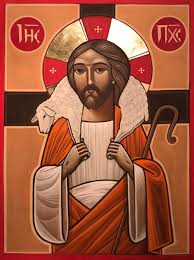
Coptic Church icon of Jesus the Good Shepherd

“On that day a fountain will be opened to the house of David and the inhabitants of Jerusalem, to cleanse them from sin and impurity.

“On that day, I will banish the names of the idols from the land, and they will be remembered no more,” declares the Lord Almighty. “I will remove both the prophets and the spirit of impurity from the land. And if anyone still prophesies, their father and mother, to whom they were born, will say to them, ‘You must die, because you have told lies in the Lord’s name.’ Then their own parents will stab the one who prophesies.

“On that day every prophet will be ashamed of their prophetic vision. They will not put on a prophet’s garment of hair in order to deceive. Each will say, ‘I am not a prophet. I am a farmer; the land has been my livelihood since my youth.’ If someone asks, ‘What are these wounds on your body?’ they will answer, ‘The wounds I was given at the house of my friends.’

“Awake, sword, against my shepherd,
    against the man who is close to me!”
    declares the Lord Almighty.
“Strike the shepherd,
    and the sheep will be scattered,
    and I will turn my hand against the little ones.
In the whole land,” declares the Lord,
    “two-thirds will be struck down and perish;
    yet one-third will be left in it.
This third I will put into the fire;
    I will refine them like silver
    and test them like gold.
They will call on my name
    and I will answer them;
I will say, ‘They are my people,’
    and they will say, ‘The Lord is our God.’” (New International Version)

There’s likely a reason why so many Bible-readers have barely considered, or just never read, the minor prophets of the Old Testament: It’s difficult reading, on several levels.

Yet, the twelve books of the minor prophets, along with the four books of the major prophets, account for a lot of material within Holy Scripture. If we are to understand the whole of the Bible, as well as know God better, we need to contend with what the prophets have to say.

Impurity and cleansing, grace and judgment, idolatry and stabbing, prophets and visions, sheep and shepherds, faith and apostasy, are all part of what seems, on the surface, to be a confusing hodge-podge of verbiage from the prophet Zechariah. Yet, we can still observe the things God cares about.

The Lord promised to rid the land of idols (false gods), (false) prophets, and the spirit of impurity (false righteousness). If God takes out the false prophets, then the people can say good riddance to a false message of leading others toward idolatry and impurity.

The spirit and the message behind false prophets, unholy leaders, and unrighteous teachers, has to do with propagating lies and suppressing truth, so that they can deceive people and manipulate others for their own benefit – leading groups of people away from reality, and into commitments that go nowhere.

This insidious stuff is meant to be taken quite seriously – because it leads to a breakdown in community, a proliferation of injustice, and oppressive spiritual bondage. That’s why we have a rather dramatic picture of parents stabbing a child – not because God likes violence – but to demonstrate that false prophets and their message will damage and destroy a nation, if indulged.

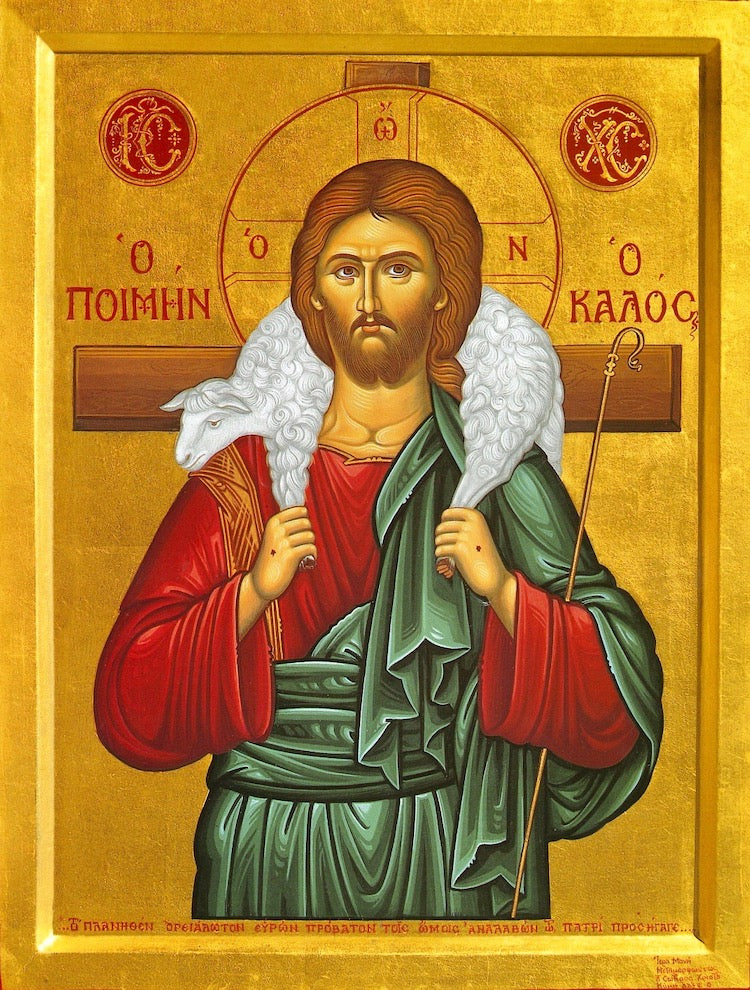
Orthodox icon of Jesus the Good Shepherd

We must always keep in mind and remember that injustice and unrighteousness must always be nipped in the bud (Deuteronomy 13:6-11). Sin, that is, those things which deceive and make false promises that result in a downward spiral toward death, is to be confronted. In the New Testament, Jesus put the matter this way:

If your right eye causes you to stumble, gouge it out and throw it away. It is better for you to lose one part of your body than for your whole body to be thrown into hell. And if your right hand causes you to stumble, cut it off and throw it away. It is better for you to lose one part of your body than for your whole body to go into hell. (Matthew 5:29-30, NIV)

Christ was not advocating a physical maiming of oneself, but rather for us to separate ourself from sin by whatever means necessary. In other words, Jesus was saying that sin isn’t something to be managed, but instead something to eradicate altogether.

Truth matters. Truth brings reality and beauty to light. Falsehood is terrible. To promote that which is false, and perhaps even worse, tolerate it, gives hate and injustice a platform from which to crawl out of the darkness and make the world blind. It would take an awful lot to undo error’s presence.

This is why the shepherd, or maybe, from the Christian perspective, the Christ, is stricken. The Good Shepherd, the one who is truth incarnate, would have to suffer. The injustice and unrighteousness is so foul and degrading that only the pure can undo the impure. And it is all set in motion, not by the forces of darkness, but by God.

God strikes the shepherd, and the sheep scatter. He is not struck because he deserves it – far from it – but because he assumes responsibility for the wrongdoing of others. Father God is the parent who stabs a spear in the side of God the Son.

The ultimate good shepherd of the sheep will die as a heinous offender; and God is the executioner.

In Christ, God put the wrong on him who never did anything wrong, so we could be put right with God.

2 Corinthians 5:21, MSG

This same great shepherd of the sheep, who became the Lamb of God that takes away the sin of the world, is coming again. And he will bring the refining and purifying fire of divine judgment upon the earth.

In this upcoming Advent season, we remember not only that Jesus has come to save the world. We also are reminded that there is yet a second Advent, in which Jesus will come to judge the living and the dead.

Behold, He is coming with clouds, and every eye will see Him, even they who pierced Him. And all the tribes of the earth will mourn because of Him. Even so, Amen.

“I am the Alpha and the Omega, the Beginning and the End,” says the Lord, “who is and who was and who is to come, the Almighty.” (Revelation 1:7-8, NKJV)

Blessed God and Father of our Lord Jesus Christ, preserve us from our own madness. Direct us away from dealing destruction to others; help us to steer clear of paths which lead to the ruin of ourselves and our world.

Protect us. Enable us to hear you. Beloved Jesus, show us your precious face in all others – you in us, and we in each other, from all places. Amen.

Injustice Makes Everything Weird (Zechariah 11:4-17)

This is what the Lord my God says: “Shepherd the flock marked for slaughter. Their buyers slaughter them and go unpunished. Those who sell them say, ‘Praise the Lord, I am rich!’ Their own shepherds do not spare them. For I will no longer have pity on the people of the land,” declares the Lord. “I will give everyone into the hands of their neighbors and their king. They will devastate the land, and I will not rescue anyone from their hands.”

So I shepherded the flock marked for slaughter, particularly the oppressed of the flock. Then I took two staffs and called one Favor and the other Union, and I shepherded the flock. In one month I got rid of the three shepherds.

The flock detested me, and I grew weary of them and said, “I will not be your shepherd. Let the dying die, and the perishing perish. Let those who are left eat one another’s flesh.”

Then I took my staff called Favor and broke it, revoking the covenant I had made with all the nations. It was revoked on that day, and so the oppressed of the flock who were watching me knew it was the word of the Lord.

I told them, “If you think it best, give me my pay; but if not, keep it.” So they paid me thirty pieces of silver.

And the Lord said to me, “Throw it to the potter”—the handsome price at which they valued me! So I took the thirty pieces of silver and threw them to the potter at the house of the Lord.

Then I broke my second staff called Union, breaking the family bond between Judah and Israel.

Then the Lord said to me, “Take again the equipment of a foolish shepherd. For I am going to raise up a shepherd over the land who will not care for the lost, or seek the young, or heal the injured, or feed the healthy, but will eat the meat of the choice sheep, tearing off their hooves.

“Woe to the worthless shepherd,
    who deserts the flock!
May the sword strike his arm and his right eye!
    May his arm be completely withered,
    his right eye totally blinded!” (New International Version)

Injustice makes everything weird. Leaders who treat others with dishonor and disrespect are only looking to take advantage of people for their own selfish purposes. Unfortunately, such leaders try and make their leadership appear as if they care about the people they lead – even though they really don’t. This is what makes a group of people led by a charlatan feel insecure, confused, and unsure about things.

Today’s Old Testament lesson is a rather confusing allegory of ancient Israel’s history. Despite God’s desire to lead the people in righteousness and justice, many (if not most) of the leaders oppressed them.

As a sign of what was going on, and what was about to happen, the prophet himself was called to lead the people. He shepherded a flock that was marked for slaughter. The shepherds before him were only concerned about their financial bottom line and fleecing the sheep.

When the prophet took over, he used the shepherd crooks of “Favor” and “Union,” indicating that he was concerned to extend grace and form unity around what is right and just. Although the wicked shepherds were forced out from their leadership, the prophet became exasperated in caring for the sheep.

Thus, he destroyed the shepherd staffs – symbolizing God’s rejection of the flock. The owners of the flock paid the prophet thirty shekels of silver, which were then thrown into the potter’s field. New Testament readers will immediately connect this to Judas Iscariot. All of this is a demonstration of the wealthy trying to try pay off God for them not properly shepherding the sheep.

God, however, raised up another worthless and evil leader who shepherds the flock through oppression and injustice. For which the Lord then curses such leadership.

Yes, it’s all a convoluted affair – which is typically what sin does to everything and everyone it touches. Sin messes with and mucks up people to the point that they don’t know which way is up.

What makes it all even more complicated is the reality that the sheep are just as bad as their shepherds. The people got the leaders they deserved. So, the prophet had the unenviable task of watching over a group of people marked for divine judgment.

But, of course, not every single individual is guilty. Some are true victims who don’t deserve any of the injustice that was happening. And that is the very sad thing about the presence of unrighteousness, wickedness, and injustice – that good people, trying to do the right thing, have to endure such suffering of both body and soul.

And the prophet became a victim of the flock. No amount of money can make up for people who treat their leader poorly by refusing to accept the shepherd’s genuine care, clear warnings, and true counsel.

It’s a sad situation whenever people become so stubborn and self-centered that they are unable to receive good things when offered to them. The only thing people have to look forward to, in such a situation, is divine rebuke and retribution.

There are things much more valuable than money. Honor, respect, dignity, listening, obedience, wisdom, humility, righteousness, justice, and salvation are vitally important and needed – and of greater worth than any sort of financial sum.

Wolves are kept at bay by faithful shepherds who are concerned for the flock. This is how God leads and cares for people. So, evil shepherds who fleece the flock, as well as wicked sheep who oppress their shepherds, are especially heinous to God.

A flock who detests a good shepherd will end up getting a predatory tyrant for a leader, as a means of both divine judgment, and as a way of weaning people back to good leadership. Suffering at the hands of bad shepherds has its root cause in a failure to value and respond properly to the loving care and discipline of the ultimate and true Good Shepherd of the sheep.

It is impossible to be in right relation with God apart from listening to and obeying God’s Word. No matter who we are – whether leader or follower, shepherd or sheep – all must consider the worth of justice and the evil of injustice in navigating the world we live in. For injustice, indeed, makes everything and everyone a creepy sort of weird.

O God:
Give me strength to live another day;
Let me not turn coward before its difficulties or prove recreant to its duties;
Let me not lose faith in other people;
Keep me sweet and sound of heart, in spite of ingratitude, treachery, or meanness;
Preserve me from minding little stings or giving them;
Help me to keep my heart clean, and to live so honestly and fearlessly that no outward failure can dishearten me or take away the joy of conscious integrity;
Open wide the eyes of my soul that I may see good in all things;
Grant me this day some new vision of your truth;
Inspire me with the spirit of joy and gladness;
and make me the cup of strength to suffering souls;
in the name of the strong Deliverer, our Lord and Savior, Jesus Christ. Amen.

Messages of Hope (Zechariah 8:1-17)

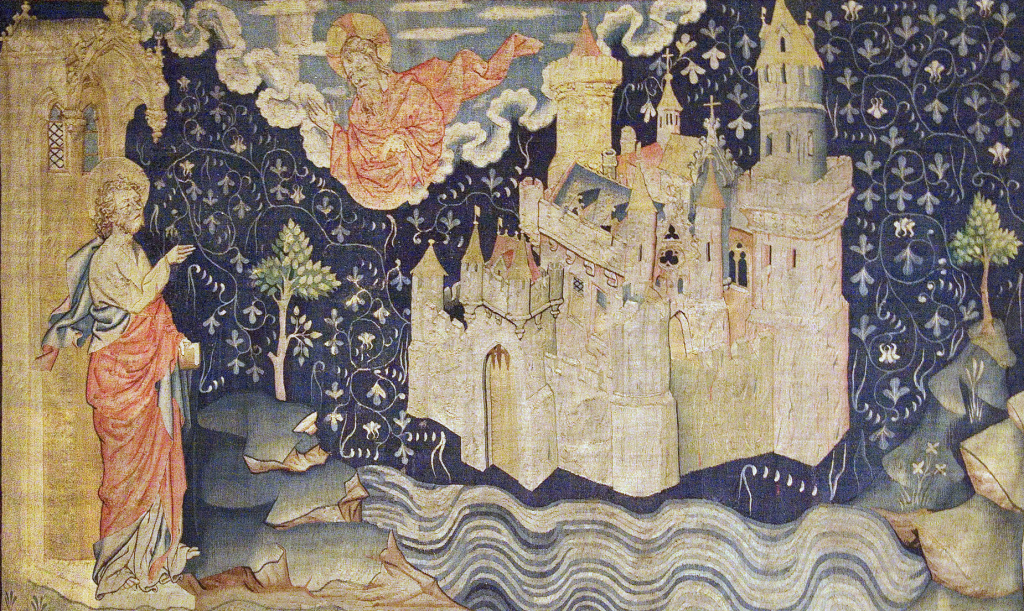
A 14th century tapestry of the Apostle John’s vision of the New Jerusalem

The word of the Lord Almighty came to me.

This is what the Lord Almighty says: “I am very jealous for Zion; I am burning with jealousy for her.”

This is what the Lord says: “I will return to Zion and dwell in Jerusalem. Then Jerusalem will be called the Faithful City, and the mountain of the Lord Almighty will be called the Holy Mountain.”

This is what the Lord Almighty says: “Once again men and women of ripe old age will sit in the streets of Jerusalem, each of them with cane in hand because of their age. The city streets will be filled with boys and girls playing there.”

This is what the Lord Almighty says: “It may seem marvelous to the remnant of this people at that time, but will it seem marvelous to me?” declares the Lord Almighty.

This is what the Lord Almighty says: “I will save my people from the countries of the east and the west. I will bring them back to live in Jerusalem; they will be my people, and I will be faithful and righteous to them as their God.”

This is what the Lord Almighty says: “Now hear these words, ‘Let your hands be strong so that the temple may be built.’ This is also what the prophets said who were present when the foundation was laid for the house of the Lord Almighty. Before that time there were no wages for people or hire for animals. No one could go about their business safely because of their enemies since I had turned everyone against their neighbor. But now I will not deal with the remnant of this people as I did in the past,” declares the Lord Almighty.

“The seed will grow well, the vine will yield its fruit, the ground will produce its crops, and the heavens will drop their dew. I will give all these things as an inheritance to the remnant of this people. Just as you, Judah and Israel, have been a curse among the nations, so I will save you, and you will be a blessing. Do not be afraid, but let your hands be strong.”

This is what the Lord Almighty says: “Just as I had determined to bring disaster on you and showed no pity when your ancestors angered me,” says the Lord Almighty, “so now I have determined to do good again to Jerusalem and Judah. Do not be afraid. These are the things you are to do: Speak the truth to each other and render true and sound judgment in your courts; do not plot evil against each other, and do not love to swear falsely. I hate all this,” declares the Lord. (New International Version)

The name “Zechariah” means “Yahweh remembers.” The Lord indeed remembers the divine covenant which was established. And God will fulfill all promises made.

The Lord is determined to do good – not really because people so much deserve it but because it is God’s character to be good, and thus, do good, even when there is little goodness on the earth to be found.

New Jerusalem by Sister Gertrude Morgan (1900-1980)

God’s judgment is but for a moment; but the Lord’s promise, salvation, and peace shall endure forever. God’s wrath is quite real and certain, yet it is a brief extension of the Lord’s steadfast love. Rebellion and judgment are never the last words; forgiveness and grace are:

Many times he [Yahweh] delivered them [the Israelites],
    but they were rebellious in their purposes
    and were brought low through their iniquity.
Nevertheless, he regarded their distress
    when he heard their cry.
For their sake he remembered his covenant
    and showed compassion according to the abundance of his steadfast love.
He caused them to be pitied
    by all who held them captive. (Psalm 106:43-46, NRSV)

All of the Old Testament prophets end their message of impending judgment with the final note of hope. That is, it won’t always be this way. There are better days ahead. The Lord’s coming is not all wrath; it’s mercy and hope. Notice the five brief messages of hope which Zechariah gives the people:

1. Yahweh burns with jealousy for Zion

Throughout the Bible, God likens the relationship to the Israelites much like a lover – as if the Lord were married to them. God’s covenant relationship with people is at the heart of understanding the whole of Scripture. Whenever they stray from divine promises, Yahweh is offended and hurt. 

God is an emotional Being, which is why we have emotions as people created in his image. Early humanity strayed so far from God that it hurt:

The Lord saw that humanity had become thoroughly evil on the earth and that every idea their minds thought up was always completely evil. The Lord regretted making human beings on the earth, and he was heartbroken. (Genesis 6:5-6, CEB)

Yet, God was gracious, sparing Noah and his family. The Lord took a group of Noah’s descendants, Abraham’s family, and set godly covenant affection on them. Through the Israelites, God hoped to lead the entire world to right relations. Yet, they, too, came to fail the gracious covenant made and set their affections on others.

Like a jilted lover, God longed for Israel to remain faithful, and, at the same time, was hurt and angry. Just as the prophet Hosea did not give up on his wife, even though she was brazenly unfaithful, so God looked at Israel as a spouse and could not bear to give her up.

2. Yahweh returns to Zion  

Jerusalem will be known as a faithful city and a holy mountain. The presence of God is what makes that happen. Because even though people can be fickle, inconsistent, complacent, and unfaithful, Yahweh remains true to the divine character of steadfast and immovable love for people.

You will never again be called ‘The People God Left.’
    Your land will never again be called ‘The Land God Destroyed.’
You will be called ‘The People God Loves.’
    Your land will be called ‘God’s Bride,’
because the Lord loves you,
    and your land will be his. (Isaiah 62:4, ERV)

3. The streets of Jerusalem will be full of children playing

The elderly will be sitting there watching the kids play, full of delight at the scene. Much too often we Westerners measure both the significance and success of our cities by its industry, businesses, buildings, wealth, and culture.

Methinks we may be misguided with such measurements. Instead, I suggest, along with the prophet, that we gage our cities by their effect on both the old and the young – because long life and children are signs of blessing from God.

4. Nothing is impossible with Yahweh

Is anything too hard for God? That, my friends, is a rhetorical question. If the Lord can cause old women to bear children (Genesis 18:10-14) and large armies to evaporate (Judges 7:1-25) then there is nothing more preposterous than to always view everything from our puny human perspective. Mary gained such a vantage and believed. We, too, have such an Advent hope within us.

“You will conceive and give birth to a son, and you are to call him Jesus. He will be great and will be called the Son of the Most High. The Lord God will give him the throne of his father David, and he will reign over Jacob’s descendants forever; his kingdom will never end.”

“How will this be,” Mary asked the angel, “since I am a virgin?”

The angel answered, “The Holy Spirit will come on you, and the power of the Most High will overshadow you. So the holy one to be born will be called the Son of God. Even Elizabeth your relative is going to have a child in her old age, and she who was said to be unable to conceive is in her sixth month. For no word from God will ever fail.”

“I am the Lord’s servant,” Mary answered. “May your word to me be fulfilled.” (Luke 1:31-38, NIV)

5. Yahweh renews and restores

Separation, diaspora, and disconnection will become a thing of the past. The Lord sets all things right again, brings people together, and heals, so that everything exists as it is meant to exist.

Deliverance from sin, death, and hell is the means of bringing renewal to the earth and its people. Salvation belongs to God. Righteousness and justice will characterize the future.

For the word of the Lord is upright,
    and all his work is done in faithfulness.
He loves righteousness and justice;
    the earth is full of the steadfast love of the Lord. (Psalm 33:4-5, NRSV)

Hope is fully realized when people put their trust in God and do their part by having strong hands and faithful hearts. We must be truthful and gracious whenever we speak. The Lord expects us to do the right thing by one another, both personally and publicly. We are to never cook up plans to take unfair advantage of others. Instead, we need to keep our lives simple and honest.

The promise of blessing is assured by God. However, the timing of that blessing is conditioned by our response. And there is no better time than the Christian season of Advent to recall what the Lord will do, as well as what God wants us to do.

May we be people of hope and let hope live in our hearts now and always, to the glory of God. Amen.