A Prayer of Desperation (Jonah 2:1-10)

From inside the fish, Jonah prayed to the Lord his God:

When I was in trouble, Lord,
I prayed to you,
    and you listened to me.
From deep in the world
    of the dead,
I begged for your help,
    and you answered my prayer.

You threw me down
    to the bottom of the sea.
The water was churning
    all around;
I was completely covered
    by your mighty waves.
I thought I was swept away
    from your sight,
never again to see
    your holy temple.

I was almost drowned
by the swirling waters
    that surrounded me.
Seaweed had wrapped
    around my head.
I had sunk down deep
    below the mountains
    beneath the sea.
I knew that forever,
    I would be a prisoner there.

But you, Lord God,
    rescued me from that pit.
When my life was slipping away,
    I remembered you—
and in your holy temple
    you heard my prayer.

All who worship worthless idols
turn from the God
    who offers them mercy.
But with shouts of praise,
I will offer a sacrifice
    to you, my Lord.
I will keep my promise,
because you are the one
    with power to save.

The Lord commanded the fish to vomit up Jonah on the shore. And it did. (Contemporary English Version)

Desperate (adjective):

  1. reckless or dangerous because of despair, hopelessness, or urgency: a desperate prayer for help
  2. having an urgent need, desire: desperate to stay alive in a watery grave
  3. leaving little or no hope; very serious or dangerous: desperately stuck in the belly of a fish
  4. extremely bad; intolerable or shocking: skin being bleached white inside of a stomach
  5. extreme or excessive: swallowed and puked-out by a fish

Out of all the postures of prayer I have taken in my life, and in every prayer of desperation I’ve ever uttered to God, none of my experiences were ever quite like Jonah’s. Curled up in a fetal position inside the belly of a big fish will tend to bring out a desperate plea for help. And desperate prayers are the sort God wants from us.

I am God Most High!
    The only sacrifice I want
is for you to be thankful
    and to keep your word.
Pray to me in time of trouble.
I will rescue you,
    and you will honor me. (Psalm 50:14-15, CEV)

The Lord says, “If you love me
    and truly know who I am,
I will rescue you
    and keep you safe.
When you are in trouble,
    call out to me.
I will answer and be there
    to protect and honor you.
You will live a long life
    and see my saving power.” (Psalm 91:14-16, CEV)

Anyplace of difficulty, adversity, or overwhelming situation, can be transformed from the acid belly of a fish to a womb of possibility and new life.

In running from God, Jonah chose unwisely, and took the path of separation and death. Being swallowed whole by a great fish, and languishing in such a place of sheer isolation, is also a metaphor mirroring the actual circumstance of Jonah’s great separation from everyone, everything, especially God.

Our own fleeing from what we hate, and searching for safety apart from the Lord, only lands us in a place of horror. Jonah got himself so far from everything that he became entombed in a living death. In truth, God is the only safe and sacred place we have, our only secure refuge. We don’t need to run in order to be protected – not when God has our backs.

The turning point is whenever we come to our senses and make the choice to unmask our actual thoughts, feelings, and intentions before the Lord. The change comes whenever we make an honest cry of desperation in prayer. For prayer is the very breath of life; it is our hope.

What do you do when you are in distress?

Prayer elicits mercy from the heart of God. The value of adopting biblical prayers, like the ones in the psalter and Jonah’s prayer, is that frequent use of praying them fills our minds and hearts with words in times of great distress.

Its when we are in overwhelming need that scriptural prayers and familiar passages reawaken us with fresh hope for deliverance and renewal.

Jonah’s dark watery grave became empty when he decided to voice his desperate prayer to God. It’s one thing to pray because you want something; it’s another thing to pray because your very life is on the line.

Living for God is much more than holding to particular doctrines or making pious statements about God. The spiritual life is one in which we open ourselves to new beginnings and new life – going beyond ourselves and connecting with a transcendent God.

We must abandon ourselves to God. We are in no position to negotiate or make deals with the Lord. There needs to be a radical letting go of hatred and bigotry, injustice and unrighteousness, and especially our bent toward wanting things our way.

It is from the empty places of life that we find possibility. It was from the grave of the fish’s belly that set up Jonah’s experience of being vomited out in a spiritual resurrection.

Jonah was in the stomach of a big fish for three days and nights, just as the Son of Man will be deep in the earth for three days and nights. (Matthew 12:40, CEV)

Abandoning the false self, forsaking the old life, and coming to the end of ourselves, puts us in a position to pray desperate prayers which God delights to answer beyond what we can even ask or think.

Most holy and merciful God, I am in your care. Help me know that I need not face my troubles alone. May you grant me consolation in my sorrow, courage in my fear, and healing in the midst of my suffering. Fill me with the grace to accept whatever lies ahead for me; and strengthen my faith. Thank you that I have a living hope, through Jesus Christ my Lord, who with you and the Holy Spirit are one God, now and forever. Amen.

Who Is Running from God? (Jonah 1:1-17)

The Lord gave this message to Jonah son of Amittai: “Get up and go to the great city of Nineveh. Announce my judgment against it because I have seen how wicked its people are.”

But Jonah got up and went in the opposite direction to get away from the Lord. He went down to the port of Joppa, where he found a ship leaving for Tarshish. He bought a ticket and went on board, hoping to escape from the Lord by sailing to Tarshish.

But the Lord hurled a powerful wind over the sea, causing a violent storm that threatened to break the ship apart. Fearing for their lives, the desperate sailors shouted to their gods for help and threw the cargo overboard to lighten the ship.

But all this time Jonah was sound asleep down in the hold. So the captain went down after him. “How can you sleep at a time like this?” he shouted. “Get up and pray to your god! Maybe he will pay attention to us and spare our lives.”

Then the crew cast lots to see which of them had offended the gods and caused the terrible storm. When they did this, the lots identified Jonah as the culprit. “Why has this awful storm come down on us?” they demanded. “Who are you? What is your line of work? What country are you from? What is your nationality?”

Jonah answered, “I am a Hebrew, and I worship the Lord, the God of heaven, who made the sea and the land.”

The sailors were terrified when they heard this, for he had already told them he was running away from the Lord. “Oh, why did you do it?” they groaned. And since the storm was getting worse all the time, they asked him, “What should we do to you to stop this storm?”

“Throw me into the sea,” Jonah said, “and it will become calm again. I know that this terrible storm is all my fault.”

Instead, the sailors rowed even harder to get the ship to the land. But the stormy sea was too violent for them, and they couldn’t make it. Then they cried out to the Lord, Jonah’s God. “O Lord,” they pleaded, “don’t make us die for this man’s sin. And don’t hold us responsible for his death. O Lord, you have sent this storm upon him for your own good reasons.”

Then the sailors picked Jonah up and threw him into the raging sea, and the storm stopped at once! The sailors were awestruck by the Lord’s great power, and they offered him a sacrifice and vowed to serve him.

Now the Lord had arranged for a great fish to swallow Jonah. And Jonah was inside the fish for three days and three nights. (New Living Translation)

God said, “Go!”

Jonah said, “No!”

And, God said, “Oh!?”

Jonah did a complete turn-and-run from God’s clear instructions to go to the city of Nineveh. That doesn’t sound like a good idea. So, why did Jonah run? And why do we run?

Who were the Assyrians?

Nineveh was a large city in the ancient world, and the capital of Assyria. The Assyrians had a reputation as fierce soldiers and conquered the Middle East. They are mentioned many times in the Old Testament. It was Assyria that God used to judge the northern kingdom of Israel.

The typical military practice of the Assyrians was to attack a city and completely subjugate it by deporting most of the people and repopulating it with some of their own people. They did this so that the conquered people could not mount a revolt or resistance to their rule.

The Assyrians, the Ninevites, were notorious in the ancient world for their brutality toward conquered peoples. Many forms of torture that we are aware of today were invented by the Assyrians. Their methods were awful and inhumane. The Assyrians were experts at thinking up and executing extreme forms of torture on everyone who resisted their power. It was a very violent culture.

Who is God?

God isn’t at all like the Ninevites. The ways of the Assyrians caught the notice of God, who was ready to pronounce judgment on the heart of the Assyrian Empire, the capital city of Nineveh. So, as God typically did in the Old Testament, he told one of his prophets to go and give a message.

The message was simple: “Go to the great city of Nineveh and preach against it, because its wickedness has come up before me.” Lest we think God was determined to wipe Nineveh off the map, think again. Jonah confesses later in the book, “I knew that you are a gracious and compassionate God, slow to anger and abounding in love, a God who relents from sending calamity.” (Jonah 4:2)

Who was Jonah?

Jonah did not like the Assyrians. More than that, he hated their guts. They killed, maimed, executed, and deported Jonah’s fellow Israelites. The last thing Jonah wanted was to have effective preaching and see Nineveh repent of their violent ways. Jonah wanted judgment, not grace.

In this little four-chapter prophetic book of the Old Testament, it is Jonah who needs divine deliverance as much as the Ninevites do. In fact, Jonah’s need for rescue gets more attention than the evil Assyrians. The message of Jonah comes down to this:

Racism and hatred, however much perceived to be legitimate, have no part whatsoever in the kingdom of God.

Who are we?

Christians are the community of the redeemed. New life in Jesus Christ involves a wholesale jettison of bigotry and the manure pile of hatred directed toward any ethnic and/or religious group of people, period. New life means adopting the love of God. It involves becoming a dispenser of grace and mercy with all people, not just the ones we feel deserve it.

What does God want us to learn?

To share the same heart as God has – a heart that beats for people to know and live by a better way – a heart that has grace and compassion even in the face of flat-out evil. We are meant to think twice about pointing the finger at others. Instead, we are to take the plank out of our own eye before we address the splinter in another’s eye.

It wasn’t the Assyrians who were running from God; it was Jonah. In God’s upside-down realm, the wicked become the righteous, and the righteous are exposed as wicked. The unrighteous run to God, whereas the religious run from God. Nineveh eventually turned from their evil ways.

So, let’s keep to the side of mercy, not judgment.

O God, you created all people in your image. We thank you for the astonishing variety of races and cultures in this world. Enrich our lives by ever-widening circles of friendship, and show us your presence in those who differ most from us, until our knowledge of your love is made perfect in our love for all your children; through your Son, Jesus Christ our Lord. Amen.

Be Merciful (Jonah 4:1-11)

Jonah was really upset and angry. So he prayed:

Our Lord, I knew from the very beginning that you wouldn’t destroy Nineveh. That’s why I left my own country and headed for Spain. You are a kind and merciful God, and you are very patient. You always show love, and you don’t like to punish anyone.

Now let me die! I’d be better off dead.

The Lord replied, “What right do you have to be angry?”

Jonah then left through the east gate of the city and made a shelter to protect himself from the sun. He sat under the shelter, waiting to see what would happen to Nineveh.

The Lord made a vine grow up to shade Jonah’s head and protect him from the sun. Jonah was very happy to have the vine, but early the next morning the Lord sent a worm to chew on the vine, and the vine dried up. During the day the Lord sent a scorching wind, and the sun beat down on Jonah’s head, making him feel faint. Jonah was ready to die, and he shouted, “I wish I were dead!”

But the Lord asked, “Jonah, do you have the right to be angry about the vine?”

“Yes, I do,” he answered, “and I’m angry enough to die.”

But the Lord said:

You are concerned about a vine that you did not plant or take care of, a vine that grew up in one night and died the next. In that city of Nineveh there are more than 120,000 people who cannot tell right from wrong, and many cattle are also there. Don’t you think I should be concerned about that big city? (Contemporary English Version)

Fear and anger go hand in hand. The fear of what sort of evil might happen often leads a person toward angry vitriol, even violence.

I once dealt with a woman who was so upset with her husband that she was literally shaking with anger. There was a time when her husband had been abusive, but thankfully, he gave his life to God, changed, and became a loving person. 

The thing that was so upsetting for the wife is that God saved her husband without punishing him for all the abuse he had dished out. She wanted some divine payback! The woman was actually furious about God showing grace and compassion.

This is not a novel or new experience. In the ancient world, the Assyrians were notorious for their brutality toward conquered peoples. They thought up forms of torture as a creative past-time. It was a violent culture, full of inhumane practices, and soldiers who were the scourge of the Middle East.

The violent ways of the Assyrians caught the notice of God. Divine judgment was hanging over the capital of the Assyrian Empire, Nineveh. So, God told the prophet Jonah to go and give the powerful empire a message of impending doom. (Jonah 1:2)

Jonah did not immediately obey God. However, he eventually went to Nineveh (after the infamous being in the belly of a great fish for three days and nights). The result was a great repentance of sin from the Assyrian people. 

The entire city turned from their evil ways. God saw this mass repentance and relented from sending disaster. Instead of destroying the city, with all its inhabitants and animals, the Lord was merciful and spared them. After all, God delights in seeing humility and the courage to admit evil and turn from it.

But Jonah had a serious problem with God’s grace toward the Assyrians. He was so upset and angry about the whole affair, that he wanted to die. Jonah was actually annoyed and greatly displeased by God’s goodness. Jonah wanted justice; he was looking for judgment. The last thing he wanted was divine mercy toward the very people who were experts at killing Jews. 

Yet, we must come to grips with the reality that God’s grace is so massive that it even extends to some of the most evil people in history. And Jonah wanted no part of that sort of theology.

God asked Jonah twice, “Do you have a right to be angry?” Jonah wanted destruction and pay-back for all the sin of the Assyrians. But God searches our hearts and exposes our expectations. Often, when those expectations do not happen, we are disappointed and become angry, even livid over the lack of retribution from God.

God wanted Jonah to share the same heart of mercy. And God still desires God’s people to have a heart that has grace and compassion, even in the face of terrible evil. Sometimes, God calls us to do what we least want to do in order to reveal what is really in our own hearts.  

Hating people to the point of wanting nothing but destruction upon them does nothing to bring about the righteous life that God desires. In Christian understandings, the blood of Jesus Christ has the power to bring healing and hope, even to the worst of sinners.

Whenever our fears turn to anger and we believe that God should bomb evil people off the face of the earth… or if we think our neighbors might be harboring ill-intent just because they are of a different race, ethnicity, or religion… or if we harbor bitterness because of real evil present in this world and want at least a little payback; then, we are no better than Jonah.

We end up looking just as ridiculous as Jonah, sitting at the edge of the city, pouting like a little kid.

Let’s grow up and rise above the current rancor that exists in so many places. Be concerned for the billions of people on this earth who need a merciful divine intervention and the grace of repentance that leads to new life. 

Pray for your enemies. Do good works for those who oppose you. Gain a bigger for the nations of the world. Remember what is really important in life. 

Any fool can rant and rave with anger against another; but the wise and gracious follower of God patiently and carefully prays and acts in ways that brings mercy and grace to others.

Merciful God, your presence of love in this world is truly amazing. Despite the real existence of evil on this earth, your grace cuts through it all and has the last word. Work in my life in such a way that fear is done away with and sinful anger vanishes, to be replaced with the love of Jesus Christ. Amen.

Anyone Can Change (Jonah 3:1-10)

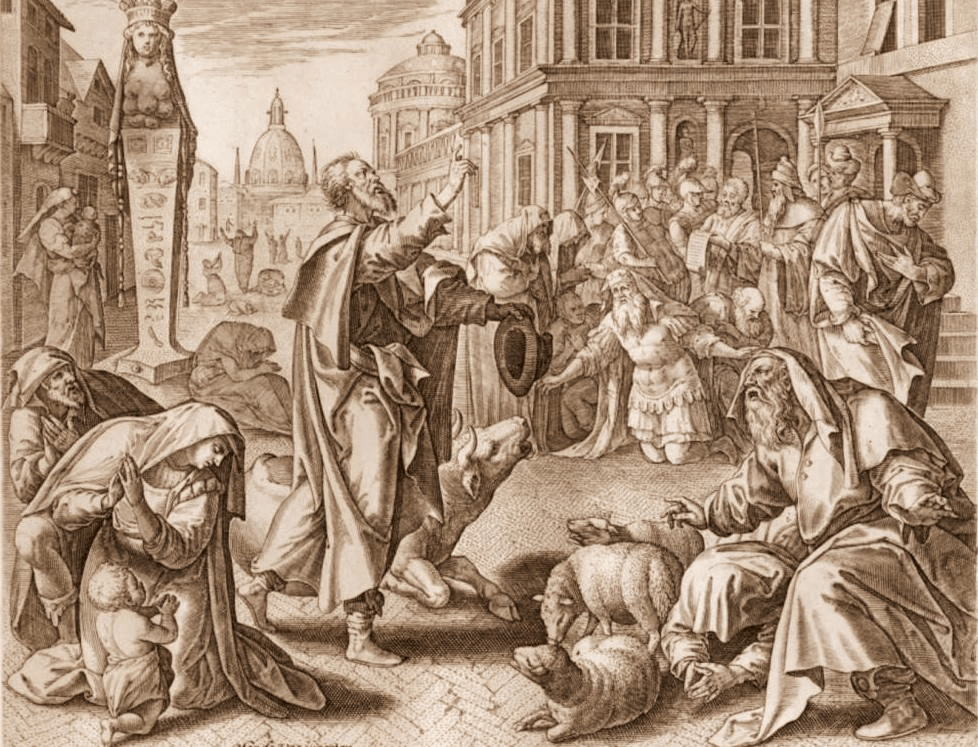
Print of Jonah preaching to the Ninevites and their repenting, by Philip Galle 1547–1612 

The Lord’s word came to Jonah a second time: “Get up and go to Nineveh, that great city, and declare against it the proclamation that I am commanding you.” And Jonah got up and went to Nineveh, according to the Lord’s word. (Now Nineveh was indeed an enormous city, a three days’ walk across.)

Jonah started into the city, walking one day, and he cried out, “Just forty days more and Nineveh will be overthrown!” And the people of Nineveh believed God. They proclaimed a fast and put on mourning clothes, from the greatest of them to the least significant.

When word of it reached the king of Nineveh, he got up from his throne, stripped himself of his robe, covered himself with mourning clothes, and sat in ashes. Then he announced, “In Nineveh, by decree of the king and his officials: Neither human nor animal, cattle nor flock, will taste anything! No grazing and no drinking water! Let humans and animals alike put on mourning clothes, and let them call upon God forcefully! And let all persons stop their evil behavior and the violence that’s under their control!” He thought, Who knows? God may see this and turn from his wrath, so that we might not perish.

God saw what they were doing—that they had ceased their evil behavior. So God stopped planning to destroy them, and he didn’t do it. (Common English Bible)

Anyone can turn around, even the nastiest of people.

Lent (the Christian season lasting six weeks from Ash Wednesday to Easter Sunday) is the ideal time of year to change, to turn around, to repent — to return to God and re-focus our lives.

The season of Lent is something like a forty-day trial run in changing your lifestyle and letting God change your heart. Repentance is the key that unlocks the soul’s ability to connect with God. To repent means to stop going in one direction and start going in another one. It makes all the difference in the orientation of our souls. 

Repentance leads to a real change of direction, a complete re-orientation of life. The evidence of such a change is this:

  • Owning up to the problem and confronting it
  • An eagerness to make things right
  • Indignation over what has been done or said
  • A desire and energy to do what is best for those we have wronged
  • A willingness to accept whatever consequences that might result from the offense

There’s nothing romantic about repentance; it’s typically messy, usually ugly, and often painful. Yet, there must be suffering before glory. Trying to take repentance out of the equation is to eviscerate life and leave our souls vacuous and empty.

Sometimes, we may not even realize we need to repent because we get caught up in the drama of whatever we’re doing – school, relationships, family, church, or work. Our lives can become filled with distractions that take us away from the spiritual life and the need to change.

But our soul knows it’s empty. And so, often unaware, we try to fill the vacuum with meaningless stuff, busywork, and mindless activities. What we’re really doing is running from real life and from God. 

We need to connect with the Divine; we need repentance. The Ninevites instinctively knew what to do; they fasted, prayed, and changed their ways. If a group of people who were experts at human torture and abuse could know this and intentionally pay attention to God, then how much more ought we to connect with what is most important?

Godly sorrow brings repentance that leads to salvation and leaves no regret.

2 Corinthians 7:10, NIV

Throughout Holy Scripture, whenever people were confronted with divine realities, they were completely undone; they began to see their own sin for what it truly is. 

When the Apostle Peter saw the Lord Jesus in his immensity and power through a miraculous catch of fish he fell at Jesus’ knees and said, “Go away from me, Lord; I am a sinful man.” (Luke 5:8) 

When the Apostle John had a vision of Jesus Christ in all his glory, and heard his voice, he fell at the Lord’s feet as though dead. (Revelation 1:12-17)

When the prophet Ezekiel had a vision of God and saw the appearance of God’s glory, he fell facedown. (Ezekiel 1:25-28) 

Even Daniel, perhaps the most righteous prophet and person of all time, saw a vision of God in all his glory, he fell prostrate with his face to the ground, totally overwhelmed with God’s holiness and human sinfulness. (Daniel 8:15-18)

We must put ourselves in a position to hear God so that we can turn from all the obstacles that prevents us from experiencing life as it is meant to be lived. And the all the things which hinder us from repenting are legion:

  • inattention to God’s words and God’s creation
  • constant and prolonged preoccupations and daydreams that prevents availability to God
  • lack of sleep and good health habits that dulls the spiritual senses and prevents awareness of God
  • a paucity of spiritual practices and disciplines that would put us in a position to experience God

Let us, then, take a lesson from the repenting Ninevites and pay attention to God. For God is calling, yet we do not hear him. So, let’s put ourselves in a position to hear the message of God; identify the things that grieve God’s heart; and repent.

God has gone out of the way to reach us so that we can change for the better. And anyone, no matter who they are, can experience it – even a terribly sinful nation of people.

What will you do with this grace?

Almighty and everlasting God, the One who freely pardons all who repent: Redeem and renew every penitent heart with your infinite mercy and grace, forgiving all our sins, and cleansing us from an evil conscience. Amen.