Jeremiah 7:1-15 – Holding People Accountable

The prophet Jeremiah, Basilica of St Vitalis, Ravenna, Italy—Photo by mountainpix

The word that came to Jeremiah from the Lord: Stand in the gate of the Lord’s house, and proclaim there this word, and say, Hear the word of the Lord, all you people of Judah, you who enter these gates to worship the Lord. Thus says the Lord of hosts, the God of Israel: Amend your ways and your doings and let me dwell with you in this place. Do not trust in these deceptive words: “This is the temple of the Lord, the temple of the Lord, the temple of the Lord.”

For if you truly amend your ways and your doings, if you truly act justly one with another, if you do not oppress the alien, the orphan, and the widow or shed innocent blood in this place, and if you do not go after other gods to your own hurt, then I will dwell with you in this place, in the land that I gave to your ancestors forever and ever.

Here you are, trusting in deceptive words to no avail. Will you steal, murder, commit adultery, swear falsely, make offerings to Baal, and go after other gods that you have not known and then come and stand before me in this house, which is called by my name, and say, “We are safe!”—only to go on doing all these abominations? Has this house, which is called by my name, become a den of robbers in your sight? I, too, am watching, says the Lord. Go now to my place that was in Shiloh, where I made my name dwell at first, and see what I did to it for the wickedness of my people Israel. 

And now, because you have done all these things, says the Lord, and when I spoke to you persistently, you did not listen, and when I called you, you did not answer, therefore I will do to the house that is called by my name, in which you trust, and to the place that I gave to you and to your ancestors just what I did to Shiloh. And I will cast you out of my sight, just as I cast out all your kinsfolk, all the offspring of Ephraim. (New Revised Standard Version)

One of the dangers of the religious life is slipping into the view that possessing a certain thing protects us from all harm – sort of like a talisman or rabbit’s foot.

Today’s Old Testament lesson is a classic example of succumbing to just such a danger. The ancient Jews in Jerusalem, in the days of the prophet Jeremiah, sincerely believed that because they had God’s temple in their city that this would protect them from any kind of attack from the outside. 

What is more, since they viewed the temple as an incredibly powerful good-luck-charm, the people thought that they could do whatever they wanted; they were covered and protected. So, they had no sense of accountability to the holy God whose temple overlooked Jerusalem and saw all of their unjust ways.
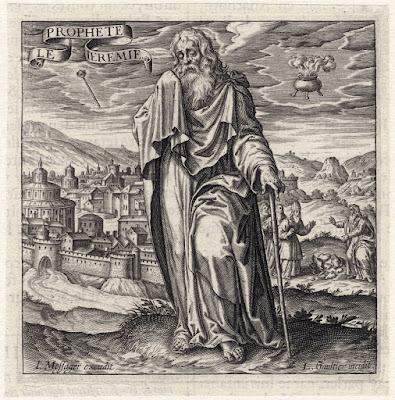
An engraving of the prophet Jeremiah by Léonard Gaultier (1561-1641)

Separated by a few millennia, we might see the folly with this magical type of thinking. Yet, it is just as easy for us to slip into the same mentality. 

Whenever we Americans think that our nation is so great that no one will ever take us over; or when we sincerely believe that because we are a missionary-sending nation that God will protect us; or when we buy into the notion that we can live however we want, but God would never judge us!; after all, we aren’t as bad as other nations!; well, then, we have come under the same condemnation as the Jews of old, we need to hear God’s Word for us today.

Jeremiah’s message was uncompromising. He clearly let the people know that while they have been living their hedonistic lives, God has been trying to talk them. But the people refused to listen. The prophet insisted that having the temple in the city is not some inoculation from keeping enemies at bay.

The prophet Jeremiah asserted that the people must change their ways, start living right, and be fair and honest with each other. They need to stop taking advantage of foreigners, orphans, and widows. They cannot kill innocent people and worship other gods, then turn around and invoke the temple as God’s presence and sanction on their security.

Justice is the responsibility of everyone; there are no favorites with God. The Lord does not favor particular people, ethnicities, or nations above others. Because one is an American, or not, makes no difference. Race and gender don’t come into view.

The sovereign God will hold all people culpable for their violent speech and behavior, no matter who they are or where they are from. Oppression, injustice, and spiritual gerrymandering will be dealt with by Judge Jesus, for both Jew and Gentile, man and woman, Westerner and Easterner, young and old.

For whom God has given much, much will be required. The Lord holds all people accountable for their actions.

Holy God, you still speak today through your Holy Word. Help me to listen well and pay attention to what you are saying so that I might honor you through humility and obedience for the sake of Jesus. Amen.

Jeremiah 3:1-5 – Spiritual Adultery

“If a man divorces a woman
    and she goes and marries someone else,
he will not take her back again,
    for that would surely corrupt the land.
But you have prostituted yourself with many lovers,
    so why are you trying to come back to me?”
    says the Lord.
“Look at the shrines on every hilltop.
    Is there any place you have not been defiled
    by your adultery with other gods?
You sit like a prostitute beside the road waiting for a customer.
    You sit alone like a nomad in the desert.
You have polluted the land with your prostitution
    and your wickedness.
That’s why even the spring rains have failed.
    For you are a brazen prostitute and completely shameless.
Yet you say to me,
    ‘Father, you have been my guide since my youth.
Surely you won’t be angry forever!
    Surely you can forget about it!’
So you talk,
    but you keep on doing all the evil you can.” (New Living Translation)

We all have needs. 

As humans, each one of us has a deep hunger for love, intimacy, attention, affirmation, and encouragement. When these needs are met within gracious and loving relationships, especially in the marital bond, then there is genuine happiness and flourishing. 

But when our deep wants go unmet over a stretch of time, smiles are replaced with furrowed brows and confident strides give way to slumped shoulders.

We feel deeply and are moved at a visceral level because we are made in the image and likeness of G-d – a G-d who feels and has great emotion. 

Perhaps we too often think of G-d as some disembodied ethereal brain without any feelings. I hope today’s Old Testament lesson puts a collar on such notions. G-d entered into a loving covenant relationship with Israel. Yet, over time, the people looked for their relational, emotional, and spiritual needs to be met in other gods rather than the One true G-d. 

And it pained G-d’s heart.

G-d felt deeply about the people turning away to pursue other gods. The Lord responded to the people like a jilted lover, agonized by their acting like a prostitute – looking for their intimate needs to be satisfied elsewhere. 

It seems to me G-d was so profoundly hurt because the Lord knows that our deepest and greatest needs can only really be met through the divine covenant relationship. People need G-d.

To put it in the stark terms of Jeremiah’s prophecy: 

  • Are we playing the part of a harlot, running after all kinds of other relationships and things that we wrongheadedly believe will meet the needs of our lives? 
  • Do we sell ourselves to others in the misguided belief that we will find true happiness? 
  • Have we sought other lovers and forsaken our first love of the Divine? 

Everyone has a legitimate need for attention, love, and relational connection. The problem arises whenever we seek to meet those needs in illegitimate ways. That’s what we call “sin.”

The most important thing in life is not our job position, our social status, or even whether we are married with family. What matters most is the kind of person you are – it’s all about who you become. Because that’s what you will take into eternity. You and I are unceasing spiritual beings with an eternal destiny in G-d’s great universe.

Spiritual prostitution – and faith communities acting like spiritual brothels – are far beneath who we are and how we were designed by our Creator.

The pathos of G-d calls us to better than hanging out in a dark emotional shame lounge of sordid characters drinking cheap dandelion wine and smoking nasty cut-rate cigars in smelly old leisure suits.

We belong to G-d.

Our place is in the wide-open sunlit rooms of G-d’s kingdom. We have been adopted into G-d’s family and there is no longer any need for walking the streets and going into dive bars, looking for a quick fix of some damning elixir which promises life.

It behooves us all to become aware and connect with our longings and needs, and thereby allowing the G-d who delights to meet those needs into the core of our being.

Know who you really are. Because in that knowing, there is eternal life.

Jealous God, you are zealous for your presence to be known in the lives of all your creatures. Help me to be aware of the deepest needs of my life. May I find in you the desire of my heart and let you fill me with your infinite grace, love, mercy, and attention so that I will know true peace and joy. Amen.

Jeremiah 31:7-14 – A Restored People

Now this is what the Lord says:
“Sing with joy for Israel.
    Shout for the greatest of nations!
Shout out with praise and joy:
‘Save your people, O Lord,
    the remnant of Israel!’
For I will bring them from the north
    and from the distant corners of the earth.
I will not forget the blind and lame,
    the expectant mothers and women in labor.
    A great company will return!
Tears of joy will stream down their faces,
    and I will lead them home with great care.
They will walk beside quiet streams
    and on smooth paths where they will not stumble.
For I am Israel’s father,
    and Ephraim is my oldest child.

“Listen to this message from the Lord,
    you nations of the world;
    proclaim it in distant coastlands:
The Lord, who scattered his people,
    will gather them and watch over them
    as a shepherd does his flock.
For the Lord has redeemed Israel
    from those too strong for them.
They will come home and sing songs of joy on the heights of Jerusalem.
    They will be radiant because of the Lord’s good gifts—
the abundant crops of grain, new wine, and olive oil,
    and the healthy flocks and herds.
Their life will be like a watered garden,
    and all their sorrows will be gone.
The young women will dance for joy,
    and the men—old and young—will join in the celebration.
I will turn their mourning into joy.
    I will comfort them and exchange their sorrow for rejoicing.
The priests will enjoy abundance,
    and my people will feast on my good gifts.
    I, the Lord, have spoken!” (New Living Translation)

Experiencing restoration is a beautiful thing. Sick and suffering bodies restored to health brings rejoicing. Estranged relationships brought together again elicits singing. Spirits broken by sin made whole again through restoring grace causes shouts of joy.

God is an expert in restoration. Dilapidated communities, broken individuals, and peoples in diaspora can find fresh hope amid challenging circumstances.

Take a look at the actions of God through the verbs in today’s Old Testament lesson:

  • “I will bring.” The Lord gathers scattered people together, as well as making the disparate parts of people into a unified whole again.
  • “I will not forget.” In the gathering action of God, no one is left behind. Attention is given to the stragglers, to those unable on their own strength or ability to journey on the road back to the Lord.
  • “I will turn.” The unfortunate are turned into the fortunate. The underprivileged become privileged. Grief, lament, and mourning give way to joy and a new lease on life.
  • “I will comfort.” A great reversal occurs with God’s intervention. Sorrow is transformed into praise. Goodness is found in abundance because the Lord is a good God.

God calls the people to action, to a response of experiencing the restorative powers of grace. The Lord encourages such behavior because it helps us never forget that no one and no circumstance is ever beyond the renewing grace of God. Notice the verbs which characterize that response:

  • “Sing.” No mumbling here, my friends. No timidity about being off tune. A lonely person, fragmented group, depressed community, polarized neighborhood, or scattered nation restored by God’s merciful grace becomes an exuberant people. Singing organically arises from them.
  • “Shout.” Even the rocks will cry out if the people don’t. A last second win in the sports stadium amongst thousands of fans doesn’t even hold a candle to celebrative shouts of believers gathered and restored.
  • “Listen.” Whenever hearing God’s voice results in restoration, then the desire and motivation to listen increases exponentially.
  • “Proclaim.” Proclaiming good news is a joy and privilege. And in anticipation of Epiphany, the gospel declared to Gentiles is a gracious message of inclusion and hope.

We are helped to picture the incredible restoration of people coming together and gathered by God with two metaphors:

  1. The Good Shepherd. Like a faithful shepherd over the flock of sheep, the Lord actively seeks the lost, brings them home, and continues to stand watch over them as a compassionate guardian.
  2. The Exodus. Just as God redeemed the people out of Egyptian slavery and took them to a good land of abundance, so the Lord shall return those persons exiled from that abundant place and restore them to the peace of settled rest.

The restoring action of God gathers the scattered. The lost are found. That which is fragmented is made whole. Those previously disabled become able. The weak become strong, the sick healed, the hungry fed, and the prisoner freed.

In times of famine, pandemic, poverty, hardship, and scant resources, there is hope. The Lord knows how to restore fortunes and bring untold abundance amid the most difficult of situations.

True joy comes through hard suffering. The pains of childbirth give way to unspeakable joy.

Today is the final day in the twelve days of the Christmas season. God, entering humanity through a woman, in the flesh, began the gracious work of ransoming, redeeming, and restoring a sinful world that had exiled itself from peace and abundance. In Christ, our lives are full of blessing.

Praise the God and Father of our Lord Jesus Christ for the spiritual blessings that Christ has brought us from heaven! (Ephesians 1:3, CEV)

“I am the gate. Those who come in by me will be saved; they will come in and go out and find pasture. The thief comes only in order to steal, kill, and destroy. I have come in order that you might have life—life in all its fullness. I am the good shepherd, who is willing to die for the sheep.” (John 10:9-11, GNT)

May you know and experience the restorative grace of God in Christ today and every day. Amen.

Jeremiah 33:14-16 – Longing for Justice and Righteousness

Jeremiah by Marc Chagall, 1956

The Lord said:

I made a wonderful promise to Israel and Judah, and the days are coming when I will keep it.

I promise that the time will come
when I will appoint a king
    from the family of David,
a king who will be honest
    and rule with justice.
In those days,
    Judah will be safe;
Jerusalem will have peace
and will be named,
   “The Lord Gives Justice.” (Contemporary English Version)

Jeremiah is known as “the weeping prophet.” From the very beginning of his prophetic ministry, Jeremiah was given a message that Jerusalem and Judah would experience God’s wrath and be exiled to a foreign country. 

The prophet Jeremiah was faithful to his calling. Yet, he loved his homeland, and it grieved his heart to know that everything familiar around him would be either altered or destroyed. All would change because God’s judgment was coming.

The Lord gave Jeremiah an unpopular message, especially since Judah was enjoying a time of abundance, economic stability, and relative freedom from war. No one took Jeremiah seriously. Initially, when Jeremiah began to spread his message of gloom and doom, he was perceived as a kook, and no one took him seriously. 

But Jeremiah did not let up. The eye-rolling turned into annoyance, and then, over time, contempt. Judah’s king and the governing officials tried to silence Jeremiah as being subversive and unpatriotic. As a result, Jeremiah was imprisoned several times.

Jeremiah, in today’s Old Testament lesson, is under house arrest. The city of Jerusalem is under siege by the Babylonian army. Jeremiah’s prophecy is knocking at the door….

But the people are not listening, believing they’ll be delivered by God for two reasons:

1) They see the Babylonians are evil pagans who do not recognize the One true God, so, obviously, God would never use such an ungodly army to overthrow the people of God, right!?

2) They have the temple and the true worship of God, and God would never let the temple be desecrated, right!? 

So, the people of Jerusalem felt immune from any kind of terrible judgment, as if being God’s people with God’s temple would ward-off any disaster.

The siege against Jerusalem lasted over two years. During that time, the people of Jerusalem went from cocky and confident to having a very rude awakening. Horrible disaster was upon them. At their lowest point, with barely any food, and atrocities occurring throughout the city, Jeremiah’s word from God was a message of grace. 

The people would not be delivered from their inevitable fate. Yet, God would not wipe them off the map and destroy them forever. There is coming a day when there will be a Deliverer, a just and right Savior from the line of the greatest Israelite king ever, David.

The hardest reality for Jerusalem’s people to accept was that their way of life would never be the same again. It would forever change. Although they continued to practice all the rituals of the temple system and worship, over the generations it had simply become a rabbit’s foot for them – as long as they did their duty, they could walk away and do whatever they wanted. And they did.

That approach got God’s attention. Divine wrath came through the most unlikely of instruments: the pagan Babylonians led by the arrogant King Nebuchadnezzar.

The transition from one way of life to another was excruciating. 

Oftentimes change happens and it’s out of our control. However, what is within our influence is how we make the transition from the previous reality to the new reality. 

A biblical way to deal with difficult changes and transitions is by focusing on God’s promises. There are two pairs of the promise we have within the prophecy of Jeremiah: judgment and grace; justice and righteousness. 

“Justice and righteousness was never meant to be the work of only one person, or one part of society. It should be the foundation of how everyone stewards their lives, as well as an integral, normal part of all of society. Every aspect of this world needs God’s justice and righteousness.”

Jessica Nicholas

By looking ahead with hope to the new future of what God is doing and will accomplish, we then come to grips with present troubles.

Judgment and Grace

All of the Old Testament prophetic books have a rhythm of judgment and grace. The promise God gave to the people through Jeremiah was that judgment was coming; and, that grace would follow on its heels.

Proclaiming only a message of judgment without grace brings despair, death, and hell; there is hopelessness. Conversely, only speaking of grace apart from judgment is oxymoronic – it doesn’t exist because there is no need for grace if there is no judgment; grace is an undeserved mercy given freely by God in the face of our sinful selves.

The siege of Jerusalem was terribly horrific. The details are too graphic to mention. Even the most pious of believers who believed Jeremiah’s message were completely aghast at the level of cruelty and violence done to God’s people.

At the people’s darkest hour, the message of grace came to them….

Justice and Righteousness

A safe, secure, just, and peaceful future will be provided by God. The Lord will not forget the people. Better days are coming. A king will arise. His rule will be just and right, providing protection, peace, and prosperity. God’s people were to keep their heads up looking toward that future in order to help them now in the present.

This requires patience. They must wait.

While waiting, the people need to live in the way God intended before all this terror happened. They are to uphold justice and live righteously because that’s what the coming king is all about.

Justice and righteousness are often paired together in the Old Testament. They’re really two sides of the same coin. We may often think of justice in the punitive sense of giving lawbreakers what they deserve. Yet, biblical justice has more to do with giving someone what they need and deserve to live and thrive as human beings. 

To act justly means to provide essentials like clean drinking water, a safe environment, food to eat, a place to sleep, etc. Righteousness is the relational element to justice. To be righteous means to have right relationships, to connect with people, to move toward them and provide them with all the relational things that people need like respect, dignity, friendship, hospitality, fellowship, etc.

Justice and righteousness go together. Justice without righteousness is at best, impersonal, and, at worst, condescending. Righteousness without justice is a dead faith that wishes well but never delivers. Together, however, justice and righteousness brings love, peace, harmony, well-being, and human flourishing because all the basic necessities of life, physical and relational, are met in abundance.

This is what is meant in the Old Testament when Israel is referred to as “a land of milk and honey.”

Conclusion

For Christians, the time of abundance is here, in Christ. Yet, it’s not here in its fullness. We anticipate, wait, and hope for the Second Coming of our Savior and King. While we exercise patience, we long for better days. A true Advent spirit is a deep longing for justice and righteousness because King Jesus is just and right.

So, what do you long for today? 

I long for justice.

I long for broken spirits to be made right, for people’s healing of both body and soul. I long for the day when children with epilepsy will have no more seizures. I long for the day when individuals and families will not have to contend with cancer anymore. I long for the day when there will be no more depression, anxiety, mental illness, or dementia. I long for the day when people will be free of addictions. I long for the day when there will be no more sex trafficking, death from malnutrition, grinding poverty, corrupt governments, whole families and communities torn by the ravages of diseases, refugees with no place to call home, and devastating natural disasters. 

I long for righteousness.

I long for the day when women and girls across the globe will not be abused and become the victims of disordered power. I long for the day when nations, ethnicities, races, and everyone everywhere will no longer hate each other. I long for every individual to know forgiveness. I long for people to experience the exhilaration of new life in Christ. I long for my community to hear and believe the gospel. I long for peace, harmony, unity, equity, and an egalitarian spirit.

I long for God’s benevolent rule to come in all its fullness, freedom, joy, prosperity, peace, and happiness. I long for Christ’s coming! And I long to be doing justice and righteousness when Jesus arrives!

Maranatha, come Lord Jesus!