Speaking Truth to Power (Jeremiah 26:1-15)

The prophet Jeremiah, 6th century mosaic, Ravenna, Italy

Early in the rule of Judah’s King Jehoiakim, Josiah’s son, this word came from the Lord: The Lord proclaims: Stand in the temple courtyard and speak to all the people of the towns of Judah who have come to the temple to worship. Tell them everything I command you; leave nothing out. Perhaps they will listen, and each will turn from their evil ways. If they do, I will relent and not carry out the harm I have in mind for them because of the wrong they have done. 

So tell them, The Lord proclaims: If you don’t listen to me or follow the Instruction I have set before you—if you don’t listen to the words of the prophets that I have sent to you time and again, though you haven’t listened, then I will make this temple a ruin like Shiloh, and this city I will make a curse before all nations on earth.

The priests, the prophets, and all the people heard Jeremiah declare these words in the Lord’s temple. And when Jeremiah finished saying everything the Lord told him to say, the priests and the prophets and all the people seized him and said, “You must die! Why do you prophesy in the Lord’s name that ‘this temple will become a ruin like Shiloh, and this city will be destroyed and left without inhabitant’?” Then all the people joined ranks against Jeremiah in the Lord’s temple.

When the officials of Judah heard these things, they went up from the royal palace to the Lord’s temple and took their places at the entrance of the New Gate of the Lord’s temple. The priests and the prophets said to the officials and all the people: “This man deserves to die for prophesying against this city as you have all heard firsthand.”

Jeremiah said to all the officials and to all the people, “The Lord sent me to prophesy to this temple and this city everything you have heard. So now transform your ways and actions. Obey the Lord your God, and the Lord may relent and not carry out the harm that he’s pronounced against you. 

But me? I’m in your hands. Do whatever you would like to me. Only know for certain that if you sentence me to death, you and the people of this city will be guilty of killing an innocent man. The Lord has in fact sent me to speak everything I have said to you.” (Common English Bible)

When it comes to the spiritual and religious life, on the one hand, we hold the joy and contentment of divine connection and peace; and, on the other hand, we hold the sadness that many turn their backs on divine realities. In Christian terms, Jesus is both the cornerstone of faith and the stone which causes people to stumble and fall. (1 Peter 2:8)

Frankly, the Lord is not okay with cruel injustice, hollow worship, and inattention to both the divine and human. There is a way to make things right. But not everyone wants that. Systemic evil persists because there are always those who benefit from the current structures of power – and they care little about how it impacts those on the underbelly of their control.

Things may be going well for a large chunk of people. And, conversely, things may not be going well at all, for an even larger group of folks. Therefore, it is necessary to acknowledge that the world is not only good, but also quite broken. We must speak truth to power. I understand that this is no easy task, because rarely are things simply black and white, all good or all bad.

Jeremiah preaches in the temple gate, a woodcut by Unknown artist, 1886

In the prophet Jeremiah’s day, it was not that his opponents were pure evil with no acknowledgment of God. Rather, the problem was that the power brokers in Judah tried to keep a strict separation of religion from everything else; they were perfectly fine with God, that is, if the Lord would stay in the temple where he belonged.

But Jeremiah would have none of this sort of mentality and behavior. Keeping Yahweh out of matters of social justice, geopolitics, and institutional governance led to severe humanitarian problems. Jeremiah became God’s voice to a generation of people who ignored the divine in everything but religious ritual.

Bifurcating worship and work disconnects daily life from divine resources. Without God infused in all of life, a lack of grace fills the empty places. What’s more, the sovereign Lord can neither be silenced nor dismissed; God will find a way to accomplish peace and justice for the common good of everyone, and not just the few.

The heart of Jeremiah’s message was for king and people to be obedient in all of life, to recenter themselves around God’s law – not just the religious bits but the social ones, as well. Jeremiah did not proclaim something new. He was calling those in places of power and authority to a proper Torah observance.

The true needs and interests of our communities can never be addressed and lifted-up in the narrow self-serving interests of persons in power who turn a blind eye to anyone unlike them.

The needs and interests of our world lie in becoming who we were designed to be from the beginning: A people belonging to God, tapping into the deep reservoir of light and spirituality within us. It is to acknowledge the image of God inside us all.

We are to follow in the way of grace and truth. There is to be no division between the sacred and the secular because, for the Christian, Jesus is Lord of all.

We are to continually use our voice for both praise and prophecy, for shouting celebration to God and for speaking truth to power.

Holy God, the gracious Sovereign of all, we give you praise for your steadfast love toward us, your people. Keep us grounded in humility, sensitive to sin, attentive to that which is just and right, merciful in all things, pure in worship, and peace-loving through Christ our Lord in the strength of the Spirit. Amen.


Listen to the Prophets (Jeremiah 25:1-14)

St. Nicholas Church fresco of the prophets Isaiah, Jeremiah, Ezekiel, and Daniel by Leopold Bruckner, Prešov, Slovakia

This is the Message given to Jeremiah for all the people of Judah. It came in the fourth year of Jehoiakim son of Josiah king of Judah. It was the first year of Nebuchadnezzar king of Babylon.

Jeremiah the prophet delivered the Message to all the people of Judah and citizens of Jerusalem:

From the thirteenth year of Josiah son of Amon king of Judah right up to the present day—twenty-three years it’s been!—God’s Word has come to me, and from early each morning to late every night I’ve passed it on to you. And you haven’t listened to a word of it!

Not only that but God also sent a steady stream of prophets to you who were just as persistent as me, and you never listened. They told you, “Turn back—right now, each one of you!—from your evil way of life and bad behavior and live in the land God gave you and your ancestors, the land he intended to give you forever. Don’t follow the god-fads of the day, taking up and worshiping these no-gods. Don’t make me angry with your god-businesses, making and selling gods—a dangerous business!

“You refused to listen to any of this, and now I am really angry. These god-making businesses of yours are your doom.”

The verdict of God-of-the-Angel-Armies on all this: “Because you have refused to listen to what I’ve said, I’m stepping in. I’m sending for the armies out of the north headed by Nebuchadnezzar king of Babylon, my servant in this, and I’m setting them on this land and people and even the surrounding countries. I’m devoting the whole works to total destruction—a horror to top all the horrors in history. And I’ll banish every sound of joy—singing, laughter, marriage festivities, genial workmen, candlelit suppers. The whole landscape will be one vast wasteland. These countries will be in subjection to the king of Babylon for seventy years.

“Once the seventy years is up, I’ll punish the king of Babylon and the whole nation of Babylon for their sin. Then they’ll be the wasteland. Everything that I said I’d do to that country, I’ll do—everything that’s written in this book, everything Jeremiah preached against all the godless nations. Many nations and great kings will make slaves of the Babylonians, paying them back for everything they’ve done to others. They won’t get by with anything.” God’s Decree. (The Message)

An ancient rabbi once said that we have two ears and one mouth so that we will listen twice as much as we talk. 

Listening with curious and focused attention is a forgotten skill and a lost art in Western society. 

Slick marketing, political punditry, and over-the-top speech all scream into the culture because there is such a dearth of listening. It seems many people are more concerned to make their opinions known than do any kind of deep listening to another.

No one seems to want to put in the work of discovering another’s true thoughts, feelings, and needs. Instead, we’d rather rant, play armchair quarterback, and make uninformed comments on things we don’t understand.

It’s really downright sad and tragic that we fail to listen to each other. And it is especially terrible when we do not listen to God. 

The Old Testament prophets exist because of a failure to listen. At the time of Jeremiah, not only did the people not hear; they refused to listen. They put their fingers in their ears and babbled “la-la-la-la-la.” So, it was only fitting that the Lord sent the people to Babylon.

This was not merely the inability to listen because they were overworked, too tired, or “hangry.” The problem was much deeper than that. For years, God kept up a steady stream of words, telling the people exactly what was expected. But they didn’t listen, on purpose. Like a parent speaking to an angsty teenager, it all went in one ear and out the other with nothing getting done.

God passionately desired the people to amend their evil ways. But they didn’t want to hear it. 

So, after years, even centuries of unfaithfulness, unrighteousness, and injustice, God’s patience came to its limit. Tragedy happened. The Babylonian Exile became a terrible and harsh reality.

If there is no deep listening to God and God’s Word to us, there will be deep repercussions. 

Listen, my friends: None of us can do the will of God if we don’t know what God wants. It takes listening. And listening takes focused attention. And focused attention requires a posture of humility. And humility requires being emptied of all pride and hubris. 

Apart from genuine listening with the intent to understand and alter actions accordingly, there will be no peace, no love, no grace. The space of inattention quickly fills with lazy ears, emotional heaviness, spiritual sickness, xenophobic suspicion, anxious fear, dark thoughts, angry rants, and a retreat into selfish caring for oneself. 

The beginning of wisdom and human flourishing starts with listening well. Paying attention through deep listening brings humility of heart, purification of pride, and love of God and neighbor.

Truly hearing the words of God leads to self-awareness, cries for God’s mercy, a knowledge of humanity, the study of Holy Scripture, and a familiarity with the Church’s long tradition of sound teaching.

Therefore, silence is vital for everyone. Prayer needs to be more about sitting still in solitude and silence in order to listen and much less about talking at God.

But if we insist on making more noise than a couple of skeletons dancing on a tin roof, we will eventually be those skeletons – without any substance and only good for the grave.

So, read the prophets. Listen to them. Pay attention to their message. And heed their warnings and exhortations. Your ears will be glad you did.

Holy Father and God of all, your speech goes out into all the earth. Your Word is there for us to hear if we will only but listen. 

Lord Jesus, let your words and your teachings penetrate so deeply into my soul that your loving ways come out of me in all I say and do.

Blessed Holy Spirit, help me to so listen to your inner voice that encouragement and forgiveness pours forth from the wellspring of a heart which is baptized in God’s Word. Amen.

Heartfelt Prayer (Lamentations 5:1-22)

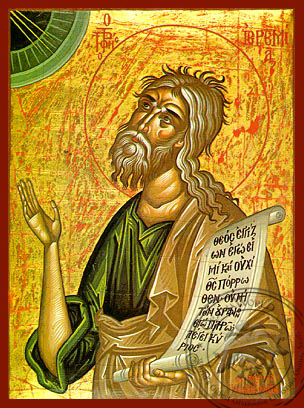
Orthodox icon of Jeremiah praying

O Lord, reflect on what has happened to us;
consider and look at our disgrace.

Our inheritance is turned over to strangers;
foreigners now occupy our homes.

We have become fatherless orphans;
our mothers have become widows.

We must pay money for our own water;
we must buy our own wood at a steep price.

We are pursued—they are breathing down our necks;
we are weary and have no rest.

We have submitted to Egypt and Assyria
in order to buy food to eat.

Our forefathers sinned and are dead,
but we suffer their punishment.

Slaves rule over us;
there is no one to rescue us from their power.

At the risk of our lives, we get our food
because robbers lurk in the wilderness.

Our skin is as hot as an oven
due to a fever from hunger.

They raped women in Zion,
virgins in the towns of Judah.

Princes were hung by their hands;
elders were mistreated.

The young men perform menial labor;
boys stagger from their labor.

The elders are gone from the city gate;
the young men have stopped playing their music.

Our hearts no longer have any joy;
our dancing is turned to mourning.

The crown has fallen from our head;
woe to us, for we have sinned!

Because of this, our hearts are sick;
because of these things, we can hardly see through our tears.

For wild animals are prowling over Mount Zion,
which lies desolate.

But you, O Lord, reign forever;
your throne endures from generation to generation.

Why do you keep on forgetting us?
Why do you forsake us so long?

Bring us back to yourself, O Lord, so that we may return to you;
renew our life as in days before,
unless you have utterly rejected us
and are angry with us beyond measure. (New English Translation)

“’Knock and it shall be opened.’ But does knocking mean hammering and kicking the door like a maniac?”

C.S. Lewis, A Grief Observed

Prayer is not about getting the right words strung together in a correct formula in a perfect disposition of the heart. Rather, prayer is conversation and a dialogue with God. 

Sometimes prayer looks a lot more like a triage unit in a hospital than it does a steeple on a church. Prayer often looks like desperation more than it does praise. 

God is a Being that we can tell the truth about what is really going on in our lives. Prayer isn’t prayer when we just tell God what we think God wants to hear.

“Prayer is not asking. It is a longing of the soul. It is daily admission of one’s weakness. It is better in prayer to have a heart without words than words without a heart.”

Mahatma Gandhi

The biblical book of Lamentations is the prophet Jeremiah’s extended prayer of grief, lament, complaint, and raw feeling. His hometown of Jerusalem was decimated by the invading Babylonian army. Thousands of people were taken out of the city and into exile. The ones left, including Jeremiah, were beside themselves with anger, grief, sadness, and fear.

We hear his cry to God, not worrying about whether it is appropriate language or not. Jeremiah’s words and phrases to God were heartfelt and real:

“We’re worn out and without any rest.”

“All the joy is gone from our hearts.” 

“We are heartsick.”

“We can hardly see through our tears.”

“Why do you keep forgetting us, God?”
“Lord, why dump us and leave us like this?

“Give us a fresh start, for God’s sake!”

Jeremiah was not concerned about how he looked or sounded, and not afraid to express his real thoughts and feelings.

Every thought and feeling is a valid entry into prayer. It is of utmost importance that we pray what is actually inside of us and not what we believe God would like to hear from us. 

The Lord doesn’t like pretense and posturing; God wants the real us. 

Plastic words and phony speeches are an affront to God. We must pray precisely what is on our minds and in our hearts – unfiltered, if need be. No matter the headache or the heartache, we only need to pray, without any concern for doing it perfectly.

“Suffering forces us to change.
We don’t like change and most of the time we fear it and fight it.
We like to remain in emotionally familiar places
even through sometimes those places are not healthy for us.
On occasion, the suffering is so great that we have to give up.
We surrender the old and begin anew.
Often it is the pain we experience that leads us, not only to a different life,
but a richer and more rewarding one.” Dennis Wholey

Gracious God, sometimes I feel like I have to have it all together to even speak to you. Yet you already know my heart better than I know it myself. Forgive my constant hiding from you and accept my heartfelt prayer to you for grace and help, through Jesus Christ my Savior and Lord. Amen.

How Can I Move Through My Grief? (Lamentations 1:7-15)

The Lamentations of Jeremiah by Marc Chagall (1887-1985)

Her people recall the good life
    that once was theirs;
now they suffer
    and are scattered.
No one was there to protect them
from their enemies who sneered
    when their city was taken.

Jerusalem’s horrible sins
    have made the city a joke.
Those who once admired her
    now hate her instead—
she has been disgraced;
    she groans and turns away.

Her sins had made her filthy,
but she wasn’t worried
    about what could happen.
And when Jerusalem fell,
    it was so tragic.
No one gave her comfort
    when she cried out,
“Help! I’m in trouble, Lord!
    The enemy has won.”

Zion’s treasures were stolen.
Jerusalem saw foreigners
    enter her place of worship,
though the Lord
had forbidden them
    to belong to his people.

Everyone in the city groans
    while searching for food;
they trade their valuables
for barely enough scraps
    to stay alive.

Jerusalem shouts to the Lord,
“Please look and see
    how miserable I am!”
No passerby even cares.
Why doesn’t someone notice
    my terrible sufferings?
You were fiercely angry, Lord,
and you punished me
    worst of all.
From heaven you sent a fire
    that burned in my bones;
you set a trap for my feet
    and made me turn back.
All day long you leave me
    in shock from constant pain.
You have tied my sins
    around my neck,
and they weigh so heavily
    that my strength is gone.
You have put me in the power
    of enemies too strong for me.

You, Lord, have turned back
my warriors and crushed
    my young heroes.
Judah was a woman untouched,
but you let her be trampled
    like grapes in a wine pit. (Contemporary English Version)

“The darker the night, the brighter the stars. The deeper the grief, the closer is God.”

Fyodor Dostoevsky

The only way to the mountain is through the valley. The only way to make the pain go away is to move through it – not by avoiding it, pretending it’s not there, or trying to move around it. Pain and suffering are inevitable; misery is optional.

The reality is that, when experiencing catastrophic loss, you and I will grieve forever. We shall never “get over” it; we only learn to live with it.

Yes, I do believe there is spiritual and emotional healing. Significant change and grinding loss doesn’t need to define who we are. We can rebuild ourselves around the loss we have suffered.

Yes, you and I will be whole again. However, we shall never ever be the same again. It isn’t possible – nor should it be.

The prophet Jeremiah, the exiles in Babylon, and the remaining people of Jerusalem faced a tremendous and heartbreaking adjustment to a new world full of changes and losses. Expressing that grief was central to not becoming stuck in the past, living in the here and now, and moving into the future.

Grief is the normal mental, emotional, spiritual, and/or physical response to any significant change or loss. Grief is not optional but necessary. It is our personhood’s way of facing the pain and moving through it to a place of finding renewed meaning, support, and purpose in life.

How do people move through the grief?

  • Community: Grief needs a witness. It must be expressed. We must tell our stories of life, love, and loss. Otherwise, the grief just sits unmoved deep within and eventually becomes gangrene of the soul.

Help carry each other’s burdens. In this way you will follow Christ’s teachings.

Galatians 6:2, GW
  • Connection: Grief doesn’t so much go away as it morphs into fond memories of remembrance through ritual behavior.

Then Jesus took a loaf of bread, and when he had given thanks he broke it and gave it to them, saying, “This is my body, which is given for you. Do this in remembrance of me.” (Luke 22:19, NRSV)

  • Character: No one is defined by their grief, their disease, their mental disorder, their disability, or their addiction. In many religious traditions, people are identified as carrying the image and likeness of G-d.

God knew what he was doing from the very beginning. He decided from the outset to shape the lives of those who love him along the same lines as the life of his Son. The Son stands first in the line of humanity he restored. We see the original and intended shape of our lives there in him.

After God made that decision of what his children should be like, he followed it up by calling people by name. After he called them by name, he set them on a solid basis with himself. And then, after getting them established, he stayed with them to the end, gloriously completing what he had begun. (Romans 8:29-30, MSG)

  • Care: Practice caring for yourself. Give yourself the grace and the permission to be happy… or sad… or angry – to feel what you need to feel. Treat yourself like you would treat your best friend.

Jesus said, “Come to me, all you who are struggling hard and carrying heavy loads, and I will give you rest. Put on my yoke and learn from me. I’m gentle and humble. And you will find rest for yourselves. My yoke is easy to bear, and my burden is light.” (Matthew 11:28-30, CEB)

  • Compare not: Please do not compare your grief and loss with anyone else’s. The truth is this: The absolute worst loss is your loss, not somebody else’s.

The Lord is close to the brokenhearted and saves those who are crushed in spirit. (Psalm 34:18, NIV)

  • Count: Count your wins. Count your blessings. Say them out loud. Write them down. Share them with a friend or loved one.

Bless the Lord, O my soul,

    and forget not all his benefits,

who forgives all your iniquity,

    who heals all your diseases,

who redeems your life from the pit,

    who crowns you with steadfast love and mercy. (Psalm 103:2-4, ESV)

Sometimes, prayer is the only possible way forward. Maybe the Lord will once again hear us and respond, as of old:

“I have surely seen the affliction of my people… I have heard their cry… for I know their sorrows.” (Exodus 3:7, NET)

May the presence of the Lord melt your fear and discouragement. May God strengthen and help you. May the Lord lift you and hold you in gracious and compassionate hands. Amen.