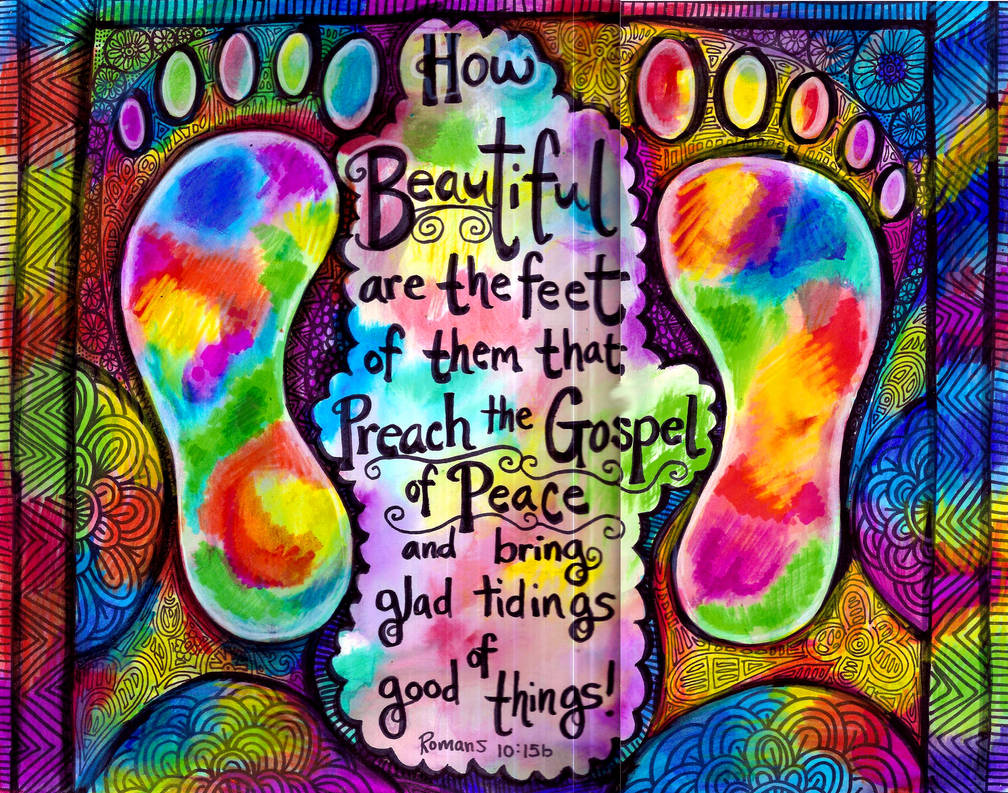
Beautiful Feet (Romans 10:15b-21)

As it is written: “How beautiful are the feet of those who bring good news!”

But not all the Israelites accepted the good news. For Isaiah says, “Lord, who has believed our message?” Consequently, faith comes from hearing the message, and the message is heard through the word about Christ. But I ask: Did they not hear? Of course they did:

“Their voice has gone out into all the earth,
    their words to the ends of the world.”

Again I ask: Did Israel not understand? First, Moses says,

“I will make you envious by those who are not a nation;
    I will make you angry by a nation that has no understanding.”

And Isaiah boldly says,

“I was found by those who did not seek me;
    I revealed myself to those who did not ask for me.”

But concerning Israel he says,

“All day long I have held out my hands
    to a disobedient and obstinate people.” (New International Version)

“Beautiful” is not a typical description of anybody’s feet. That’s because feet are kind of gross. Feet stink. They get dirty and itchy; they’re often calloused and downright nasty looking. And no one comments that their feet feel good. People’s feet rarely feel that way.

It seems to me that feet are an apt metaphor for the bringing of salvation, of good news.

The Christian good news is this: There is salvation – forgiveness of sins – through Jesus Christ; and it is accessed by faith.

“Salvation” is a term which perhaps gets overused by Christians to the point that it becomes misunderstood and/or taken for granted. When that happens, it only becomes “meh” news and is no longer good news. For some, it’s a bit like feet – they’re there, but they hurt too much. We don’t think much about our feet until the corns, the bunions, or the toenails bother us. There’s a “meh” relationship to the foot.

In Christianity, the triune God has conspired within himself to bring us salvation. The good news is that God the Father has mercifully sent God the Son for the rescue of the entire world from sin, death, and hell; and Father and Son have further sent God the Holy Spirit to help us respond and live by faith.

Even back in the Old Testament, with the prophet Isaiah, such a merciful deliverance was predicted. Isaiah’s description of the life and rejection of the Suffering Servant wondered if faith would happen in response to salvation. Would they really see it as “good” news? Can feet really be beautiful?

Who has believed our message
    and to whom has the arm of the Lord been revealed? (Isaiah 53:1, NIV)

The Apostle Paul, knowing a thing or two about suffering, walking a lot of missionary miles with his feet, was confident that, indeed, faith is awakened in the hearing of the message. The message is good news, and it will be received. Good news has to be proclaimed before it can take hold.

So faith comes from what is heard, and what is heard comes through the word of Christ. (Romans 10:17, NRSV)

Good news has to be announced up-close and personal. It takes getting on our two feet, walking across the street, across the room, or across the world to bring it. That’s because salvation is relational. The message of salvation is there amongst people; it has always been deep within them, as those created in the image and likeness of God.

The heavens are telling the glory of God,
    and the firmament proclaims his handiwork.
Day to day pours forth speech,
    and night to night declares knowledge.
There is no speech, nor are there words;
    their voice is not heard;
yet their voice goes out through all the earth
    and their words to the end of the world. (Psalm 19:1-4, NRSV)

In the book of Romans, we see Jewish Christians and Gentile Christians together in one church. Historically, the Jews were God’s people – the insiders – and the Gentiles were not a people, the outsiders. Now the Gentiles are included and are no longer outsiders. Not all the insiders were okay with this situation.

In the Old Testament, Moses predicted insider Israel’s overall response to this situation of feet walking amongst the Gentiles and announcing the good news of salvation.

They have roused my jealousy by worshiping things that are not God;
    they have provoked my anger with their useless idols.
Now I will rouse their jealousy through people who are not even a people;
    I will provoke their anger through the foolish Gentiles. (Deuteronomy 32:21, NLT)

The prophet Isaiah also spoke of Gentile inclusion into God’s saving activity; and the Jewish response to salvation for them:

I was ready to respond to those who didn’t ask.
    I was ready to be found by those who didn’t look for me.
I said, “I’m here! I’m here!” to a nation
    that didn’t call on my name.
I extended my hands all day
    to a rebellious people
        walking in a way that isn’t good,
        following their own plans.” (Isaiah 65:1-2, CEB)

This in no way is meant to be hard on ancient Israelites and the Jewish people. It is really a commentary on including others who are different, what God thinks about it, and the challenge this poses to those holding onto the status quo.

Throughout all of biblical history, into the past two thousand years of church history, and even today, those who consider themselves as God’s people, the insiders, tend to be blinded by the privileges bestowed on them by a gracious God. And they usually think of only one thing: To preserve their status and their spiritual monopoly by excluding others who are different.

It is a hardening of the heart – or maybe the calloused feet – that does not want to recognize that certain persons and people groups can be saved and included as God’s people alongside the rest.

Fortunately, the Apostle Paul, a Jewish Christian, longed for all to be saved and to come to a knowledge of God. He himself wanted to know Christ and “be found in him, not having a righteousness of my own that comes from the law, but that which is through faith in Christ—the righteousness that comes from God on the basis of faith.” (Philippians 3:19)

Salvation is neither attained through strict observance of the rules, nor by being a good or nice person. It is graciously given by the God who came and whose feet walked amongst us. Deliverance comes through an acceptance by faith in the Son of God who loved us and gave himself for us – including people who others might consider as outsiders or unworthy of it.

From my vantage point, the feet that bring a gracious message of good news for all are truly beautiful.

Almighty God, Father of all mercies, we give you humble thanks for your goodness and steadfast love to all kinds of people. We thank you especially for your immeasurable love in the redemption of the world by our Lord Jesus Christ. And, we pray, give us such an awareness of your mercies, that with truly thankful hearts we may show forth your praise, not only with our lips, but in our lives, by giving ourselves to your service, and by walking before you in holiness and righteousness all our days. Amen.

Good News Is for Everyone (Isaiah 56:1, 6-8)

This is what the Lord says:

“Maintain justice
    and do what is right,
for my salvation is close at hand
    and my righteousness will soon be revealed….

And foreigners who bind themselves to the Lord
    to minister to him,
to love the name of the Lord,
    and to be his servants,
all who keep the Sabbath without desecrating it
    and who hold fast to my covenant—
these I will bring to my holy mountain
    and give them joy in my house of prayer.
Their burnt offerings and sacrifices
    will be accepted on my altar;
for my house will be called
    a house of prayer for all nations.”
The Sovereign Lord declares—
    he who gathers the exiles of Israel:
“I will gather still others to them
    besides those already gathered.” (New International Version)

Issues of identity

Ever since the Jewish people existed – for the past 4,000 years – there have been other people and other nations who have conquered them, displaced them, and have even tried to annihilate them altogether, several times throughout history.

A seminal experience for ancient Israel was when God’s temple was destroyed and the people taken into exile in Babylon. Generations later, many faithful Jews returned to Jerusalem to rebuild and reform under Nehemiah and Ezra.

Undergoing defeat, occupation, and oppression can and will do a great deal of psychological, emotional, and spiritual harm. And when it happens repeatedly, it’s easy to understand how any group of people might wonder: “Are we still God’s people? Have so many years of being in other places made us different? Who are we right now?”

These are questions of identity. For many Jews, since God allowed them to be conquered, because they did not obey the covenant, then now is the time to double-down on following the rules and proving they are truly God’s chosen people. So much so, that some (not all) insisted that their identity can only be maintained by radically separating themselves from everyone and everything foreign that is not Jewish. 

We can understand how a vulnerable people who have been attacked and conquered would be suspicious about welcoming outsiders. In fact, any sort of hospitality could be seen as a betrayal of their own struggle, and a deviation from their sense of community, identity, and integrity. 

Diversity and inclusion isn’t warm and fuzzy

So, when God comes along and shares a plan of bringing foreigners to the holy mountain, it’s scandalous. The people don’t see this as a wonderful moment of everybody getting to together, singing kumbaya, and letting bygones be bygones. Nobody in Israel is saying, “Lord, please let us gather together with a bunch of foreigners, strangers, aliens, and gentiles!”

Quite the opposite. Instead, they start circling the wagons to survive and maintain and preserve their Jewish identity. Isaiah’s message challenged the people to their core. It was not a popular idea – even coming from God – of including the other. Such change was a threat.

Welcoming strangers can be upsetting

Whenever I walk through neighborhoods in major cities and see banners in yards that say, “All Are Welcome!” and churches that emblazon that message on their signage, I wonder if they really understand what they’re saying. There are many folks who expect welcoming the stranger to feel good, to be rewarding and connect us to one another. There may be romantic notions of connecting with others with idyllic visions of new people folding seamlessly into who we already are.

The reality is typically much different than that. We are surprised and disheartened when others don’t think or act like we do, and having them around feels awkward. They’re upsetting the status quo and making the group into something I don’t like. It might be something like your crazy uncle who shows up on holidays and makes everything weird. 

The thing we must face and contend with is this: Strangers, foreigners, immigrants, and anyone different from ourselves, often bring God’s own message to us, coming in amongst us to disrupt and transform. Strangers bring strange practices; foreigners bring foreign worldviews; and different people bring different practices and ideas we aren’t familiar with. But why in the world would we ever be surprised that strangers are strange!? 

What in God’s name is going on?

On God’s holy mountain, people are gathered around values, ethics, and obedience. Community and being together with the Lord is defined by faith, and not by simply signing off on a list of approved beliefs and doctrinal statements. God makes it clear that faithfulness, even of foreigners, will determine who is brought into the house of prayer for all people. Deliverance is offered to those who walk the walk and don’t just talk the talk.

What’s more, deliverance does not involve revenge, nor assurances that bad things will never happen again. Instead, salvation means freedom to pray and be connected to God. This is what God wants. And so, the Lord will bring and gather faithful people from all over – both Jew and Gentile. They will all dwell together in God’s house with much joy.

An invitation for belonging

We find words in today’s text having to do with a sense of belonging: house, accepting, prayer, gather. Isaiah puts forth a compelling vision of life with God, where we belong and have community. At the heart of God is a hospitality which invites all kinds of people to come and enjoy the divine presence and being with one another.

At the time of Christ’s incarnation, the angels showed up and announced good news of great joy to all people. And yet, far too many persons, perhaps out of sense to guard against outsiders hurting them, turn this gracious message on it’s head by announcing bad news of great judgment to all people that aren’t like me and don’t think like me.

Christ’s Church has struggled through its history to invite and include the other, and to uphold this basic message of gracious good news for everyone.

From the Council of Jerusalem that met to decide whether one ought to become a Jew first in order to be a Christian (Acts 15), to withholding membership to African Americans in certain churches in the 20th century, to the just plain ignoring of the poor and marginalized in many places, we must be intentional and deliberate about reaching and ministering to all people.

The joy of salvation is that I do not need to jump through certain spiritual hoops to enter into Christianity, nor be a certain kind of person. The church is not an exclusive club of one particular sort of people based in race, gender, ethnicity, class, spiritual pedigree, or even certain preferences on issues. Through repentance and faith in Jesus, all may come to God.

All people have intrinsic worth as individuals created in the image of God, and therefore need the attention of Christians in bringing the gospel to them. It is much too easy to ignore people we do not understand and who are different from us, or to look down on those who do not agree with me on disputable matters.

When it comes to the good news of Jesus, having people out of sight does not mean we keep them out of mind. Too many people are often off the radar of many churches for a variety of reasons, not the least of which is because the poor and needy have to compete with the wealthy and powerful for attention. To intentionally reach and minister to a different class or generation or race requires much love and many resources.

How big is your inner space?

Jesus had a big enough inner space to accommodate prostitutes, drunks, tax collectors, and a whole variety of sinners. Do you and I have a big enough space to allow people in our lives who are not like us, without feeling threatened or insecure? The Pharisees feared being contaminated if having table fellowship with such people; the Sadducees were afraid of losing their religious power if the status quo was changed to focus on others; and the Zealots feared continued Roman domination if Jesus kept up spending his time in graciousness to all kinds of sinners. So, all the religious people killed him.

The gospel of Jesus is good news of great joy for everyone. We are to work together to propagate this message by having the shared purpose of evangelism to everyone without discrimination. When we engage in this critical endeavor together, there is tremendous joy. We are meant to gather on God’s holy mountain and share with all sorts of people.

Blessed Lord God, through your Son you commanded us to go into all the world and proclaim good news to every creature. Increase our faith and zeal, that we may more earnestly desire the salvation of all people.

We confess that our hearts are often indifferent and dull to your cry of mission. Forgive our callousness and judgmentalism toward others, and by your Holy Spirit fill us with a burning zeal to bring light into darkness. Give us loving hearts, sincerity of speech, and holiness of life.

Knowing that this world, as it is now, will not last forever, drawing to a close, may we by your Spirit’s prompting, support the mission of this church with our personal witness, our earnest prayers, and our sacrificial gifts. Grant that through us many may be included on your holy mountain, through Jesus Christ, your Son, our Lord, who with you and the Holy Spirit reign as one God, now and forever. Amen.

I Am with You (Isaiah 43:1-7)

The Train Crossed the Red Sea, by Marc Chagall, 1966

But now thus says the Lord,
    he who created you, O Jacob,
    he who formed you, O Israel:
Do not fear, for I have redeemed you;
    I have called you by name; you are mine.
When you pass through the waters, I will be with you,
    and through the rivers, they shall not overwhelm you;
when you walk through fire you shall not be burned,
    and the flame shall not consume you.
For I am the Lord your God,
    the Holy One of Israel, your Savior.
I give Egypt as your ransom,
    Cush and Seba in exchange for you.
Because you are precious in my sight
    and honored and I love you,
I give people in return for you,
    nations in exchange for your life.
Do not fear, for I am with you;
    I will bring your offspring from the east,
    and from the west I will gather you;
I will say to the north, “Give them up,”
    and to the south, “Do not withhold;
bring my sons from far away
    and my daughters from the end of the earth—
everyone who is called by my name,
    whom I created for my glory,
    whom I formed and made.” (New Revised Standard Version)

God is for us, not against us. The Lord is with us. In fact, a healthy way of viewing the entirety of Holy Scripture is to see it communicating a singular message that divine presence is always there, always a given. Which, then, allows us to respond with faith and trust, instead of fear and anxiety.

God is with us because God loves us. Contrary to how many folks were raised in the church, the Lord is not a continually angry Being. God isn’t like the perpetually upset parent who always finds fault with the child. Rather, the God of Scripture is Love itself, alive and flamed with a desire to gather humanity within a protective brood, much like a concerned mother hen.

“Be still, and know that I am God!
    I am exalted among the nations;
    I am exalted in the earth.”
The Lord of hosts is with us;
    the God of Jacob is our refuge.

Psalm 46:10-11, NRSV

“Look, the virgin shall become pregnant and give birth to a son, and they shall name him Emmanuel,” which means, “God is with us.” (Matthew 1:23, NRSV)

Jesus said, “And remember, I am with you always, to the end of the age.” (Matthew 28:20, NRSV)

Beloved, let us love one another, because love is from God; everyone who loves is born of God and knows God. Whoever does not love does not know God, for God is love. (1 John 4:7-8, NRSV)

There are times when our souls can become parched and dry, times when it seems no one quite understands, and as if circumstances might overwhelm the spirit. The best remedy to such times is to fill oneself full of God, of the divine love and presence that is with us. 

Today’s Old Testament lesson is the perfect prescription for those passing through difficulty and/or wondering what lies ahead, fearful of the future. The following is my own translation/interpretation of this encouraging passage of Holy Scripture; may it fortify your soul today and lead you through the sticking points of life:

Now listen up to what the Lord says, the One who created you and formed you:

Don’t be afraid, because I’m the God who has bought you from the auction block with the ultimate price;

            I have called you by name, and you are now mine.

When you are in water over your head, I want you to know that I will be with you;

            and when it seems like you are drowning, please understand that I’ve got you;

when you walk through fiery trials, I want you to know that you will not be burned,

            and the circumstance will not consume you and burn you out.

This will all be true because I am the Lord your God,

            the Holy One, your Savior.

I put everyone around you in their place,

            and there is no one who is in a position to buy you back from me.

Because you are infinitely precious in my eyes,

            and honored, and I love you,

there is nothing I would not give for you,

            nothing I would not do to keep you with me.

Don’t be afraid because I am with you always;

            I will gather all my children from the east and from the west,

            so that you will never be alone on this earth.

In fact, I will command all the ends of this planet of yours

            to not withhold, to bring together every son and daughter from the farthest reaches,

everyone who is called by my name,

            whom I created for my glory,

            whom I formed and made.

You are all in this life together,

            and I, the Lord, am watching over each and every one of you. 

 Bank on it.

Amen.

Divine Affirmation (Isaiah 44:1-5)

The Lord says,

“Listen now, Israel, my servant,
    my chosen people, the descendants of Jacob.
I am the Lord who created you;
    from the time you were born, I have helped you.
Do not be afraid; you are my servant,
    my chosen people whom I love.

“I will give water to the thirsty land
    and make streams flow on the dry ground.
I will pour out my spirit on your children
    and my blessing on your descendants.
They will thrive like well-watered grass,
    like willows by streams of running water.

“One by one, people will say, ‘I am the Lord’s.’
    They will come to join the people of Israel.
They each will mark the name of the Lord on their arms
    and call themselves one of God’s people.” (Good News Translation)

Who do you believe you are, at the very core of your being?

Your very essence, the person you are deep down inside, is worthy of divine blessing and belonging. You are loved by God.

In a world of abject hate and injustice, there remains within the soul the majesty of people created in the image and likeness of God. There is still hope for us, that is, if we will receive water in our thirst and be bathed in the reality of who we are. And I take a decidedly Christian perspective on that identity.

I am a firm believer in making daily affirmations of truth based upon what God has done for us in Christ. The Christian doctrine of justification means that God has justified us and made us right, along with all creation through the cross of Jesus. This is more than a doctrine to believe, but it is also a reality to be lived into each and every day.

I know it doesn’t always feel like we belong or that we are blessed. Many of our adverse situations may cause us to wonder about whether God accepts us, or not.

As we go through life, there are those who don’t like the way we do things, or are upset about our views on particular subjects, or think that we ought to be doing something we aren’t doing. In such times, my initial reaction might be to justify myself – to defend my words or my silence, my actions or inactions, and my work. 

I am not yet what I will be someday, but I am not what I used to be either.

These sorts of encounters can easily leave us feeling insecure, like a vulnerable teenager trying to look cool in the middle of his awkwardness. I even once had a person complain to me that on a particular Sunday my shoes were not shined well enough. For a person like me who is borderline obsessive-compulsive, that was not an easy mental slough-off; I really wanted to beat myself up over the lack of shiny shoes!

The truth of the Christian life is that I have no need to justify myself. Why? Because God has already justified me in Christ. 

The following are some regular affirmations we can tell ourselves for truth and righteousness to awaken within our souls:

  1. I thankfully acknowledge and accept who I am in my unchangeable physical appearance which God has uniquely designed for me, so that the Lord can bring a special view to others through my life. (Psalm 139:13-18; 2 Corinthians 10:12, 12:9-10)
  2. I thankfully acknowledge and accept that I am unconditionally loved and treasured by God, who wanted a relationship with me, and to whom I belong. (Romans 8:31-32, 38-39; John 6:44, 17:23)
  3. I thankfully acknowledge that I am unconditionally accepted as a worthy person to God, because of Jesus Christ, in whom I trust for all things. (Ephesians 1:16; Romans 4:6-8; Isaiah 61:10)
  4. I thankfully acknowledge that I am a secure person because God cares about me and asks me to trust divine leadership and goodness. (Romans 8:28; Matthew 6:25-33; Proverbs 3:5-6; Psalm 37:3-7, 23)
  5. I thankfully acknowledge that I am in a process of growth. My sinful nature is part of my personality, but it is not who I am. I consider myself dead to the sinful nature and alive and responsive to God. I am not yet what I will be someday, but I am not what I used to be either. I accept my struggles with guilt and shame as opportunities to depend more on God and Christ’s justification for me. (1 Peter 2:1-3; Romans 6:11; 2 Corinthians 10:13; Galatians 5:16)
  6. I thankfully acknowledge and accept that I am a competent person who is adequate to fulfill God’s will successfully each day. My strength is supplied by God’s Holy Spirit, who works through me to make an important and eternal impact on others with the love of God and the message of Christ. (Philippians 2:13, 4:13; 1 Corinthians 10:13; 1 Peter 4:10-11; 2 Corinthians 5:20)

We are loved, accepted, and cared for by God. And we have important lives to live. Therefore, we need not threatened or devastated by the way some people treat us. 

Others do not determine our self-worth. We might be pained when others let us down, but it is not the end of the world. We can continue to act responsibly toward them without demanding that they understand us, accept us, or respect us.

Many if not most people try to find acceptance and significance through family, peers, faith communities, achievements, appearance, work, etc. Yet, none of those sources can satisfy or fulfill our basic personal needs. This is why there are so many people who feel resentment, anxiety, guilt, or a vague sense of emptiness and even despair.

Yet when a person trusts God and exhibits faith in Christ, as the true source of justification in order to satisfy basic needs, that person can learn to regard themself in their new identity with Christ: 

  • Their faith can be trained to believe in and focus on a new self-concept, even in circumstances when they feel the pain of rejection. 
  • They can rebound from disappointment and develop resilience. 
  • They can forgive others and continue to serve others without dependence upon positive feedback from another.

To be justified by Christ means that we can live in the security of being a child of God without depending on others to do for us what God has already done through Jesus. Learning to live in this way takes daily affirmations of faith and truth.

Glory to the Father and to the Son and to the Holy Spirit; as it was in the beginning is now and shall be forever. Our faith and hope is not in vain, because God’s love has been poured into our hearts. Amen.