Divine Intervention (Isaiah 1:24-31)

The Siege and Destruction of Jerusalem, by David Roberts (1796-1964)

So now, listen to what the Lord Almighty, Israel’s powerful God, is saying: “I will take revenge on you, my enemies, and you will cause me no more trouble. I will take action against you. I will purify you the way metal is refined, and will remove all your impurity. I will give you rulers and advisers like those you had long ago. Then Jerusalem will be called the righteous, faithful city.”

Because the Lord is righteous, he will save Jerusalem and everyone there who repents. But he will crush everyone who sins and rebels against him; he will kill everyone who forsakes him.

You will be sorry that you ever worshiped trees and planted sacred gardens. You will wither like a dying oak, like a garden that no one waters. Just as straw is set on fire by a spark, so powerful people will be destroyed by their own evil deeds, and no one will be able to stop the destruction. (Good News Translation)

Judgment does not mean that you need to leave a part of yourself behind in order to be accepted or belong. Judgment isn’t about stuffing down emotions and denying certain thoughts about things because you were told to.

Rather, judgment – divine judgment – is for those leaders, and the persons who support such leaders, who tell people they have to live a particular way, be a certain way, and think in the same way the leaders say you have to think.

Isaiah’s prophecy is first and foremost directed toward leaders – political leaders and religious leaders. Indeed, the nation of Israel had gone down a path of worship that God never condoned nor wanted.

And the Lord put the primary blame squarely upon rulers who led their people in unacceptable ways by telling them things that God never wanted. As a result, the nation as a whole, lived unjustly and unrighteously.

God was determined to do something about the situation of bad leadership: Replace the rulers and advisers. Get rid of them, just like a metallurgist gets rid of impure and worthless dross.

A lot of things in life rise and fall because of leadership. The character and competence of a leader is of upmost importance. God raises up particular people to lead. So, leaders and rulers are expected to fulfill their mandated duty with all diligence and decorum.

The city of Jerusalem fell to the invading Babylonians in 586 B.C.E. All of the Old Testament prophetic books are related to that seminal event in one way or another.

Jerusalem’s destruction, according to the prophets, had a direct relationship to the failure of political kings and religious priests to lead the people according to God’s law. And that failure was specifically tied to the lack of religious piety and leadership performance amongst the rulers of the land.

Indeed, individuals are responsible for their own thoughts and words and actions. Yet, at the same time, the leaders of a city and a nation are also responsible for whether they are leading the people into ways of justice and equity, or injustice and prejudice.

People in responsible positions of authority are to take ownership of the sort of culture they develop. And when people, as a whole, have rude and irresponsible words and actions, such behavior isn’t only on individuals – it’s on the leaders, as well.

God will hold everyone accountable – especially leaders = for what they have done, and not done, to foster a just and right society.

In the time of the prophets, the majority of those in authority led the people into a degenerate state. It had become so bad that divine judgment would intervene in order to burn out the evil, and remove the worthless dross of incompetent and inconsiderate leadership.

Only through the wholesale replacement of rulers and advisers could restoration and regeneration ever take place.

Fortunately, the Lord is a God of justice, mercy, and grace. The Lord is a redeeming God. And the theme of redemption runs throughout the Book of Isaiah. Yet, for a nation to be redeemed, it will require an elimination of rebellious evil.

The wrath of God exists precisely because of the love of God. Since the Lord has a steadfast, committed, and covenantal love for the people, God will render judgment, purging hate and injustice from the land.

When God decrees something, no one can stop it. And when God decrees destruction upon the material things which promote illegitimate worship and public injustice, you can be absolutely sure that it’s going to happen.

No one, no city, and no nation is truly autonomous, in the sense that they can do whatever the heck they want to do, regardless of whether it is right or just, or not. There is no person and no government who is free to indulge in their own selfish agenda.

We have a purpose and a mandate as people on this earth, to care for this world – the people and the environments we inhabit.

All of the ways in which individuals, groups, and governments cheapen and degrade human dignity and environmental worth, puts everyone at risk of survival and a good life on this planet.

Unjust and dysfunctional systems and structures must be purged of their impurities. And that means, in many cases, a new order of things must occur.

If we cannot learn to play well with one another, then playtime will be over; and God will call us back into the house and make us sit in the corner for a long time – or worse.

Whenever leadership fails to be neighborliness, then we have a huge problem.

Our world suffering divine devastation of all the things we know and love may not be far behind. And, quite frankly, it will be our own damn fault – and not somebody else’s.

However, in the prophetic biblical tradition, devastation and destruction never have the last word. There is always hope – a confident expectation that good, right, and just forms of social, economic, and religious communities will function yet again.

There are good leaders waiting in the wings. It’s just that no one yet sees or knows them. But God will raise them up at the proper time, to accomplish good purposes in communities, churches, families, and governments everywhere.

A divine intervention will make the last be first, and the first be last.

May it be so, for the blessing of the world, and to the glory and praise of God. Amen.

The Parable of the Tenants (Mark 12:1-12)

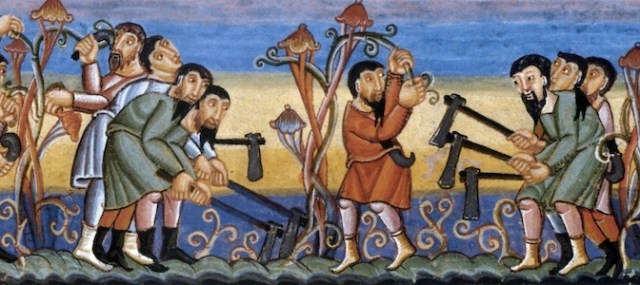
Parable of the Vineyard Workers, from Unknown Artist in the Middle Ages

Then he began to speak to them in parables. “A man planted a vineyard, put a fence around it, dug a pit for the winepress, and built a watchtower; then he leased it to tenants and went away. 

When the season came, he sent a slave to the tenants to collect from them his share of the produce of the vineyard. But they seized him and beat him and sent him away empty-handed. 

And again he sent another slave to them; this one they beat over the head and insulted. Then he sent another, and that one they killed. And so it was with many others; some they beat, and others they killed. 

He had still one other, a beloved son. Finally he sent him to them, saying, ‘They will respect my son.’ But those tenants said to one another, ‘This is the heir; come, let us kill him, and the inheritance will be ours.’ So they seized him, killed him, and threw him out of the vineyard. 

What then will the owner of the vineyard do? He will come and destroy the tenants and give the vineyard to others. Have you not read this scripture:

‘The stone that the builders rejected
    has become the cornerstone;
this was the Lord’s doing,
    and it is amazing in our eyes’?”

When they realized that he had told this parable against them, they wanted to arrest him, but they feared the crowd. So they left him and went away. (New Revised Standard Version)

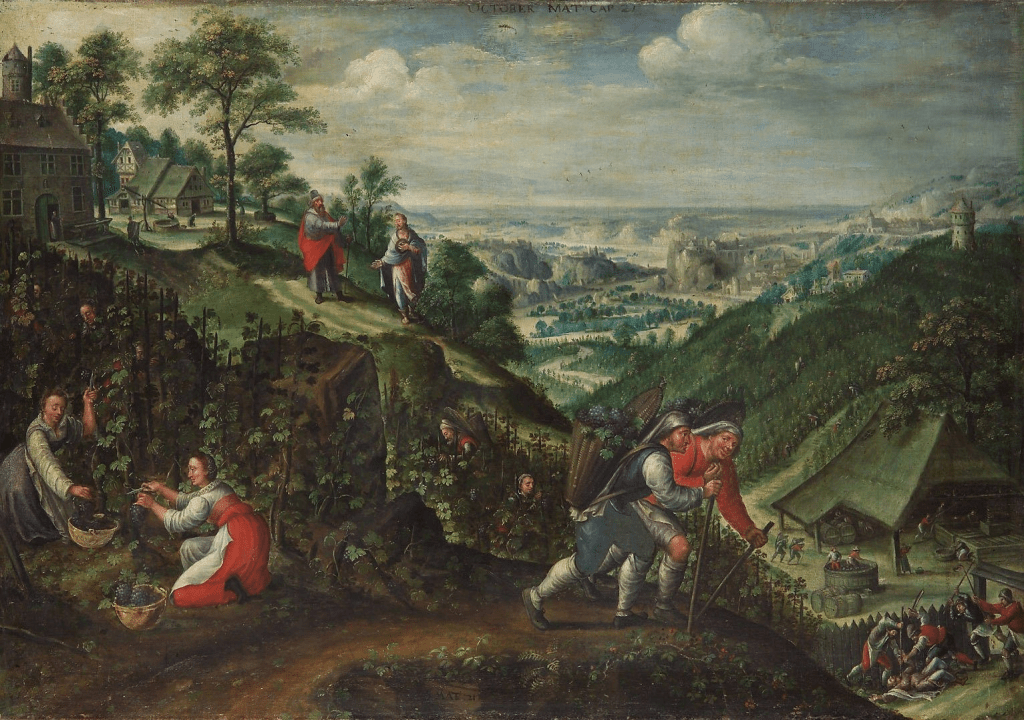
Parable of the Wicked Tenants, by Maarten Van Valckenborg (1535-1612)

Jesus was at the temple in Jerusalem. While there, the religious leaders confronted him over his supposed ministerial authority. Jesus, rather than become defensive, took the initiative by telling a parable.

The parable’s imagery comes directly from the second chapter of the prophet Isaiah in the Old Testament. It, too, was a parable concerning a vineyard. Isaiah leveled an accusation against the entire nation of Israel.

Jesus picked up the same imagery and directed his accusation against the people in front of him, the Jewish religious leaders. The connection between the parable of Isaiah and the parable of Jesus would not have been lost on those leaders.

In many ways, I can relate to the parable’s setting in the land. I grew up on a farm, and appreciate the deep connection of working the land and caring for it. I know something of owning land and having renters work it, since that it was my family did in my parent’s later years.

Anytime there is a relationship between owners, and renters or tenants or servants, it is an unequal relation. And whichever situation you relate to will affect your perspective of the parable.

If you understand what it means to be a landowner, with all of the rights and responsibilities of that ownership, and with the people who work that land, then you likely resonate with the landowner in Christ’s parable. You also will likely detest what the tenants in the parable do.

Perhaps you relate more to being a renter or a tenant. Having an understanding of what it means to rent from another, you may likely see the how the tenants in the parable think, and why they do what they do.

Having personal experiences on both sides of the owner/renter situation – for both good and bad – I can easily see how the violence in the parable could happen. I have my own stories of justice and injustice when it comes to each, the owners and the renters/tenants.

Much like today, ancient power dynamics were a fundamental part of life for many people. And those relations were, and are, fraught with all sorts of inequality.

Christ’s parable is a rather violent story. It’s not really bedtime reading. Notice that the owner has slaves, whom he sends to collect what is due him. Several of them are beaten and/or killed.

There is no backstory to the tenants situation. Yet, at the time of Christ’s ministry, there were many lower class folk who lost their land to unscrupulous owners, in a system of inequity. It’s possible that some of the men Jesus was talking to owned some land. And the religious leaders in the Gospels are rarely presented in a positive light.

Even today, there are violent struggles regarding land, especially in the Middle East. And the power dynamics and inequities are rife with injustice which is claiming to be justice. There are no easy answers to quelling the constant violence.

Feelings of hatred, anger, and fear are common. The desire to kill too often overcomes the desire for life. A group of people are outraged for being the brunt of murder, killing, and evil. Another group already feels neglected and have been the victims of unjust usury and death. They feel justified in their violence toward those they view as perpetrators.

Imagine how people on this earth, such as Palestinians, Israelis, Native Americans, and Ukrainians – just to name a few – feel about land. Land involves life, because the land has water, the potential for farming, trees, and a place to live. Thus, whoever controls land, in many ways, controls life. Agribusiness owns large chunks of land in the United States – and not the smaller family farms. Ah, but that is a topic for another time….

In Christ’s parable, everybody suffered in some way. Servants died. The landowner’s son died. The tenants were destroyed. Life was permanently altered for all involved.

Is that how any of us really want to live?

If we take a theological perspective, God owns everything. But we think we own the land and its resources. We believe we have the right to do whatever we want with it. And that is where the problem arises.

Until we truly hold to the notion that we humans are a society of equals, and that we are all subject to a God who owns everything, then we will continue to experience the effects of injustice, war, and death.

Can we, at least, change our minds? Yes, we can. And Christians are called to do just that:

Do not be conformed to this age, but be transformed by the renewing of the mind, so that you may discern what is the will of God—what is good and acceptable and perfect.

For by the grace given to me I say to everyone among you not to think of yourself more highly than you ought to think but to think with sober judgment, each according to the measure of faith that God has assigned. (Romans 12:2-3, NRSV)

The religious leaders of Christ’s day needed to change their minds about Jesus. Yet, no matter what they did, he would still become the cornerstone, if they rejected him as just one of the stones in the edifice of God’s kingdom.

Today, the parable is still meant to speak to people, to you and me. We have the chance to embrace the Prince of Peace, and walk in the way of peace, not violence. We still yet have the opportunity to be peacemakers, and live in a way that promotes human flourishing, and not human carnage.

If, like the parable of the prophet Isaiah, Christ’s parable is meant to speak to everyone, then it is most necessary that we heed the words of Jesus.

Almighty God our heavenly Father, guide the nations of the world into the way of justice and truth, and establish among them peace, which is the fruit of righteousness, so that they may become the kingdom of our Lord and Savior Jesus Christ. Amen.

Truth Stumbles in the Public Square (Isaiah 59:9-19)

Therefore justice is far from us,
    and deliverance does not reach us;
we wait for light, but there is only darkness;
    and for brightness, but we walk in gloom.
We grope like the blind along a wall,
    groping like those who have no eyes;
we stumble at noon as in the twilight,
    among the vigorous as though we were dead.
We all growl like bears;
    like doves we moan mournfully.
We wait for justice, but there is none;
    for salvation, but it is far from us.
For our transgressions before you are many,
    and our sins testify against us.
Our transgressions indeed are with us,
    and we know our iniquities:
transgressing and denying the Lord
    and turning away from following our God,
talking oppression and revolt,
    conceiving lying words and uttering them from the heart.
Justice is turned back,
    and deliverance stands at a distance,
for truth stumbles in the public square,
    and uprightness cannot enter.
Truth is lacking,
    and whoever turns from evil is despoiled.

The Lord saw it, and it displeased him
    that there was no justice.
He saw that there was no one
    and was appalled that there was no one to intervene,
so his own arm brought him victory,
    and his righteousness upheld him.
He put on righteousness like a breastplate
    and a helmet of salvation on his head;
he put on garments of vengeance for clothing
    and wrapped himself in fury as in a mantle.
According to their deeds, so will he repay
    wrath to his adversaries, requital to his enemies;
    to the coastlands he will render requital.
So those in the west shall fear the name of the Lord,
    and those in the east, his glory,
for he will come like a pent-up stream
    that the wind of the Lord drives on. (New Revised Standard Version)

We in the United States of America are in a presidential election year. Soon Americans will be voting for their choice of president, as well as an array of federal, state, and local candidates on the ballot.

For many, these four year cycles of elections bring a lot of anxiety, dread, and perhaps most of all, anger. Television commercials and media outlets overflow with the most egregious forms of logical fallacies, and finger pointing, one could imagine.

According to the Pew Research Center, public trust in the U.S. federal government is at 22 percent. That figure is slightly up from 5-10 years ago when it hit an historic low of 15 percent. To put that in perspective, the public trust was at 73 percent in 1960, and 36 percent when Richard Nixon resigned from office due to the Watergate scandal.

In some ways, our contemporary situation is akin to the situation of ancient Judah when Isaiah was prophet. Peace and protection, justice and righteousness, were hard to come by. There was no real trust in government.

The Judeans of the time blamed everyone but themselves for their social and political troubles. They even blamed God. Citizens were not taking responsibility to effect good and right in the land.

It appears that nobody was accepting accountability for their own junk, and blaming God and others for their governmental woes. So, they turned away from each other, and God.

Politics, today as in Isaiah’s day, has become less about the vocation of statecraft and unselfish public servants promoting the welfare of citizens; it has become more about winning elections and possessing power. 

A party spirit rules the day, where, in the Unites States, Republicans and Democrats are more divided than ever with less and less ability to truly listen to one another in order to advance genuine justice, ethical righteousness, and social peace within both the nation and the world.

We, as citizens of both our local regions and of the world, must avoid getting sucked into the vortex of acrimonious speech and hate-filled rhetoric. 

Christians, especially those who desire to live and love like Jesus, need to be at the forefront of forsaking the hypocrisy of saying one thing and doing another; of envying power in order to satisfy personal agendas; and, of believing that malicious talk is justified if it accomplishes my wants and needs. 

We are not to keep looking for politicians, and everyone else whom we disagree with, to change. Rather, we ourselves are to practice repentance and allow the grace of God to transform and renew us. 

If what we speak in the public square is selfish and deceitful, we have no further to look than within, when it comes to turning from evil. A slow, careful, and serious reading of the prophet Isaiah becomes quite necessary. If it does not lead to repentance, we only have God’s displeasure to anticipate.

So, instead of continually insisting that others change or move over, let’s focus on us and seek the following:

  • Seek our better angels of humility, tolerance, and patience to guide our public discourse.
  • Open our eyes to see the image of God in others who are different from us and who see the world differently than we do.
  • Embrace civility and basic human respect for all persons, no matter who they are, as our presuppositions to all conversations.
  • Develop good listening skills so that we aren’t misinterpreting and misrepresenting another’s viewpoint.
  • Be willing, within our own communities of faith, to participate and worship together as the one people of God, without assigning other identities to each other which are not helpful.
  • Enlarge our hearts so that we are big enough people to hold the differing perspectives and politics of others without demonizing them.
  • Default to grace when we aren’t sure what to do say or do.

The Lord will not contend forever with injustice and unrighteousness in the world’s politics, including the extremely local politics of church, family, and neighborhood. Divine intervention cuts both ways, bringing deliverance and freedom, as well as judgment and retribution.

Let us, then, be found to be truthful and honest in all our words and ways; encouraging and helpful in all our public rhetoric and service. Let us seek the peace of everyone, both near and far.

God of truth and justice, you have every right to judge the world. Yet, instead of destroying the earth, you sent your Son to redeem lost humanity to yourself. May I, along with every creature you have made, come to our senses and speak truth with love; and act with integrity so that there is again righteousness throughout the land. Amen.

Against Arrogance and Injustice (Isaiah 47:1-9)

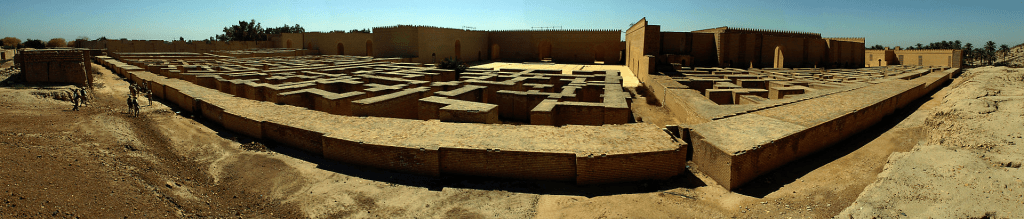
Ancient ruins of Babylon in present day Iraq

City of Babylon,
You are delicate
    and untouched,
    but that will change.
Surrender your royal power
    and sit in the dirt.
Start grinding grain!
    Take off your veil.
Strip off your fancy clothes
    and wade across rivers.
You will suffer the shame
    of going naked,
because I will take revenge,
    and no one can escape.
I am the Lord All-Powerful,
the holy God of Israel.
    I am their Savior.

Babylon, be silent!
    Sit in the dark.
No longer will nations
    accept you as their queen.
I was angry with my people.
So I let you take their land
    and bring disgrace on them.
You showed them no mercy,
but were especially cruel
    to those who were old.
You thought that you
    would be queen forever.
You didn’t care what you did;
it never entered your mind
    that you might get caught.

You think that you alone
    are all-powerful,
that you won’t be a widow
    or lose your children.
All you care about is pleasure,
    but listen to what I say.
Your magic powers and charms
    will suddenly fail,
then you will be a widow
    and lose your children. (Contemporary English Version)

The God of the Bible is not merely a local deity that the ancient Hebrews worshiped way back in history. From the biblical standpoint, God is the Lord of the universe, and the Creator of heaven and earth. Therefore, every nation on earth is accountable to the Divine Sovereign of all, the right and just Judge of the world.

Divine judgment extended to ancient Babylon. Just because they may not have worshiped and served the God of the Israelites, doesn’t mean they were off the hook for their violence and injustice.

For every nation and each person on this earth will have to give an account of their life and existence before God.

The prophet Isaiah likened Babylon to a princess who becomes a slave girl. It’s as if God is taunting her, putting her in her place; showing her who is really in charge.

Babylon had trusted in her own cleverly devised ways of manipulating reality to get what she wanted in this world. But she became helpless, stripped of her power and authority by the One who holds ultimate authority; and holds everyone accountable.

The mocking, taunting, and sarcastic nature of the Lord toward Babylon in Isaiah’s prophecy may seem out of sync with how we understand God. Yet, I invite you to remember how some great injustice of the past was done to you, or someone you care about, from someone with power and authority over you.

Allow me the liberty of reframing and retranslating today’s Old Testament lesson from the vantage of one person’s unjust victimization from another’s position of power and authority, with God exacting divine attention to such an injustice:

“Get off your high horse and sit in the dirt,
    Miss High and Mighty Babylon.
No more doing whatever the hell you want—No! Sit on the ground,
    daughter of Pride and Arrogance.
Nobody will be calling you anymore in order to get things done;
    you won’t be batting your big eyelashes and getting your way with me! So, get used to it.
Get a real job, a job where you have to do what you’ve made others do:
    Dig ditches, scrub toilets, stand at the factory line for hours on end.
You might as well get rid of your fancy clothes,
    and put on some real working gear—because the gig is up, sister.
Your true vulnerability will be on public display,
    and you will feel the criticism and manipulation that you did to others.
Now you have to contend with me. I’m intervening. And I’m taking vengeance.
    No one gets away with treating people like dirt. And if dirt is what you like, dirt is what I’m going to give you.”

Our Redeemer speaks,
    whose name is Yahweh of Armies, The Sacred One:
“Shut up and sit down in the dirt,
    Miss High and Mighty.
Because no one is ever again going to call you
    ‘Boss Lady in charge,’ or ‘Queen of the Empire.’
Believe me, I was angry with my own people,
    and was disgusted with my own children.
Which is why I let them be under your authority;
    but you didn’t show any compassion to them whatsoever.
You treated long-standing reliable people like cogs in a machine,
    and expected them to work at hard labor like they’re young men.
You arrogantly said, ‘I’m Miss High and Mighty!
    I’m here forever, and you will always serve me.’
You took no one seriously, took nothing to heart,
    never thought a wit about the consequences of your actions.
Well, Miss High and Mighty, you better start thinking!
    You’re acting as if you are the center of the universe,
saying to yourself, ‘I’m in charge. There’s nobody but me.
    I will always be in charge, I’ll never lose my authority.’
But two things are going to hit you between the eyes,
    suddenly, on the same day:
Your high position, and your company suck-ups, will be gone, a total loss,
    and your manipulative and gaslighting ways won’t help you, at all.”

Let it be known that the God of Holy Scripture hates injustice, and wants all people everywhere to extend basic human kindness and goodness to one another without prejudice or favoritism.

Individuals and even nations who selfishly grab power and control for themselves, shall have to contend with the ultimate authority in the universe. And that, my friend, is a very good thing for the righteous; and very bad thing for the selfish and arrogant.

Injustice, unfairness, and selfishness will not exist forever. Therefore, it is best for everyone to put their efforts into what lasts, what is permanent and enduring. In the end, peace and righteousness will have an unending rule and reign. Loving relationships will last. God’s justice shall endure.

So, be encouraged, in your own difficult experience and hardship. If you are the victim of another’s positional power used against you, know that the Lord sees, cares, and will do something about it.

Almighty God, who created us in your image: Grant us grace fearlessly to contend against evil and to make no peace with oppression; and, that we may reverently use our freedom, help us to employ it in the maintenance of justice in our communities and among the nations, to the glory of your holy Name; through Jesus Christ our Lord, who lives and reigns with you and the Holy Spirit, one God, now and forever. Amen.