Isaiah 12:2-6 – Grace Changes Us

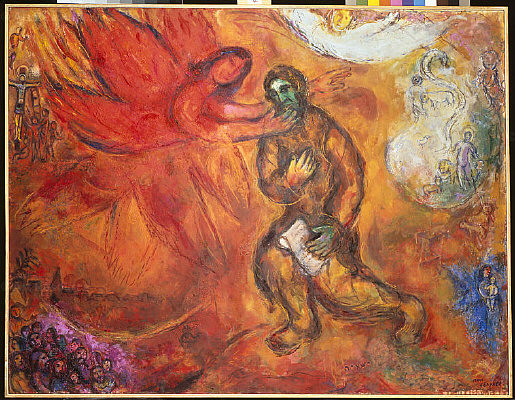
The Prophet Isaiah by Marc Chagall, 1968

“Surely God is my salvation;
    I will trust and not be afraid.
The Lord, the Lord himself, is my strength and my defense;
    he has become my salvation.”
With joy you will draw water
    from the wells of salvation.

In that day you will say:

“Give praise to the Lord, proclaim his name;
    make known among the nations what he has done,
    and proclaim that his name is exalted.

Sing to the Lord, for he has done glorious things;
    let this be known to all the world.
Shout aloud and sing for joy, people of Zion,
    for great is the Holy One of Israel among you.”
(New International Version)

The large Old Testament book of Isaiah is thick with a message of judgment for both Israel and the surrounding nations. The sins of ancient Israel, seven-hundred years before the birth of Christ, were many. The primary offenses were injustice toward the needy; the have’s taking advantage of the have-not’s; and empty worship rituals toward God.

Social and spiritual corruption was rampant. God pleaded with the people through the prophets to stop doing wrong and start doing right by encouraging the oppressed and defending the powerless. (Isaiah 1:10-17)

Although God’s judgment was imminent, via the powerful Assyrian Empire, God would not annihilate the people. God promised a Righteous Branch would grow from the seemingly dead stump of Israel. A child will be born, a Messiah given. There will be hope in Israel. Heartfelt praise, and proclamation of God’s great name, will again fill the air.

For me, what is so remarkable about all this is the grace of God. The Lord made promises to Israel not based upon what they would or would not do; God made promises to the people by God’s own radically free love. This wasn’t a matter of playing Let’s Make a Deal with God saying, “If you get your act together, then I will be good to you.” No, before Israel even had a chance to return to the Lord, God was already choosing to be merciful.

I am absolutely convinced with the firmest conviction possible that the Scriptures of the Old and New Testaments are all about God and God’s own unbounded, unfettered, free, crazy, illogical, and wildly wonderful grace. Because God is love, the Lord constantly goes out of the way to be gracious so that we will be together and enjoy our divine/human relationship.

If we miss the message of God’s grace in the Holy Scriptures, we have missed salvation – because only grace can save us. Without grace, we are lost. Today’s Old Testament lesson is full of praise because it’s a response to the undeserved grace which God freely gives. 

Any Christian preacher worth their salt is a preacher of grace. Grace is the very thing that is distinctive about Christianity. Grace is love that seeks you out when you have nothing to give in return. Grace is recklessly generous. Grace does not use carrot sticks, scorecards, or power politics. Grace never demands – it only gives. 

Grace is unconditional acceptance given to an undeserving person by an unobligated giver. 

That is what God did for Israel… and for us. And when we get a hold of this truth, even a little bit, our hearts become bubblers of praise.

The prophecy of Isaiah is an adventure of God’s reckless love toward unlovable people, which is why it is one of the most quoted books of the Old Testament by Jesus. Jesus came because of grace. 

Jesus came to release us from our obsessive need to be right, our compulsion to be rewarded, and our demands to be respected. 

Because Jesus came to set sinful captives free, life does not have to be a joyless effort to justify and validate ourselves before others. The grace of God in Christ is a game-changer. And with but a glimpse of it, we are forever undone by its mercy.

Grace causes us to praise God.

There was once a pastor who had a three-year old daughter who was going around the house singing the chorus “We Exalt Thee” except that she kept mispronouncing one of the words: “I exhaust thee, I exhaust thee, I exhaust thee, O Lord!” Perhaps she was right. Maybe too many folks are exhausting God with folded arms instead of hands raised in praise and worship.

Grace causes us to trust God.

Grace alleviates our fears. For, if God is for us, who can be against us? God takes care of us despite our weaknesses and failures. 

Grace causes us to have joy in God.

With joy we draw water from the wells of salvation. Jesus is the Living Water we can continually draw from and drink. Grace keeps giving without an end in sight. We get to keep coming to God with an inexhaustible supply of fresh grace.

Grace causes us to give thanks to God in prayer.

Gratitude to God ought to characterize our corporate gatherings. Expressing thanks is more than for the individual in their prayer closet – it is to be offered in the gathered assembly of believers. Grace eliminates self-consciousness altogether because there is nothing to be self-conscious about with God. The Lord has seen you at your worst, and still loves you.

What’s more, we need not be self-conscious about appearing ignorant, looking silly, or not having all the answers in making known among the nations what God has done. If we are influenced by grace, then we can freely speak of God to all kinds of people we encounter. 

“God forbid that I should travel with anybody a quarter of an hour without speaking of Christ to them.”

George Whitefield (1714-1770)

Grace causes us to sing together to God. 

When grace takes hold of a congregation, there is no mumbling of songs – there are loud shouts and singing for joy because God is good! God wants some noisy worship! 

Grace brings such gladness that we don’t care how we appear to other people; we are going to shout, sing, and express our joy! Yes, there is an important place for contemplative, reverent, and reflective worship. And there is also a place for letting go, becoming unhinged, and dancing before Jesus!

The world mostly ignores God. Even some Christians take God’s grace for granted.  Israel’s greatest sin was assuming everything was fine. But it wasn’t. There was no grace. And with no grace there is no God. Eventually, Israel found joy in the most unlikely of places – in exile. God’s grace would transform a terrible time of trouble into raising of voices in song.

Isaiah’s prophecy is about returning to the Lord. The season of Advent is all about God’s relentless pursuit of wayward people – the anticipation of grace coming in the form of an infant – and the bringing of grace to a people living in darkness.

Let us, then, return to the Lord. Let us be captivated by grace. Let us renew our love for Jesus. Let us lose ourselves in praise and adoration of the One who gave everything for us. Let us worship Christ the King. Let us proclaim the name of Jesus as exalted over everything.

Great God of grace, be merciful to us as we limp to you with all of our wounds and brokenness. We have made such a mess of our lives with our bad attitudes, ugly words, selfish actions, and our ignoring of you through it all. So, we come to you with nothing but ourselves in all of our sin. Forgive us, cleanse us, renew us, revive us, refresh us, and reform us according to the ways of Jesus Christ. Thank you for your undeserved grace. We give you praise for the lengths you went to secure our forgiveness. With a joy too deep for words, we humbly offer to you our lives so that the name of Jesus will be exalted in us individually and corporately. Amen.


Isaiah 40:1-11 – The Lord’s Glory Will Appear

Comfort, comfort my people!
    says your God.
Speak compassionately to Jerusalem,
        and proclaim to her that her compulsory service has ended,
    that her penalty has been paid,
    that she has received from the Lord’s hand double for all her sins!

A voice is crying out:
“Clear the Lord’s way in the desert!
    Make a level highway in the wilderness for our God!
Every valley will be raised up,
    and every mountain and hill will be flattened.
    Uneven ground will become level,
    and rough terrain a valley plain.
The Lord’s glory will appear,
    and all humanity will see it together;
    the Lord’s mouth has commanded it.”

A voice was saying:
    “Call out!”
And another said,
    “What should I call out?”
All flesh is grass;
    all its loyalty is like the flowers of the field.
The grass dries up
    and the flower withers
    when the Lord’s breath blows on it.
    Surely the people are grass.
The grass dries up;
    the flower withers,
    but our God’s word will exist forever.

Go up on a high mountain,
    messenger Zion!
Raise your voice and shout,
    messenger Jerusalem!
Raise it; don’t be afraid;
    say to the cities of Judah,
    “Here is your God!”
Here is the Lord God,
    coming with strength,
    with a triumphant arm,
    bringing his reward with him
    and his payment before him.
Like a shepherd, God will tend the flock;
    he will gather lambs in his arms
    and lift them onto his lap.
    He will gently guide the nursing ewes. (Common English Bible)

Advent is a time of longing, hoping, and anticipating fulfilled promises. Meanwhile, in this awkward liminal space, it’s a hard slog.

Most of the Christian’s life is lived in the mundane, yet necessary work of mission. The daily pilgrimage of faith is barely noticed by most people. Our small and seemingly obscure acts of kindness; the discreet gestures of love; and the graciously chosen words of encouragement can be undetected by so many – except for God.

I am sure the ancient Jewish people felt that, for an awfully long time, they were plodding along as faithfully as they could with often little to show for it. However, they knew it would not always be this way. God’s people anticipated that a time was coming when their pedantic service would see the light of day.

I am sure we, too, have times when it feels as if our prayers are only bouncing off the ceiling. In such times, words of comfort and assurance come as a breath of fresh air. When we least expect it, God speaks to us tenderly and with compassion. The Lord steps into our weariness and exhausting work and says, “Enough!”

Whereas our walk with God may often feel like trudging up and down hills, sloshing through muddy valleys, and traversing hard terrain, the proclamation of comfort assures us that it will not always be this way. The way to God will be made level so that we can connect with the Lord post haste.

No matter how much our worldly circumstances break us down, even shattering our expectations and dreams, we carry with us an unflagging vision of wholeness, integrity, and hope. God is our true home, our polestar, our ultimate destiny. Feeling displaced, out of sorts, or like we just do not belong are signs that we long for our place with God.

And when we find our home with God, all might be going to hell around us, yet we are buttressed and sustained by living divine words. For those with eyes to see, ears to hear, and hearts attuned to grace, there is John the Baptist, smoothing the highway to our Lord – preparing the way to Jesus. (Mark 1:1-4)

God, as the warrior who powerfully fights our battles – and the shepherd who lovingly tends to our needs – firmly takes the initiative to bring us home, going out of the way to gently pick us up and carry us back to the place we belong.

The good news is that the world is changed by God. The world around us is no longer the way we thought it was or was supposed to be. Despair gives way to confident expectation, and discouragement is slowly replaced by consolation. The long exile is coming to an end. Jesus is coming soon. All will be made right. Justice and peace will have the day.

Let your hearts be true and humble, as befits God’s holy reign. For the glory of the Lord is on the earth and will be from everlasting to everlasting.

Glory to God in the highest, and on earth, peace to people of goodwill. We praise you; we bless you; we adore you; we give thanks to you for your great glory. Amen.

Isaiah 59:9-19 – (Un)Truth in the Public Square

Because of all this, justice is far from us,
    and righteousness beyond our reach.
We expect light, and there is darkness;
    we await a gleam of light, but walk about in gloom.
We grope along the wall like the blind;
    like those without eyes we grope.
We stumble at noonday as if it were twilight,
    and among the strong as if we were dying.
All of us growl like bears,
    and like doves we moan.
We expect justice, but there is none;
    we await salvation, but it is far from us.
Our rebellions are numerous in your presence;
    our sins testify against us.
Our rebellions are with us;
    we’re aware of our guilt:
    defying and denying the Lord,
    turning away from our God,
    planning oppression and revolt,
    muttering lying words conceived in our minds.
Justice is pushed aside;
    righteousness stands far off,
    because truth has stumbled in the public square,
    and honesty can’t enter.
Truth is missing;
    anyone turning from evil is plundered.

The Lord looked and was upset at the absence of justice.
Seeing that there was no one,
    and astonished that no one would intervene,
    God’s arm brought victory,
    upheld by righteousness,
    putting on righteousness as armor
    and a helmet of salvation on his head,
    putting on garments of vengeance,
    and wrapping himself in a cloak of zeal.
God will repay according to their actions:
    wrath to his foes, retribution to enemies,
    retribution to the coastlands,
    so those in the west will fear the Lord’s name,
    and those in the east will fear God’s glory.
It will come like a rushing river
    that the Lord’s wind drives on. (Common English Bible)

It is telling that when the word “politics” is used today, we immediately think of other words like, “polarized” “rancorous” and “corrupt.” The word “statecraft,” that is, the positive use of politics as a vocation in serving the common good of all persons, seems now like some anachronistic concept of the past.

Isaiah the prophet may have spoken over two millennia ago, yet his words are eerily relevant today, when he said, “Truth has stumbled in the public square.”

Politics, today as in Isaiah’s day, has become less about unselfish public servants promoting the welfare of citizens, and more about winning elections and possessing power. 

A party spirit rules the day, where, in the Unites States, Republicans and Democrats are more divided than ever with less and less ability to truly listen to one another in order to advance genuine justice, ethical righteousness, and social peace within both the nation and the world.

We, as citizens of both our local regions and of the world, must avoid getting sucked into the vortex of acrimonious speech and hate-filled rhetoric. 

Christians, especially those who desire to live and love like Jesus, need to be at the forefront of forsaking the hypocrisy of saying one thing and doing another; of envying power in order to satisfy personal agendas; and, of believing that malicious talk is justified if it accomplishes my wants and needs. 

We are not to keep looking for politicians, and everyone else whom we disagree with, to change. Rather, we ourselves are to practice repentance and allow the grace of God to transform and renew us. 

If what we speak in the public square is selfish and deceitful, we have no further to look than within, when it comes to turning from evil. A slow, careful, and serious reading of the prophet Isaiah is quite necessary. If it does not lead to repentance, we only have God’s displeasure to anticipate.

So, instead of continually insisting that others change or move over, let’s focus on us and seek the following:

  • Seek our better angels of humility, tolerance, and patience to guide our public discourse.
  • Open our eyes to see the image of God in others who are different from us and who see the world differently than we do.
  • Embrace civility and basic human respect for all persons, no matter who they are, as our presuppositions to all conversations.
  • Develop good listening skills so that we aren’t misinterpreting and misrepresenting another’s viewpoint.
  • Be willing, within our own communities of faith, to participate and worship together as the one people of God, without assigning other identities to each other which are not helpful.
  • Enlarge our hearts so that we are big enough people to hold the differing perspectives and politics of others without demonizing them.
  • Default to grace when we aren’t sure what to do say or do.

The Lord will not contend forever with injustice and unrighteousness in the world’s politics, including the extremely local politics of church, family, and neighborhood. Divine intervention cuts both ways, bringing deliverance and freedom, as well as judgment and retribution.

Let us, then, be found to be truthful and honest in all our words and ways; encouraging and helpful in all our public service; and seeking the peace of everyone in our own relational orbits.

Great God of truth and justice, you have every right to judge the world. Yet, instead of destroying the earth, you sent your Son to redeem lost humanity to yourself. May I, along with every creature you have made, come to our senses and speak truth with grace and act with integrity so that there is again righteousness throughout the land. Amen.

A Big Glorious Vision of Worship

In the year that King Uzziah died, I saw the Lord, high and exalted, seated on a throne; and the train of his robe filled the temple. Above him were seraphim, each with six wings: With two wings they covered their faces, with two they covered their feet, and with two they were flying. And they were calling to one another:

“Holy, holy, holy is the Lord Almighty;
    the whole earth is full of his glory.”

At the sound of their voices the doorposts and thresholds shook, and the temple was filled with smoke.

“Woe to me!” I cried. “I am ruined! For I am a man of unclean lips, and I live among a people of unclean lips, and my eyes have seen the King, the Lord Almighty.”

Then one of the seraphim flew to me with a live coal in his hand, which he had taken with tongs from the altar. With it he touched my mouth and said, “See, this has touched your lips; your guilt is taken away and your sin atoned for.”

Then I heard the voice of the Lord saying, “Whom shall I send? And who will go for us?”

And I said, “Here am I. Send me!” (Isaiah 6:1-8, NIV)

Uzziah was a king of Judah who reigned for fifty-two years. For most of his rule, he followed God faithfully. Under Uzziah the Jews had enjoyed the best political stability, economic security, and consistent worship of God since the days of King Solomon, hundreds of years before. 

Yet, if one were to look below the surface of Judah, it was also a time of spiritual complacency, apathy in worship, taking prosperity for granted, and self-centered – often oppressing others. The nation needed a fresh experience of God, and it came through the prophet Isaiah.

The essence of worship is a recognition and celebration of the triune God. Worship is a relational rhythm between God and humanity in which God self-reveals and people respond.

Worship is an experience of seeing and hearing divine revelation; repenting from wayward actions; and renewing missional service.

Worshiping the triune God ideally happens every day. It’s a lifestyle – not the result of one cleverly planned hour on Sunday. The people of Isaiah’s day were going through the ritual motions of worship without having their hearts in it. Worship was a kind of rabbit’s foot for them in which, if they had regular attendance within the temple, they believed they could do whatever they wanted with their lives outside the temple. 

As a result, the people did not see or hear God in their worship. Authentic worship of God does not have to do with the environment, the fellowship, or the music. True worship of the triune God is a heart desire to see and hear God. 

If worship does not happen in the sanctuary, that is because worship fails to occur daily life. Real worship is a life-changing encounter with Father, Son, and Holy Spirit. It experiences God’s revelation and changes our view of him. Bona fide worship leads to repentance and changes our view of self. True worship brings spiritual renewal and changes our view of mission and service.

Revelation: Worship Changes Our View of God

Isaiah saw a vision of God in the majestic divine throne room. It was a grand and transcendent vision of a God who dominates the entire setting. The train of God’s robe filled the temple. This is Isaiah’s way of saying the vision was incredibly large. If the train of his robe fills up the temple, then God is an immense Being. Gaining a vision of God’s hugeness is what causes our human problems to be seen as small. 

One time the Assyrian King Sennacherib invaded the land and approached Jerusalem during the reign of Uzziah’s great grandson, Hezekiah. The Assyrians were the dreaded horde of the ancient world, and it seemed no one could withstand them. So, the people prayed:

King Hezekiah and the prophet Isaiah son of Amoz cried out in prayer to heaven about this. And the Lord sent an angel, who annihilated all the fighting men and the commanders and officers in the camp of the Assyrian king… So, the Lord saved Hezekiah and the people of Jerusalem from the hand of Sennacherib king of Assyria and from the hand of all others. God took care of them on every side. (2 Chronicles 32:20-22, NIV)

Isaiah’s vision included seraphs – angels with the job description to glorify God with ceaseless praise. Their physical description symbolizes their function: covering their face symbolizes humility in God’s presence; covering their feet identifies it as holy ground; and flying symbolizes their work to do God’s will.

The seraphs have two-thirds wing power for worship, and one-third wing power for work. If this is any indication how God’s creatures are to conduct their lives, we as humans have a great deal of adjusting to do to accommodate the worship of God.

The sound of worship that came from the seraphs was proclaiming God’s holiness. Isaiah’s view of God changed as a result. As he saw God’s glory, Isaiah saw God as much bigger than he had before. For example, European visitors who come to the United States sometimes have no frame of reference as to how spacious the geography of our country is.

Some have a notion they can make day trips to places like San Francisco, Houston, or New York City because where they live is much more geographically compact. But once they get here, they experience the land in all its glory, and they gain an appreciation for the bigness of America. We all need to experience God’s glory and see God’s holiness because it will cause us to repent of old ways of seeing.

Repentance: Worship Changes Our View of Self

Isaiah was reduced to nothing after seeing a vision of the holy God. Humans cannot see God’s glory without also seeing their sinful selves. Isaiah’s response to God was not praise, but confession. Show me a proud, self-centered, and arrogant person and I will show you a person who has not seen God. Isaiah was unable to cleanse his own sin. Isaiah needed God to purge and purify his uncleanness. The New Testament says:

If we live in the light in the same way as he is in the light, we have fellowship with each other, and the blood of Jesus, his Son, cleanses us from every sin… If we confess our sins, he is faithful and just to forgive us our sins and cleanse us from everything we’ve done wrong. (1 John 1:7, 9, CEB)

Seeing God completely unravels us, for we see our depravity for what it truly is:

  • When the Apostle Peter saw the Lord’s immensity and power through a miraculous catch of fish he fell at Jesus’ knees and said, “Go away from me, Lord; I am a sinful man.” (Luke 5:8) 
  • When the Apostle John had a vision of Christ’s glory, and heard his voice, he fell at the Lord’s feet as though dead. (Revelation 1:12-17)
  • When the prophet Ezekiel had a vision of God and saw the appearance of God’s glory, he fell facedown. (Ezekiel 1:25-28)
  • Even Daniel, perhaps the most righteous prophet of all time, when seeing a vision of God’s glory, fell prostrate with his face to the ground, totally overwhelmed with God’s holiness and his own human sinfulness. (Daniel 8:15-18)

There is wickedness and indifference in the world. People do not see God’s glory and holiness. Because, if they did, they would be totally undone and see the foulness and degradation of hate and injustice. They would turn from apathetic and complacent ways of living. The world and the church need a vision of a holy God that comes from meeting with God. Isaiah saw the Lord. And because he repented, he was then able to hear the voice of God.

Renewal: Worship Changes Our View of Service

God is calling us. God’s voice has gone out. If we do not hear it, it’s because we have not experienced God’s self-revealing and have not responded with repentance. Apart from worship, we are unable to hear God. While Isaiah was worshiping God, he saw, responded, and heard the Lord. The early church heard the voice of God to service and mission:

The church at Antioch had several prophets and teachers…. While they were worshiping the Lord and fasting, the Holy Spirit told them, “Appoint Barnabas and Saul to do the work for which I have chosen them.” Everyone prayed and fasted for a while longer. Next, they placed their hands on Barnabas and Saul to show that they had been appointed to do this work. Then everyone sent them on their way. (Acts 13:1-3, CEV)

Isaiah was willing. He didn’t ask any clarifying questions. He neither inquired what the mission would be nor questioned God as to the plan. Isaiah plainly said, “Here I am, send me.”  It was an unconditional response to hearing God. Isaiah made no deals with God, did not try and negotiate terms of service. Isaiah simply told God he was willing to be sent. 

Many people fill their lives with stuff and activity. And they are unable to hear the voice of God. There’s just too much noise drowning out God. We have uncritically, without any discernment through prayer and worship, filled our lives to overflowing with never-ending things to do. And we have even sanctified it and called it holy, as if God’s will for us is to be constantly on the go.

Someday, we must give an account of our lives. God will ask why we did not take a risk, get involved, and go out into the world with a deep sense of mission. Too many people will say, “I never heard the call!” Yet, God was calling. “Whom shall I send? And who will go for us?” says the triune God.

Conclusion

God’s glory was revealed to Isaiah. Isaiah responded to that vision with confession and repentance. This brought a renewed sense of mission to his life. Isaiah was then able to hear God’s voice calling him to service. It is not our ability God cares about. Because God can equip anybody for any type of work. Instead, it is our availability God cares about.

We need to put ourselves in a position to see and hear God. The obstacles to visioning God’s glory and hearing God’s voice are legion: inattention to God’s Word and God’s creation; no mindfulness to the Holy Spirit; intense, constant, and prolonged preoccupations; lack of availability to the ways of Jesus; little sleep; unhealthy habits; a dull spiritual sense; lack of personal and divine awareness; a paucity of spiritual practices and disciplines; and a failure to be able to experience a vision of God.

God has graciously revealed himself to us as Father, Son, and Spirit. The Trinity is not so much a doctrine to believe as it is a powerful reality to live into. If we see and hear God today it will cause us to repent and be renewed in mission and service.

*Above painting of the prophet Isaiah by Marc Chagall, 1968