The Penitent Soul Changes the World (Hosea 5:15-6:6)

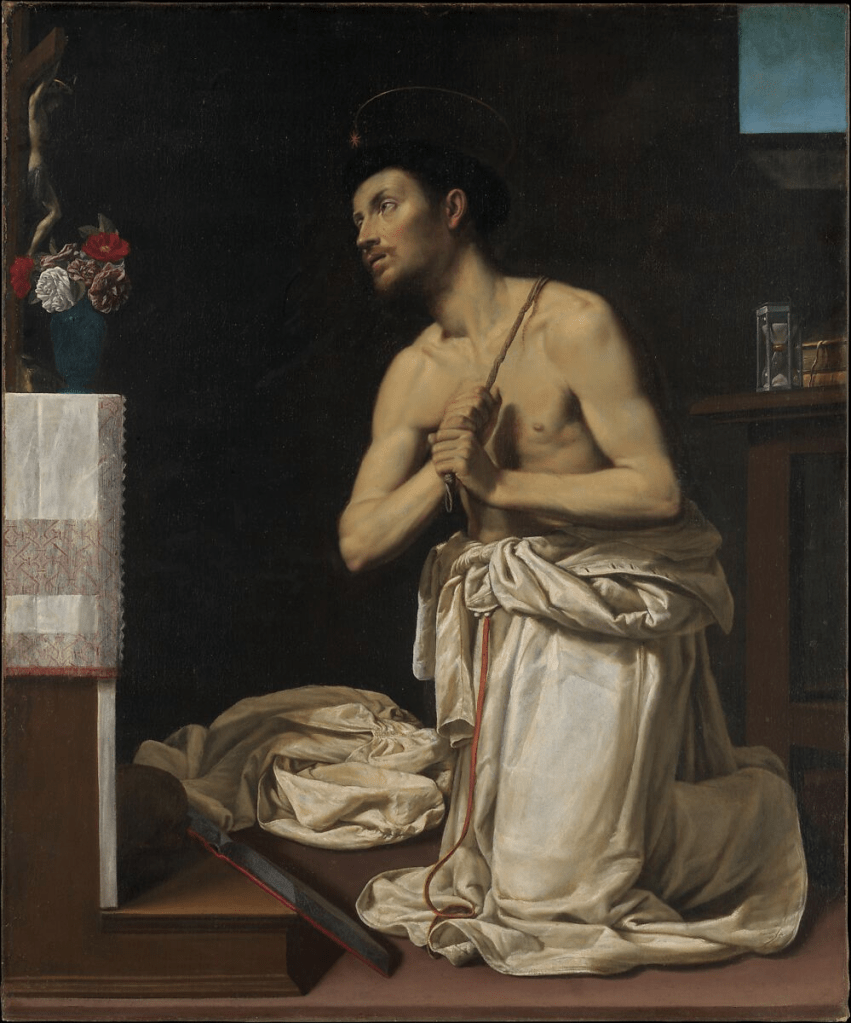
Saint Dominic in Penitence, by Filippo Tarchiani, c.1607

I will return again to my place
    until they acknowledge their guilt and seek my face.
    In their distress they will beg my favor:

“Come, let us return to the Lord,
    for it is he who has torn, and he will heal us;
    he has struck down, and he will bind us up.
After two days he will revive us;
    on the third day he will raise us up,
    that we may live before him.
Let us know, let us press on to know the Lord;
    his appearing is as sure as the dawn;
he will come to us like the showers,
    like the spring rains that water the earth.”

What shall I do with you, O Ephraim?
    What shall I do with you, O Judah?
Your love is like a morning cloud,
    like the dew that goes away early.
Therefore I have hewn them by the prophets;
    I have killed them by the words of my mouth,
    and my judgment goes forth as the light.
For I desire steadfast love and not sacrifice,
    the knowledge of God rather than burnt offerings. (New Revised Standard Version Update Edition)

We are meant for righteousness, not wickedness. So, whenever we fail to do what is right, we will suffer pain. This is because wicked attitudes, words, and behavior go against how we were designed and created as humans.

There are times when we all transgress what is right by either doing outright wrong, or by failing to do what is good, right, and just when we have the opportunity to do so. Therefore, repentance is vital and necessary. That is, to practice something that seems to be lost in our contemporary language: penitence.

Penitence simply means to have regret over wrongdoing. When we are penitent, we seek to repent (turn from what is wrong and do what is right). God has no interest in those who offer the forms of repentance without any penitence. That’s why God told the ancient Israelites that love and knowledge are what’s important, more than sacrifices and offerings.

What’s more, penitence is necessary for spiritual maturation and growth. The penitent soul finds that one’s faults and wrongs can be transformed into assets – such is the power of God through one’s penitent repentance.

And even more, the individual who experiences penitence and repents of wrongdoing, is forgiven, leading the whole world to be forgiven along with them.

Just one penitent and repentant person will intercede and confess the sins of the world; and that can change everything. So, imagine when a community of forgiven persons are motivated to bring about humanity’s greatness and nobility through penitent prayer.

I want you to think this thought: Any sort of moral misdeed committed by an individual weakens the soul of the entire community, and indeed, all the world.

Every attitude and action has a consequence, whether good or bad. Penitence, repentance, and forgiveness are the mandatory practices to restoring and renewing a life-giving dynamic to everyone.

Thus, penitence brings healing to the world; the individual who repents is forgiven; and the whole world is forgiven with him.

The powers of evil want to keep us ignorant of such things – which is why knowledge of God is so very important. Ignorance inevitably leads to sin and to the construction of a false self, which then encrusts itself upon the soul.

Penitence and repentance remain as lights deep within a person, even if they are buried beneath all sorts of arrogance and bravado of the ego.

Change of our world and transformation of our lives will not come apart from a vigorous and popular education of God and God’s Word. With so much ignorance all around us, it is imperative that individuals and communities become familiar with how spiritual realities work.

Although it appears that sinister darkness is spreading across the world and into the depths of humanity, the hope and promise of light discerns that evil can and will be overcome.

Penitence is the key to the healing presence this world needs.

For those who have experienced the renewal and reformation of a forgiven life, the steadfast love of God’s grace is very much needed for those still stuck in the mud of wickedness.

In truth, the meanness of a person betrays how much anguish of soul they are actually experiencing. Their estrangement of God is such that they are in great spiritual pain.

So, every situation designed by God to evoke penitence and repentance within such a mean person leads not only to a struggle in the soul, but also to outward conflicts with others in the forms of bullying, arrogance, and hardness of heart.

Not only do we suffer because of another’s grotesque sin, so does God. The pain of the wicked person unfortunately works to bring others pain, including God.

The Lord observed the extent of human wickedness on the earth, and he saw that everything they thought or imagined was consistently and totally evil. So the Lord was sorry he had ever made them and put them on the earth. It broke his heart. (Genesis 6:5-6, NLT)

Both humanity and God are in anguish when the dark powers take hold within an individual, and in the community.

We must have the grace to bear with others and hold our ground, giving the Spirit of God time to bring about penitence and repentance. For our part, continual learning of divine things and a commitment to steadfast love becomes the hands and feet of our prayers.

When one suffers, we all suffer, because there is an inextricable connection between all people.

Regret, remorse, and sorrow over wrongdoing are the prerequisites for goodness to become ensconced in the world. Penitence serves both the individual and the community, preventing any poisonous root of bitterness to grow up and corrupt many people.

See to it that no one falls short of the grace of God and that no bitter root grows up to cause trouble and defile many. (Hebrews 12:15, NIV)

God and humanity are meant to be united. And the Lord will create whatever conditions are necessary for divisions to be healed, and for people to love one another and love God will all their hearts, souls, minds, and energy.

Almighty God, my heavenly Father: I have sinned against you, through my own fault, in thought, and word, and deed, and in what I have left undone. For the sake of your Son our Lord Jesus Christ, forgive me all my offenses; and grant that I may serve you in newness of life, to the glory of your Name. Amen.

Mercy, Not Sacrifice (Hosea 6:1-6)

“Come, let us return to the Lord,
    for it is he who has torn, and he will heal us;
    he has struck down, and he will bind us up.
After two days he will revive us;
    on the third day he will raise us up,
    that we may live before him.
Let us know, let us press on to know the Lord;
    his appearing is as sure as the dawn;
he will come to us like the showers,
    like the spring rains that water the earth.”

What shall I do with you, O Ephraim?
    What shall I do with you, O Judah?
Your love is like a morning cloud,
    like the dew that goes away early.
Therefore I have hewn them by the prophets;
    I have killed them by the words of my mouth,
    and my judgment goes forth as the light.
For I desire steadfast love and not sacrifice,
    the knowledge of God rather than burnt offerings. (New Revised Standard Version)

My favorite word in all of Holy Scripture is the Hebrew word chesed (חֶסֶד pronounced “hes-ed” with a guttural sound on the “h”). It’s such a rich word that no single English word can capture its depth. 

So, chesed is translated in various ways across the English translations of the Bible as “mercy,” “grace,” “steadfast love,” “covenant loyalty,” “kindness,” “compassion,” and more. It’s no wonder, then, that since chesed marks the character and activity of God, the Lord very much desires people to reflect this same stance toward others. 

In today’s Old Testament lesson, God was calling and wooing wayward people to return to a divine life of closeness with the Lord. God demonstrated chesed by not putting the people away, like a spouse outright divorcing an unfaithful partner. But instead, God committed to loving the Israelites even when they were unlovely.

At all times, the response God wants is not simply going through the motions of outward worship. Ritual practices mean little if there is no heart behind them. The Lord longs for people to demonstrate both fidelity and fealty through mercy and a steadfast love to God and neighbor. Both our work and our worship are to be infused with divine mercy. 

God deeply desires a close relationship with humanity and is profoundly pained when people seek after other gods to meet their needs and to love them. Hosea’s prophecy is an impassioned plea for all persons to find their true fulfillment and enjoyment in a committed loving divine/human union, just like a marriage.

In Christian readings of Hosea’s prophecy, repentance means accepting God’s chesed through Jesus Christ. The believer is to allow the character of God to rule and reign in their heart so that commitment comes flowing out in loving words, actions, thoughts, and dispositions. Mercy finds its highest expression in the person and work of Jesus. Thus, Advent is a season of anticipating the great love and mercy of God through the incarnation of Christ.

It, therefore, ought to be no surprise that Jesus lifted Hosea’s prophecy as a treasured principle of operation when asked why he deliberately made connections with “questionable” people:

While Jesus was having dinner at Matthew’s house, many tax collectors and sinners came and ate with him and his disciples. When the Pharisees saw this, they asked his disciples, “Why does your teacher eat with tax collectors and sinners?” On hearing this, Jesus said, “It is not the healthy who need a doctor, but the sick. But go and learn what this means: ‘I desire mercy, not sacrifice.’ For I have not come to call the righteous, but sinners.” (Matthew 9:10-12, NIV)

And when confronted about “questionable” activities Jesus appealed to the same source of Hosea’s prophecy:

“Look! Your disciples are doing what is unlawful on the Sabbath.” Jesus answered, “Haven’t you read what David did when he and his companions were hungry? He entered the house of God, and he and his companions ate the consecrated bread—which was not lawful for them to do, but only for the priests. Or haven’t you read in the Law that the priests on Sabbath duty in the temple desecrate the Sabbath and yet are innocent? I tell you that something greater than the temple is here. If you had known what these words mean, ‘I desire mercy, not sacrifice,’ you would not have condemned the innocent.” (Matthew 12:2-7, NIV)

One can never go wrong with mercy and grace. If in doubt between whether to judge another or show mercy, the Christian’s choice is clear. Grace and love create connections – reconnecting the disconnected. The heart of true Christian spirituality is a deep kinship with the divine. Whenever that relation is broken or severed, it is vital to restore it. The means of doing so is not judgment but mercy.

Chesed is more than a word; it is a way of life. God wants mercy. Grace is the Lord’s divine will.

So, let us today receive the forgiveness of Jesus and devote ourselves to prayer and works of love which come from a heart profoundly touched by grace. May the result be healing of that which has been broken, and reconciled relationships with others.

Merciful and loving God, the One who shows amazing grace, forgive us for our wanderings away from the divine life. Return us, again, to the grace of Jesus Christ our Savior so that our hearts will be renewed and aflame with love for others. In the Name of the Father, Son, and Spirit, the Great Three in One. Amen.

Hosea 6:1-10 – “I Want Mercy, Not Sacrifice”

“Come, let us return to the Lord.
He has torn us to pieces
    but he will heal us;
he has injured us
    but he will bind up our wounds.
After two days he will revive us;
    on the third day he will restore us,
    that we may live in his presence.
Let us acknowledge the Lord;
    let us press on to acknowledge him.
As surely as the sun rises,
    he will appear;
he will come to us like the winter rains,
    like the spring rains that water the earth.”

“What can I do with you, Ephraim?
    What can I do with you, Judah?
Your love is like the morning mist,
    like the early dew that disappears.
Therefore I cut you in pieces with my prophets,
    I killed you with the words of my mouth—
    then my judgments go forth like the sun.
For I desire mercy, not sacrifice,
    and acknowledgment of God rather than burnt offerings.
As at Adam, they have broken the covenant;
    they were unfaithful to me there.
Gilead is a city of evildoers,
    stained with footprints of blood.
As marauders lie in ambush for a victim,
    so do bands of priests;
they murder on the road to Shechem,
    carrying out their wicked schemes.
I have seen a horrible thing in Israel:
    There Ephraim is given to prostitution,
    Israel is defiled. (New International Version)

My favorite word in all of Holy Scripture is the Hebrew word חסד (“chesed” pronounced in English “kes-ed).  It is such a rich word that no one English word can capture its depth and import. 

So, chesed is translated in various ways across English translations of the Bible as:

  • Goodness (American Standard Version)
  • Faithful love (Common English Bible)
  • Loyalty (God’s Word Translation)
  • Constant love (Good News Translation)
  • Mercy (King James Version)
  • Love that lasts (The Message)
  • Faithfulness (New English Translation)
  • Loving-kindness (New Life Version)
  • Steadfast love (New Revised Standard Version)

Chesed is God’s committed, gracious, and loving covenant loyalty to people. The Lord’s very attributes are sheer Love.

Since chesed marks the character and activity of God, the Lord very much desires people to reflect this same stance toward one another. In other words, because God is merciful and kind, we, as people created in God’s image, are to be marked with this same character in all we do. 

In today’s Old Testament lesson, God is calling and wooing wayward people to return to a life of closeness with the Lord. God demonstrated chesed by not sending the people away, like a spouse outright divorcing an unfaithful partner. Instead, the Lord is committed to loving the Israelites even when they were unlovely.

At all times, the response God wants from people is not simply to go through the motions of outward worship. Ritual practices mean little if there is no heart behind them. The Lord longs for people to demonstrate both fidelity and fealty through mercy and a steadfast love to God and neighbor.

Both our work and our worship are to be infused with divine mercy. 

God deeply desires a close relationship with humanity. The Lord is deeply grieved when people whore after other gods to meet their needs for love and belonging. Hosea’s prophecy is an impassioned plea for all persons to find their true fulfillment and enjoyment in a committed loving divine/human union, like a marriage.

In Christian readings of Hosea’s prophecy, repentance means accepting God’s chesed through Jesus Christ.

The believer is to allow the character of God to rule and reign in their heart so that love and commitment come flowing out in words, actions, thoughts, and dispositions.

Mercy, in Christianity, finds its highest expression in the person and work of Jesus.

It is no wonder, then, that Jesus lifted Hosea’s prophecy as a treasured principle of operation when asked why he deliberately made connections with “questionable” people:

As Jesus continued on from there, he saw a man named Matthew sitting at a kiosk for collecting taxes. He said to him, “Follow me,” and he got up and followed him. As Jesus sat down to eat in Matthew’s house, many tax collectors and sinners joined Jesus and his disciples at the table.

But when the Pharisees saw this, they said to his disciples, “Why does your teacher eat with tax collectors and sinners?”

When Jesus heard it, he said, “Healthy people don’t need a doctor, but sick people do. Go and learn what this means: I want mercy and not sacrifice. I didn’t come to call righteous people, but sinners.” (Matthew 9:9-13, CEB)

And when confronted about “questionable” activities, Jesus appealed to the same source of Hosea’s prophecy:

“Look! Your disciples are doing something that is not right to do on the day of rest—a holy day.”

Jesus asked them, “Haven’t you read what David did when he and his men were hungry? Haven’t you read how he went into the house of God and ate  the bread of the presence? He and his men had no right to eat those loaves. Only the priests have that right. Or haven’t you read in Moses’ Teachings that on the day of rest—a holy day, the priests in the temple do things they shouldn’t on the day of rest yet remain innocent? I can guarantee that something  greater than the temple is here. If you had known what ‘I want mercy, not sacrifices’ means, you would not have condemned innocent people. (Matthew 12:2-7, GW)

One can never go wrong with mercy and grace. If in doubt between whether to judge another or show mercy, the Christian’s choice is clear.

Grace and love reconnects the disconnected. The heart of true Christian spirituality is a deep kinship with the divine. Whenever that relation is broken or severed, it is vital to restore it. The means of doing so is not judgment; it’s mercy.

Chesed is more than a word; it is a way of life.

God wants mercy. Grace is the Lord’s divine will. So, let us today receive the forgiveness of Jesus and devote ourselves to prayer and works of love which come from a heart profoundly touched by grace. 

May the result of our return to the Lord be healing of that which has been broken, and reconciled relationships with others.

Merciful and loving God, the One who shows amazing grace, forgive us for our wanderings away from the divine life. Return us, again, to the grace of Jesus Christ our Savior so that our hearts will be renewed and aflame with love for others. In the Name of the Father, Son, and Spirit, the Great Three in One. Amen.

Hosea 3:1-5 – Reconcile the Past

Then the Lord said to me, “Go and love your wife again, even though she commits adultery with another lover. This will illustrate that the Lord still loves Israel, even though the people have turned to other gods and love to worship them.”

So, I bought her back for fifteen pieces of silver and five bushels of barley and a measure of wine. Then I said to her, “You must live in my house for many days and stop your prostitution. During this time, you will not have sexual relations with anyone, not even with me.”

This shows that Israel will go a long time without a king or prince, and without sacrifices, sacred pillars, priests, or even idols! But afterward the people will return and devote themselves to the Lord their God and to David’s descendant, their king. In the last days, they will tremble in awe of the Lord and of his goodness. (New Living Translation)

Sometimes you have to get your behind in the past before you can put your past behind you.

The ancient nation of Israel was in a spiritual pickle. Gradually, over hundreds of years, they made small decisions of compromised religion which added up to a severe breach of faith with their historic God.

The relationship between God and God’s people, throughout the prophetic books of the Old Testament, is many times likened to a marriage of two spouses – God, the faithful spouse, and Israel, the unfaithful spouse who adulterated themselves by seeking the love of other gods.

This situation evoked feelings of sadness and anger within God. To help restore the broken marriage, the Lord used the prophet Hosea as an earthly illustration of the divine/human dilemma.

Just as Hosea graciously took a wife of dubious repute, so God mercifully took Israel. Just as Hosea’s wife, Gomer, slept with other men, so Israel went to bed with other gods. And just as Hosea remained faithful and actively sought to reconcile the past with his wife, so God tenaciously and dramatically honored the covenant relationship with Israel by showing steadfast love, despite her sordid past.

Israel needed to do her part by reconciling the past – returning to the Lord through acknowledging the truth of the situation and owning their responsibility to make things right.

Holy Scripture exhorts the believer to live according to truth. Whenever we fail to do so, we suffer spiritual loss. We are told to confess and reject unfaithful patterns of past behavior and not allow them to influence us today (Titus 2:12; 1 Peter 1:14, 18). 

Neglecting our responsibility inevitably causes emotional, mental and physical repercussions, as well as spiritual. In the New Testament, when the Apostle Paul said he was forgetting what is behind and straining toward what is ahead, he could say that because he had come to terms with and reconciled his own terrible unfaithful past with God. (Philippians 3:4-13)

It is both helpful and necessary to go back into one’s life and deal with the past on the basis of truth. In doing so, we honor our relationship with God. We must ask the Lord to turn the searchlight of truth on us and our past. 

Trust God to help you remember all the times in which you need to reconcile what has happened (or failed to happen). Make the choice before God to be as honest as you possibly can. 

The following are some suggestions from a former professor and mentor, the late Dr. Victor Matthews, (put in my own words) to carefully follow:

  1. Write out every time you were unfaithful or were hurt by another’s unfaithfulness (reject the temptation to just think and/or talk about it). Be complete, name the people involved, state what happened, do not try and protect yourself or other people and do not fantasize and let your thoughts run amok.
  2. Evaluate each past event on the basis of truth. If you were unfaithful, then confess it to God truthfully and receive forgiveness and cleansing (1 John 1:9). If you were hurt by someone, and it was their fault, then state out loud that “_______ should not have done that to me.” When you have finished writing out the event(s) deliberately stop and completely forgive the person(s) (Mark 11:25-26).  If you were at fault in some way, then confess that to God, as well.
  3. Resist the temptation to hurry with this process! Do not generalize by putting many events into one. Be specific and take the time necessary to get in touch with what God is trying to help you connect with.  This practice of reconciling the past is not introspection, so do not indulge in self-pity, self-criticism, or develop a martyr syndrome.
  4. Affirm that your inner critic, others, and any dark force may no longer use your past against you. “In the Name of the Lord Jesus Christ I take this event away from Satan and declare that he may not use it against me anymore!” (Ephesians 4:27; 5:11; 6:14).
  5. Receive the healing provided for those who believe and live according to God’s words and ways (Isaiah 53:5). “Now that I have made this right with you, O Lord, I receive the healing you have provided for me through the cross of Jesus Christ.” (Galatians 2:19-20)

When you have finished your work, then count it finished. When Jesus said, “It is finished!” he meant what he said. (John 19:30)

Reconciling the past means leaning into the finished work of Jesus for our complete healing. If and when we think of our unfaithful past, then firmly state: “I have dealt with that truthfully. It is settled, once and for all.” 

Whenever unfaithful, from this point forward, confess it, receive forgiveness, and make the affirmations of truth. In doing so, we are living by faith in the Son of God who loved us and gave himself for us. Amen.