Leadership Matters (2 Kings 9:30-37)

Jehu Commanding Jezebel’s Death, by Philip Galle, c.1561

Jehu then went to Jezreel. When Jezebel heard of it, she put on her eye shadow and arranged her hair. She looked down out of the window. When Jehu came through the gate, she said, “Do you come in peace, Zimri, you master murderer?”

Jehu looked up to the window and said, “Who’s on my side? Anyone?” Two or three high officials looked down at him. Then he said, “Throw her out!” So they threw her out of the window. Some of her blood splattered against the wall and on the horses, and they trampled her. 

Jehu then went in to eat and drink. He said, “Deal with this cursed woman and bury her. She was, after all, a king’s daughter.” They went to bury her, but they couldn’t find her body. Only her skull was left, along with her hands and feet. They went back and reported this to Jehu.

He said, “This is the Lord’s word spoken through his servant Elijah from Tishbe: Dogs will devour Jezebel’s flesh in the area of Jezreel. Jezebel’s corpse will be like dung spread out in a field in that plot of land in Jezreel, so no one will be able to say, This was Jezebel.” (Common English Bible)

“Jezebel” is not a common name for a reason. Few parents would ever give their child such a moniker. Jezebel is portrayed in Old Testament Scripture as a pagan priestess who cared nothing for Israel’s one true God; and would do anything to get her way – even if it meant fabricating false witnesses and committing murder (1 Kings 21). Here name is used synonymously in the New Testament with spiritual prostitution and opposition to God (Revelation 2:20).

Jezebel was from the city of Tyre, and married King Ahab. She introduced her husband and his nation to the chief Canaanite god Baal. Jezebel promoted the worship practices of Baal. She brought to Israel 450 prophets of Baal, and 400 prophets of Asherah. What’s more, Jezebel’s commitment to Baal led her to persecute and kill the prophets of God (1 Kings 18:4, 13).

Jehu was a military man, called by God through the prophet Elisha:

“This is what the Lord, the God of Israel, says: ‘I anoint you king over the Lord’s people Israel. You are to destroy the house of Ahab your master, and I will avenge the blood of my servants the prophets and the blood of all the Lord’s servants shed by Jezebel. The whole house of Ahab will perish. I will cut off from Ahab every last male in Israel—slave or free. I will make the house of Ahab like the house of Jeroboam son of Nebat and like the house of Baasha son of Ahijah. As for Jezebel, dogs will devour her on the plot of ground at Jezreel, and no one will bury her.’”  (2 Kings 9:6-10, NIV)

Eventually, Jehu made his way to Jezebel – and she knew full well that he intended on killing her. So, Jezebel readied by presenting herself as beautiful as possible. It seems that she intended on seducing or currying favor with Jehu so that she might continue in the royal court. But Jehu wasn’t having it.

The new king of Israel, Jehu, in seeing Jezebel, didn’t even bother to go up to her when she showed herself out of the upper level latticed window. He simply asked where the loyalty is, from those attending her. The eunuchs responded by throwing Jezebel out the window to her death. Thus, the details of Elijah’s earlier prophecy came to pass in a gruesome way.

In my reading of the story this time around, I wondered how many people are in jobs who are working for someone they see continually doing selfish and unfair things. My mind gravitated toward the eunuchs – Jezebel’s servants – who daily dealt with her. I wondered:

  • Were the eunuchs ever disturbed by Jezebel’s actions?
  • Did they ever get angry over all the injustice they saw? Or, were the eunuchs just like their mistress, having no regard for the many lives she destroyed?
  • What was the nature of their loyalty? Was it forced, or was it just shrewd?
  • Did the eunuchs dispose of their mistress because they finally saw a way out, or did they toss her out the window as a mere watching out for themselves and wanting to be on the winner’s side?

The text never tells us about the life or motives of the eunuchs. Yet, I imagine they most likely saw the situation for what it was at the time. And I suspect they had a sense that Jezebel’s reign of injustice needed to be finished.

In saying this, I’m in no way advocating for dislodging an unjust and unfair leader by violent means. But what I am saying is that, if one has a strong sense of goodness within them, its distressing to see a bad leader act in sinister and malevolent ways day after day. Consider the following statistics from the Niagara Institute:

57% of all workers have left a job in their lifetime because of bad leadership. 32% say they have considered leaving a job due to poor management, and/or due to unbearable working conditions.

69% of workers would pay better attention to their work if they were treated with more respect by their employers. 79% of employees have quit a job in their lifetime due to a lack of appreciation.

96% of employees said that management showing empathy would make them want to stay with the company. Moreover, management thinks they’re doing a good job, with 92% of managers saying that their company is empathetic; whereas only 50% of employees agree.

35% of employees say their direct manager is their biggest source of stress at work.

Over 120,000 deaths every year may be attributed to how U.S. organizations manage their employees. This doesn’t even account for the physical and mental toll an ineffective leader can take over a period of time.

Maybe Jezebel’s eunuchs knew their own deaths were just a matter of time.

I’ve been on both ends of being an employee/worker and a leader/manager. I can say that I have suffered abuse in both roles. Yet, in my judgment, the onus on making a workplace a good and positive environment is on management.

Whatever role we occupy in this life, it is everyone’s responsibility to ensure that there is no injustice; and that integrity and fairness are ubiquitous. Leaders are especially called to exhibit what is good, right, and just in everything they do.

Let’s all be willing to hold one another accountable for how we work and live together in this world. If not, we’ll keep having stories like Jehu and Jezebel.

“A Blessing for Leaders,” by John O’Donohue

May you have the grace and wisdom

To act kindly, learning

To distinguish between what is

Personal and what is not.

May you be hospitable to criticism.

May you never put yourself at the center of things.

May you act not from arrogance but out of service.

May you work on yourself,

Building up and refining the ways of your mind.

May those who work for you know

You see and respect them.

May you learn to cultivate the art of presence

In order to engage with those who meet you.

When someone fails or disappoints you,

May the graciousness with which you engage

Be their stairway to renewal and refinement.

May you treasure the gifts of the mind

Through reading and creative thinking

So that you continue as a servant of the frontier

Where the new will draw its enrichment from the old,

And you never become a functionary.

May you know the wisdom of deep listening,

The healing of wholesome words,

The encouragement of the appreciative gaze,

The decorum of held dignity,

The springtime edge of the bleak question.

May you have a mind that loves frontiers

So that you can evoke the bright fields

That lie beyond the view of the regular eye.

May you have good friends

To mirror your blind spots.

May leadership be for you

A true adventure of growth.

Morality Matters (2 Kings 9:14-26)

Then Jehu, Jehoshaphat’s son and Nimshi’s grandson, plotted against Joram. Now Joram along with all of Israel had been guarding Ramoth-Gilead against Aram’s King Hazael, but King Joram had gone back to Jezreel to recover from wounds that the Arameans had given him when he fought Hazael.

So Jehu said, “If this is the way you feel, then don’t let anyone escape from the city to talk about it in Jezreel.” Then Jehu got on a chariot and drove to Jezreel because Joram was resting there. Judah’s King Ahaziah had also come to visit Joram.

The guard standing on the tower at Jezreel saw a crowd of people coming with Jehu. He said, “I see a crowd of people.”

Joram said, “Take a chariot driver. Send him out to meet them to ask, ‘Do you come in peace?’”

So the driver went to meet him and said, “The king asks, ‘Do you come in peace?’”

Jehu replied, “What do you care about peace? Come around and follow me.”

Meanwhile, the tower guard reported, “The messenger met them, but he isn’t returning.”

The king sent a second driver. He came to them and said, “The king asks, ‘Do you come in peace?’”

Jehu said, “What do you care about peace? Come around and follow me.”

The tower guard reported, “The messenger met them, but he isn’t returning. And the style of chariot driving is like Jehu, Nimshi’s son. Jehu drives like a madman.”

Joram said, “Hitch up the chariot!” So they hitched up his chariot. Then Israel’s King Joram and Judah’s King Ahaziah—each in his own chariot—went out to meet Jehu. They happened to meet him at the plot of ground that belonged to Naboth the Jezreelite.

When Joram saw Jehu, he said, “Do you come in peace, Jehu?”

He said, “How can there be peace as long as the immoralities of your mother Jezebel and her many acts of sorcery continue?”

Then Joram turned his chariot around and fled. He shouted to Ahaziah, “It’s a trap, Ahaziah!”

Jehu took his bow and shot Joram in the back. The arrow went through his heart, and he fell down in his chariot. Jehu said to Bidkar his chariot officer, “Pick him up, and throw him on the plot of ground belonging to Naboth the Jezreelite. Remember how you and I were driving chariot teams behind his father Ahab when the Lord spoke this prophecy about him: Yesterday I saw Naboth’s blood and his sons’ blood, declares the Lord. I swear that I will pay you back on this very plot of ground, declares the Lord. Now pick him up, and throw him on that plot of ground, in agreement with the Lord’s word.” (Common English Bible)

Jehu shoots an arrow that strikes Joram in the back, by Jan Luyken, 1712

Ancient storytelling often had a moral to it. Historical writing was typically less concerned for objective details and much more interested to point out, in narrative form, how people morally lived and what happened to them. Rather than commenting on what the moral(s) are, the storyteller lets the story speak for itself.

Today’s Old Testament lesson brings several kings into the story (Jehu, Joram, Ahaziah, and Ahab). We are meant to contrast Jehu’s zeal for justice and living into God’s call with the others kings’ injustice and living for power and wealth. The final end of the kings is designed for us to see the ultimate consequence of injustice.

Elisha the prophet had given a non-descript Israelite military man, Jehu, instructions from the Lord about carrying out divine judgment against the unjust royal house of Omri – and more specifically, against King Ahab and Queen Jezebel.

After Jehu’s prophetic call and anointing, the soldiers under his command immediately acclaimed him as king. Jehu wasted no time in going after the people responsible for years of abusive power.

Rather than simply giving orders to his soldiers and remaining in back of his army, Jehu led his men into the thick of battle. We get the picture of a person with single-minded determination, aggressively going after unjust leaders; and seeking to upend a royal system of power which strayed far from their original mandate of upholding God’s system of law and covenant.

Jehu’s zeal is exemplified in his chariot driving: He was going to speedily get to where he needed to go, and do what he needed to do.

The story emphasizes the increasing drama of messengers sent to enquire of Jehu’s intentions: Are they peaceful? Clearly, no. There was betrayal afoot, as Jehu boldly drove against his own king of Israel, as well as the king of Judah.

The unjust kings had created a situation in their nations of peace for themselves, but not necessarily others. So, Jehu would take that peace from them.

The two kings of Israel and Judah personally went out to Jehu, not realizing what was about to happen. Ironically, it took place on land which Naboth had previously owned, and of which Ahab and Jezebel diabolically stole. It is a powerful depiction of what goes around comes around.

Jehu quickly got to the nub of the issue: There cannot be peace as long as Jezebel’s idolatry and witchcraft abound in the land. Her wicked ways had become thoroughly imbued throughout both Israel and Judah, and was supported by both of the kings.

From the perspective of Jehu, there was no peace that could exist between a follower of Yahweh and a practitioner of the Baal and Asherah cults. Jehu’s intent was to fulfill the prophecy that was announced by Elijah twelve years earlier. And he went about it with violent zeal.

Whenever the Lord begins to exact judgment and ensconce justice, there’s no way anyone is going to stop it. Joram went out to face an enemy that he could not stop. There was no escaping the inexorable force of God.

Divine providence brought the kings together on the very piece of land that was once Naboth’s vineyard – the place where Ahab took sinister control of it. (1 Kings 21). Murderous theft was the inevitable result of spiritual fornication; Ahab and Jezebel had prostituted themselves with the gods Baal and Asherah.

Spiritual adultery never ends well. Because God is a jealous Lover. Peace is not achieved by letting everyone do whatever they want. Instead, it is established through integrity, justice, truth, and ethical morality.

Eternal God, in whose perfect kingdom the sword of righteousness is drawn: Spread abroad your mighty Spirit, so that all peoples may be gathered under the banner of the Prince of Peace, as children of one Father; to whom be dominion and glory, now and forever. Amen.

A Calling Is a Sacred Responsibility (2 Kings 9:1-13)

King Jehu

The prophet Elisha called to a member of the group of prophets, “Get ready, take this jug of oil with you, and go to Ramoth-Gilead. When you arrive there, look for Jehu, Jehoshaphat’s son and Nimshi’s grandson. Go to him, then pull him away from his associates, taking him to a private room. Take the jug of oil and pour it on his head. Then say, ‘This is what the Lord has said: I anoint you king of Israel.’ Then open the door, and run out of there without stopping.”

So the young prophet went to Ramoth-Gilead. He came in, and the military commanders were sitting right there. He said, “Commander, I have a word for you.”

“For which one of us?” Jehu asked.

The young prophet said, “For you, Commander.”

So Jehu got up and went inside. The prophet then poured oil on his head and said to him, “This is what the Lord, Israel’s God, says: I anoint you king over the Lord’s people, over Israel. You will strike down your master Ahab’s family. In this way I will take revenge for the violence done by Jezebel to my servants the prophets and to all the Lord’s servants. Ahab’s whole family will die. I will eliminate from Ahab everyone who urinates on a wall, whether slave or free, in Israel. I will make Ahab’s dynasty like the dynasty of Jeroboam, Nebat’s son, and like the dynasty of Baasha, Ahijah’s son. And as for Jezebel: The dogs will devour her in the area of Jezreel. No one will bury her.” Then the young prophet opened the door and ran.

Jehu went out to his master’s officers. They said to him, “Is everything okay?

Why did this fanatic come to you?”

Jehu said to them, “You know the man and the nonsense he talks.”

“That’s a lie!” they said. “Come on, tell us!”

Jehu replied, “This is what he said to me: ‘This is what the Lord says: I anoint you king of Israel.’”

Then each man quickly took his cloak and put it beneath Jehu on the paved steps. They blew a trumpet and said, “Jehu has become king!” (Common English Bible)

The biblical books of 1 & 2 Kings (originally one book of Kings) tells of the kingdoms of Israel and Judah over a five-hundred year period from c.960-586 B.C.E. The dynasties of the house of Omri and the house of Jehu were the longest lasting in Israel.

The books of First and Second Kings are primarily concerned with an evaluation of the 20 kings of Judah and the 19 kings of Israel. Of greatest concern was whether the particular king was loyal to God, or not. If the king tolerated worship of other gods besides Yahweh, and established sacrifices outside of Jerusalem, then that king was evaluated as doing evil in the eyes of the Lord.

This judgment of the kings is consistent with Deuteronomic laws of sole loyalty to God, and the importance of a central location for all Jewish people to worship (in Jerusalem).

To understand why it was so important for Jehu to be anointed with a mission is to know something of the house of Omri, and in particular, the king Ahab and his queen Jezebel. They are both conveyed to us in the biblical text as a power couple who want what they want, without a lot of concern about the subjects of their kingdom.

Jezebel was a follower of Baal and Asherah, not Yahweh. She provided for hundreds of their prophets. Her husband the king was fine with this situation. Jezebel was a clear enemy of God’s prophets, and killed hundreds of them, so that there were only a few left, including Elijah and Elisha (1 Kings 18:13).

Ahab and Jezebel’s powerful misuse of authority is relayed in the story of Naboth (1 Kings 21). Ahab wanted to buy Naboth’s vineyard, which was adjacent to his own land. But Naboth refused to sell, mainly because the land was his family’s ancient generational inheritance.

Jezebel went to work and arranged false witnesses to claim that Naboth had cursed both God and King (which was the ultimate sign of treason in Israel). As a result, Naboth was wrongly stoned to death; and Ahab unjustly confiscated his property.

Elijah prophesied that Ahab’s descendants would die, his dynasty will perish, and that Jezebel would be eaten by dogs (1 Kings 21:17-24). In our story for today, this is alluded to in the reference of God eliminating all that belong to Ahab who “urinate on a wall,” that is, unjustly marking the territory of another as their own property.

Indeed, it all shook-out according to prophecy. Ahab died in battle. Then, Ahab and Jezebel’s son Ahaziah succeeded him as king. Young Ahaziah died two years into his reign, and his brother Jehoram became king. Jehoram was then killed by Jehu. After this, some of Jezebel’s own palace officials tossed her out a window to her death, and dogs descended on her carcass – all to Elijah’s earlier prophecy.

Injustice, unrighteousness, abuse of power, and selfish concerns are ugly nasty business. These sorts of attitudes and behaviors ruin people, and keep others locked into patterns of poverty and powerlessness. God is not okay with any of it.

Whenever we are in the middle of oppression and/or authoritative people abusing their power for their own benefit, its hard to maintain our sense of rightness and goodness. Yet, we must. In such times, patience and perseverance is needed without resorting to attempts of paying back evil with evil.

What’s more, we can find ways of tapping into the spiritual power of God within us, in order to resist and subvert unjust authority with righteousness. To some degree, everyone can do something by employing nonviolent resistance tactics like networking, protest, persuasion, non-cooperation, and speaking out through either speech or writing.

Only those who possess nothing can be entrusted with everything. Systemic evil isn’t changed from the top, because those at the top benefit from the system. Rather, structural evil is transformed through grass roots efforts from the bottom up. What’s more, individuals rarely change from the outside-in, but rather from the inside-out.

A ruling establishment is not always necessarily wrong. Yet, it takes a lot of willing accountability and plenty of intentional soul searching for administrations to remain on the straight and narrow.

Such realities characterized Jehu. He was a non-descript military man. There was nothing, in particular, which distinguished him as having a special calling from God.

Yet, although Jehu fulfilled his calling, he added to the call; the Lord was not pleased with Jehu’s form of violent bloodshed, and so, put an end to Jehu’s house, just as Omri’s house had been purged from Israel.

Power and authority will do that to a person – which is why leaders must be continuously vigilant to guard against developing a thick ego and following their pride.

And so do we. Anyone who receives a call from God has a sacred responsibility and trust to fulfill that calling with competence, care, and conscientiousness.

Almighty God, direct me in all my activity with Your grace, wisdom, and help, so that in all I do and say may glorify Your holy Name; through Jesus Christ our Lord, in the power of the Holy Spirit. Amen.

A Divine Appointment (2 Kings 8:1-6)

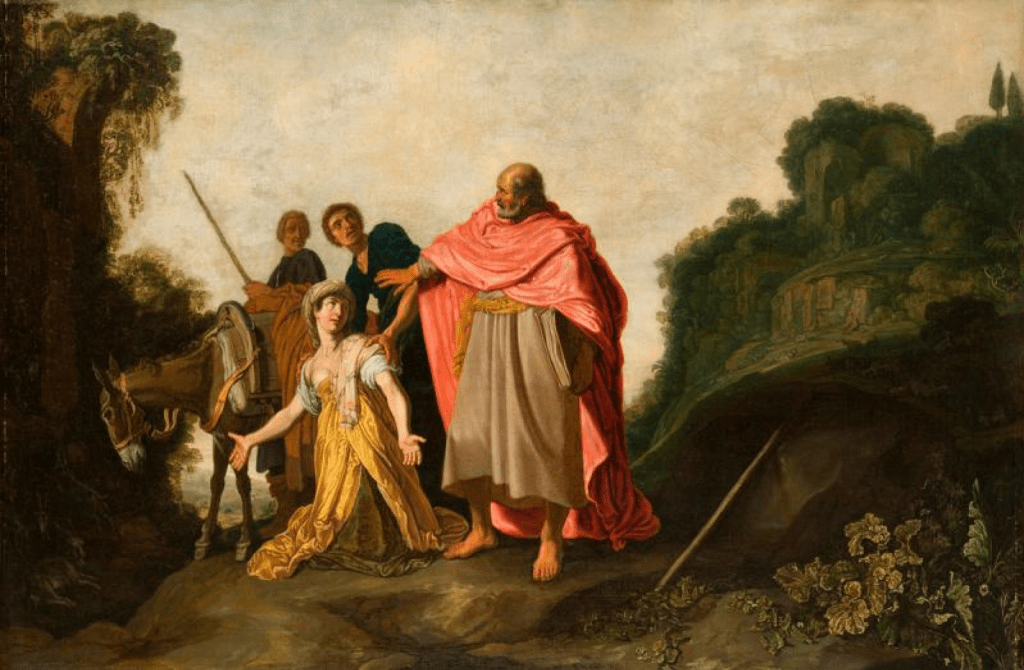
The prophet Elisha and the Shunammite woman, by Pieter Lastman, 1620

Elisha spoke to the woman whose son he had brought back to life: “You and your household must go away and live wherever you can, because the Lord has called for a famine. It is coming to the land and will last seven years.”

So the woman went and did what the man of God asked. She and her household moved away, living in Philistia seven years. When seven years had passed, the woman returned from Philistia. She went to appeal to the king for her house and her farmland. The king was speaking to Gehazi, the man of God’s servant, asking him, “Tell me about all the great things Elisha has done.” So Gehazi was telling the king how Elisha had brought the dead to life. At that very moment, the woman whose son he had brought back to life began to appeal to the king for her house and her farmland.

Gehazi said, “Your Majesty, this is the woman herself! And this is her son, the one Elisha brought to life!”

The king questioned the woman, and she told him her story. Then the king appointed an official to help her, saying, “Return everything that belongs to her, as well as everything that the farmland has produced, starting from the day she left the country until right now.” (Common English Bible)

People of faith typically don’t see divine appointments coming at all; they often show up in the middle of hard mundane days.

The prophecies and actions of the prophet Elisha are covered in the book of 2 Kings with a series of ten incredible narratives (chapters 2-9). Each of them are designed to demonstrate the power of God over (and sometimes against) the power of the king.

This was important because the royal decisions and actions of most of the Israelite kings were quite disconnected from God’s law and justice. Most kings did whatever they wanted, sometimes to the point of completely leading the people away from the worship of Yahweh and toward the worship of other gods.

Today’s Old Testament lesson concerns the ninth story in this series of narratives. A widow, whose son Elisha had restored to life in the second narrative (2 Kings 4:8-37) left for the land of the Philistines when there was a severe famine. Although the woman was simply listening to the prophet and doing what he said, squatters took advantage of the situation and took over her house and property while she was away.

In a clear demonstration of what a “divine appointment” looks like in Holy Scripture, Elisha’s servant and the king were talking together about this very woman and the miracle that took place with her son. The prophet had essentially raised her dead child to life. Then, lo and behold, the woman walked into the conversation to appeal the injustice that had happened to her and her family.

Even the worst of kings would discern the right thing to do in such a situation. After questioning the woman, the king ensured that she would get everything restored to her. Through it all, we are meant to see the power and sovereignty of God over the human authority of political kings.

I hope that you, at some point in your life, have experienced a meeting with another person that you can see was unmistakably arranged by God. And a great need you had was met because of this encounter. The Lord blessed you through it in a way that you didn’t see coming at all.

The fact of the matter is that God is sovereign, all-knowing, and all-powerful, along with being infinitely gracious, good, just, right, and loving. Therefore, God sets about to bless both us and other people. And when God determines to do something, nothing and no one in heaven or on earth can stop it.

Wherever you presently are, and whatever it is you are doing now in your life, is really no accident. And if your life situation is awful and far from any sort of idyllic scene of blessing, then please know that this is a circumstance that is ripe for a divine appointment.

For how could we ever know God as the Great Deliverer unless we were between a rock and a hard place with nowhere to turn? How could we ever experience God as the Divine Healer unless we were broken and/or brokenhearted?

How could we ever realize God as Provider unless we were out of resources and down to our last penny? Or God as Helper unless we were desperate and unable to move? Or God as the One who restores unless we had lost everything?

Just as there cannot be resurrection and new life without a crucifixion and an old life, so our lives will inevitably take a trajectory of suffering and hardship before glory and blessing. In order to allow the good to completely fill us, we must be totally emptied of everything else.

Maybe you will never experience something quite as dramatic as the woman did with gaining her son back to life, and her property restored after a terrible famine, but know this: The great Lord and God of all, the Sovereign of the universe, has your back through all that you’re going through on this earth.

I often get asked by patients and parishioners alike, “Where is God?” It feels to them that God is absent, silent, and far from understanding what they’re going through in the midst of their very challenging adversity.

Really, however, it’s actually an easy question for me to answer: Jesus is our Immanuel, God with us. The Spirit of God is right beside you, walking with you, even holding you up at times, through all the crud and crap of this old fallen sinful world of ours. Seeing only one set of footsteps in the sand, it turns out God is the One that carries the weak and weary in their trouble. The Lord is anything but absent.

If God has authority over earthly rulers, then the Lord most certainly has power to handle your life.

O God, why have you abandoned me? Though you have hidden your face from me, still from this dread and empty place, I cry to you, who have promised me that underneath are your everlasting arms. God, you are my help and comfort; you shelter and surround me in love so tender that I may know your presence with me, now and always. Amen.