Dealing with a Clash of Belief (Acts 3:17-4:4)

“And now, friends, I know you had no idea what you were doing when you killed Jesus, and neither did your leaders. But God, who through the preaching of all the prophets had said all along that his Messiah would be killed, knew exactly what you were doing and used it to fulfill his plans.

“Now it’s time to change your ways! Turn to face God so he can wipe away your sins, pour out showers of blessing to refresh you, and send you the Messiah he prepared for you, namely, Jesus. For the time being he must remain out of sight in heaven until everything is restored to order again just the way God, through the preaching of his holy prophets of old, said it would be. Moses, for instance, said, ‘Your God will raise up for you a prophet just like me from your family. Listen to every word he speaks to you. Every last living soul who refuses to listen to that prophet will be wiped out from the people.’

“All the prophets from Samuel on down said the same thing, said most emphatically that these days would come. These prophets, along with the covenant God made with your ancestors, are your family tree. God’s covenant-word to Abraham provides the text: ‘By your offspring all the families of the earth will be blessed.’ But you are first in line: God, having raised up his Son, sent him to bless you as you turn, one by one, from your evil ways.”

While Peter and John were addressing the people, the priests, the chief of the Temple police, and some Sadducees came up, indignant that these upstart apostles were instructing the people and proclaiming that the resurrection from the dead had taken place in Jesus. They arrested them and threw them in jail until morning, for by now it was late in the evening. But many of those who listened had already believed the Message—in round numbers about five thousand! (The Message)

I believe a lack of self-awareness is at the middle of a great many sins in this world. A lot of folks just simply do not realize how they come across to others; what impact their words and actions have upon others; and their illogical and nonsensical forms of thinking.

It’s frustrating and maddening for those who can see the blind spots in another’s life. And, keep in mind, it’s the same for others concerning some area of thought or dogmatic belief we may hold to, as well.

Recently, I had one of those surreal conversations. I had made a statement, quoting a verse from one of the New Testament Gospels about what Jesus said. Later in the day, a person who heard me say it, approached me and emphatically stated, “Jesus never said that.”

Even though I went directly to the verse and read it, the person then stated, “But that’s not from the King James or New King James Version.” So, I went to the New King James and read it. “You have to go to the King James because that’s the most reliable.” And then, after reading it there, the person dogmatically stated, “Well, that was added by a scribe. Jesus didn’t really say that.”

Even after all this, and pointing the person toward the field of textual criticism and how languages get translated, they still refused to consider the evidence right in front of their face. Yes, indeed, it is maddening! (Note: The person went so far as to begin attacking my biblical hermeneutic and my faith, because well, if you cannot accept the evidence, then you must go the ad hominem route of discrediting the person. *Sigh*)

People generally do not like their beliefs challenged nor upended. And some persons will do just about anything to maintain those beliefs – including verbal attacks against someone’s very personhood.

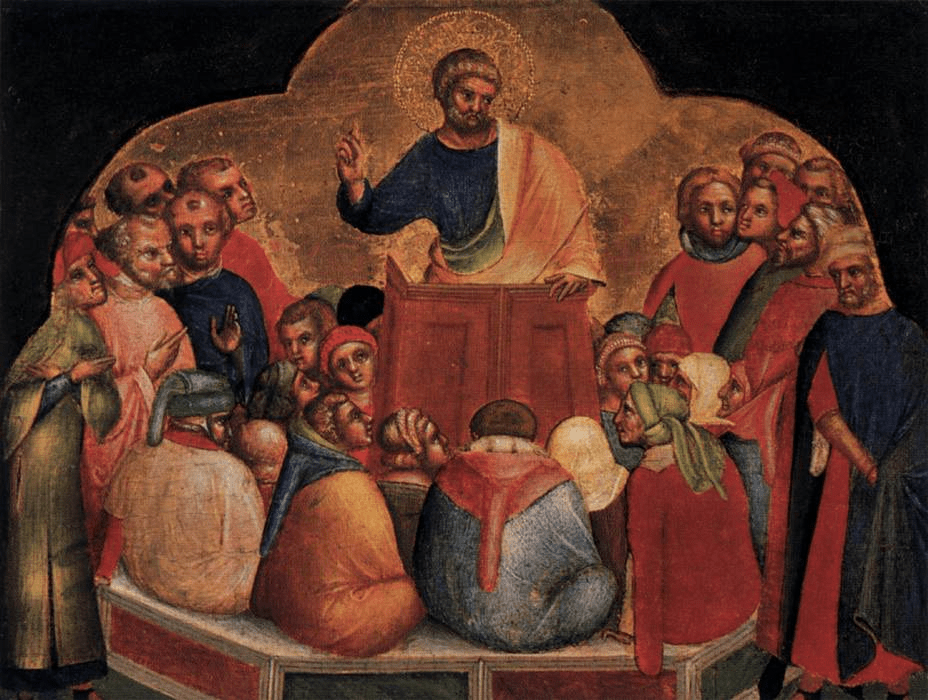
Apostle Peter preaching, by Lorenzo Veneziano, c.1370

And that is exactly what happened with the Apostles Peter and John. Their proclamation of Christ and his resurrection struck a nerve with the Jewish Sadducees who were the keepers of proper worship and liturgy amongst the temple. The Apostles’ teaching was so scandalous and threatening to their own beliefs, that they used their authority to throw Peter and John in jail – just for proclaiming a message the Sadducees didn’t like.

It never feels good getting toasted by those who claim insight and knowledge but are, in reality, a bunch of ignorant simpletons who don’t want to change and will hold onto their sense of power and superiority at all costs.

Yet, the consolation to all of this, is that there are others who are open-minded enough to listen well and adjust their belief systems to match the truthful evidence given to them. And so, despite the efforts of the Sadducees to suppress apostolic preaching, the fledgling group of Christ followers were being added by the thousands.

It turns out that nobody can resist the Holy Spirit of God, no matter how much earthly pull and power they possess.

Today’s New Testament lesson reminds us and teaches us that:

  • Self-awareness of why we hold to our particular beliefs, matters. We ought to hold our dogmatism very loosely.
  • Proclamation of the gospel, that is, the good news of Christ’s crucifixion and resurrection, makes a difference in lot of people’s lives.
  • Opposition is to be expected. There are some who view the good news of grace as the bad news of judgment against themselves; they will oppose it by any means possible.
  • Humility will always serve us well in the spiritual life, whereas condescending arrogance will never help anybody. For God’s sake, please have enough humility to listen and learn, even if (and especially) you don’t like what you’re hearing – no matter which end of the discussion you are on.

If we want the world to be different, then the change begins with you and me. Christians have the opportunity, if they will take up the mantle, of being the most calm, humble, and attentive people in the room. In this time of the year, no other stance and skill can be more important amongst family, friends, and others during the holidays.

O Lord, you have told us what is good, and what you require of us: To do what is right, to love mercy, and to walk humbly. Help us walk together in love and compassion towards the cross, humbly with you and one another. Let your Holy Spirit guide us on the right path to truth and reconciliation with humility; and enable us to hear each other, for we do not want to walk by pride or self-sufficiency, through Jesus Christ our Lord. Amen.

We’ve Had Our Fill of the Arrogant (Psalm 123)

I look up toward you,
the one enthroned in heaven.
Look, as the eyes of servants look to the hand of their master,
as the eyes of a female servant look to the hand of her mistress,
so our eyes will look to the Lord, our God, until he shows us favor.
Show us favor, O Lord, show us favor!
For we have had our fill of humiliation, and then some.
We have had our fill
of the taunts of the self-assured,
of the contempt of the proud. (New English Translation)

The patriarch of the Hebrews, Abraham, lived 4,000 years ago. Moses, the lawgiver and leader of the Israelites out of Egyptian slavery, lived 3,500 years ago. By the time the psalmist wrote today’s psalm, there had already been at least between 1,000 and 1,500 years of Jewish history. And, from the point the psalm was written until now, nearly 3,000 years of history have come to pass.

For all these millennia, the Jewish people have had to endure the contempt and hatred of all kinds of non-Jewish groups and nations. Their suffering has been continual and constant. They have endured multiple attempts of others trying to rid the earth of them. Jews have been mercilessly mocked, violently beaten, religiously persecuted, arrogantly humiliated, callously abused, and perennially shamed, just for being Jews.

The Jewish people know about generational trauma and suffering. They’ve experienced endless heartache and soul damage. And yet, the Jews are still here. They survive, despite so many intentions to wipe them off the map. There are few people groups that can say they still exist after 4,000 years of history.

I submit to you that one of the many reasons the Jewish people have survived, even thrived, for so long is that they have a rich heritage of Hebrew poetry and working out their emotions and their musings before God – and put it down on paper.

The Jewish people acknowledge their emotional and spiritual pain to God, lament it before God, and trust in God to handle their oppressors.

For the one who remains silent, and never sets pen to paper, will fade away and be forgotten. But the one who brings their shame to the light, and contends with the Lord about their suffering, shall see generation after generation continuing to struggle onward and upward.

Trusting God

The controlling image of today’s psalm has to do with the eyes looking. The psalmist looks up to heaven where God is enthroned as Creator and Sovereign over all the earth. Specifically, the eyes look toward the throne room of God.

Underlying the trust and faith of the people is the confession that God is the rightful and powerful Ruler of all. Just as servants look to their masters for provision, so the praying community of people looks to God for their every need – whether it be physical, mental, emotional, or spiritual.

Ultimately, this community looks for a sign of God’s inexhaustible and divine mercy. The worshiper prays, sings, and looks longingly with eyes wide open to the heavens. They look up in confident anticipation, searching for hope and a glimpse of divine mercy.

Here you will not find any sort of rugged individualism, prideful struggling alone, or refusals to ask for help. No! There is a refreshing realism and vulnerability of knowing who you are, where you are, and what you need – without any apology.

Complaining to God

The community of worshipers repeated their heartfelt and strong prayer for mercy from God. The people were facing a relentless stream of contempt from others, and they had more than enough of receiving this.

Those who mocked the Jews are identified as the proud and arrogant. In contrast to the worshipers, the mockers do not look up to the heavenly king, but instead look down on those different from themselves.

The arrogant look only to themselves, not to any master, and certainly not to the sovereign King of the universe. But the followers of the Lord look to their God for mercy because its absent from their experience of being and living on this earth.

Conclusion

The psalm begins with an affirmation of trust, and then, moves to the people’s plea for help from the God whom they place their trust and faith. This psalm was not only befitting of the ancient crisis of Israel’s exile to Babylon and all that happened afterwards in history; the psalm befits us today, as well.

Today, the Jewish people, along with many other religious communities around the world, are experiencing genocidal behavior from mockers who detest them and want to be rid of them altogether.

For all of us who seek the Lord and desire to truly live a pious and penitent life, our eyes look to the divine king for hope. In the midst of oppression by arrogant mockers who operate out of autonomy and independence from the God of mercy, we lift our eyes to the heavens and search God’s heavenly throne room for a glimpse of hope.

In every age – whether ancient, medieval, or modern – the faithful have always needed each other in the community. We have always had to embrace an interdependent dynamic of relating to one another, rather than operate as a mere collection of individuals who happen to be in the same place at the same time.

The faithful understand that life is not something they have earned or made, but is a gift from the Creator and Sovereign who is enthroned in the heavens. And without this perspective, we will continue to see hateful groups of people try to annihilate those different from themselves.

Merciful and loving God, when we are overwhelmed with fear and uncertainty, undermined by the distress of mockery, please love us and grant us patience under suffering.

Help us to love others as you love us; to accept others without judgment; to see difference as your gift of creation; and to remember that love is our greatest calling.

Generous God, you give freely of your love and mercy and grace. Prompt us to share our blessings and respond to the cries of the world.

Encourage us to help those facing the pain of discrimination and prejudice. May they experience healing of both body and soul.

Nurture us in faith, so that we will reach those in need, both near and far.

Inspire us to love all your children equally, without exception; and let us give and receive love, through the One whose name is Love, Jesus Christ, your Son, our Lord. Amen.

Unmasking the Hypocrite (Matthew 15:1-9)

Then some Pharisees and teachers of the law came to Jesus from Jerusalem and asked, “Why do your disciples break the tradition of the elders? They don’t wash their hands before they eat!”

Jesus replied, “And why do you break the command of God for the sake of your tradition? For God said, ‘Honor your father and mother’ and ‘Anyone who curses their father or mother is to be put to death.’But you say that if anyone declares that what might have been used to help their father or mother is ‘devoted to God,’ they are not to ‘honor their father or mother’ with it. Thus you nullify the word of God for the sake of your tradition. You hypocrites! Isaiah was right when he prophesied about you:

“‘These people honor me with their lips,
    but their hearts are far from me.
They worship me in vain;
    their teachings are merely human rules.’” (New International Version)

Reading the Gospel lesson for today, I try to imagine what emotions Jesus might have experienced when confronted by the teachers of the law about his disciples’ lack of attention to tradition concerning ritual hand washings.

Maybe Jesus felt frustration, anger, sadness, exasperation, disappointment, irritation, aggravation, or discouragement. Perhaps Christ experienced all those emotions. Whatever Jesus was feeling at the time, I can easily see him taking a deep breath and exhaling a great big *sigh* over the religious leaders’ hypocrisy.

Hypocrisy is a disconnect between the values we espouse and our behavior. When there is incongruence between what we say is important and how we really live, this is being two-faced and duplicitous.

The men who came to see Jesus were plain old insincere hacks who practiced religious quackery. And Jesus saw right through their fake pretention of righteousness.

First off, this narrative is not a dig on rituals themselves but on using ritual to leverage an appearance of religious superiority over others. This type of motivation for engaging in rituals ignores their ethical and moral intention. Sometimes folks can get so doggone wrapped up in how faith is represented that they lose sight of the faith itself.

Hypocrisy has to do with our motives – not so much what we do, but why we do it. Rituals are good. Why we do them or not, or how we go about doing them, gets at the heart of our objectives for engaging religious practices. Are they truly a worship offering to God, or are they merely mechanisms for keeping up appearances of holiness?

The hypocrite is an actor. Hypocrisy is acting a part which is not truly the person. It is to live from the false self through the attempt of providing an idealized perfect person to the public, instead of embracing the true self and realizing our common humanity with one another in genuine devotion to God and service to others.

Religious hypocrisy is particularly insidious because it uses what is sacred for selfish purposes. It damages the credibility of the religion, creates idolatry, and covers hate with a veneer of pretentious piety.

The hypocrite is one who is a bundle of disparate parts in massive need of integration to a whole and real self. The cost to facing this is letting others see the true self with all of its flaws, imperfections, and weaknesses.

A lot of people have no willingness, nor the intention, to be viewed by others in the true self; so they maintain their play-acting and continue to seek attention and accolades through being the model religious person.

We all must come to grips with the reality that God cares a whole lot about why we do what we do. When the forms of faith become tools of oppression, and big burdens upon others backs, then those forms have supplanted the faith itself. Out of the overflow of the heart the mouth speaks, and from the heart the hands and feet move.

Whenever we care more about being and appearing right – rather than getting it right and becoming better – then we have a heart problem. The heart of the issue is the heart itself. Clean up the heart, and everything else follows – not the other way around.

The probity of today’s Gospel lesson is that we might misinterpret what is important to God. We may be playing the hypocrite; and yet have the misguided belief we are genuine.

The capacity for our hearts to enlarge with love is in direct relation to an awareness of the hidden motives buried within those hearts. Evil intentions and motivations are what separate us from God – not our race, class, age, gender, religion, ethnicity, behavior, rituals, or anything else on the outside.

If we find ourselves being nit-picky of others, this is usually a clue that the unconscious self is trying to protect us from facing the pain of our own sins by projecting and focusing on another’s supposed missteps with tradition or ritual.

Fortunately, Jesus came to this earth full of grace and truth. Christ sometimes, maybe oftentimes, set aside niceness and decorum to go for the heart. In shining a light on the motives behind the deeds of people, some repented and received the good news of the kingdom of God; and, others resisted in order to maintain their illusion of control and superiority.

None could ride the fence with Jesus around. You either loved him or hated him.

The beauty of grace is that when we squarely and uncompromisingly face our sins and let go of things we consider so important, and turn to God with authenticity, we are welcome at his Table.

Most holy and merciful Father, we acknowledge and confess before you our sinful nature, prone to evil and slow to do good, and all our shortcomings, offenses, and malevolent motives. You alone know how often we have sinned in wandering from Christ’s way of grace and truth, in wasting your gifts of compassion and justice, and in forgetting your love.

O Lord have mercy on us. We are ashamed and sorry for all the ways we have displeased you. Teach us to hate our errors; cleanse us from our secret faults; and forgive us our sins; for the sake of your dear Son, our Lord. Most holy and loving God help us to live in your light and to walk in your ways according to the commandment of Jesus Christ, our Savior, in the enabling of your blessed Holy Spirit. Amen.

Against Vainglory (John 5:39-47)

Christ and Pharisee by Russian artist Ivan Filichev, 1993

You study the Scriptures diligently because you think that in them you have eternal life. These are the very Scriptures that testify about me, yet you refuse to come to me to have life.

“I do not accept glory from human beings, but I know you. I know that you do not have the love of God in your hearts. I have come in my Father’s name, and you do not accept me; but if someone else comes in his own name, you will accept him. How can you believe since you accept glory from one another but do not seek the glory that comes from the only God?

“But do not think I will accuse you before the Father. Your accuser is Moses, on whom your hopes are set. If you believed Moses, you would believe me, for he wrote about me. But since you do not believe what he wrote, how are you going to believe what I say?” (New International Version)

I like kids, even and especially Junior High kids. They have not yet learned how to mask their honesty (like Senior High kids). Have a conversation with any early adolescent (other than your own kid) and you will likely get an unfiltered and unvarnished take on whatever topic you are discussing together. If the subject of celebrities comes up, they can quickly rattle off their favorites. There is a reason for that; they are very much in touch with wanting to be impressive, to stand out, even to be famous someday.

I have long contended that if you want to gauge a society’s true values, talk to a young adolescent. Such unique and special people happen to have an emerging awareness of the world; but they do not yet the sophistication to hide their true thoughts from others. Junior High age kids tend to reflect what most adults are thinking but would never dare say out loud. After all, why lose prestige in the eyes of others who think I am wonderful? It’s probably best not to rock the boat, we reason.

“Vainglory” is an old out-of-style word which few people use anymore, yet perfectly captures exactly what Jesus was talking about when it came to people being unable to discern the import of his ministry, and especially his divinity. Wherever and whenever you find an inordinate focus on wanting attention, seeking to impress others, and desiring celebrity status, there you will see vainglory digging its talons into a society.

“They say that hens do cackle loudest when there is nothing vital in the eggs they have laid.”

Ambrose Bierce

Vainglory is precisely what it sounds like: an almost narcissistic self-absorption into one’s need for importance and attention so that the personal vanity blocks being able to see the people right in front of them. In placing so much energy into becoming a celebrity among peers, the vainglorious person’s vanity fogs them from reality and the truth of another.

Conversely, we are to seek the glory which comes from God. Since so many are programmed to seek honor from others, it can be quite the undertaking to turn the hunt into finding our identity and fame as persons in the image of God. Our Gospel lesson today says our reorientation program begins with faith in Jesus Christ. It is the first step toward the unmasking of egomania and soliciting God’s favor.

The sixteenth-century Reformer, John Calvin, said that “a person is only prepared to obey the heavenly teaching when he is convinced that the chief thing to be sought in all of life is God’s approval.”

So then, the appropriate response to vainglory is to fly like a bat of hell to the heavenly mercy of God. There is no shame in wanting honor; it’s just a matter of where we go looking for it. Faith is crippled when we keep trying to discern which way the wind is blowing. Both our identity and our sanity will eventually blow away. However, if we cease prioritizing worldly recognition and cancel our membership in the mutual admiration club, then our conscience clears enough to let divine grace fill our souls with the love of God in Christ.

Give me Jesus and that will be enough, thank you very much. As for recognition and attention, to be adored by the Savior is all I really need. Because at the end of the day, after the hurt of being ignored, overlooked, and forgotten, Jesus is standing at the door knocking, eager to come into the house and grace me with the gift of acceptance, approval, and admiration.

O Lord, in the name of Jesus Christ your Son our God, give me the love which never ceases, that will light my soul with divine grace so that I might be satisfied in you and lessen the darkness of the world. Lord Jesus, I seek your presence and glory. May I see you, desire you, look on you in love, and long after you, for your sake. Amen.