
The Arrogant Leader Will Be Deposed (Isaiah 22:15-25)

This is what the Lord, the Lord Almighty, says:

“Go, say to this steward,
    to Shebna the palace administrator:
What are you doing here and who gave you permission
    to cut out a grave for yourself here,
hewing your grave on the height
    and chiseling your resting place in the rock?

“Beware, the Lord is about to take firm hold of you
    and hurl you away, you mighty man.
He will roll you up tightly like a ball
    and throw you into a large country.
There you will die
    and there the chariots you were so proud of
    will become a disgrace to your master’s house.
I will depose you from your office,
    and you will be ousted from your position.

“In that day I will summon my servant, Eliakim son of Hilkiah. I will clothe him with your robe and fasten your sash around him and hand your authority over to him. He will be a father to those who live in Jerusalem and to the people of Judah. I will place on his shoulder the key to the house of David; what he opens no one can shut, and what he shuts no one can open. I will drive him like a peg into a firm place; he will become a seat of honor for the house of his father. All the glory of his family will hang on him: its offspring and offshoots—all its lesser vessels, from the bowls to all the jars.

“In that day,” declares the Lord Almighty, “the peg driven into the firm place will give way; it will be sheared off and will fall, and the load hanging on it will be cut down.” The Lord has spoken. (New International Version)

The nation of Judah was in a pickle. The Babylonian Empire loomed over them to the East as a mighty army about to swallow them whole. What’s more, the prophets were proclaiming judgment against Judah, with Babylon as the instrument.

Although we don’t always know why hard circumstances come about, in the case of ancient Judah, the prophet Isaiah made it clear what was going on. Isaiah wasn’t afraid to name the names of those responsible for Judah’s situation. Particular government officials were the objects of blame, as well as punishment.

Shebna, the palace administrator or master of the household, held a position somewhat like the prime minister of today. He had a great deal of power, and was second only to King Hezekiah. Isaiah identified and called out Shebna for misusing his administrative office.

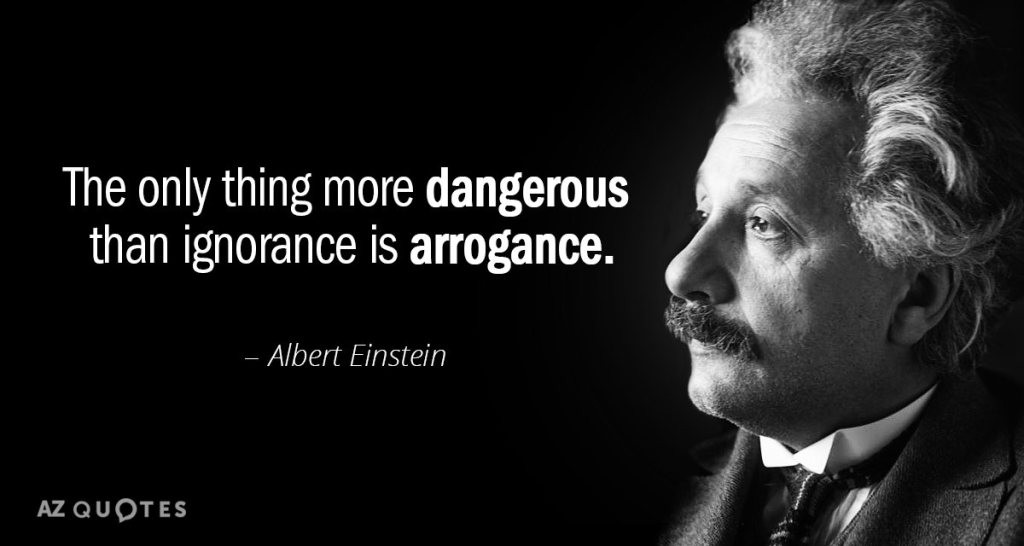
The specific offense Isaiah spoke of was that Shebna made arrangements to ensure his personal grave-sight would have all of the grandeur of a royal tomb. Shebna – the conniving rascal that he was – arrogantly put himself on the same level of the royal king, Hezekiah, who was a righteous man.

The God of Judah, the Lord God Almighty, observed what was happening. And God was not okay with what Shebna was doing, and how he was going about his duties. Shebna was failing to discharge his responsibilities. Instead, he was finagling to make sure his own name would be remembered as great.

Shebna was a disgrace to his king, Hezekiah. So, the Lord would have him violently dislodged from his position, and exiled. In that place he would die and never see his country again. Because Shebna was so taken up with selfish concerns, he failed to do the job of preparing his nation for the growing threat of Babylon.
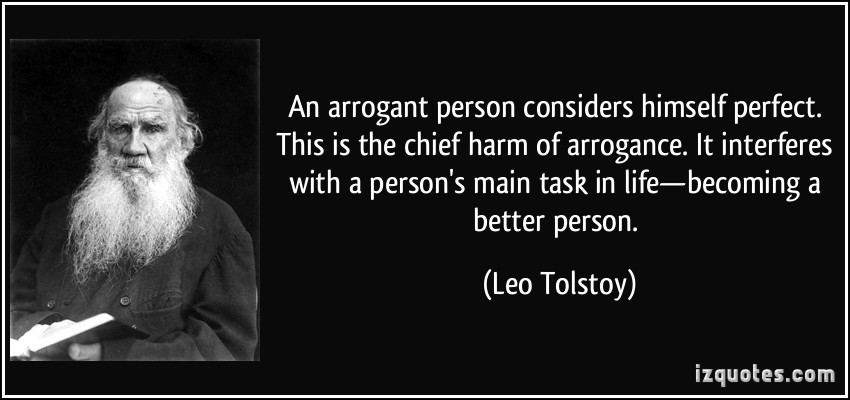
In place of Shebna, Eliakim son of Hilkiah would become the administrator, the prime minister. He would use his authority for the common good of the nation, and not for making his own name significant, and his own tomb big.

God promised security and honor for Eliakim and his family. Yet, even Eliakim would feel the weight of severe consequences along with the entire nation of Judah.

Although a change in leadership brought hope for peace and prosperity, it never materialized. Future leaders would sink lower than Shebna. And future kings would go to the lowest depths of depravity. All of it anticipated the Babylonian army’s invasion and the people’s exile.

Does any of today’s Old Testament lesson sound familiar in today’s governmental workings in the world, including and especially in the United States?

Being concerned and enamored with putting one’s name on places one does not deserve; being unconcerned with the plight of the poor, the immigrant, and the powerless; and being unprepared to use authority for just and right purposes, puts one in the legacy of Shebna, not Eliakim. The selfish politician ought only to expect eventual divine judgment, and not any sort of praise from neither the people, nor God.

If the God of the universe takes notice of a prime minister’s intended creation of a permanent mausoleum, then how much more will the Lord take note of a president’s abuse of authority and the tearing down and erecting of buildings which benefit his own name, and not the concerns of the needy in the land?

Whenever talk of compassion and practice of humility is replaced with petty arrogance and unmerciful arrest of citizens, then we really ought to expect nothing less than what happened to the selfish persons and governmental officials of old who came to an ignominious end.

Most merciful God, we confess that we have sinned against you in thought, word, and deed, by what we have done, and by what we have left undone. We have not loved you with our whole heart; we have not loved our neighbors as ourselves. We are truly sorry and we humbly repent. For the sake of your Son Jesus Christ, have mercy on us and forgive us; that we may delight in your will, and walk in your ways, to the glory of your Name. Amen.

Anti-Intellectualism

Everyone with good sense
    wants to learn. (Proverbs 18:15, CEV)

Anti-intellectualism:

  1. opposition to or hostility toward intellectuals and the modern academic, artistic, social, religious, and other theories associated with them
  2. the belief or doctrine that intellect and reason are less important than actions and emotions in solving practical problems and understanding reality

Holy Scripture encourages knowledge, understanding, and wisdom. In order to be a truly wise and understanding person, there must be a combination of knowledge and experience. When these two elements come together, and are practiced over a long period of time, then spiritual maturity is realized.

In every church I’ve ever served across the decades there have been individuals and groups of people in my congregations who are anti-intellectual. They were not big fans of seminaries. They often mistrusted highly educated persons with multiple degrees. And they had a hard time submitting to any authority structure that smacked to them of being elitist.

Unfortunately, the majority of those persons, in my experience, refused to learn in any other way other than their own personal experience. I don’t think I need to tell you the many pitfalls such a stance creates: constant misinterpretation of situations; prejudice toward others whom they don’t understand; and chronic disobedience to every authority in their life.

It likely wouldn’t surprise you to know that these sorts of parishioners rarely, if ever, read their Bibles, or even seek to learn other than hearing Sunday sermons. They reek of spiritual immaturity and pride, being puffed-up with themselves that they aren’t like the elites in power.

Now imagine what a group of people like this would be like if they were in the highest levels of government… But we need not imagine; the reality is in front of us every day.

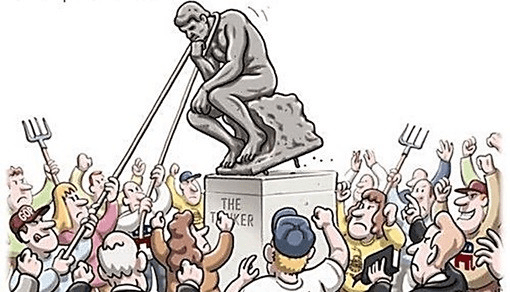
To understand the current political climate in the United States, it seems to me we need to see that the present governmental administration, at its heart, is an anti-intellectual movement.

Now please know that I am not saying that everyone in the administration is stupid. What I am saying is that many if not most Republicans have a deep seated problem with educational elites – hence the sustained attention on American universities, especially Harvard.

They believe themselves to be practical, no nonsense people who can get things done without umpteen committees and eggheaded reports. The problem, however, is that in their belief of experiential superiority, they’ve refused to listen. They end up making snap judgments of situations and other people. In other words, they can quickly make a disaster of things whenever they’re in charge.

Furthermore, what the anti-intellectuals end up doing most is grasping for as much worldly power as they can gain.

For Protestant Evangelicals, their desire for power stems from their perceived loss of a golden age of Christendom. Back then they were in power – prayer in schools, no abortion, the Ten Commandments in every court house, riding your bike in the neighborhood with safety, etc.

Yet, because there is such a paucity of listening and seeking to understand, the anti-intellectuals fail to understand that their own golden age was a bronze age of Jim Crow laws, failed reservation promises, and the need to operate in the shadows for all sorts of other persons.

Holy Scripture’s Book of Proverbs – which is a combination of accumulated knowledge and lived experience – has something to say about those who refuse to listen and learn from others:

With wisdom you will learn
what is right
    and honest and fair.
    with knowledge. (Proverbs 2:9-10, CEV)

Fools think they know
    what is best,
but a sensible person
    listens to advice. (Proverbs 12:15-16, CEV)


Stupidity leads to foolishness;
    be smart and learn. (Proverbs 14:18, CEV)

Fools have no desire to learn,
instead they would rather
    give their own opinion. (Proverbs 18:2, CEV)

Pride leads to destruction;
    humility leads to honor.
It’s stupid and embarrassing
to give an answer
    before you listen. (Proverbs 18:12-14, CEV)

An ignorant fool learns
    by seeing others punished;
a sensible person learns
    by being instructed. (Proverbs 21:11, CEV)

If we apply our hearts to wisdom, we will learn:

  • the pursuit of power at all costs creates stupidity
  • the disdain and/or ignorance of others has adverse consequences for all
  • there has always been an anti-intellectual strain throughout the history of the world (including U.S. history)
  • the act of placing blame on others (such as the so-called “elites”) will come back to bite us

It does no good to reason with an anti-intellectual, namely because they will not avail themselves of logic nor learning.

Instead, it is wise to treat an anti-intellectual like we ourselves would want to be treated: to have another listen to us and be curious about why we hold to what we hold, without judgment; and to have another respect our ability to choose for ourselves.

Can you imagine a world where we would all commit ourselves to listening and learning, acquiring knowledge, understanding, and wisdom? We would likely live in a very different world than the one we are in today.

May the course of this world be peaceably governed by divine providence. And may the church everywhere joyfully serve God in confidence and serenity. Amen.

How Do You Want To Be Remembered?

Someday when I am dead and buried, I would be fine with my gravestone stating, “He was humble and wise.” For I have always sought (however imperfectly) to embrace and live a life characterized by poverty of spirit, largeness of heart, and a sage mind.

Yet, most of all, I’d like to be remembered by the phrase, “He loved God.” The Great Command of Jesus to love God and each other is something I pray and seek in my daily life. And I hope that at the end of my earthly life, the love of God within me has made the world a better place.

In saying this, it means I forsake a lot of other ambitions to be remembered by. I don’t really care if I am remembered for any other virtues or abilities other than love, humility, and wisdom.

For the times that I have unknowingly pursued other things above what is of concern to my Lord Jesus, I admit and renounce those things. Because that is what humility and love does. And it’s the wisest thing a person could do.

That is in direct contrast and opposition to worldly ambitions for wealth and financial resources, power and authority, attention and greatness. Such desires arise from pride, not humility. With arrogance, ignorance and hate are not far behind.

Such virtue is itself the good life. And it is not out of touch for any of us. For Christ himself repeatedly told and reminded his disciples that the kingdom of God is near, so near as to be within us.

“The time has come, and God’s kingdom is near. Change the way you think and act, and believe the Good News.” (Mark 1:15, God’s Word Translation)

“The Kingdom of God is near you now.” (Luke 10:9, New Living Translation)

And we are told to make God’s kingdom a priority. We are to humble ourselves before God and seek the reign of God and the values of how God operates, rather than putting all our equity into material possessions.

“Seek first the kingdom of God and his righteousness, and all these things (material resources) will be given to you as well.” (Matthew 6:33, New International Version)

The super-rich of this world have a super difficult time ever humbling themselves to anyone, including God, because they can so easily rely upon their vast earthly resources.

“Truly I tell you, it will be hard for a rich person to enter the kingdom of heaven. Again I tell you: It is easier for a camel to go through the eye of a needle than for someone who is rich to enter the kingdom of God.” (Matthew 19:23-24, New Revised Standard Version)

God’s kingdom is not something that is so far out of touch for us, or way out there somewhere, as if we could not, and therefore need not, pay much attention to it. No, it is much closer than any of us realize.

You and I have the light within us. For some people (maybe most people) this light has diminished to a tiny little flame or spark. They themselves either cannot or will not perceive there is something right and good that exists down deep in this soul created in the image and likeness of God.

Phrases such as “Let us rely upon our better angels,” and “Get in touch with our nobler instincts,” are more modern ways of expressing that there is inherent worth within us that we can tap into. It doesn’t even take a Christian or a religious person to recognize this reality.

We really do have a higher self, a conscience containing a moral compass, a given benevolent nature, altruistic impulses, and a compassionate side to us. Will we seek this part of ourselves? Will we tap into it? Will we allow it to come out into the world in order to bless it, not curse it?

Yet, as we know all too well, we also a have within us a depraved part which wants to rule over others and acquire as much wealth and power as possible. As with most things, we ourselves are a paradoxical conundrum of competing desires.

How do you want to be remembered? We can pursue the kingdom of God within us, or we can seek the kingdoms of this world outside of us. It’s your choice. But you will need help, if going after such things as humility, wisdom, and love as your way of life – not only help from God, but also help from others.

“Ask, and it will be given to you; search, and you will find; knock, and the door will be opened for you. For everyone who asks receives, and everyone who searches finds, and for everyone who knocks, the door will be opened. Is there anyone among you who, if your child asked for bread, would give a stone? Or if the child asked for a fish, would give a snake? If you, then, who are evil, know how to give good gifts to your children, how much more will your Father in heaven give good things to those who ask him!

“In everything do to others as you would have them do to you, for this is the Law and the Prophets. (Matthew 7:7-12, New Revised Standard Version)

What is true of you, that you would like engraved on your gravestone? How do you want to be remembered? That’s what we need in this world, for this time and for this place.

With God In the Dark (Psalm 3)

By Unknown Artist

Lord, I have so many enemies!
    So many are standing against me.
So many are talking about me:
    “Even God won’t help him.”
But you, Lord, are my shield!
    You are my glory!
    You are the one who restores me.
I cry out loud to the Lord,
    and he answers me from his holy mountain.
I lie down, sleep, and wake up
    because the Lord helps me.
I won’t be afraid of thousands of people
    surrounding me on all sides.

Stand up, Lord!
    Save me, my God!
In fact, hit all my enemies on the jaw;
    shatter the teeth of the wicked!
Rescue comes from the Lord!
    May your blessing be on your people! (Common English Bible)

I don’t like cockeye arrogant people. It irks me when a person believes that their way is the only way. Such persons within the church tend to think God is always on their side. Their pride leads them to believe that God won’t help anyone who differs from them.

That sort of arrogance causes the proud person to become a self-appointed judge of all things. So, they have no problem believing that they are God’s instrument of judgment toward those who don’t agree with them.

Ironically, in their delusion, enemies of God actually believe they are on God’s side.

These were the sort of persons that opposed the psalmist, King David. They thought they knew better about how to reign over a kingdom than David did. So, David prayed with a lot of flavor for God to disprove the arrogant assertions of his enemies.

David rightly asserted that trust has its foundation in God, and not in the beliefs of humans. He discerned that God is his shield and protection against the foe. David believed that the power of God can repel any attack, as well as restore anyone to any position, as God sees fit.

The contrast in the psalm is between humble David and his proud enemies. David was the sort of person who called on God when he was in trouble. David’s enemies were the kind of people who first formed their own opinions and laid their own plans, then told God to bless what they came up with.

That’s not only the difference between humility and pride; it is also the difference between wisdom and foolishness, intelligence and stupidity.

Whatever David’s opponents would do is no match for the protective encircling presence of God around him. Although proud enemies are like wild animals with powerful jaws, God can snatch anyone out of their teeth.

Even though David’s enemies advanced against him with arrogant self-confidence, God can rescue anyone from any army. No plan formed against the godly person shall succeed. The Lord can deliver one from any and every situation.

With God, one’s fear is mitigated by faith; and sleep eventually comes with a relaxing trust in the Lord. The faithful Christian arises with a prayer in their heart saying:

Almighty God, everlasting Father, you have brought me in safety to this new day. Preserve me with your mighty power, that I may not fall into sin, nor be overcome by adversity. And in all I do today, direct me to the fulfillment of Your purposes, through Jesus Christ my Lord. Amen.

The godly understand that the Lord never slumbers nor sleeps. God is ever-present with needed watch-care. And so, we declare along with the psalmist:

I look to the hills!
    Where will I find help?
It will come from the Lord,
    who created heaven and earth.

The Lord is your protector,
and he won’t go to sleep
    or let you stumble.
The protector of Israel
doesn’t doze
    or ever get drowsy.

The Lord is your protector,
there at your right side
    to shade you from the sun.
You won’t be harmed
by the sun during the day
    or by the moon at night.

The Lord will protect you
and keep you safe
    from all dangers.
The Lord will protect you
now and always
    wherever you go. (Psalm 121, CEV)

Even though the believer may become burdened with distress and adversity, without any sign of relief, they never cease to cry out and call upon God. They trust in God’s promises. They support themselves with their knowledge of God. They endure and persevere through all things.

In the end, the faithful will realize blessing and goodness. The unfaithful and arrogant won’t.

Perhaps you have been tossing and turning every night. If you sleep at all, your dreams are nightmares. During the day you might have the wherewithal to resist doubt and distress. But at night, your defenses are down, and waves of anxiety come upon you like a bunch of unwanted thugs.

In your disquieted state, make your repose to God. There is no shame in discouragement and defeat, for all the godly will suffer in some way. You shall ultimately prove victorious over all your fears, because of your reliance upon the Lord.

Whereas the ungodly puffed up person relies upon themselves, they shall be overcome by the smallest of perils. They do not realize that the routines of prayer, mindfulness, self-awareness, and the singing of hymns regulate and regimen the mind, even when unwanted situations persist for days, weeks, months, or even years at a time.

The unfaithful don’t understand that consistent rhythms of faithfulness done day after day, despite one’s circumstances, leads to a good life.

This liturgy of life in communing with God perhaps happens best at night.

On my bed I remember you;
    I think of you through the watches of the night. (Psalm 63:6, NIV)

In the night, Lord, I remember your name,
    that I may keep your law. (Psalm 119:55, NIV)

If you are a night owl, then use the time after everyone is in bed to take advantage of the quiet time with God. Your faith can be and is being forged in those dark hours after sunset. Allow yourself to fall asleep in God’s protective hands.

If you are a morning person, arise before the dawn and let the unhindered time when everyone else is sleeping bring you close to God in prayer and devotion. Let the coming of the day be shaped by the consistent discipline of scripture reading and contemplative prayer.

I rise before dawn and cry for help;
    I have put my hope in your word. (Psalm 119:147, NIV)

May the dark hours be to you blessing and honor. May the glory and power of God be seen, even in the night. For God sees you, and is with you, now and forever. Amen.