The Compassion of Jesus

Jesus healing - 13th century
Jesus and his ministry of healing, from a 13th century church mosaic.

Compassion is a concern for the well-being of others. It is the basis for altruism and the most virtuous motive one can possess. Compassion is activated within the human heart when witnessing another person’s suffering. Compassion spurs us to help. It is through compassion that people feel seen and known. Compassion brings care, empathy, and sympathy together as a bridge to connect with another person or group of people in need. Without compassion, there is no life.

While on this earth, I believe Jesus was the very embodiment of compassion. To reflect on Christ’s compassion helps us to raise our own compassion quotient and avoid succumbing to the whims of indifference to human need.

When Jesus saw the crowds, he had compassion on them, because they were harassed and helpless, like sheep without a shepherd. (Matthew 9:36)

The compassion of Jesus responds to human need. In his earthly ministry of preaching, teaching, and healing, Jesus went through all the towns and villages. He neither waited for people to come to him nor wanted anyone to fall through the cracks. During this work, Jesus was moved by the depth of people’s needs. The word for “compassion” in the Bible means “to be moved in the pit of your gut.” It is to be filled with pity and heart-broken over the unmet needs of people.

What moves and stirs compassion deep down in your gut? Jesus went about the towns and was brokenhearted over people who were harassed and helpless, locked into patterns of life that were harmful and damaging.  Jesus came to this earth to seek and save people, offering forgiveness of sins and a new life. Jesus willingly offered compassion – his motivation was neither from duty nor guilt. Compassion is the proper motivation for all things.

Jesus went out and ministered, then was moved by what he saw.  Compassion comes upon us as we go out and enter people’s lives, seeing first-hand the depth of need represented.  Show me a person with compassion, and I will show you a person who takes the time and effort to know another.

“Pray earnestly to the Lord of the harvest to send out laborers into his harvest,” implored Jesus. (Matthew 9:38)

The compassion of Jesus issues in a call to pray. Christ saw the masses of people and told his disciples to ask God to send workers because the harvest is plentiful.  Jesus knows there are large numbers of people waiting to hear the good news of the kingdom of God. So, he said to pray earnestly and compassionately.

Compassion is the motive which brings us to prayer. Compassion impels us to pray that workers be sent to people who are ripe for hearing good news. We must not listen to the hellish lie: That certain people don’t really want the good news of the kingdom of God; that my neighbor, or co-worker, or family member is not spiritual and doesn’t care about forgiveness of sins, or grace – that there is nothing within them to respond to compassion. The devil does not want us to have merciful compassion for them, to be moved to intercede for them in prayer, nor to become a harvester in the field of people.  Jesus said the harvest is plentiful, and it is through compassionate prayer that the work will be done.

Jesus called his twelve followers together and gave them authority to drive out evil spirits and to heal every kind of disease and sickness. (Matthew 10:1)

Ethiopian Jesus the Healer
Ethiopian Orthodox depiction of Jesus the Healer

The compassion of Jesus caused him to send out his disciples. The call to prayer is central; it is also not everything. As faith without works is dead, so prayer without mission is empty. The people Jesus authorized for ministry were the twelve, and they were a motley crew, indeed!  For example, having Matthew the tax collector and Simon the Zealot on the same team together would be like sending Joe Biden and Donald Trump as a pair out for ministry. Yet, the compassion of Jesus changes lives and brings people together from diverse backgrounds and viewpoints.

The disciples were told, in their initial mission as followers of Jesus, to go only to the house of Israel – Israel’s house needed to be put in order first before they could ever think of going to Gentiles. There were Jews all around them, and Jesus goes after them first.  Remember Christ’s final instructions: You will be my witnesses first in Jerusalem, then Judea, and Samaria, and the rest of the world (Acts 1:8). We begin by reaching out to people in our own backyard.

Jesus told the disciples to do exactly what he had been doing: preaching and healing, proclaiming the message that “the kingdom of God is near.”  The kingdom is not only something in the future; the kingdom of God has already broken into the present time, and the evidence of it is the transformation of people’s lives now. The blessings and promises of kingdom life are presently available.

Jesus sent the disciples out and told them not to take anything with them.  They were to leave all their baggage behind. The disciples were to be stripped of everything so that they had the ability to see people and their needs and be moved with compassion as Jesus was. The kingdom of God was near to them, so they did not need to add anything for the mission (Matthew 10:1-15). Jesus did not want his disciples assuming they already knew what people needed. Instead, they must be present to people and discover their needs without bias. As compassion is freely received, it is to be freely given.

Compassion is the appropriate response to human need.  Yet, we do not always react with compassion. The following are a few approaches which prevent us from becoming compassionate, and some ways of cultivating a compassionate life:

  1. A defeating and discouraging environment. Contempt breeds contempt. Anger produces more anger. Hatred feeds hatred. Abuse drives out compassion. The environment around us makes a difference. If we find we must check our hearts at the door and avoid compassion to just make it, then we need a change of environment. Life is too short and the world too compassion-starved to maintain a situation that drags us down and hinders the kingdom of God within us.
  2. An unhealthy pace of life. A person cannot have a compassionate heart if they are running too fast to see other people’s needs. When spare moments are used to try and figure out how to keep all the balls in the air and all the plates spinning, there is no way to dole out compassion to others. Slow down. No one comes to the end of life and wishes they had logged more hours of work at their job. Develop a plan on how to slow down enough to tune into the needs of others and have emotional energy for them.
  3. Excessive caregiving. Compassion fatigue is a real thing. Resentment can build toward the very people we care for because of constant giving without receiving. When the emotional gas tank is empty, it is possible to become cold-hearted. Yet, some keep going anyway – and ruin their engine. Caring for others must be meticulously balanced with caring for self. There is a time for everything, including rest and recuperation.  Jesus regularly practiced the disciplines of solitude and silence. If he needed those restorative practices, so do we.
  4. Objectifying people. Whenever we put adjectives in front of people, it is a clue that compassion is lacking. Referring to “those” people; “lesbian” neighbors; “black” folks at work; my “obnoxious” relative; or, the “poor” family down the street; are all examples of objectifying people and putting them at a distance from ourselves. Your neighbors are your neighbors, your family is your family, and the people in your life are just people, period. Compassion arises as we look for what is common among us, not different. Compassion brings solidarity with others, not separation and division.

May you allow God the time to form a compassionate heart within through being with Jesus. May compassion toward others be the defining characteristic of your life.

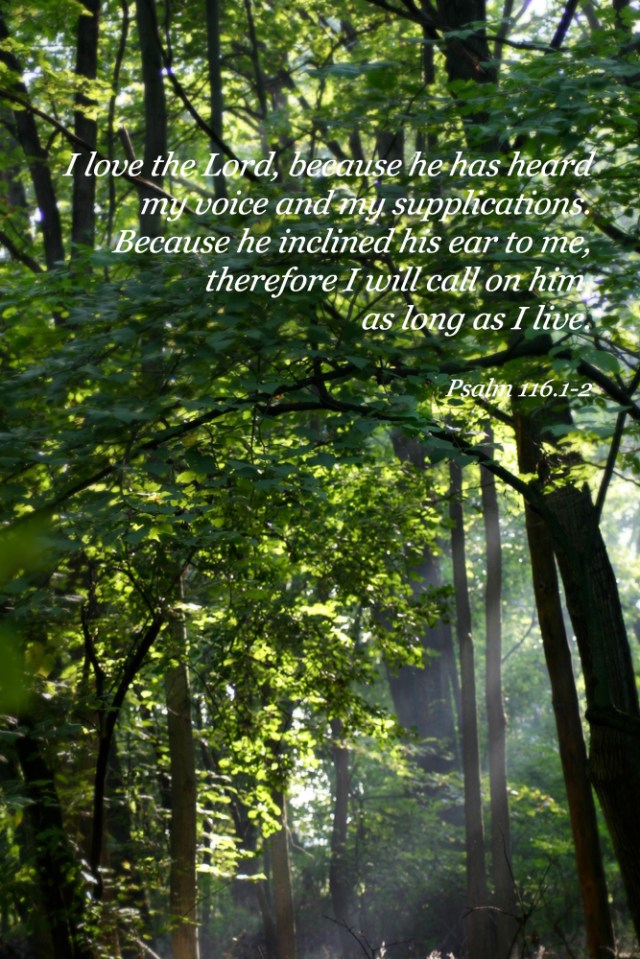
Psalm 116:1-2, 12-19 – A Testimony of Deliverance

psalm 116.1-2 pic

I love the Lord because he hears
my requests for mercy.
I’ll call out to him as long as I live,
because he listens closely to me….

What can I give back to the Lord
for all the good things he has done for me?
I’ll lift up the cup of salvation.
I’ll call on the Lord’s name.
I’ll keep the promises I made to the Lord
in the presence of all God’s people.
The death of the Lord’s faithful
is a costly loss in his eyes.

Oh yes, Lord, I am definitely your servant!
I am your servant and the son of your female servant—
you’ve freed me from my chains.
So I’ll offer a sacrifice of thanksgiving to you,
and I’ll call on the Lord’s name.
I’ll keep the promises I made to the Lord
in the presence of all God’s people,
     in the courtyards of the Lord’s house,
which is in the center of Jerusalem.

Praise the Lord! (CEB)

As the Church’s Prayer Book, the Psalms were originally crafted for public as well as personal use. The Psalter is meant to be prayed, sung, and spoken out loud. The Psalms address the human condition and encompass the full range of human emotion. There are times when we are so distressed that we are unable to form words – and the psalms help us say what is in our heart. There are also times when we are so elated that we have no words to express our joy. The psalms assist us with this, as well. Today’s psalm is such a response.

The psalmist is beside himself with appreciation and praise because of answered prayer. Although the he does not provide what that answer was, this psalm is a staple for the Jewish people at Passover to specifically thank the Lord for the deliverance from Egyptian slavery. The event appears less important than the reality that God listens.

The Lord hears the cry of the oppressed and bends his ear to catch our prayers.

Because of such mercy, the psalmist pledges fealty to the Lord and commits to following through with promises to God. “I love the Lord,” is the cry of his thankful heart. The psalmist gave public testimony that prayer does indeed change things. At times when our own prayers seem to just bounce off the ceiling, it is good to hear from another that the Lord still answers prayer – that life can be different than its present confusion.

When my dear wife had a spine surgery six years ago and awoke from it unable to move her legs, I prayed. I asked for mercy. I pleaded for grace. And I did it for hours at the foot of her hospital bed. I remember that I stubbornly would not accept the fact that she could not move her lower body.  And I decided to stand there and pray until I got an answer from God.

Eventually, I prayed myself asleep. My wife woke me up sometime in the early morning the next day. She told me to pull back the covers and look at her right big toe…. She could give it an ever-small twitch. We called the nurse, who was so excited that she called everyone she could get a hold of. With a dozen hospital staff huddled around the hospital bed, my wife proceeded to give that big toe a hearty move. The staff erupted with clapping, and I am not kidding when I say that we had a party with noise and shouts in a hospital room at 4am. Nobody cared we were going nuts. I certainly did not.

Yes, God is still in the business of answering prayer.

Through the hard times, the good times, and the confusing times, the Lord is our constant ballast for all seasons of life, whether good or bad. And I love God for that abiding presence. I can also give testimony that through all of the adverse situations my wife and I have faced, we have learned to stop, be still, and find that all we ever wanted we already have, even when everything changes.

Perhaps you are reading this today and feel some desperation, maybe some wondering, if God pays any attention to your plight. Yes, the Lord does. You are not alone. We all have times of needing freedom from whatever chains are keeping us in bondage. So, I offer this prayer for you….

O God, who in Jesus Christ called us out of the darkness and into your marvelous light; enable us always to declare your wonderful deeds, offer thanksgiving for your steadfast love, and eternally praise you with heart, soul, mind, and strength.

Eternal God, for the sake of Jesus, send your Holy Spirit to the person(s) praying along with me now who need healing of body and soul, or who seek deliverance from a difficult and debilitating situation. Be gracious to drive away all that is unjust and crippling and mercifully make whole that which is broken. Grant deliverance from the power of evil and provide true faith in Jesus Christ our Lord, who suffered on our behalf and rose from death so that we too can live with joy and peace in the Holy Spirit.

Merciful God, you are the source of all healing and wholeness. We give thanks to you for your love. As we wait in expectation for the coming of the day when Jesus shall return, when suffering and pain shall be no more, please reassure us by your Spirit of your mighty power and help us to trust in your great love.

May your unending compassion be poured out to these your people who long for your hope to explode within them – to the glory of Jesus Christ, your Son, our Savior, who with you and the Holy Spirit live and reign together, one God, now and forever. Amen.

Hebrews 3:1-6 – Fix Your Thoughts on Jesus

Christ of Mercy
Byzantine Christ of Mercy, circa 1100

Therefore, holy brothers and sisters, who share in the heavenly calling, fix your thoughts on Jesus, whom we acknowledge as our apostle and high priest. He was faithful to the one who appointed him, just as Moses was faithful in all God’s house. Jesus has been found worthy of greater honor than Moses, just as the builder of a house has greater honor than the house itself. For every house is built by someone, but God is the builder of everything. “Moses was faithful as a servant in all God’s house,” bearing witness to what would be spoken by God in the future. But Christ is faithful as the Son over God’s house. And we are his house, if indeed we hold firmly to our confidence and the hope in which we glory. (NIV)

It is hard to be patient. Perseverance is difficult. If the Christian life were all bunny rabbits and rainbows, there would be no need for the strengthening of faith and the development of endurance – it would all be fun and easy. However, we know life is often hard and demanding. It requires effort and faith is the muscle that gets us through adversity. If unused, faith atrophies. Faith needs strenuous exercise to grow, and must be tested in adverse circumstances to mature.

The author of Hebrews wrote his letter to Jewish Christians because they were losing their grip of faith. The hard circumstances of the believers were leading them to entertain the notion of returning to their old ways of life, apart from Christ. They needed to refocus and set their thoughts on Jesus in the present moment.

When in the middle of situations, we neither asked for nor want, it can be tempting to view the past as “the good old days.” Yet, if you stop to think about it, you really know better. Because of your present struggle, the mind conveniently filters out all the crud from the past to make the bygone days look romantically better than they really were.

“Better” is what the book of Hebrews is all about.

The author persistently insists that Jesus is better than anything from the Hebrew Christians’ past. Moses is one of the most revered figures in Old Testament history. The writer of Hebrews acknowledges this basic respect for Moses, and goes beyond the glittery Mosaic-era reminiscing to remind the people that whereas Moses was faithful within God’s house, it is Jesus who is the Master over the house. Reality check, believers: Jesus is better than Moses.

What is more, followers of Jesus are the house. Jesus Christ is Lord – not Moses, or anybody else. Jesus cares for and protects his house. It might be tempting to believe that a previous house we had in another city or town was better. That was then, this is now. Today we live in God’s house. Therefore, we must hold on and not let go of the confidence we have in Jesus and the privilege we have living in God’s house.

When life is tough, daydreaming about a rosy past is easy. For sure, we can find all kinds of things we miss from previous days elsewhere. I have moved dozens of times in my life, and each place I have lived has a unique and special place in my life. Yet, trolling our personal histories, much like time-wasting gallivants on the internet, does nothing for the development of faith and perseverance.

Faith needs strengthening so that it is sustainable through the entire Christian life.

Just as a bodybuilder needs disciplined routines of exercise, so the Christian requires spiritual disciplines for a faith conditioning program which focuses the mind on Jesus. There are many spiritual practices, all which are wonderfully useful. Three of the most basic of those disciplines are: Scripture reading and spiritual reflection; personal and corporate prayer, and worship/fellowship. They are the Christian’s barbells.

  • Since God has revealed himself through Holy Scripture, we have the gracious privilege of reading the Bible to encounter the living Lord. I look at this not so much as reading but as taking a posture of listening to God. So, I read slowly and carefully, being alert to the Spirit’s voice.

For the word of God is alive and active. Sharper than any double-edged sword, it penetrates even to dividing soul and spirit, joints and marrow; it judges the thoughts and attitudes of the heart. (Hebrews 4:12, NIV)

  • Since God desires conversation with us, prayer opens us to a divine dialogue with the Lord. The Russian Orthodox monk, Theophan the Recluse (1815-1894) describes it this way: “To pray is to descend with the mind into the heart, and there stand before the face of the Lord, ever-present, all seeing, within you.” With this kind of description, prayer is sustained much less by duty and much more by a desire to connect with God.

Therefore, since we have a great high priest who has ascended into heaven, Jesus the Son of God, let us hold firmly to the faith we profess. For we do not have a high priest who is unable to empathize with our weaknesses, but we have one who has been tempted in every way, just as we are—yet he did not sin. Let us then approach God’s throne of grace with confidence, so that we may receive mercy and find grace to help us in our time of need. (Hebrews 4:14-16, NIV)

  • Since God exists in the fellowship of three persons, our fellowship with one another spiritually forms us for the sake of blessing the world. As we share in the life of our Triune God in worship, we gain ability to live in healthy community and learn from each other. By opening our lives to both God and others, we discover newfound faith and learn to strengthen one another.

See to it, brothers and sisters, that none of you has a sinful, unbelieving heart that turns away from the living God. But encourage one another daily, as long as it is called “Today,” so that none of you may be hardened by sin’s deceitfulness. We have come to share in Christ, if indeed we hold our original conviction firmly to the very end. (Hebrews 3:12-14, NIV)

In the present moment, right now, today, Jesus has a hold of you. Fix your thoughts on him. Today, Jesus wants to walk with you through your trouble – not transport you to the past. Now is the time to follow Jesus into all the situations that are in front of us. You are not alone. You can do this. We are all in this together.

Lord Jesus, you are sovereign over my past, present, and future.  Today has its situations and problems.  Help me walk into and through them with your gracious protection so that perseverance is developed within me and my faith in you is strengthened for tomorrow.  Amen.

Romans 8:26-27 – The Prayer Helper

praying

And the Holy Spirit helps us in our weakness. For example, we don’t know what God wants us to pray for. But the Holy Spirit prays for us with groanings that cannot be expressed in words. And the Father who knows all hearts knows what the Spirit is saying, for the Spirit pleads for us believers in harmony with God’s own will. (NLT)

There are times when we are so distressed that we have difficulty forming any kind of words in prayer. There are seasons where our spirits are so sad and angry that our minds cannot focus enough for prayer. And there are events that come upon us unexpected and with such emotional impact that our souls feel pummeled and beat up to the point that all we can do is groan.

In recent days, I have found myself with just such feelings. Feeling the sheer weight of 100,000+ deaths due to COVID-19, as well as the literal weight of a Minneapolis police officer on the neck of George Floyd resulting in death have me groaning both inside and out. I am deeply concerned for my African American brothers and sisters and for the many grieving families, including my own encounters with them, who lament the loss of loved ones.

Yet, I am strangely and mystically warmed with the Holy Spirit’s abiding presence within me – because the Spirit takes my feeble sighs and silent sobs and himself groans before the Father. God feels what I feel and has both the mercy and the authority to do something about it. In my inability to voice prayer with any kind of erudition to the heavenly Father, the Spirit works with the simple grunting of my soul. Like a skillful translator of languages, the Holy Spirit effectively takes every heartfelt muttering and expresses a divine groan to the Father which perfectly expresses my raw and real intentions.

The Holy Spirit is an expert on knowing our concerns, knowing God’s will, and bringing the two in harmony with each other. 

Since the Spirit helps us in our weakness, we possess the confident expectation that we will not always be in this position. Meanwhile, we learn to slow down our breathing to receive the breath of the Spirit. We sit in silence, anticipating the gentle voice and refreshing breeze of the Spirit. We become versed in moving with new rhythms of rejoicing and groaning; praising and grieving; hope and lament; faith and agonizing patience. We discover that the Spirit is our ultimate essential service in an upside-down world. Above all, we tenaciously hold onto our imperfect prayers, confident that the Spirit will groan them in the ear of our gracious heavenly Father.

The Holy Spirit is the One who stands in the gap between where we are and where we need to be and intercedes for us, bridging the chasm and bringing us deliverance from our impatience.

One of the oldest definitions of prayer is this: Lifting mind and heart to God. Too often in our efforts to pray formally (both communally and privately) we fail to actually lift our hearts and minds to God because what is really inside us is not something we generally connect with prayer at all. Our frustrations, bitterness, jealousies, lusts, curses, sloth, and quiet despair are sometimes understood to be the opposite of prayer, as if they are things to be overcome so that we can then pray.

Prayer, however, is a conversation, a dialogue, in which we lay bare our deepest thoughts and emotions to a God who graciously receives them and responds in his good time. The great comfort of prayer is that when you cannot put words to it, God hears your heart. And with the Spirit animating those prayers, they never have an expiration date. Indeed, the Holy Spirit is our personal prayer helper.

So, may you know the merciful presence of God’s Holy Spirit this moment, throughout this day, and every day. And may that presence fulfill you, sustain you, and nurture you now and forever. Amen.