“You saw the suffering of our ancestors in Egypt; you heard their cry at the Red Sea. You sent signs and wonders against Pharaoh, against all his officials and all the people of his land, for you knew how arrogantly the Egyptians treated them. You made a name for yourself, which remains to this day. You divided the sea before them, so that they passed through it on dry ground, but you hurled their pursuers into the depths, like a stone into mighty waters. By day you led them with a pillar of cloud, and by night with a pillar of fire to give them light on the way they were to take.
“You came down on Mount Sinai; you spoke to them from heaven. You gave them regulations and laws that are just and right, and decrees and commands that are good. You made known to them your holy Sabbath and gave them commands, decrees, and laws through your servant Moses. In their hunger you gave them bread from heaven and in their thirst you brought them water from the rock; you told them to go in and take possession of the land you had sworn with uplifted hand to give them. (NIV)
Memory is precious and valuable. Having once worked as a chaplain in a memory care unit, I can testify that Alzheimer’s and dementia are tragic. The residents and patients for whom I interacted with were wonderful people. They just did not remember much – even their own names, sometimes. It is especially hard for family members. Spouses, children, grandchildren, and friends still remember – and, at times, not being remembered by this person they love is a deep sadness.
I wonder if this is the same kind of sadness which God felt. Having delivered his people from Egyptian bondage and sending them to the Promised Land, over the generations the people of God eventually forgot. With their memories far from them, the people lapsed into living as if they no longer knew who they were anymore.
To make a long biblical story short, God’s people were taken from their homes and exiled to Babylon. Yet, God still remembered them even though many of them forgot him. God sent Ezra the teacher and Nehemiah the leader to remind the people and help make the memories stick.
In today’s Old Testament lesson, we pick up Ezra and Nehemiah’s teaching and leading of the people in a collective and prayerful confession of their sins. At the heart of it all was a failed memory of God’s deliverance. Unlike Alzheimer’s and dementia folks who do not choose their condition, and who experience memory issues through no fault of their own, God’s people allowed themselves to forget.
The people needed to come back to remembrance and recall the mighty acts of God on their behalf in history. Those memories were meant to serve the people well, to enable them to always live by faith and trust in a benevolent God’s all-seeing care.
The path to renewal always begins with awareness and memory.
So, then, that is why Jews remember the Sabbath and the Passover. That is why Christians memorialize the death of Jesus through Holy Communion. We are to always remember the redemptive events of God in bringing us from bondage to liberation.
We can only know where we are going if we are served with full cognitive abilities of memory and history. For the Christian, a failure to remember inevitably leads to a failure of faith. And an ignorance of history will only lead us to an exile of the soul, putting us at risk of listening to hucksters who claim knowledge, but who themselves suffer from major memory issues.
Memory and remembrance are beautiful things, that is, when we have wonderful things to remember. Even traumatic events need to be remembered – not for experiencing re-traumatization – but to unburden the spirit of its heavy weight, and to bring a loving God’s healing power to bear on those memories.
Confessional prayer helps us to do just that: Acknowledge the past, receive grace in the present, and have direction and hope for the future. God still desires to take us from cruel bondage and bring us to a land flowing with milk and honey.
Recollection brings awareness; and awareness allows us the power to make choices of faith, hope, and love.
Blessed heavenly Father, we come to you in remembrance that our Lord Jesus Christ was sent from you into the world to assume our flesh and blood and to fulfill for us all obedience to the divine law, even to the bitter and shameful death of the cross. By Christ’s death, resurrection, and ascension he established a new and eternal covenant of grace and reconciliation that we might be accepted and never forsaken nor forgotten by you. Most righteous God, we remember the perfect sacrifice offered once on the cross by our Lord Jesus for the sin of the whole world. In the joy of his resurrection and in expectation of his coming again, we offer ourselves to you as holy and living sacrifices. Amen.
And when you pray, do not keep on babbling like pagans, for they think they will be heard because of their many words. Do not be like them, for your Father knows what you need before you ask him.
This, then, is how you should pray:
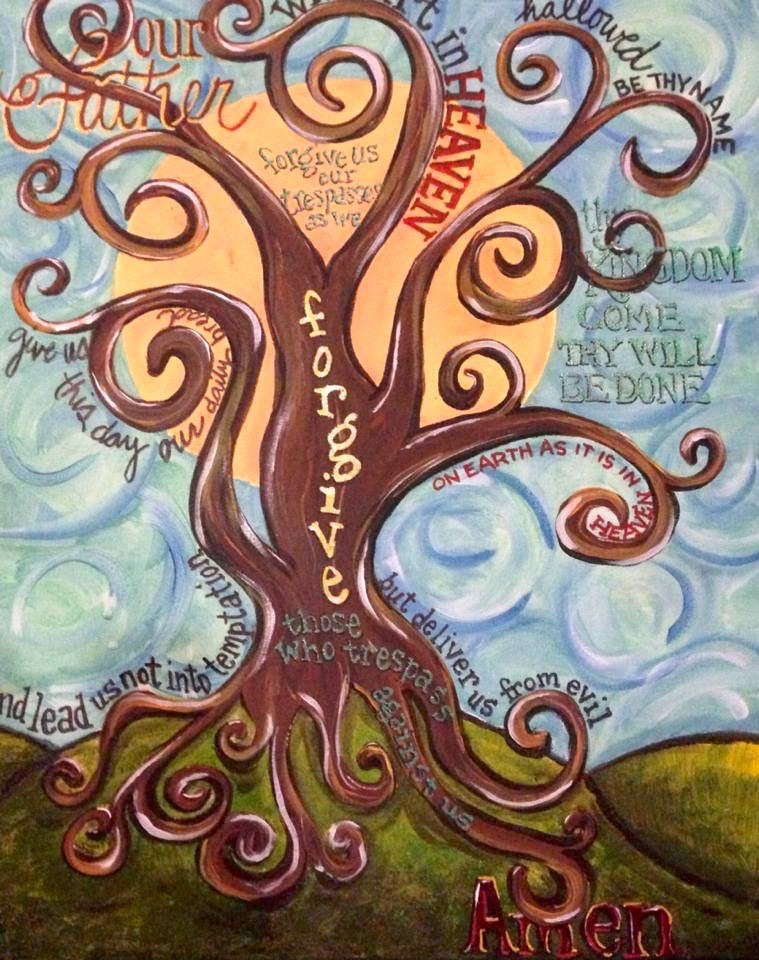
“Our Father in heaven, hallowed be your name, your kingdom come, your will be done, on earth as it is in heaven. Give us today our daily bread. And forgive us our debts, as we also have forgiven our debtors. And lead us not into temptation, but deliver us from the evil one.”
For if you forgive other people when they sin against you, your heavenly Father will also forgive you. But if you do not forgive others their sins, your Father will not forgive your sins. (NIV)
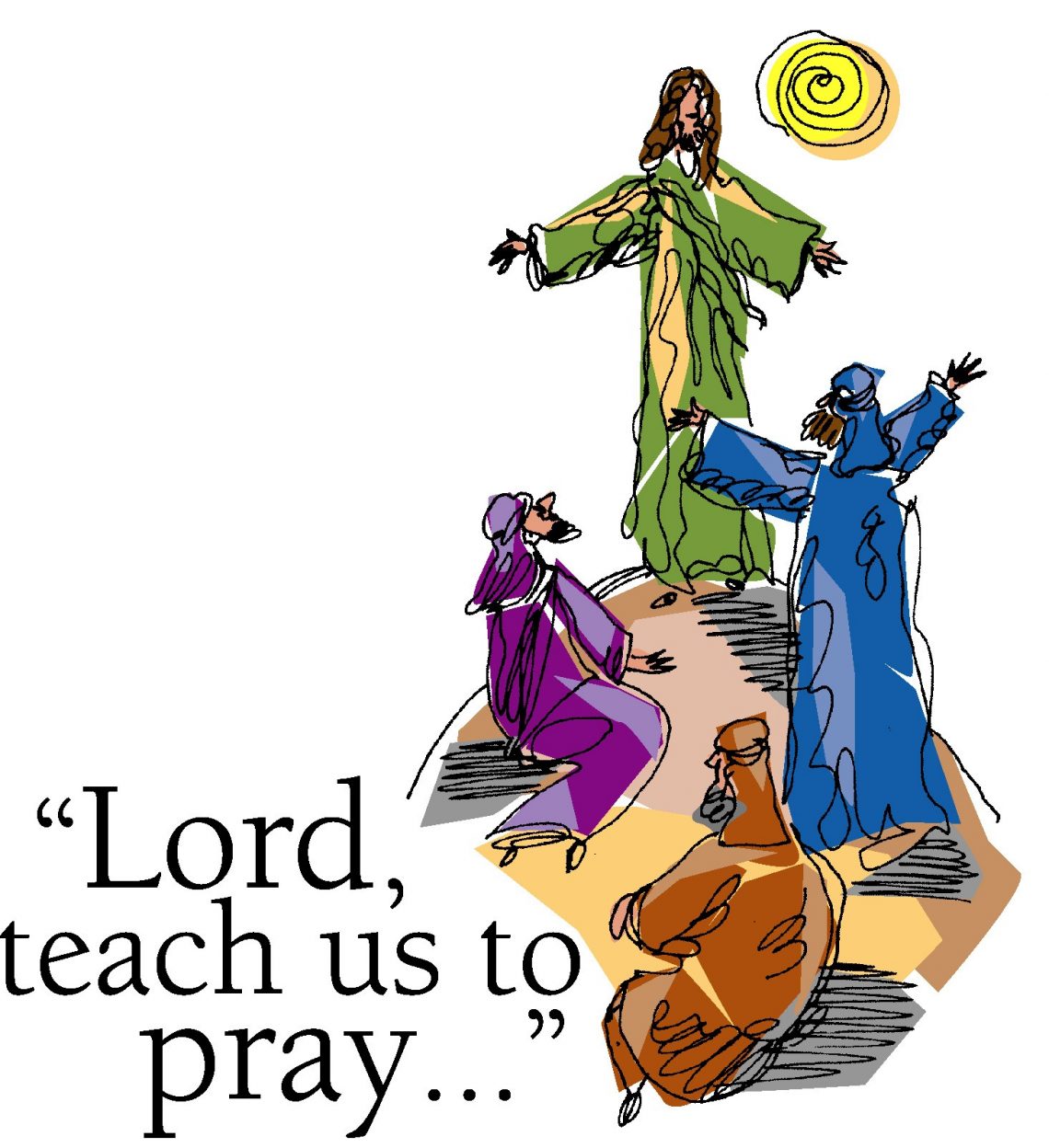
God knows what we need before we even ask him, which means that the Creator of the universe has his ear inclined to listen to us. The Lord desires, even longs for us to pray to him. Since this is God’s disposition every day, Jesus communicated to us a model way of prayer. This prayer exemplifies the values of Christ’s Beatitudes and reflects the priorities of God’s kingdom. The Lord’s Prayer is meant to be prayed often, mindfully, and with flavor.
Jesus gave us six petitions to guide us in our prayers: The first three petitions are priorities of God that set the tone for the next three petitions, which are centered in our problems of living in this fallen world.
Addressing God
Jesus gave us instruction of how to address God: “Our Father in heaven.” All the pronouns in the Lord’s Prayer are plural, not singular. We are to be concerned for both our own individual issues, and for the needs of the community, of the problems and situations of the world.
“Father” is an endearing and relational word. “In heaven” balances the closeness and nearness of our heavenly Father with his sovereign and transcendent nature. Our God is both near and far – a close friend as well as a holy king. So, we address him with a proper understanding of who he is.
Three Priorities
First Petition: “Hallowed be your name.”
“Hallow” comes from the root word for holiness; it is to sanctify, to set apart. God is concerned that his creatures revere him and treat him as the Holy One.
Notice the use of the verb: not hallowed “is” your name, but hallowed, or holy “be” your name. That is, Jesus guides us to pray that God’s name would be shown as holy through us by the way we live. The world sees a holy God when his people walk in holiness, reflecting his benevolent nature.
After Christ’s resurrection and ascension, the Apostle Peter encouraged a struggling band of young Christians:
So, you must live as God’s obedient children. Don’t slip back into your old ways of living to satisfy your own desires. You didn’t know any better back then. But now you must be holy in everything you do, just as God who chose you is holy. For the Scriptures say, “You must be holy because I am holy.” And remember that the heavenly Father to whom you pray has no favorites. He will judge or reward you according to what you do. So, you must live in reverence of him during your time here as “temporary residents.” (1 Peter 1:14-17, NLT)
Second Petition: “Your kingdom come.”
We live in a fallen world that has come under the domain of dark forces. The unfolding drama of Holy Scripture is that God himself is on a mission to restore his creation to a benevolent rule and gracious reign. Jesus is the King, we are the subjects, and God’s realm exists wherever his subjects go. And where his subjects go, they are to pierce the darkness by embodying the good news that King Jesus has overcome the demonic realm and brought us into God’s kingdom. The prayer and proclamation of this good news is of utmost priority to God.
Third Petition: “Your will be done on earth as it is in heaven.”
God’s ethical will has been revealed to us by Jesus in the Sermon on the Mount with the Beatitudes as the cornerstone of his teaching (Matthew 5-7). God’s will is that Christ’s followers be humble; grieve over personal and communal sin in the world; act with gentleness instead of prideful condescension toward others; hunger after true righteousness instead of legalistic self-righteousness; show mercy; be pure in heart; pursue peace; and, rejoice when persecuted. All of this results in being salt and light in this dark world.
Furthermore, we are to reconcile with others instead of hold grudges; deal with our lust through accountability instead of making excuses for our mental adultery; cherish our spouse instead of taking the easy way out when problems arise in marriage; tell the truth at all times instead of shading it; and, love, not retaliate when personally hurt or insulted. This is God’s will, and if it seems an impossible task, that is because we need divine resources to live our Christian ethic. In other words, we need to pray!
These three petitions are priorities for God. They are three ways of essentially asking the same thing – that the full manifestation of God’s reign on earth be realized. Thus, our prayers are not primarily to receive goods and services from God, but for us to render service to God. The priority of prayer given by Jesus centers in the advancement of God’s merciful rule, and the doing of God’s will. These prioritized prayers are a burning desire to see God honored on earth as he is already honored in heaven.
Three Problems
Fourth Petition: “Give us today our daily bread.”
It is our bodies that enable us to do God’s will, and so we must be concerned for them. We must have the necessities of life and daily sustenance to carry out God’s priorities for the church and the world. This is not a prayer for long-term luxuries, but daily needs.
In the ancient world, people were paid at the end of each day. Folks also shopped every day at the marketplace for their food (no fridge!). When there was a flood or a drought, it did not just mean high grocery prices; people faced starvation and death. They needed to trust God for today, and not worry about tomorrow. Even though we do not always readily perceive our great dependence on God, we still are in divine hands and need faith.
Fifth Petition: “Forgive our debts, as we also have forgiven our debtors.”
Sin is pictured as a debt. If someone has sinned (trespassed) against us, we must forgive them, thus releasing them from their debt. To forgive does not mean to forget. Rather, we are not to hold the debt or the sin over someone’s head for the rest of their life.
The simple truth is that the person who is forgiven by God is a forgiving person. Our own forgiveness implies that we have done the hard work of repentance through identifying our sin and renouncing it. So, if we fail to forgive, it demonstrates a lack of change on our part. We cannot, then, be forgiven if we are avail ourselves of the grace which is freely offered.
The practice of forgiveness is of utmost importance to Jesus. Living the Beatitudes of Jesus and being a peacemaker means we are to squarely face our bitterness. Simply sweeping our hurt under the rug and not extending forgiveness only gives the demonic realm a foothold into our lives – which is why we are to pray the final petition….
Sixth Petition: “And lead us not into temptation but deliver us from the evil one.”
Just as we have real physical necessities we must trust God for, we also have genuine spiritual needs which hinge on the issue of forgiveness – our forgiveness from God through Christ, and the forgiveness we extend to others who have hurt or offended us.
An unforgiving heart is the primary reason for the temptation to hate, seek revenge, and retaliate. If we have spent days, weeks, months, years, or even decades harboring an unforgiving spirit through anger, bitterness, and avoidance of facing our past trauma, we have embraced the dark side and need deliverance from evil.
The path to deliverance is through acknowledging the offense, receiving grace and forgiveness from God, and passing that same forgiveness and grace to those who hurt us. This is not about whether they deserve it or not; it is a matter of what I need to do.
Conclusion
A desire to see God’s agenda accomplished through the first three petitions leads us to seek grace and forgiveness, not giving ground to the devil. The truth sets us free; telling our secrets brings freedom. Apart from naming our shame, we will remain bound and in need of liberation. Tell your secrets to God in the prayer closet, and then tell them to a trusted friend(s). We pray, and we act on what God tells us in prayer.
The Lord’s Prayer is a model prayer. That means we use the six petitions of Jesus to frame our prayers in our own words, as well as say the words in our favorite translation of the Bible.
We are to pray this prayer continually, for in doing so it will shape our everyday lives, serve as a guide for how to live, and provide discernment in making life’s many decisions. To be the church is to pray. To be a Christian is to pray. So, let us daily and in every way make use of our Lord’s Prayer.
Painting by American artist Chiura Obata (1885-1975)
God brought his people
out of Egypt,
that land
with a strange language.
When the sea looked at God,
it ran away,
and the Jordan River
flowed upstream.
The mountains and the hills
skipped around like goats.
Ask the sea why it ran away
or ask the Jordan
why it flowed upstream.
Ask the mountains and the hills
why they skipped like goats!
Earth, you will tremble,
when the Lord God of Jacob
comes near,
because he turns solid rock
into flowing streams
and pools of water. (CEV)
I’m a metaphor guy. I like word pictures, analogies, and illustrations. Maybe that’s one reason I resonate with the Old Testament. The Hebrew mind revels in story, symbol, similitude, and even the occasional sarcasm. The turn-of-phrase is something which connects well with me – which is why I like today’s psalm. The language is freighted with metonymy and personification.
This psalm is a poetic response to the Jewish Passover and exodus out of slavery to freedom. It is a brief song of thanksgiving which nicely recounts the Israelite experience from Egypt to the Promised Land. At the behest of a mighty God, the Red Sea parted when the people left Egypt, and the Jordan River stopped its flowing when the people entered the Promised Land.
It’s a whole lot more powerful to say, “When the sea looked at God, it ran away,” than it is to say, “The Red Sea parted.” God is so mighty, so powerful, so large and sovereign that we must use the full extent of language to even begin to describe his wonderful works. A big God with awesome capability needs some wordsmithing worthy of his greatness.
Not only does the sea flee from its place, the river turns back, the mountains and hills shake and skip. To try and somehow capture the immensity of God, the psalmist used language which communicates that even inanimate objects come alive and fulfill his divine bidding.
It is one thing to make a flat statement such as, “Put your trust in God,” and it is quite another matter to open up the tool of language and allow it to picture a divine Being so amazing that nothing nor anyone can possibly stand in his way. And this very same God works for us, not against us.
The Lord God almighty, Creator of heaven and earth, has taken his formidable power and granted us a pinch of it – because that’s all we really need. Jesus, intimately familiar with his mighty heavenly Father, commented:
If your faith is as big as a mustard seed, you can say to this mulberry tree, “Dig yourself up and plant yourself in the ocean!” And the tree will obey you. (Luke 17:6, ERV)
For assuredly, I say to you, whoever says to this mountain, “Be removed and be cast into the sea,” and does not doubt in his heart, but believes that those things he says will be done, he will have whatever he says. (Mark 11:23, NKJV)
All of creation conspires together to participate in the great liberating and saving acts of God for his people. And if that wasn’t enough, we have been given his Holy Spirit to be with us forever – uprooting trees and moving mountains to accomplish the good and loving plan of God here on earth as it is always done in heaven.
Mighty God you invite us to be with you, to have a place near you. Your presence is joy, light, and comfort. Your nearness is holy, awesome, and wonderful. In the play of sunlight through rainbows, in the sounds of music and laughter, in the beauty of creation and the taste of bread and wine, your presence is known. Your saving presence surrounds us, whether we are fearful or joyful, laughing or crying. You invite us, welcome us, forgive us and renew us with fresh hope and new life. You love us into your presence. We bless and thank you. We praise and adore you. We enjoy being with you, in the name, the spirit and the presence of Jesus. Amen
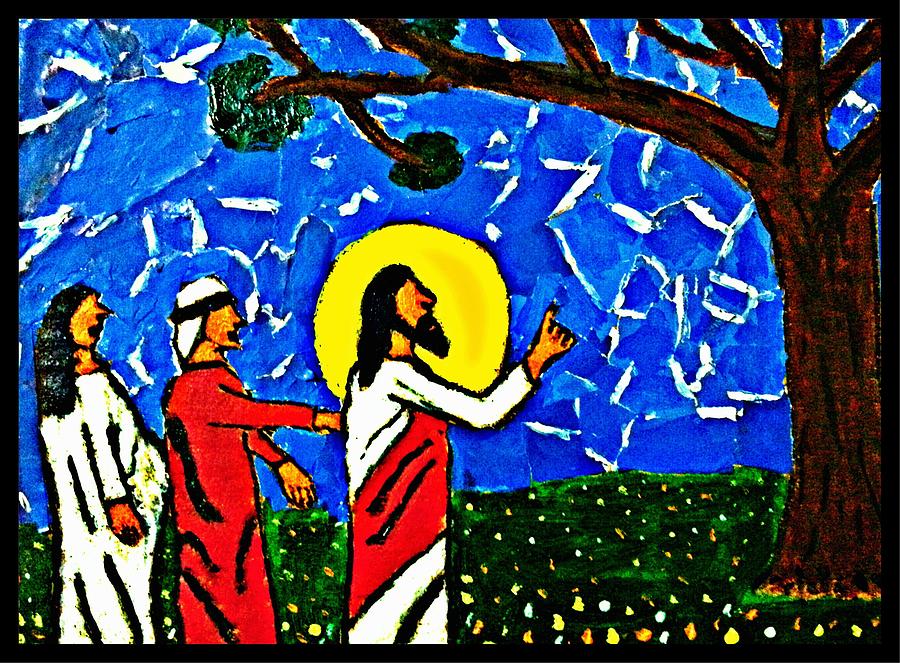
Jesus Cursing the Fig Tree by Ganosh Kelagina Beedu Shenay, 2016
Early in the morning, as Jesus was on his way back to the city, he was hungry. Seeing a fig tree by the road, he went up to it but found nothing on it except leaves. Then he said to it, “May you never bear fruit again!” Immediately the tree withered.
When the disciples saw this, they were amazed. “How did the fig tree wither so quickly?” they asked.
Jesus replied, “Truly I tell you, if you have faith and do not doubt, not only can you do what was done to the fig tree, but also you can say to this mountain, ‘Go, throw yourself into the sea,’ and it will be done. If you believe, you will receive whatever you ask for in prayer.” (NIV)
God wants us to pray! Prayer happens from a place of faith because to pray, one must believe that God is good and answers prayer. Conversely, prayerlessness is faithlessness. A person of little faith prays only a little. A person full of faith cannot stop praying.
God’s world revolves more around promise than command – which means that Jesus merely exhorting the disciples to pray would fall flat; they needed a deep change of heart. God calls us all to transformation. Lasting change takes place at the roots of our lives. When there is a drought, pouring lots of water on our backyard trees at the first sign of withering leaves is too late. The tree may look fine on the outside, but on the inside, it is dying from lack of water. Real change comes from the inside-out. It is the root of a person’s life, below the surface where others do not see, that needs change, and not merely the outward behavior. Prayer must be directed to the root, to the heart of the issue.
In today’s Gospel story, Jesus was up early and going to Jerusalem. He was hungry and wanted some breakfast, so he approached a fig tree. Figs were known back in Christ’s day as the poor man’s food. Fig trees were everywhere. Approaching a certain fig tree, Jesus found one that looked fine, but no figs. He chose to use the tree as a teachable moment for his disciples. Christ cursed the tree and immediately the entire tree withered. So, why did Jesus curse the tree?
Jesus cursed the fig tree because it looked good on the outside, but it was already dead on the inside. The tree had everything a tree needed: branches, leaves, and a trunk – except fruit. The tree served as an illustration for the disciples of believing prayer. The tree looked fine, and had the promise of fruit, yet, none was found. The point of the tree illustration is this: Jesus is looking for faith in his followers.
In the prophet Jeremiah’s day, the nation of Judah had enjoyed a long stretch of prosperity and good circumstances. By all outward appearances they were doing fine. Temple attendance was at its peak and everyone was offering their sacrifices. But something was wrong….
I will put an end to them,
declares the Lord;
there are no grapes on the vine,
no figs on the tree,
only withered leaves.
They have squandered what I have given them! (Jeremiah 8:13, CEB)
Although fine on the outside, the people of Judah trusted in themselves, their ability to produce a harvest, and their outward show of how many cattle and sheep they brought to the temple. But what God was looking for was fruit, not nice leaves. He was watching for offerings of believing prayer, born of a faith that is confident in the goodness of God. And the Lord is still looking for people’s faith in God alone – rather than in religiously outward forms of success.
Jesus wants his followers to understand and believe that our words and prayers can have the immediate effect of changing the world. We can even speak to a mountain and it will have to move if we tell it to. We probably do not go around talking to mountains, but all of us go around talking to ourselves about mountain-like problems. The power that levels mountains is prayer that speaks confidence and boldness. If you believe, you will receive whatever you ask for in prayer.
Doubt sometimes stands in the way of prayer – not doubt in ourselves because we do not answer our own prayers. The Apostle James said:
“If any of you needs wisdom, you should ask God for it. He is generous to everyone and will give you wisdom without criticizing you. But when you ask God, you must believe and not doubt. Anyone who doubts is like a wave in the sea, blown up and down by the wind. Such doubters are thinking two different things at the same time, and they cannot decide about anything they do. They should not think they will receive anything from the Lord.” (James 1:5-8, NCV)
Both James and his brother Jesus refer to an unshakable faith in the goodness of God. This is faith in the person of God, and not faith in faith itself. If we are honest, every one of us who has made a difficult prayer request, mustering-up all the faith we can, and then being disappointed when it did not happen, has been hurt. The unstable person vacillates when this happens, doubting whether God is good (playing the he-loves-me, he-loves-me-not game). The person of faith believes God answers prayers according to his will, and that if the prayer is not answered, God knows what he is doing and will answer it in his own good timing and purposes.
Maybe you have even indulged your inner-critic, a Job-like friend, telling you that you have a failure of faith, or not enough faith, and that is why your prayer was not answered. Yet, positive thinking is not the same as Christian faith. It is neither a matter of being optimistic, nor of sending $19.95 to some hack preacher who promises to give you the secret of answered prayer, along with a free gold cross.
God’s will for our lives is sometimes, maybe even oftentimes, a mystery. However, we do know what God’s will is for a lot of things. For example, God is not willing that any should perish but all be brought to eternal life. So, we can pray with confidence for a person’s deliverance from sin. We can be bold about trusting in God’s promises – he will do what he says he will do. Boldness is only as good as the truth it is based upon.
Imposing Mountain View and Lake Glacier National Park. Many Glacier Area. Swiftcurrent Lake.
We have every right, based in our union with Jesus Christ and our redemption in him, to ask God confidently and boldly for the removal of mountains. We have the authority in Christ to do so. Therefore, we do not need to offer tepid, milquetoast, mumbling prayers with sighs and hunched shoulders (i.e. “Well, God, if it is your will, could you help me?”).
It is time for men to step out and give God some healthy hairy-chested prayers. And, this is not the time for women to be worried about what the men do, or not do. Everyone is to be bold in prayer.
“God desires of us nothing more ardently than that we ask many and great things of him, and he is displeased if we do not confidently ask and entreat.” –Martin Luther
Jesus wants faithful and fruitful prayer. He still scans the horizon of our spiritual lives looking for believing prayer. Christ desires from those who follow him bold prayers which curse and wither fruitless and feckless places. When my children were small there was an adult store in our neighborhood. It disturbed my spirit. Each time I passed it I confidently prayed that the pornography and exploitation of women would dry up and cease in Jesus’ name, and that those who worked in that establishment would find more gainful and ethical employment. And that is exactly what happened.
Aggressive prayer against the enemy of our souls is needed, prayer that claims the authority which has been given us in Christ, prayer that is based in solid biblical truth and robust theology. So, let us pray in faith and confidence….
Heavenly Father, we praise you for the grace we possess through the Lord Jesus Christ. We rejoice in Christ’s teaching and the victory you have provided for us to live above sin and failure. We come before you in confession and to plead your mercy over our sins, the sins of other believers, and the sins of our world. We confess the sin of prayerlessness, faithlessness, apathy, complacency, and indifference to those who are lost. We also acknowledge before you the wickedness of our world through the evil machinations of injustice, oppression, and exploitation of others.
We praise your holy name, O God, that there is plenty of grace through the person and work of the Lord Jesus. We plead the blood of the cross and the power of the resurrection against the sins and rebellion of people against you. We pray and wait for you, Holy Spirit, to bring us all to new life in Jesus Christ.
We recognize that Satan and the kingdom of darkness have plotted and laid strategies against new spiritual life, keeping your people from believing prayer. So, in the name of the Lord Jesus Christ, we claim our place as children of God. We smash and pull down all the strongholds which Satan has erected against humanity – and pray that the power of Christ’s resurrection would hinder and frustrate the plans formed against us.
We pull down demonic strongholds of prayerlessness and carelessness with the Word of God. We claim back for the Lord Jesus Christ the ground Satan is claiming as a means of hindering faith, hope, and love; and, we affirm that Satan’s plans were fully defeated through the cross and resurrection of Jesus. We pull down all of Satan’s plans to divert fresh faith when it comes. Blessed Holy Spirit, may you send a renewal to the hearts and souls of all people. May it bring a wondrous season of peace and joy.
We, your people, accept the role of standing in the gap for others in prayer. You yourself, God, said that we, in Christ, are mighty through God to the pulling down of strongholds. So, we bring all the work of the Lord Jesus Christ to focus directly against the powers of darkness that blind people and keep them in bondage. We pray the victory of Christ’s incarnation, crucifixion, resurrection, ascension, and glorification directly against all of Satan’s power in their lives. We now bind all powers of darkness set to destroying them, and we unbind those demonic bonds and blinders from them in the mighty name of Jesus.
By faith we claim humanity for fruitful lives of spiritual abundance, social justice, and sanctified relationships in the name of Jesus Christ our Lord, who defeated all powers and principalities of this world. Amen.