The Rhythms of Jesus

The Solitude of Christ by French painter Alphonse Osbert, 1897

As soon as they left the synagogue, they went with James and John to the home of Simon and Andrew. Simon’s mother-in-law was in bed with a fever, and they immediately told Jesus about her.So, he went to her, took her hand, and helped her up. The fever left her, and she began to wait on them.

That evening after sunset the people brought to Jesus all the sick and demon possessed. The whole town gathered at the door, and Jesus healed many who had various diseases. He also drove out many demons, but he would not let the demons speak because they knew who he was.

Incredibly early in the morning, while it was still dark, Jesus got up, left the house, and went off to a solitary place, where he prayed. Simon and his companions went to look for him, and when they found him, they exclaimed: “Everyone is looking for you!”

Jesus replied, “Let us go somewhere else—to the nearby villages—so I can preach there also. That is why I have come.” So, he traveled throughout Galilee, preaching in their synagogues, and driving out demons.

A man with leprosy came to him and begged him on his knees, “If you are willing, you can make me clean.”

Jesus was indignant. He reached out his hand and touched the man. “I am willing,” he said. “Be clean!” Immediately the leprosy left him, and he was cleansed.

Jesus sent him away at once with a strong warning: “See that you don’t tell this to anyone. But go, show yourself to the priest and offer the sacrifices that Moses commanded for your cleansing, as a testimony to them.” Instead, he went out and began to talk freely, spreading the news. As a result, Jesus could no longer enter a town openly but stayed outside in lonely places. Yet the people still came to him from everywhere. (Mark 1:29-39, NIV)

Solitude by Russian painter Tatiana Yushmanova

We need rhythm.  Everything in life is rhythmic. Each new year moves with the rhythm of the four seasons. Our hearts beat in rhythm. When we walk, our gait is in a distinct rhythm. When talking, we speak with a rhythmic cadence. We sing and make music because of rhythm. We need healthy rhythms of waking and sleeping.

When our rhythm is off, we are off. Busy or unhealthy lifestyles can insidiously drag us away from the spiritual rhythms we need for healthy living. Over time, it may go unnoticed that our rhythm is off.  For many folks, normal is getting dressed in clothes bought for work, driving through traffic in a car still being paid for, to go to a job to pay for the clothes, car, house, and other stuff that is left empty of life all day to afford to live in it. Many people are oriented more by the rhythms of work, school, and sports than by a connection to the life, death, and resurrection of Christ.

Our 24/7 world demands more time and resources, convincing us we can never slow down or take a break. Some people know their rhythm is off and out of sync with God’s ways but feel powerless to change it. So, how do we restore the unforced rhythms of God’s grace to the center of our stressed and chaotic lives without being overwhelmed by a new set of time commitments? To have healthy rhythms of life, we must look to Jesus.

Jesus was continually filled with the life of God the Father and therefore was always overflowing with that life to others. Christ had a rhythm of life which was oriented around times of inner solitude with his heavenly Father, and times of outward spiritual care to people.  Jesus needed regular, dedicated time for solitude and prayer for the rigors of ministry. So then, how much more do we!

There are two distinct sections in today’s Gospel lesson: Christ’s outward healing ministry; and his inward attention to solitude and prayer. By examining Jesus and following his rhythms of life, we can find the way to living healthy fulfilled spiritual lives as Christians.

The outward healing ministry of Jesus was powerful and effective.

Jesus was committed to helping and healing people with the authority given him. Peter’s mother-in-law was sick. Every sickness in the ancient world was serious and could easily result in either permanent physical damage or death. In a clear demonstration of power, Jesus simply took her by the hand and raised her up to new life. As soon the fever left her, the woman immediately began serving the people in the house. The proper response to being healed by Christ is to become a servant of others. 

13th Century Byzantine Church mosaic of Jesus healing Peter’s mother-in-law

Jesus and the disciples were in the little village of Capernaum, and being a small town, the news spread quickly of what happened with Peter’s mother-in-law. As a result, by evening, every sick and demonized person in the village showed up to see Jesus. Christ healed them all and confronted the demonic among them. Jesus wanted to avoid creating a circus and desired to move about freely, so he commanded the demons not to speak, because they knew who he was and what he was up to.

Healing is wonderful. Talking about it, not so much. Discussing healing is difficult because seeing one person healed and restored while another person is not, defies simple answers. So, I offer a few biblical observations about this human conundrum we all have likely experienced.

  • Healing narratives in the Gospels say much more about Jesus than about us. 

Jesus has the power and authority to overthrow demons, cure the incurable, and restore people to health. It is all a sign that the kingdom of God is near, and when the kingdom comes in all its fullness, there will be no more sickness, pain, or demonic influence.

  • Good health, security, and safety are not necessarily a sign of God’s presence any more than pain and suffering are signs of God’s punishment, or a lack of personal faith. 

We have enough stories in the Bible to let us know we are not privy to the big picture of what God is doing. We will not always see what the Lord is up to and very well may never have an answer to our questions, this side of heaven.

  • Every person who is healed today will eventually get sick again and someday die. 

Even Lazarus, whom Jesus raised from the dead, died again. The ultimate meaning of any person’s healing is more than the physical – it affects the entire person – body, mind, emotions, soul, and spirit. For example, forgiveness is many times the needed miracle before any kind of physical healing can occur.

Sometimes the greatest miracle of all is our response to sickness and suffering.  A surgeon, Richard Selzer, describes one such miracle:  “I stood by the bed where a young woman lies in post-op after surgery, her mouth twisted looking clownish.  A tiny twig of the facial nerve, the one to the muscles of her mouth, has been severed to remove a tumor in her cheek.  Her young husband is in the room.  He stood on the opposite side of the bed as if I were not really in the room, his full attention on her.  She asked me, ‘Will my mouth always be like this?’  ‘Yes, it will, because the nerve has been cut,’ I say.  She nodded somberly.  But the young husband began to smile.  He said, ‘I like it; it is kind of cute.’  He bent down to kiss her crooked mouth and I was close enough to see how he twisted his own lips to accommodate hers, to show her that their kiss still works.”

Perhaps the kind of healing we all need is the ability to receive God’s love in the person of Jesus who has accommodated himself to us.

Christ did not spend every waking moment with people, teaching and healing. Jesus knew that working without prayer, rest, and solitude is not realistic and rarely ends well.

The inward prayer and solitude of Jesus caused him to be powerful and effective.

Early the next morning after a day of healing ministry, Jesus got up and went to be alone with the Father. The fact that Peter and the disciples hunted him down when they could not find him, shows they did not quite see the same value of solitude that Jesus did. In Christ’s healthy rhythm of life, he included significant doses of solitude with his Father.

It is important for believers to spend generous portions of time with God. If we fail to do this, God has ways of getting our attention. We must slow down and calm our racing thoughts enough to listen. Human suffering is a great way to meet Jesus!  We cannot rush from task to task and expect to live a healthy spiritual life.  We need time with Jesus.

“Without great solitude, no serious work is possible.”

Pablo Picasso

Only through a healthy rhythm of life that includes solitude and prayer will we have clear direction for our daily lives, and wisdom for sound decision-making.  Jesus came away from his time of solitude having re-connected with his purpose for being on earth.  It was his clear conviction that he must travel and not just stay in one place.

Traveling is important to the Christian life.  I am not talking about moving from state to state like I have done in my life; I mean that we must keep moving, like walking across the room to engage others we do not know. Our lives become stagnant when we only ever interact in our small circle of friends and family. 

So, Jesus traveled throughout Galilee, convinced to do so through his time of solitude and prayer, to spread the good news of God’s benevolent kingdom and drive out demons wherever he went.  Even in this we are to imitate our Lord.

Driving out demons is, yes, a literal reference. The demons were driven out so that people could be liberated and experience freedom and connection in community, since most demonized people were always in solitude. They were freed so that they could have healthy rhythms of life of not just solitude but of ministry, service, and community. Hell is a separation from God and others.  Jesus came to bring relational health and wholeness through relational connection.

Conclusion

Both continual work and prolonged withdrawal from others is unhealthy.  To always be working and serving eventually leads to bitterness, exhaustion, and burn-out.  To always be alone (even in a crowd) and not serving leads to spiritual sickness.  It may be counter-intuitive for us to break away from work, but solitude and prayer will help us more productive.

If we are constantly on the go, there is healing available through solitude. If we are continually withdrawn from others, then the healing we need will come through engaging with others and moving past passivity.

To attach and detach, to connect and let go, to engage and desist, are spiritual rhythms of life that we must hone and practice so that we will be healthy persons for ourselves and for others.

Psalm 35:1-10 – Tell It Like It Is

O Lord, oppose those who oppose me.
    Fight those who fight against me.
Put on your armor, and take up your shield.
    Prepare for battle, and come to my aid.
Lift up your spear and javelin
    against those who pursue me.
Let me hear you say,
    “I will give you victory!”
Bring shame and disgrace on those trying to kill me;
    turn them back and humiliate those who want to harm me.
Blow them away like chaff in the wind—
    a wind sent by the angel of the Lord.
Make their path dark and slippery,
    with the angel of the Lord pursuing them.
I did them no wrong, but they laid a trap for me.
    I did them no wrong, but they dug a pit to catch me.
So let sudden ruin come upon them!
    Let them be caught in the trap they set for me!
    Let them be destroyed in the pit they dug for me.

Then I will rejoice in the Lord.
    I will be glad because he rescues me.
With every bone in my body I will praise him:
    “Lord, who can compare with you?
Who else rescues the helpless from the strong?
    Who else protects the helpless and poor from those who rob them?” (NLT)

Sometimes, you must tell it like it is. There is a time to do your best in putting up a good face and dealing with people who gossip, slander, and try to get their way. There is also a time to call such behavior “evil” and cry out to God for help.

Psalm 35 is a classic prayer in the category called “imprecatory psalms.” The term “imprecatory” means to call down a curse on a person or group of people. Maybe this surprises you that there is such language in the Bible.  In fact, there are eighteen such imprecatory psalms which make a clear petition for God to turn the evil back on the people who inflict it (or try to) on others.

The imprecatory Psalms are prayers, calling upon God to remedy those injustices which neither we as individuals, nor the state, are competent to remedy.

J.A. Motyer

I am a believer in making simple observations about the biblical text. So, here are a few things to observe about this psalm, along with all the imprecatory psalms of David:

1. David asked God to deal with the evil behavior of powerful people.

Unlike most of us, David went through a time in life when there were powerful people literally trying to hunt him down and take his life.  As much as we might speculate whether David wanted to take matters into his own hands, the fact remains that he did not do so. Instead, David relied on God to execute judgment.

2. David did not hold his feelings back in describing exactly what he wanted God to do.

There is nothing sanitized about imprecatory psalms. They are as raw and real as it gets. David was understandably upset. He had done nothing wrong, yet he was being chased like an animal. David said it plainly to God: attack the attackers; hunt them like they have hunted; get the angels involved; give them the disaster they try tried to dish out; and let them fall into their own pit. Whatever you might think about how a proper pious person ought to pray, imprecatory curses are likely not your first thought. But here they are, out there for us to read in the Holy Bible.

3. The psalms are the prayer book of the church.

That includes the imprecatory psalms. Yes, they ought to be prayed by us right along with psalms of praise, psalms of thanksgiving, and psalms for public singing. I want you to think a radical thought:

We ought to include imprecatory prayers in our regular rhythms, routines, and rituals of prayer.

Evil will not have the last word. God opposes the proud and the arrogant who step on others to get their way.  But he gives grace to the humble, that is, to those who look for Divine justice and righteousness; are open about their feelings of hurt and upsetedness; and lift-up biblical imprecatory prayers.

Consider also that Christ taught us to pray that we would be delivered from evil:

Don’t let us yield to temptation but rescue us from the evil one. (Matthew 6:13, NLT)

St. Paul informed us that evil will indeed be turned back onto the wicked:

God’s judgment is right, and as a result you will be counted worthy of the kingdom of God, for which you are suffering. God is just: He will pay back trouble to those who trouble you and give relief to you who are troubled, and to us as well… He will punish those who do not know God and do not obey the gospel of our Lord Jesus. They will be punished with everlasting destruction and shut out from the presence of the Lord and from the glory of his might on the day he comes to be glorified in his holy people and to be marveled at among all those who have believed… With this in mind, we constantly pray for you, that our God may make you worthy of his calling, and that by his power he may bring to fruition your every desire for goodness and your every deed prompted by faith. We pray this so that the name of our Lord Jesus may be glorified in you, and you in him, according to the grace of our God and the Lord Jesus Christ. (2 Thessalonians 1:5-12, NIV)

Ultimately, there are dark spiritual forces behind every evil intent and every wicked machination on this earth:

For our struggle is not against enemies of blood and flesh, but against the rulers, against the authorities, against the cosmic powers of this present darkness, against the spiritual forces of evil in the heavenly places. (Ephesians 6:12, NRSV)

And in the end, along with David and the imprecatory psalms, we leave all judgment to the proper Judge:

Don’t insist on getting even; that’s not for you to do. “I’ll do the judging,” says God. “I’ll take care of it.”  (Romans 12:19, MSG)

Saving God, you protect the helpless from those in power and save the poor and needy who cry out to you.  Mighty God, turn back on those with slanderous tongues, gossiping words, and sinful actions the evil they intend to inflict on others.  Let them fall into a deep black hole for which they cannot get out and harm anyone again, through King Jesus, our Savior, in the assistance of the Holy Spirit.  Amen.

Psalm 86 – Theology Proper

Psalm 86 by Ann Williams

Incline your ear, O Lord, and answer me,
    for I am poor and needy.
Preserve my life, for I am devoted to you;
    save your servant who trusts in you.
You are my God; be gracious to me, O Lord,
    for to you do I cry all day long.
Gladden the soul of your servant,
    for to you, O Lord, I lift up my soul.
For you, O Lord, are good and forgiving,
    abounding in steadfast love to all who call on you.
Give ear, O Lord, to my prayer;
    listen to my cry of supplication.
In the day of my trouble I call on you,
    for you will answer me.

There is none like you among the gods, O Lord,
    nor are there any works like yours.
All the nations you have made shall come
    and bow down before you, O Lord,
    and shall glorify your name.
For you are great and do wondrous things;
    you alone are God.
Teach me your way, O Lord,
    that I may walk in your truth;
    give me an undivided heart to revere your name.
I give thanks to you, O Lord my God, with my whole heart,
    and I will glorify your name forever.
For great is your steadfast love toward me;
    you have delivered my soul from the depths of Sheol.

O God, the insolent rise up against me;
    a band of ruffians seeks my life,
    and they do not set you before them.
But you, O Lord, are a God merciful and gracious,
    slow to anger and abounding in steadfast love and faithfulness.
Turn to me and be gracious to me;
    give your strength to your servant;
    save the child of your serving girl.
Show me a sign of your favor,
    so that those who hate me may see it and be put to shame,
    because you, Lord, have helped me and comforted me. (NRSV)

Today’s psalm is a prayer of David, asking God for help against enemies. David was a guy who knew what it was like to have evil men hate him and pursue taking his life through no fault of his own. I am not sure about your experiences with such people. Although I have never faced adversity to such a degree as David, I do know something about people who, to put it bluntly, just flat-out hate my guts. It feels awful, and it can be terribly draining emotionally and spiritually. Having disrespectful and rude people talk behind your back (and sometimes even to your face) is in direct contrast to who God is.

God is described by David as merciful and gracious, slow to anger, abounding in steadfast love, and faithful. Whereas insolent people objectify others and seek their own selfish agendas, God always acts in accord with a basic character of love and grace. Based upon the nature of God, we can choose to cry out, just like David did, to show us a sign of God’s favor. We can pray for God to provide us with some tangible communication of divine love in ways we can understand so that we can be helped and receive the kind of comfort we need through our adversity.

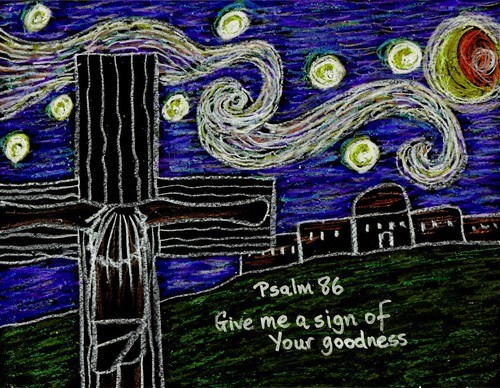
Psalm 86, chalk art by Scottish pastor and artist John Stuart, 2009

Be assured that with such a God, our pleas, cries, and tears will be noticed, affirmed, and answered. We can trust the sovereign Lord of all creation to address the insolence and injustice that exists around us and toward us.

All of this gets down to our view of God, our theological understanding of the basic Divine nature and purpose.  For some people, God is up there, somewhere, like some white-bearded old guy who is aloof to what is going on down here – there is neither anything personal nor personable about him, at all. For others, God is a force which binds all things together. In this theology, God exists, but you are never quite sure how to connect – it is like a crapshoot trying to get in touch with him.  For yet others, God is perpetually perturbed about something; he has a bee in his bonnet, and it is apparently our job to figure out what he is so sullen and upset about all the time so that we can appease him in some way.

However, the psalmist, David, sees God in wholly other ways than this. For David, God is personal, knowable, and reachable. David thought about God in ways which transcend either gendered or personality-type categories. Note the descriptions David provided: a willingness to forgive; an abiding, consistent, and steadfast presence of divine love; always having the time and desire to listen; possessing the power and ability to provide help and protection; being kind and merciful; not being easily angered; and extending needed comfort and consolation.

Now this is a God you can sink your teeth into – attentive, engaged, and anything but upset all the time. This is the reason why David has confidence to ask for deliverance, direction, and delight. Such a God is like a caring grandmother who seeks to always love and serve, and not a crotchety old curmudgeon who always seems bothered by everyone and everything.

If your theology, your view of God, cannot support and bear the weight of life’s hardest circumstances, then you need a different view of God! I invite you to see the God of David. Theology proper discerns the being, attributes, and works of God as fundamentally faithful and loving. This God has both the ability and the will to meet and satisfy your life’s greatest needs.

Great God of David, you are above all things and beside all things and with all things. You are uniquely positioned and powerful to walk with me through all the situations of my life. Thank you for sending the Son of David to make real your promises to me.  Amen.

Psalm 69:1-5, 30-36 – The Praise of Suffering

Psalm 69 by Japanese painter Makoto Fujimura

Save me, God,
    because the waters have reached my neck!
I have sunk into deep mud.
    My feet cannot touch the bottom!
I have entered deep water;
    the flood has swept me up.
I am tired of crying.
    My throat is hoarse.
    My eyes are exhausted with waiting for my God.

More numerous than the hairs on my head
    are those who hate me for no reason.
My treacherous enemies,
    those who would destroy me, are countless.
    Must I now give back
    what I did not steal in the first place?
God, you know my foolishness;
    my wrongdoings are not hidden from you….

I will praise God’s name with song;
    I will magnify him with thanks
    because that is more pleasing to the Lord than an ox,
    more pleasing than a young bull with full horns and hooves.
Let the afflicted see it and be glad!
    You who seek God—
    let your hearts beat strong again
    because the Lord listens to the needy
        and does not despise his captives.

Let heaven and earth praise God,
    the oceans too, and all that moves within them!
God will most certainly save Zion
    and will rebuild Judah’s cities
    so that God’s servants can live there and possess it.
The offspring of God’s servants will inherit Zion,
    and those who love God’s name will dwell there. (CEB)

As the Church’s and the Christian’s prayer book, the psalms offer a way to come to God when our feelings and emotions have us not knowing how to pray, at all.  If you are depressed because of people who would like to see you fail or are out to get you, then this is the psalm for you to pray!

When you are voiceless, the psalter can voice it for you. When you are unable to put your thoughts into words, the Scripture can word it for you. Two of the great attributes of God are divine power and love, which means that the Lord is more than able to do something about your situation, and it will always be done in a loving way.  Know today that God hears you and is working on a response to your lament – even if it is not in your own words but the words of Holy Scripture.

Psalm 69 by Austrian artist Ernst Fuchs, 1960

God will come through in God’s own good time. However, you can still praise the Lord right now, smack in the middle of your dilemma. David, the author of today’s psalm, chose to praise God, even though he did not get an immediate answer to his prayers. Perhaps God is more concerned to change us before changing our circumstances.

We need a solid theology of suffering. And that biblical psalms give it to us. I know of no one who wakes in the morning, sits on the edge of their bed, and says, “Gee, I want to suffer today and feel lots of emotional and spiritual pain.” No, we want happiness and joy, not agony and hardship. Yet suffering has much to teach us and the Lord is rarely quick to snatch us from its lessons. The hardship of personal suffering teaches us faith and dependence upon God, as well as leading us to ask for help from others so that we are lovingly supported.

“The way you look at things is the most powerful force in shaping your life.”

john o’donohue

Tribulations in life are common to all people without exception. The issue is whether we will submit to its hard-knock education, or not – whether we will become better people, or bitter. The Irish teacher and poet, John O’Donohue, penned a poem entitled, “For Suffering,” concerning the blessing of hard things:

May you be blessed in the holy names of those

Who, without knowing it,

Help to carry and lighten your pain.

May you know serenity

When you are called

To enter the house of suffering.

May a window of light always surprise you.

May you be granted the wisdom

To avoid false resistance;

When suffering knocks on the door of your life,

May you glimpse its eventual gifts.

May you be able to receive the fruits of suffering.

May memory bless and protect you

With the hard-earned light of past travail;

To remind you that you have survived before

And though the darkness is now deep,

You will soon see approaching light.

May the grace of time heal your wounds.

May you know that though the storm may rage,

Not a hair of your head will be harmed.

To Bless the Space Between Us: A Book of Blesings (Doubleday, 2008)

We have all likely at times felt the anguish of the psalmist – being so overwhelmed that it feels like we are drowning. The feeling is compounded exponentially when behind the sense of trying to keep our heads above water there are people who do not like us – maybe even hate us, to the point of undermining our work every chance they get.  It is in such circumstances we might experience sleepless nights hoping that somehow and someway God will show up.

The typical modus operandi for some within adverse situations is the age-old route of complaining and wishing things were different. Yet neither griping about our problems nor dishing out slander and gossip toward others is a healthy way of dealing with adversity. Just the opposite response is the proper path to the bone-crushing feeling of opposition: to praise God’s name with a song and magnify the Lord with thanksgiving. 

The reason the believer can engage in adoring God during trouble is not some Jedi-type mind trick to make us think more positively. Instead, the basis for praise is in knowing God. It is God who ultimately will deal with the wicked; it is the Lord who will bend to listen to our lament when times are hard. 

Thanking God for answers to prayer in advance of them being answered is a biblical thing to do. Having a faith robust enough to see ahead toward hope can bring love to a loveless situation, and usher in praise before the divine deed of deliverance is even accomplished.

Saving God, thank you for your deliverance!  I give you praise for loving me through sending your Son, the Lord Jesus, to this earthly realm so that I might experience salvation from sin, death, and hell. By Christ’s authority, in the power of the Holy Spirit given to me, I resist the enemy’s attempts to seize control of my life.  I belong to you, holy God. Amen.