Hebrews 4:14-5:4 – What is Your View of God?

Photo by Pixabay on Pexels.com

Since we have a great high priest who has ascended into heaven, Jesus the Son of God, let us hold firmly to the faith we profess. For we do not have a high priest who is unable to empathize with our weaknesses, but we have one who has been tempted in every way, just as we are—yet he did not sin. Let us then approach God’s throne of grace with confidence, so that we may receive mercy and find grace to help us in our time of need.

Every high priest is selected from among the people and is appointed to represent the people in matters related to God, to offer gifts and sacrifices for sins. He can deal gently with those who are ignorant and are going astray, since he himself is subject to weakness. That’s why he has to offer sacrifices for his own sins, as well as for the sins of the people. And no one takes this honor on himself, but he receives it when called by God, just as Aaron was. (NIV)

Metaphors matter. How we view, imagine, and picture God influences the way we live.

Recently, I met with a young man who was severely distressed, depressed, and had attempted suicide several times in the past several months. After listening to his story, I asked him a question: “How do you see or picture God?”  Without hesitation, he answered, “God is my CO (Commanding Officer).”  He went on to portray and picture General God who gives commands and of good soldiers who obey what’s expected of them. 

As a soldier, you would never walk up to your CO and vent all your feelings. You wouldn’t have a dialogue.  There would be no extended conversations. In the throes of trying to deal with emotional trauma, General God isn’t a metaphor that’s helpful.

Today’s New Testament lesson reminds and invites us to consider Jesus, the Son of God. Christ is pictured as our great high priest. A priest is a person who intercedes for you with God. He stands in the gap and effectively communicates your needs, desires, and feelings to a gracious and loving God.

When you are too emotionally tired to face another day, Jesus our great high priest, has our back and is graciously present with us.

Soldiers don’t have confidence to approach General God with their abject weakness or their ongoing temptations. There is only the giving and receiving of orders and strategies to be implemented. Far too many Christians have such an understanding of God and think there is something wrong with them when they cannot live up to be the kind of soldier that would make others proud.

Grace and mercy, however, are found through the confidence of approaching our great high priest. It is Jesus who thoroughly, completely, and mercifully has a first-hand understanding of what you are dealing with and is able and desirous to help.

As our permanent high priest, Jesus is uniquely positioned to hear us, empathize with our situation, and care for us in ways which truly aid us.

It’s easy to get discouraged. It takes no effort to find yourself on the outside of happiness and on the inside of a black hole. Living in this broken world can sting and hurt like hell. Yet, we have a Savior who has brought deliverance from hell by taking on hell itself.  Jesus, the pioneer of our salvation, knows better than anyone what brokenness feels like. Christ absorbed all the sin of the world on the cross. 

Jesus is presently, this very moment, sitting at the right hand of the Father in heaven, awaiting your approach with merciful eyes, a compassionate heart, and listening ears. Jesus is our risen and ascended Lord. Christ is so much more than a military officer. Jesus is our ample and able great high priest. He is awaiting you now….

Ascended and living Lord Jesus, you are my colossal high priest. You live to intercede for me. What a privilege!  May you strengthen my nascent faith today and bolster my confidence as I consider your grace and mercy in this messed-up world. Thank you for your kindness, empathy, and ability. Amen.

Psalm 51:1-12 – Facing Our Darkness

Photo by cottonbro on Pexels.com

Have mercy on me, O God,
    according to your steadfast love;
according to your abundant mercy
    blot out my transgressions.
Wash me thoroughly from my iniquity,
    and cleanse me from my sin.

For I know my transgressions,
    and my sin is ever before me.
Against you, you alone, have I sinned,
    and done what is evil in your sight,
so that you are justified in your sentence
    and blameless when you pass judgment.
Indeed, I was born guilty,
    a sinner when my mother conceived me.

You desire truth in the inward being;
    therefore teach me wisdom in my secret heart.
Purge me with hyssop, and I shall be clean;
    wash me, and I shall be whiter than snow.
Let me hear joy and gladness;
    let the bones that you have crushed rejoice.
Hide your face from my sins,
    and blot out all my iniquities.

Create in me a clean heart, O God,
    and put a new and right spirit within me.
Do not cast me away from your presence,
    and do not take your holy spirit from me.
Restore to me the joy of your salvation,
    and sustain in me a willing spirit. (NRSV)

David experienced a lot of hard things. Through it all, he held fast to walking with God. Eventually, David became king. He used his power and authority to do exactly what God likes – showing grace and kindness to those in need. Except in the case of Bathsheba, another man’s wife. He made one unwise decision, which led to a bad decision, and then to another and another – until the prophet Nathan came and called David on the carpet.

Whereas King David began his reign using his royal position to show kindness, he ended up acting like any other worldly king by giving orders and using his authority to get what he wanted. Just as David sent others to do his personal bidding, God finally sent Nathan for a divine intervention.

If we confess our sins, God will forgive us. We can trust God to do this. He always does what is right. He will make us clean from all the wrong things we have done.

1 John 1:9, ERV

Nathan wisely helped David see his sin for what it really was. Irresponsibility, adultery, and murder are serious matters. The mental and spiritual gymnastics people make to justify their poor decisions always ends up devaluing what is right and making sin less heinous than it really is.

Good news can only be properly understood considering the bad news.

Without seeing our true predicament of being held in the vice grip of sin and unable to move, we will go on wondering why nothing ever goes like we want. A person who is lost, and doesn’t know it, is in the worst of situations. Calamity is just around the corner.

Like a restaurant owner who fails to see the health violations all around him, the business is about to be shut down with him scratching his head or blaming others for his misfortune. Only when the owner comes to recognize and agree with established health standards will there be a turn around and a renewed existence for the establishment.

We must agree and comply with God about how bad things really are without sugar coating any of it.

Only then can best practices be put into place which help everyone to be safe, healthy, and happy. To King David’s credit, he saw his terrible decisions and actions for what they were and faced them squarely with a repentant heart and a renovated life.

Thus, we have today’s psalm, crafted by David as a response to his own egregious wandering from how God wanted him to reign as king. David’s sin was mercifully outdone by God’s grace. The main event to the psalm is not David’s wrongs but God’s forgiveness. Prayer is the mechanism which accesses divine pardon to even the most awful of transgressions.

The appropriate posture of the devout Christian is to pray.

Specifically, to confess our great and many sins, shortcomings, and moral failures. This might sound negative and a major downer. Yet, to not look evil square in the face and call it out for what it is, is at best denial, and at worst, allows a bitter seed of unforgiveness to gestate in the depths of your soul. 

I believe one of the best ways to confront the darkness within is by using the ancient prayer book, the Old Testament Psalms. Sometimes when we pray apart from considering the psalms, our prayers go along the lines of something like, “Change my situation so I can praise you, God.” Rather, the psalms guide us toward a shift in direction by praying:

“Change me, God, because I am the problem.”

I encourage you to pray Psalm 51 out loud, slowly, with a generous amount of emotional flavor – even, and especially, if you don’t feel like it. Pray it over more than once, and perhaps several times punctuated throughout the day today. In doing so, you will be joining the faithful across the world who today offer God a prayer of subversion against the blackness on this earth.

What places in your life allow you the freedom to confess your sins?  What places seem to keep you from confession? How might a regular practice of repentance help you beyond this season of Lent?

May almighty God, who has promised forgiveness of sins to all who turn in faith, pardon you and set you free from all your sins, strengthen you for right living, and keep you in eternal life, through Jesus Christ our Lord. Amen.

Psalm 105:1-11, 37-45 – Remember the Lord

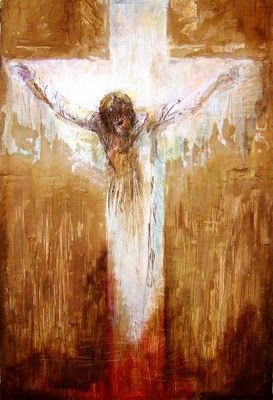
Crucifixion by Unknown artist

Give thanks to the Lord;
    call upon his name;
    make his deeds known to all people!
Sing to God;
    sing praises to the Lord;
    dwell on all his wondrous works!
Give praise to God’s holy name!
    Let the hearts rejoice of all those seeking the Lord!
Pursue the Lord and his strength;
    seek his face always!
Remember the wondrous works he has done,
    all his marvelous works, and the justice he declared—
    you who are the offspring of Abraham, his servant,
        and the children of Jacob, his chosen ones.

The Lord—he is our God.
    His justice is everywhere throughout the whole world.
God remembers his covenant forever,
    the word he commanded to a thousand generations,
        which he made with Abraham,
        the solemn pledge he swore to Isaac.
God set it up as binding law for Jacob,
    as an eternal covenant for Israel,
    promising, “I hereby give you the land of Canaan
    as your allotted inheritance….”

Then God brought Israel out, filled with silver and gold;
    not one of its tribes stumbled.
Egypt celebrated when they left,
    because the dread of Israel had come upon them.

God spread out clouds as a covering;
    gave lightning to provide light at night.
The people asked, and God brought quail;
    God filled them full with food from heaven.
God opened the rock and out gushed water—
    flowing like a river through the desert!
Because God remembered his holy promise
    to Abraham his servant,
    God brought his people out with rejoicing,
    his chosen ones with songs of joy.
God gave them the lands of other nations;
    they inherited the wealth of many peoples—
        all so that they would keep his laws
        and observe his instructions.

Praise the Lord! (CEB)

Every day I read in the psalms. There are two reasons I do this. First, the psalms are the church’s prayer book.  They are more than reading material; the psalms are designed to be owned by us as prayers. And second, I need their reminders – a lot!

Remembering is a major theme throughout the entirety of Holy Scripture. It’s just part of the human condition, fallen and forgetful as we are, to lose sight of what has taken place in the past. Today’s psalm invites us to seek the Lord through remembering all the good and wonderful works he has done.

For Israel, remembering meant continually having Passover in front of them. God redeemed the ancient Israelites out of Egyptian slavery and into a good Promised Land. They were to never forget God’s miracle through the Red Sea, God’s protection over them from other nations, and God’s provision of food and necessities in the desert.

We are to remember because we are made in God’s image and likeness. God remembers. God has an ongoing reminder in a divine day timer – Fulfill the promises I made and keep the covenant I initiated with the people, even when they’re stinkers and forget who I am.

As old as God is, there is no danger of the Lord getting some sort of divine dementia. God doesn’t forget. The Lord always keeps promises made to people. For the Christian, all God’s promises are remembered and fulfilled in the person and work of Jesus Christ. Deliverance from sin, death, and hell; the gift of the Holy Spirit; and ongoing presence and provision are given to us graciously and freely by the God who loves and cares for people. For Christians, remembering means coming to the Lord’s Table, entering the once for all loving sacrifice of Christ on our behalf.

One of the reasons I write and journal about my life and Scripture is to remember. Sometimes I forget. There are times when I’m overwhelmed with life and it feels as if God has forgotten me. In such times, I look back into my journal and see what God has done. And I peer into the psalms and see that the Creator God is active in the big, created world, always attentive to working what is just, right, and good – bending twisted circumstances and evil machinations back toward the great arc of love.

May your journey with Jesus in this season of Lent cause you to remember the Lord Jesus, to have Christ always before you.

Now We Remain by David Haas

Daniel 9:15-25 – A Prayer of Confession, Part 2

“But now, my Lord, our God—you who brought your people out of Egypt with a strong hand, making a name for yourself even to this day: We have sinned and done the wrong thing.” My Lord, please! In line with your many righteous acts, please turn your raging anger from Jerusalem, which is your city, your own holy mountain. Because of our sins and the wrongdoing of our parents, both Jerusalem and your people have become a disgrace to all our neighbors.

“But now, our God, listen to your servant’s prayer and pleas for help. Shine your face on your ruined sanctuary, for your own sake, my Lord. Open your ears, my God, and listen! Open your eyes and look at our devastation. Look at the city called by your name! We pray our prayers for help to you, not because of any righteous acts of ours but because of your great compassion. My Lord, listen! My Lord, forgive! My Lord pay attention and act! Do not delay! My God do all this for your own sake because your city and your people are called by your name.

While I was still speaking, praying, and confessing my sin and the sins of my people Israel—while I was still praying my prayer for help to the Lord my God about my God’s holy mountain— while I was still speaking this prayer, the man Gabriel approached me at the time of the evening offering. This was the same Gabriel I had seen in my earlier vision. He was weary with exhaustion.

He explained as he spoke with me: “Daniel, here is why I have come: to give you insight and understanding. When you began making your requests, a word went out, and I have come to tell it to you because you are greatly treasured. So now understand this word and grasp the meaning of this vision! Seventy weeks are appointed for your people and for your holy city to complete the rebellion, to end sins, to cover over wrongdoing, to bring eternal righteousness, to seal up prophetic vision, and to anoint the most holy place.

“So, you must know and gain wisdom about this: There will be seven weeks from the moment the word went out to restore and rebuild Jerusalem until a leader is anointed. (CEB)

We learn to pray through praying the prayers of the Bible. One of the great wrestlers of prayer in Holy Scripture is Daniel. His prayer when disaster overtook the people of Jerusalem is apropos for us in our national disasters of egregious sin. Today I take the second part of Daniel’s prayer and use it as my own prayer (this is a continuation from yesterday’s prayer of confession).

Prayer is an act of subversion. It challenges the status quo. It looks evil in the face and gives it a name. Real change begins with the step of real prayer, and real prayer is modeled after the great prayers of Scripture. The season of Lent, with its focus on repentance and spiritual discipline, is the appropriate time to offer prayers of confession and express fealty to the God who deserves it.

Our Lord God, with your own mighty arm you brought our forefathers from religious harassment to a place of religious freedom. You graced us with liberation to become what we could not in other places. Through this you made yourself famous to this very day, but we have sinned terribly.

We turned around and did to others what they did to us.

We have been unequal in our treatment of all people. In our pride, we think we are better than others, even though we have been called to treat others better than ourselves.

We keep killing one another with words and then with guns, all the while justifying our behavior through inaction and spiritual gerrymandering. Meanwhile, our children and our neighbors keep dying. 

In the past you treated us with such undeserved kindness. We now beg you to stop being so terribly angry and hear our plea for your grace to awash us again. Although we have suffered public disgrace from our own stupidity, we throw ourselves upon your great mercy.

I am your servant, Lord God, and I beg you to answer my prayers and bring honor to yourself by having pity on our grieving families as well as the people who have forgotten you. Please show mercy to us, not because we deserve it, but because of your great kindness. Forgive us! Pay attention to us, even though we failed to give you the time of day. Hurry and do something, not only for us, but to bring honor to yourself through Jesus Christ our Savior in the might of your blessed Holy Spirit. Amen.