The Finite and the Infinite (Psalm 65)

God of Zion, to you even silence is praise.
    Promises made to you are kept—
    you listen to prayer—
    and all living things come to you.
When wrongdoings become too much for me,
    you forgive our sins.
How happy is the one you choose to bring close,
    the one who lives in your courtyards!
We are filled full by the goodness of your house,
    by the holiness of your temple.

In righteousness you answer us,
    by your awesome deeds,
    God of our salvation—
    you, who are the security
        of all the far edges of the earth,
        even the distant seas.
    You establish the mountains by your strength;
    you are dressed in raw power.
    You calm the roaring seas;
        calm the roaring waves,
        calm the noise of the nations.
Those who dwell on the far edges
        stand in awe of your acts.
    You make the gateways
        of morning and evening sing for joy.
You visit the earth and make it abundant,
    enriching it greatly
        by God’s stream, full of water.
You provide people with grain
    because that is what you’ve decided.
Drenching the earth’s furrows,
        leveling its ridges,
    you soften it with rain showers;
        you bless its growth.
You crown the year with your goodness;
    your paths overflow with rich food.
Even the desert pastures drip with it,
    and the hills are dressed in pure joy.
The meadowlands are covered with flocks,
    the valleys decked out in grain—
        they shout for joy;
        they break out in song! (Common English Bible)

The biblical psalms present God as sovereign over all creation. Today’s psalm extols the Lord of the universe as God of both temple and terra, of people and the earth.

God of the temple

Praise is the appropriate offering to God – because it is the Lord who listens, forgives, and chooses to fill persons with the holiness and goodness of God’s presence, exemplified in the temple.

Infinite righteousness cannot be fulfilled by finite beings. In other words, we need God.

The nineteenth century philosopher and theologian, Søren Kierkegaard (1813-1855) insisted that the humans did not established themselves; therefore, no one can simply exercise their will toward better and brighter circumstances.

Kierkegaard argued that humanity, at its core, is a synthesis of the infinite and the finite, the temporal and the eternal. A finite human is not a self; only when connected and aware of the infinite is someone a self. (The Sickness Unto Death)

Creatures can never lift themselves above anxiety, worry, distress, or hardship with only finite resources; we need infinite supplies and divine capital, to tap into the image of God within us, to realize that our true identity is inextricably dependent upon our Creator.

“Prayers” by Yoram Raanan

We are more than bodies and brain synapses; we are also souls. And as souls, we shall never realize our true selves through the temporary means of possessions, prestige, and power. A person cannot construct a self, by themselves, to bear the weight of who we really are. That’s because our real identity is hidden with Christ in God. (Colossians 3:3)

Just as the temple in Jerusalem was much more than a physical structure, so we, as the people of God, are so much more than tangible beings.

Do you not know that you are God’s temple and that God’s Spirit dwells in you? (1 Corinthians 3:16, NRSV)

Praise, prayer, and worship are practices designed to connect with the infinite God. Indeed, the kingdom of God is much nearer than we know.

Jesus said, “The kingdom of God is not coming with things that can be observed, nor will they say, ‘Look, here it is!’ or ‘There it is!’ For, in fact, the kingdom of God is among you.” (Luke 17:20-21, NRSV)

God of terra

We walk upon and inhabit this present terra firma, this earth. The earth, and all that is in it, belongs to the Lord. God is something of a cosmic farmer, taking care of the earth, watching over it, tending to its needs.

All that takes place on this celestial ball we live upon is under the gracious and loving eye of God. It is the Lord who brings the seasons and the rains, calming the storms of the seas, as well as the storms of our lives.

One of the reasons we find ourselves in such an impending climate debacle on this earth, is that we continue to utilize all the finite resources we can muster and fail to acknowledge and become aware of the grand infinite wherewithal we have with our Creator and Sustainer.

“I am the Lord, your savior;
I am the one who created you.
I am the Lord, the Creator of all things.
    I alone stretched out the heavens;
    when I made the earth, no one helped me. (Isaiah 44:24, GNT)

The earth is beautiful. Yet, in our insistence upon merely using the temporal and physical, ugliness has come upon the earth, obscuring the true nature of God’s good creation. Distancing ourselves from the Creator only builds bigger obstacles to solving the earth’s most significant issues.

Self-imposed and ensconced impediments need to be cleared away. The weeds have overtaken the garden; we can no longer see the good plants that are supposed to grow and produce a harvest. And yet, as any farmer or gardener knows, you cannot simply yank such weeds from the ground without also pulling up what you are trying to preserve.

The Lord will provide – but if we keep to our stubborn independence from God, the process of weeding the garden will take much longer to accomplish. Yet, God is patient, not wanting any to perish but all to come around to the infinite. (2 Peter 3:9)

Conclusion

Let us come to God in our neediness and failure. We must see ourselves as infinite souls with finite solutions who can cry out to the God who hears and forgives. We need to connect with the Lord who hears our prayers. It is imperative that we rely upon the infinite Creator who is concerned to cultivate justice and righteousness upon an earth which is full of plenty for everyone.

Praise, pray, give thanks, and be connected to the infinite One whom we need for life and godliness in this present, evil, and finite age.

Stay joined to me and I will stay joined to you. No branch can produce fruit alone. It must stay connected to the vine. It is the same with you. You cannot produce fruit alone. You must stay joined to me. (John 15:4, ERV)

Blessed God and Father of all, yours is the kingdom, the power, and the glory forever. To you belongs the heavens and the earth. It is you who made all that is – sun, moon, stars, rivers, forests, minerals, birds, animals, fish, and us – and pronounced it all “good.” We seek your divine mercy and help so that our work and our worship may curb the sin that so easily entangles and bring your intended shalom to the earth. Amen.


Get Up and Pray! (Luke 22:39-46)

The Garden of Gethsemane by He Qi

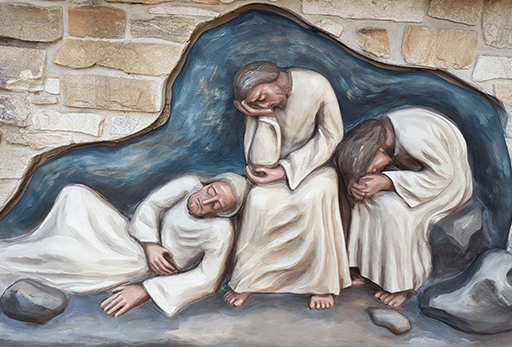
Jesus went out as usual to the Mount of Olives, and his disciples followed him. On reaching the place, he said to them, “Pray that you will not fall into temptation.” He withdrew about a stone’s throw beyond them, knelt down and prayed, “Father, if you are willing, take this cup from me; yet not my will, but yours be done.” An angel from heaven appeared to him and strengthened him. And being in anguish, he prayed more earnestly, and his sweat was like drops of blood falling to the ground.

When he rose from prayer and went back to the disciples, he found them asleep, exhausted from sorrow. “Why are you sleeping?” he asked them. “Get up and pray so that you will not fall into temptation.” (New International Version)

The prayer of Jesus and the sleeping of his disciples presents a contrast of approach when severe stress is upon us.

The Prayer of Jesus

Christ’s prayer expresses the tension all devout persons face: expressing our own wishes while seeking to submit to the Father’s wishes.

However, what is not the same, between our own prayers and the prayers of Jesus, is that we too often believe that if we are intense, wordy, and insistent enough with God, that our prayers will be answered.

While only feigning a few words about God’s will, we put our real efforts into lawyer-like presentations of why the Lord should answer our prayers in the way we want them answered.

Thus, prayer can too easily become a willful imperative that God grant our demands based in a very limited understanding of the big picture.

There is a big difference between willfulness and willingness. We must embrace the latter and eschew the former.

Jesus clearly stated exactly what he wanted: to have this terrible suffering, especially the pain about to be experienced, taken from him. Yet, he asks this with a willingness to accept the Father’s will for his life. Although an angel comes to bring comfort and strength, Christ’s request was denied. And Jesus was good with that.

We can, following the example of Jesus, unashamedly express our anguish, while at the same time, accepting God’s will for us, no matter what it may be.

Christ in Gethsemane by Michael O’Brien

It was God’s will for Jesus to suffer. And Christ not only suffered in the Garden of Gethsemane and on the cross; Jesus experienced the full range of human suffering throughout his life. He knew what it felt like to face continual adversity and hardship. 

The suffering of Christ helps us make sense of our own suffering. We can only truly be free from our stubborn expectations by embracing that which makes us suffer. 

Some suffer through the death of a loved one; some through cancer or a serious health issue; other believers right now throughout the world are suffering due to grinding poverty and la ack of food and clean water; many others suffer through violence done to them or their families.

Because of this reality, some of us may not even express our anguish to God in prayer. After all, what is a harshly worded e-mail, or trying to lose a few extra pounds, or an unexpected car repair, compared to starving children in the world? 

It’s good to keep our life situations in proper perspective, but it is also not good to tell God what he should and shouldn’t care about in this world. 

If the only things that matter and qualify as hardship and difficulty is human trafficking or the terrors of war, then you will soon find yourself plastering a smile on your face and nodding over-enthusiastically whenever someone asks you how you are doing…. Good grief…. I find chronically happy Christians to be insufferable (pun intended).

The sufferings of Christ qualified him to be a compassionate high priest, able to help us (Hebrews 2:5-18). A priest is one who stands in between the person and God, making things right with God. Christians possess a union with Jesus Christ because of his suffering, death, and resurrection. He is our champion. He stands with us in our suffering and temptations.    

The Sleep of the Disciples

Even though their Lord told them to pray, the disciples nod-off in a stress-induced sleep. Jesus wanted them to remain awake, and he was talking of more than just physical alertness. The disciples needed to keep watch so that they didn’t fall into temptation.

Throughout his earthly ministry, Jesus had been warning them that his cross will lead to their own cross to bear. They, too, will have times of trial, so intense that it will be emotionally and spiritually overwhelming. Christ desired the disciples to follow his own example of offering anguished prayer which is thoroughly submissive to God.

So, our great task is to get up and pray!

Get up and pray so that no temptation can overtake you! (1 Corinthians 10:13)

Get up and pray so that you can endure hardship! (Hebrews 12:7)

Get up and pray for the enemies who persecute you so that you may be children of your Father in heaven! (Matthew 5:44-45)

Get up and pray so that you can encourage others and build them up in the faith! (1 Thessalonians 5:10-11)

Get up and pray so that you can be joyful in hope and patient in affliction! (Romans 12:12)

Get up and pray so that you may have peace in this world of trouble! (John 16:33)

Get up and pray so that you can submit to God and resist the devil! (James 4:7)

Get up and pray so that you will not be overcome by evil but overcome evil with good! (Romans 12:11)

Get up and pray so that you can submit to one another out of reverence for Christ! (Ephesians 5:21)

Get up and pray so that you can be the salt of the earth and the light of the world! (Matthew 5:13-16)

Get up and pray so that you can proclaim that the kingdom of God is near! (Matthew 10:7)

Get up and pray so that you can preach the Word with great patience and careful instruction! (2 Timothy 4:1-2)

Get up and pray so that you can have confidence in your leaders and submit to their authority, because they keep watch over you as those who must give an account. (Hebrews 13:17)

Get up and pray!…

The Parable of the Persistent Widow (Luke 18:1-8)

“The Persistent Widow” by Ronnie Farmer, Jr.

Then Jesus told his disciples a parable to show them that they should always pray and not give up. He said: “In a certain town there was a judge who neither feared God nor cared what people thought. And there was a widow in that town who kept coming to him with the plea, ‘Grant me justice against my adversary.’

“For some time he refused. But finally he said to himself, ‘Even though I don’t fear God or care what people think, yet because this widow keeps bothering me, I will see that she gets justice, so that she won’t eventually come and attack me!’”

And the Lord said, “Listen to what the unjust judge says. And will not God bring about justice for his chosen ones, who cry out to him day and night? Will he keep putting them off? I tell you, he will see that they get justice, and quickly. However, when the Son of Man comes, will he find faith on the earth?” (New International Version)

“God desires of us nothing more ardently than that we ask many and great things of him, and he is displeased if we do not confidently ask and entreat.”

Martin Luther

God wants us to pray! Prayer happens from a place of faith because to pray, one must believe that God is good and answers prayer. Conversely, prayerlessness is faithlessness. A person of little faith prays only a little. A person full of faith cannot stop praying.

Today’s Gospel lesson is a parable about not losing heart, about justice, and ultimately about faith.

Be Persistent In Prayer

For the Gospel writer, Luke, the widow, along with orphans, the diseased, and the handicapped, represent those who are dependent and vulnerable. And so, Jesus took a particular interest in them. (Luke 20:47, 21:3)

Widows are also presented by Luke as prophetic, active, and faithful. The widow in Christ’s parable, much like the other widows mentioned by Luke, is persistent and persuasive enough to get the justice she demands – even from an unjust judge. Her persistent petitioning is held up as a lesson in prayer.

Don’t lose heart and give up praying when your prayers are not answered as quickly as you want. No matter the prayer, we typically hope for and even expect them to be answered quickly. And if they don’t, we may get upset or discouraged.

“We must patiently, believingly, continue in prayer until we obtain an answer… Most frequently we fail in not continuing in prayer until the blessing is obtained, and in not expecting the blessing.”

George Müller

We pray daily for a variety of situations as individuals and as a congregation. Not all those prayers get answered in the ways we expect. Many times, it can seem like nothing is changing, or things are just getting worse. It is possible for us to despair in those moments and give up.

Yet, even if we do not immediately see an answer to our prayers, we need to keep praying. Even if we are suffering and seeing darkness all around us, we should not stop crying out to the Lord. And the content of those prayers is important.

Be Persistent In Justice

The parable is like a sandwich. The two pieces of rye bread are prayer and faith, with justice being the ham and cheese between them. The meat of the parable is in the ingredients of the prayers.

The widow is the vulnerable justice-seeker, and the powerholder is the unjust judge. The powerful and just God replaces the unjust authority’s reluctance, granting justice to vulnerable people who cry out to him day and night.

We are to persistently and passionately pray as Jesus instructed us:

“Father,
hallowed be your name,
your kingdom come.
Give us each day our daily bread.
Forgive us our sins,
    for we also forgive everyone who sins against us.
And lead us not into temptation….”

“So I say to you: Ask and it will be given to you; seek and you will find; knock and the door will be opened to you. For everyone who asks receives; the one who seeks finds; and to the one who knocks, the door will be opened.” (Luke 11:2-4, 9-10, NIV)

Jesus said, “Seek his kingdom, and these things [food, clothing, basic necessities] will be given to you as well. Do not be afraid, little flock, for your Father has been pleased to give you the kingdom. Sell your possessions and give to the poor. Provide purses for yourselves that will not wear out, a treasure in heaven that will never fail, where no thief comes near, and no moth destroys. For where your treasure is, there your heart will be also.” (Luke 12:31-34, NIV)

Be Persistent In Faith

Christ’s parable ends with a question: When the Son of Man comes, will he find faith on the earth? In Luke’s Gospel, there are several folks whom Jesus commended for their faith:

  • A Roman centurion asked Jesus to heal his servant, being confident that Christ could do so without even being present to do it. Jesus commented, “I tell you, I have not found such great faith, even in Israel.” (Luke 7:1-10)
  • A “sinful” woman anointed the feet of Jesus with perfume and her tears, loving the Lord despite the judgmental people around her. Jesus said to the woman, “Your faith has saved you; go in peace.” (Luke 7:36-50)
  • Friends of a paralyzed man dug through a roof to get him access to Jesus, knowing that Christ could heal. When Jesus saw their faith, he said, “Friend, your sins are forgiven.” (Luke 5:17-26)
  • An unclean woman, because of a chronic issue of bleeding, touched the edge of Christ’s cloak, believing that even this small touch will heal her. Jesus said to her, “Daughter, your faith has healed you. Go in peace.” (Luke 8:43-48)
  • A Samaritan leper cried out for mercy, recognizing that Jesus is the Christ who could heal him; and then fell at his feet in profound gratitude. Jesus said to him, “Rise and go; your faith has made you well.” (Luke 17:11-19)
  • A blind beggar called out to Jesus, seeing with spiritual eyes who Jesus really is. Jesus said to him, “Receive your sight; your faith has healed you.” (Luke 18:35-43)

So, will Jesus find faith on the earth when he returns?  Yes, he will, but it may likely be in unexpected places — not among the religious professionals or the ones certain of their own righteousness, but among the outsiders, the unlovely, the unclean, the ones certain of their sinfulness.

Perhaps the best sign of faith is a willingness to persist in prayer, like widow who persisted against all odds in her struggle for justice with the powerful judge.

Conclusion

We must have faith in Christ, and not in faith itself.

If we are honest, every one of us who has made a difficult prayer request, mustering-up all the faith we can, and then being disappointed when it did not happen, has been hurt. The unstable person vacillates when this happens, playing the “God-loves-me, God-loves-me-not” game. The person of faith, however, believes God answers prayer, and that if it is not answered when I want, God knows what’s up and will answer it in God’s own good time and grace.

None of this is about the amount of faith. Maybe you have told yourself, or somebody else has said to you, that you don’t have enough faith, and that’s why your prayer was not answered.

“The value of persistent prayer is not that God will hear us, but that we will finally hear God.”

William McGill

Know this: positive thinking is not the same as Christian faith. Faith is neither a matter of optimism nor of sending $19.95 to some hack preacher who promises to give you the secret of answered prayer, along with a free gold cross.

Taking a lesson from Christ’s parable about the persistent widow, we can put aside tepid, milquetoast, mumbling prayers with hunched shoulders (i.e. “Well, God, if it is your will, could you help me?”) and instead, because of our union with Jesus Christ and our redemption in him, pray confidently and boldly. In Christ, we have the privilege and authority to do so.

Blessed heavenly Father, we praise you for the grace we possess through the Lord Jesus Christ. We rejoice in Christ’s teaching, the gift of faith, the privilege to approach your throne with boldness, and the victory you have provided for us through Christ’s crucifixion, resurrection, and ascension. 

We pray your mercy over our sins, the sins of other believers, and the sins of our world. We confess the sin of prayerlessness, faithlessness, apathy, complacency, and indifference to your concerns for righteousness and justice. We acknowledge the wickedness of our world through injustice, oppression, and exploitation of others.

We recognize that the kingdom of darkness has laid strategies against us, trying to keep your people from faith and prayer. So, in the name of the Lord Jesus Christ, we claim our place as children of God. We smash and pull down all the strongholds which Satan has erected against humanity – and pray that the power of Christ’s resurrection would hinder and frustrate the plans formed against us. 

We, your people, accept the role of standing in the gap for others in prayer. In Christ, we are mighty through God to the pulling down of strongholds. So, we bring all the work of the Lord Jesus Christ – his incarnation, crucifixion, resurrection, ascension, and glorification directly against all of Satan’s power in their lives.

By faith we pray for fruitful lives of spiritual abundance, social justice, and sanctified relationships in the name of Jesus Christ our Lord.  Amen.

Depression Is Our Teacher (Psalm 102:1-17)

Lord, hear my prayer!
    Let my cry reach you!

Don’t hide your face from me
    in my time of trouble!
Listen to me!
    Answer me quickly as I cry out!

Because my days disappear like smoke,
    my bones are burned up as if in an oven;
    my heart is smashed like dried-up grass.
    I even forget to eat my food
    because of my intense groans.
    My bones are protruding from my skin.

I’m like some wild owl—
    like some screech owl in the desert.
I lie awake all night.
    I’m all alone like a bird on a roof.

All day long my enemies make fun of me;
    those who mock me curse using my name!

I’ve been eating ashes instead of bread.
    I’ve been mixing tears into my drinks
        because of your anger and wrath,
        because you picked me up and threw me away.

My days are like a shadow soon gone.
    I’m dried up like dead grass.

But you, Lord, rule forever!
    Your fame lasts from one generation to the next!

You will stand up—
        you’ll have compassion on Zion
        because it is time to have mercy on her—
    the time set for that has now come!

Your servants cherish Zion’s stones;
    they show mercy even to her dirt.

The nations will honor the Lord’s name;
    all the earth’s rulers will honor your glory
    because the Lord will rebuild Zion;
    he will be seen there in his glory.

God will turn to the prayer of the impoverished;
    he won’t despise their prayers. (Common English Bible)

Author Marianne Williamson tells the story concerning a study of a group of chimpanzees. Supposedly, researchers observed primate behavior which correlates to human depression, such as eating at odd times, spending lots of time alone, and staying on the outskirts of the group. This behavior was observed in about 10% of the chimps, which is about the same percentage of Americans who show symptoms of depression. 

The scientists removed the depressed chimps for six months, to see how this would affect the behavior of the other 90%. You might think that in the absence of the depressed individuals, the remaining majority would produce another 10% of depressed chimps. Instead, when scientists returned six months later, all the non-depressed chimps were dead.

The interpretation and conclusion of the study is that the depressed chimps had functioned as a kind of early warning system, continually looking out for predators, tropical storms, and other threats to the group. Without that system in place, the group was doomed.

Whether the study can be substantiated, or is a fabrication, for those who pay careful attention to the inner person, knowing there is much more to us than physical pathology, this account of chimpanzees resonates deeply.

More than a mere problem to be fixed, depression can also serve as an asset to society. Depressed persons can serve an important role, providing a critical mass of individuals uniquely suited to guarding against danger.

I am not trying to put a positive spin on a terrible malady of mind and spirit. Instead, I’m simply pointing out that there is a lot going on beyond an individual’s inner sadness and struggle; it is also a community’s struggle.

Reading today’s psalm, especially if you read it aloud, you can feel the expression of deep lament borne from a person going through a major depression. Although there are persons in the church and society who, unfortunately, believe depression to be a sin, we get no such judgment from Holy Scripture. Depression just is.

Consider the following biblical characters:

  • Elijah became depressed. The prophet’s depression served as a sign and warning that there was something horribly awry in ancient Israel. Jezebel was the wicked queen, pulling the strings in a nation connected in a web of evil which permeated the land.
  • Moses became despondent time and again. The leader’s depressed spirit pointed to the faithless network of apostasy that kept rearing its golden calf in the life of the Israelite people.

Whenever we, as contemporary persons, become depressed it can and should serve as a billboard to others that something is terribly askew among us, and not just within the individual.

Please know that I fully believe depression ought to be addressed and treated so that the depressed person can come around again to a sense of happiness and hopefulness. Yet, there are also emotionally “healthy” people who try to push pills, hurry along therapy, and pronounce exhortations to the despondent people around them. It’s almost as if depressed folk make others uncomfortable and uneasy.

If depression points to societal ills, not just personal sickness, then it makes sense that non-depressed people want depressed people to get healthy now, because then they don’t have to take a good hard look at the systemic problems of our society and culture. 

Whenever we rush to make someone feel better, typically the person we really want to help is ourselves.

Depression and emotional struggles must be deeply felt, examined, and carefully dealt with. Thus, enter the psalmist. The sheer volume of laments in the psalter ought to clue us in that this is important work. Sadness and grief can get trapped in us like monkeys in a cage. Reciting psalms of lament can help express what is within us and serve as the pick which unlocks us to freedom.

Dealing with depression is a process. It takes time and therapy, perseverance and patience, to heal. Learning new ways to accept, cope, and transcend are difficult – they take time. Cheap hope is a switch which can be easily flipped; genuine hope is a large heavy gate that needs effort to open.

While the depressed among us learn to hope again, the majority who are free of depression ought to pay attention.

We who are depression-proofed persons ought also to examine ourselves, our families, our organizations, our workplaces, and our faith communities to determine what is awry and create new systems and new ways of living together on planet earth.

Depression helps us all become more aware of ourselves and our society. And it drives us to the One who can truly heal all of our ills, both personal and societal. In this way, depression can be our teacher, and not just an unwanted interloper.

After all, who wants to make a monkey of themselves?

Holy God, please observe all who live with depression and hold them in your good strong hands. Send them your love through therapists, pastors, friends, and family. Grant them assurance of your love in their dark hours.

In your mercy, hear my prayer concerning the depressed persons in my life. I feel powerless and inadequate to help. I am frustrated because depression can be so unpredictable. Help me find the resilience and resources I need to be with them during their time of pain. And teach me what I need to learn in their darkness, as well, through Jesus Christ, our Savior. Amen.