Praise and Prayer (Psalm 86:11-17)

Teach me your way, Lord,
        so that I can walk in your truth.
    Make my heart focused
        only on honoring your name.
I give thanks to you, my Lord, my God,
    with all my heart,
    and I will glorify your name forever,
    because your faithful love toward me is awesome
    and because you’ve rescued my life
        from the lowest part of hell.

The arrogant rise up against me, God.
    A gang of violent people want me dead.
    They don’t give a thought for you.
But you, my Lord,
    are a God of compassion and mercy;
    you are very patient and full of faithful love.
Come back to me! Have mercy on me!
    Give your servant your strength;
    save this child of your servant!
Show me a sign of your goodness
    so that those who hate me will see it and be put to shame—
        show a sign that you, Lord,
        have helped me and comforted me. (Common English Bible)

Psalms are prayers. And today’s prayer is from David, a guy who knew what it was like to have evil men hate him and pursue taking his life, through no fault of his own. 

I don’t know about you, but, although I have never faced adversity to such a degree as David, I do know something about people who, to put it bluntly, just flat-out hate my guts. It is not a good feeling, and it can be terribly draining emotionally and even spiritually. 

Having disrespectful and rude people who talk behind your back (and sometimes even to your face) is in direct contrast to who God is.

Who is God? What is God’s character?

God is described by David as merciful and gracious, slow to anger and abounding in steadfast love and faithfulness. Whereas insolent people objectify others and do not seek their best interests, God always acts in accord with a basic divine character of love and grace. 

Based upon the nature of God, we can choose to cry out, just like David did, to show us a sign of God’s favor. We can pray for God to provide us with some tangible communication of divine love, given on our level, so that we can grasp and understand it.

For we all, at various points in our life, need help and comfort through hardship and adversity.

Be assured that God hears the cries of the godly. The Lord notices ungodliness and injustice, and will do something about it. 

At the same time we are receiving divine guidance and help, we can trust God to address the insolence that exists around us and toward us.

Why can we trust God? What is the basis of such faith?

Seven times in the psalm, David refers to Yahweh as my Lord. And three times David refers to himself as your servant. This is a relationship – Lord to servant, Creator to creature – and it means the servant can cry out to his Lord and can confidently expect a positive response to his cry.

It is the nature and character of God to be attentive and answer God’s people.

The Lord is merciful and gracious,
    slow to anger and abounding in steadfast love.

Psalm 103:8, NRSV

Because of the divine/human relationship, David can call boldly to God, confident of God’s will and of God’s power to help. The gang of violent people who had it out for David also have no regard for God. So, David is emboldened to pray for divine favor, while at the same time, praying against those that despise him.

Yahweh, the God of David, can deliver us from the lowest parts of hell itself, because God is the expert on deliverance from the worst places that humanity finds themselves in. And so, the Lord is the One who is worthy of praise. Eventually, this reality will ultimately be recognized by all nations.

“Great and amazing are your deeds,
    Lord God the Almighty!
Just and true are your ways,
    King of the nations!
Lord, who will not fear
    and glorify your name?
For you alone are holy.
    All nations will come
    and worship before you,
for your judgments have been revealed.” (Revelation 15:3-4, NRSV)

Praise and petition go together like a hand in a glove. David freely praises God with thanksgiving for the divine character and saving actions – while at the same time, he offers fervent prayer, based upon the understanding that God is good.

David’s impassioned petition is this: Teach me your way, Lord, so that I will walk in truth; and give me an undivided heart to keep on honoring and praising your name. David longed for a completely focused heart on God and God’s will for his life.

“Hear, O Israel: The Lord is our God, the Lord alone. You shall love the Lord your God with all your heart, and with all your soul, and with all your might.” (Deuteronomy 6:4-5, NRSV)

In those times when we feel as if we are between a rock and a hard place, wanting to remain positive, yet also acknowledging life’s crud, we can come to Psalm 86 and adopt it as our own prayer for the day…

Train me, God, to walk straight;
    then I’ll follow your true path.
Put me together, one heart and mind;
    then, undivided, I’ll worship in joyful fear.
From the bottom of my heart I thank you, dear Lord;
    I’ve never kept secret what you’re up to.
You’ve always been great toward me—what love!
    You snatched me from the brink of disaster!
God, these bullies have reared their heads!
    A gang of thugs is after me—
    and they don’t care a thing about you.
But you, O God, are both tender and kind,
    not easily angered, immense in love,
    and you never, never quit.
So look me in the eye and show kindness,
    give your servant the strength to go on,
    save your dear, dear child!
Make a show of how much you love me
    so the bullies who hate me will stand there slack-jawed,
As you, God, gently and powerfully
    put me back on my feet. (The Message)

What Is Your View of God? (Psalm 86:1-10)

God’s Love… by Hope G. Smith

Incline your ear, O Lord, and answer me,
    for I am poor and needy.
Preserve my life, for I am devoted to you;
    save your servant who trusts in you.
You are my God; be gracious to me, O Lord,
    for to you do I cry all day long.
Gladden the soul of your servant,
    for to you, O Lord, I lift up my soul.
For you, O Lord, are good and forgiving,
    abounding in steadfast love to all who call on you.
Give ear, O Lord, to my prayer;
    listen to my cry of supplication.
In the day of my trouble I call on you,
    for you will answer me.

There is none like you among the gods, O Lord,
    nor are there any works like yours.
All the nations you have made shall come
    and bow down before you, O Lord,
    and shall glorify your name.
For you are great and do wondrous things;
    you alone are God. (New Revised Standard Version)

What is your view of God? 

For some, God is up there, somewhere, like some white-bearded old guy who is aloof to what is going on down here – there is neither anything personal nor personable about him, at all. If he gets involved, at all, it’s just to get out his divine BB gun and shoot a few sinners in the backside.

For others, God is a force which binds all things together; God is there, but you’re never quite sure how to get in touch with him – it’s like a crap shoot trying to connect with God. So, you might do all sorts of things to get God’s attention, like be especially good – and if that doesn’t work, maybe you’ll go the other way and be especially bad, just to get any sort of attention.

For yet others, God is perpetually perturbed about something; he’s got a bee in his divine bonnet and it’s our job to figure out what he’s sullen and upset about all the time, that we might appease God in some way. So, you might double-down on being self-sacrificial, try not to swear in front of the Pastor, and help others so that God will, in turn, help you.

The psalmist David, however, sees God in a very different way than all the aforementioned. God is not aloof and distant, nor angry. Instead, David understands and views God as personal, knowable, and reachable.

What characterizes God?

Reading today’s psalm tells us a great deal of how David thought and felt about God. Notice what we learn about God from David’s description: good and forgiving; abounding in steadfast love; listens and answers; and, does great and wondrous things.

Now this is a God you can sink your teeth into. This God is attentive, engaged, and is anything but upset all the time – which is why David has no problem asking God to listen and answer his prayer.

David put his trust in God to save him and make his heart glad. With this kind of God, David can willingly affirm his devotion. With a God of steadfast love and support, the worshiping and praying person’s heart forever belongs to the Lord.

If your view of God cannot support and bear the weight of your life’s hardest circumstances, then you need a different view of God!

Rather than God being the problem, it could be that your understanding of God is off. And if your understanding of God is off, then it’s likely that your own understanding of yourself is skewed – which is why many persons who have darker views of God are down on themselves and possess little self-worth.

I invite you to see the God of David. This God has both the ability and the willingness to satisfy your life’s greatest needs.

What will you do with your view of God?

In humility and brokenness, we call out in our misery. God responds in steadfast love and abundant mercy. With God, we can move from trouble to confidence.

And sometimes, we discover that our troubles and our circumstances change very little. But we ourselves have changed a great deal. Our compulsions for solid answers to our questions give way to a settled confidence in divine mystery. And our obsessions with a pain-free and problem-free life are replaced with a curiosity for what the hard situations in our lives will teach us.

The poor and needy cry out to God, knowing that grace and mercy characterizes the Lord. Life on this earth may not treat us well, but God gives us much more than we deserve.

The faithful trust in the Lord, fully confident that their preservation and protection are in God’s hands – and not in political leaders or padded bank accounts.

The miserable pray, constantly persevering in prayer, because their hope is in the name of the Lord who made heaven and earth. They have learned to pray expectantly, understanding that sometimes the greatest miracle of all is being delivered from the need to have a miracle.

Those who lift their faces to heaven, looking for the bright sunshine of grace, will know joy, down deep in their soul – and not simply a fleeting happiness from temporary reprieve of trouble.

The ones calling on the name of the Lord, banking their lives on God’s love, discover forgiveness and a good peaceful life of peace – rather than the anxiety of constantly worrying about tomorrow.

The spiritually devoted are confident that God will answer in their day of trouble – and they are patient, knowing full well that God’s sense of timing is much better than their own. So, they learn to hold all things loosely, knowing that God gives and God takes away. Blessed be the name of the Lord.

All those taking the time and effort to find the God who is truly characterized by kindness and compassion know in their gut, without a shadow of a doubt, that there is no one like the Lord – a God who does wondrous things and is attentive to justice and righteousness.

What is your view of God? Listen closely to the psalmist, and he will tell you what the Lord has done for him because of God’s basic nature of love and goodness.

Great God of David, you are above all things and beside all things and with all things. You are uniquely positioned and powerful to walk with me through all the situations of my life. Thank you for sending the Son of David to make your promises real to me. Amen.

A Lot of Hurting, Touching, and Healing (Luke 6:12-19)

Jesus calls his twelve disciples, by Sadao Watanabe

One of those days Jesus went out to a mountainside to pray, and spent the night praying to God. When morning came, he called his disciples to him and chose twelve of them, whom he also designated apostles: Simon (whom he named Peter), his brother Andrew, James, John, Philip, Bartholomew, Matthew, Thomas, James son of Alphaeus, Simon who was called the Zealot, Judas son of James, and Judas Iscariot, who became a traitor.

He went down with them and stood on a level place. A large crowd of his disciples was there and a great number of people from all over Judea, from Jerusalem, and from the coastal region around Tyre and Sidon, who had come to hear him and to be healed of their diseases. Those troubled by impure spirits were cured, and the people all tried to touch him, because power was coming from him and healing them all. (New International Version)

Pain is a lot

Touch is important. Humanity needs touch. It’s also one of those things that we likely take for granted. 

Philip Yancey and Dr. Paul Brand co-authored a book, originally published in 1982, entitled “Pain: The Gift Nobody Wants.” It’s largely a biography of Dr. Brand, who pioneered both the diagnosis and prognosis of leprosy. 

He discovered that leprosy occurs because of a lack of feeling – an inability to sense touch. The delicate nerve endings we all have in our fingers and toes are numb to the leper. The lack of sensing pain in the extremities leads to small cuts or injuries, which would be immediately treated by someone who feels pain, becoming gangrene with the losing of fingers and toes.

The ability to feel, to reach out and touch another person, is vitally important to our spiritual and emotional lives. Without touch, the calloused heart and unfeeling soul does not realize the damage that is being done to it.           

One of the gifts we have as people is the ability to feel guilt, sorrow, disappointment, and pain – to be touched mentally, emotionally, and spiritually – as well as physically. And in our ability to feel pain, it brings about attention to prayer and addressing the situation.

Many people are troubled in either mind or spirit, or experience chronic ailments of the body, day in and day out. They just want relief, to be at peace in both body and soul.

Jesus prays… a lot

In today’s Gospel lesson, Luke puts together two stories: one of Jesus choosing and calling his twelve disciples; and then one of Jesus being among the people and healing them of their diseases and their troubles. Let’s observe the relationship between them.

Jesus often withdrew to lonely, isolated places in order to pray (Luke 5:16). On this particular occasion, he went out and spent the entire night in prayer to God. When morning came, we discover the reason for the all-night prayer meeting: Christ chose the people who would be closest to him in his earthly ministry. He called the twelve to follow him and be his disciples.

I find it highly instructive that Jesus spent so much time in prayer before making such big decisions about his ministry. If anyone could size up somebody as a potential follower, it seems to me it would be Jesus. And yet, there was a lot of deliberation and interaction with the Father. Since the Lord Jesus found it necessary to pray with an extending time, and consult with the heavenly Father, I would say that our own prayer life and reaching out to consult and collaborate could probably use an upgrade.

Jesus heals… a lot of people

Then, Jesus and his disciples, together enter the fray of the crowd. And the disciples get their first lesson in following Jesus: Christ-centered ministry is about healing – it’s about restoring people to physical, mental, emotional, and spiritual health.

Healing is at the heart of all real Christian ministry. And healing is really what everyone is to be about, whether they identify as Christian, or not. To be healed is to experience a holistic restoration of body, mind, emotions, and spirit.

Touch is a big part of healing. Physical touch is important, and it’s powerful. Sometimes, bodily healing is needed because a person has been physically abused, or experienced some sort of physical trauma. And it can be very difficult to have others touch them, after such experiences. Yet, part of the healing will be in experiencing redemptive touch – either by surgeons, family, friends, or trusted others. The answer to bad touch and bad pain is to experience good touch and the good pain of healing.

Non-physical touch is no less important. And, I believe, Jesus understood this perhaps more than most. He routinely “touched” people in ways that changed their lives. Christ sought to not only bring physical healing, but also to heal the mental, emotional, and spiritual wounds.

Jesus touches… a lot of lives

Jesus touched a lot of lives through his healing ministry:

  • In healing lepers of their disease, Christ made sure that they were no longer ostracized from the community but were restored to full function in society.
  • In curing persons demonized and tormented by evil spirits, Jesus was concerned to restore them to their right mind and ensure they were included as members of society, as well as restored to their families.
  • In bringing salvation from guilt and shame, Jesus brought reconciliation and restoration between God and sinners.
  • In all his relational interactions, Jesus was intentional about making connections to the lonely and the lost, to those who were emotionally cut off from the mass of society.

So, whenever we feel pain – whether in body, mind, emotion, or spirit – this experience lets us know that we need to pay attention to something. As we do that, it can drive us to the source of healing, wholeness, and restoration. We go to prayer – not out of duty – but because we are convinced that there are divine resources only God can provide.

And we can come, again and again, finding the grace to help us in our time of need. For God’s mercy is inexhaustible; the grace of God will never run out or run dry.

Therefore, let followers of Jesus everywhere be aqueducts of grace, angels of mercy, and agents of healing in a world which so desperately needs the love, care, and attention we can give them.

May God the Father bless you; God the Son heal you; and God the Holy Spirit give you strength. May God the holy and undivided Trinity guard your body, save your soul, protect your mind, and bring you safely to his heavenly country; where he lives and reigns for ever and ever. Amen.

A Life of Compassion (Matthew 9:35-10:23)

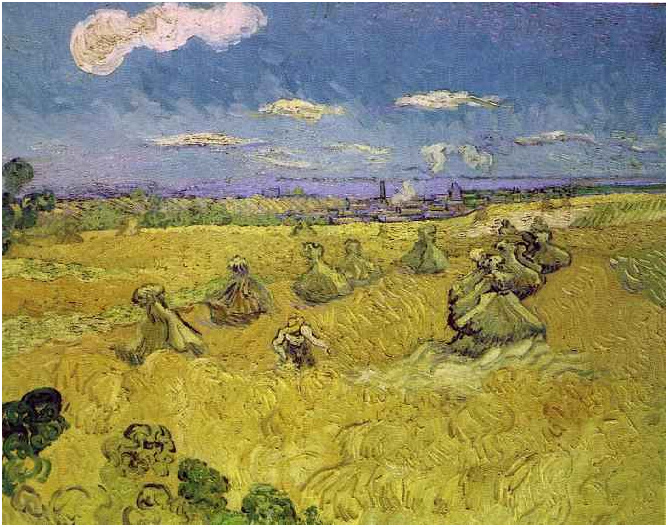
Wheat Stacks with Reaper, by Vincent Van Gogh, 1888

Jesus went through all the towns and villages, teaching in their synagogues, proclaiming the good news of the kingdom and healing every disease and sickness. When he saw the crowds, he had compassion on them, because they were harassed and helpless, like sheep without a shepherd. Then he said to his disciples, “The harvest is plentiful but the workers are few. Ask the Lord of the harvest, therefore, to send out workers into his harvest field.”

Jesus called his twelve disciples to him and gave them authority to drive out impure spirits and to heal every disease and sickness.

These are the names of the twelve apostles: first, Simon (who is called Peter) and his brother Andrew; James son of Zebedee, and his brother John; Philip and Bartholomew; Thomas and Matthew the tax collector; James son of Alphaeus, and Thaddaeus; Simon the Zealot and Judas Iscariot, who betrayed him.

These twelve Jesus sent out with the following instructions: “Do not go among the Gentiles or enter any town of the Samaritans. Go rather to the lost sheep of Israel. As you go, proclaim this message: ‘The kingdom of heaven has come near.’ Heal the sick, raise the dead, cleanse those who have leprosy, drive out demons. Freely you have received; freely give.

“Do not get any gold or silver or copper to take with you in your belts—no bag for the journey or extra shirt or sandals or a staff, for the worker is worth his keep. Whatever town or village you enter, search there for some worthy person and stay at their house until you leave. As you enter the home, give it your greeting. If the home is deserving, let your peace rest on it; if it is not, let your peace return to you. If anyone will not welcome you or listen to your words, leave that home or town and shake the dust off your feet. Truly I tell you, it will be more bearable for Sodom and Gomorrah on the day of judgment than for that town.

“I am sending you out like sheep among wolves. Therefore be as shrewd as snakes and as innocent as doves. Be on your guard; you will be handed over to the local councils and be flogged in the synagogues. On my account you will be brought before governors and kings as witnesses to them and to the Gentiles. But when they arrest you, do not worry about what to say or how to say it. At that time you will be given what to say, for it will not be you speaking, but the Spirit of your Father speaking through you.

“Brother will betray brother to death, and a father his child; children will rebel against their parents and have them put to death. You will be hated by everyone because of me, but the one who stands firm to the end will be saved. When you are persecuted in one place, flee to another. Truly I tell you, you will not finish going through the towns of Israel before the Son of Man comes. (New International Version)

Use your voice for kindness, your ears for compassion, your hands for charity, your mind for truth, and your heart for love.

We need compassion; humanity cannot survive without it.

Compassion is…

  • a concern for the well-being of others
  • the basis for altruism and the most virtuous motive one can possess
  • activated within the human heart when witnessing another person’s suffering
  • helping other people feel seen, heard, and known
  • the bridge that connects us with another in need
  • life

While on this earth, I believe Jesus was the very embodiment of compassion. To reflect on Christ’s compassion helps us to raise our own compassion quotient, and thus, avoid succumbing to the whims of indifference concerning human need.

Compassion responds to human need

In his earthly ministry of preaching, teaching, and healing, Jesus went through all the towns and villages. He neither waited for people to come to him nor wanted anyone to fall through the cracks. Doing this compassionate work, Jesus was moved by the depth of people’s needs.

The word for “compassion” in the Bible means “to be moved in the pit of your gut.” It is to be filled with pity and heartbroken over the unmet needs of people.

So, what moves and stirs compassion deep down in your gut?

Jesus went into towns and was broken-hearted over people who were harassed and helpless, locked into patterns of life that were harmful and damaging. 

Jesus came to this earth to seek and save people, offering forgiveness and a new life. Jesus willingly brought compassion – and his motivation for doing so was neither from duty nor guilt. Compassion is the proper motivation for all things.

Just as Jesus went out and ministered, then was moved by what he saw, so our compassion is aroused whenever we go out and enter people’s lives, seeing first-hand the depth of human need.

Compassion results in prayer

Christ saw the masses of people and told his disciples to ask God to send workers because the harvest is plentiful. Jesus knows there are large numbers of people waiting to hear good news. So, he said to pray earnestly and compassionately.

Compassion brings us to prayer and impels us to pray that workers be sent to people who are ripe for hearing good news. We must not listen to the hellish lie: That certain people don’t really want the good news of the kingdom of God; that my neighbor, or co-worker, or family member is not spiritual and doesn’t care about forgiveness or grace – that there is nothing within them to respond to compassion.

The devil does not want us to have merciful compassion for them, to be moved to intercede for them in prayer, nor to become a harvester in the field of people. Jesus said the harvest is plentiful; and it is through compassionate prayer that the work will be done.

Compassion sends us out

The call to prayer is central, but it’s not everything. As faith without works is dead, so prayer without mission is empty.

The people Jesus authorized for ministry were a collection of twelve motley disciples who thought differently about a great many things. Yet, the compassion of Jesus changes lives and brings people together from diverse backgrounds and viewpoints.

The disciples were told, in their initial mission as followers of Jesus, to go only to the house of Israel. Israel’s house needed to be put in order first before they could ever think of going to Gentiles. We begin by reaching out to people in our own backyard.

“You will be my witnesses in Jerusalem, and in all Judea and Samaria, and to the ends of the earth.” Jesus (Acts 1:8, NIV)

Jesus told the disciples to do exactly what he had been doing: preaching and healing, proclaiming the message that “the kingdom of God is near.” 

The kingdom is not only something in the future; the kingdom of God has already broken into the present time, and the evidence of it is the transformation of people’s lives now. The blessings and promises of kingdom life are presently available.

Jesus sent the disciples out and told them not to take anything with them. They were to leave all their baggage behind. The disciples were to be stripped of everything so that they had the ability to see people and their needs and be moved with compassion as Jesus was.

The kingdom of God was near to them, so they did not need to add anything for the mission. Jesus did not want his disciples assuming they already knew what people needed. Instead, they must be present to people and discover their needs without bias. As compassion is freely received, it is to be freely given.

Cultivating Compassion

Compassion is the appropriate response to human need. Yet, we do not always react with compassion. The following are a few approaches which prevent us from becoming compassionate, along with some ways of cultivating a compassionate life:

  1. A defeating and discouraging environment. Contempt, anger, hatred, and abuse drives out compassion. The environment around us makes a difference. If we find we must check our hearts at the door and avoid compassion to just make it, then we need a change of environment. Life is too short, and the world too compassion-starved, to maintain a situation that drags us down and hinders the kingdom of God within us.
  2. An unhealthy pace of life.  A person cannot have a compassionate heart if they are running too fast to see other people’s needs. When spare moments are used to try and figure out how to keep all the balls in the air and all the plates spinning, there’s no way to dole out compassion to others. So, slow down. No one comes to the end of life and wishes they had logged more hours of work at their job. Develop a plan on how to slow down enough to tune into the needs of others and have emotional energy for them.
  3. Excessive caregiving. Compassion fatigue is a real thing. Resentment can build toward the very people we care for because of constant giving without receiving. When the emotional gas tank is empty, it is possible to become cold-hearted. Yet, some keep going anyway – and ruin their engine. Caring for others must be meticulously balanced with caring for self. There is a time for everything, including rest and recuperation. Jesus regularly practiced the disciplines of solitude and silence. If he needed those restorative practices, so do we.
  4. Objectifying people. Whenever we put adjectives in front of people, compassion is lacking. Referring to “those” people, “lesbian” neighbors, “black” folks at work, my “obnoxious” relative, or, the “poor” family down the street, are all examples of objectifying people and putting them at a distance from ourselves. Your neighbors are your neighbors, your family is your family, and the people in your life are just people, period. Compassion arises as we look for what is common among us, not different. Compassion brings solidarity with others, not separation and division.

May you allow God the time to form a compassionate heart within through being with Jesus. May compassion toward others be the defining characteristic of your life.